 SIVARO

What Is Distributed Software Architecture? A Practitioner’s Guide
You’re running a monolithic app. Traffic spikes. The database screams. You add more servers, but the code fights you. Everything breaks at once. That’s when you start asking: what is distributed software architecture?
Here’s the short version: it’s a system where components run on multiple machines, communicate over a network, and work together to appear as a single application.
But that definition hides the real story. Let me tell you what I’ve learned building these systems at SIVARO since 2018. We process 200K events per second across distributed pipelines. I’ve made every mistake in the book. I’ll show you what works.
What Distributed Architecture Actually Means
Most people think distributed = scalable. They’re wrong. Scalability is a side effect. The core challenge is coordinating independent failures.
In a monolith, a database crash takes everything down. Simple. In a distributed system, one node fails. Others keep running. Some requests succeed. Others timeout. Your users see half-loaded pages. Your logs look like a murder mystery.
I tell our clients: “Distributed architecture isn’t about making things fast. It’s about making things fail gracefully.”
You don’t distribute because you want to. You distribute because you have to. Data volume. Geographic spread. Fault isolation. Those are the real drivers.
The Fallacy That Gets Companies in Trouble
First time I built a distributed system, I assumed networks were reliable. Every textbook tells you to plan for failure. But planning intellectually and feeling the pain are different things.
In 2022, a client at a fintech company lost 12 hours of transaction data because they assumed a message queue would always deliver. It didn’t. The queue backed up. The consumer crashed. Messages vanished.
That’s the reality of distributed systems. They lie. They drop packets. They reorder messages. They fail silently.
If you’re asking “what is distributed software architecture?” with the hope it’s a silver bullet — stop. It’s a trade-off. You gain scale. You lose simplicity.
Core Components of Any Distributed System
Every distributed system has the same parts. I’ve seen this across startups and enterprises. The names change. The patterns don’t.
1. Services (or Nodes)
These are the workers. Each runs independently. Each has a job.
At SIVARO we run services for ingestion, transformation, storage, and inference. Each service is stateless when possible. State is the enemy of distribution.
2. Communication Layer
This is how services talk. Synchronous (HTTP/gRPC) or asynchronous (message queues, event streams).
My rule: prefer async. Synchronous calls couple services together. If service A calls service B and B is slow, A is slow. Async decouples them. Service A publishes an event. Service B picks it up when ready. The system breathes.
3. Data Storage
This is where most people screw up. They use a single database and call it “distributed” because they added read replicas.
Real distributed storage means partitioning data across nodes. Sharding. Consistent hashing. Each node owns a slice of the data.
We use CockroachDB for transactional workloads and Kafka for event logs. Different tools for different jobs.
4. Coordination Service
Somebody has to tell the nodes who’s alive, who’s dead, and who owns what. ZooKeeper, etcd, Consul.
In 2023 we had a system where two nodes thought they both owned the same partition. Duplicate processing. Double billing. Took us three days to figure out — our coordination service wasn’t handling network partitions correctly.
5. Observability
You can’t debug a distributed system by SSHing into one box. You need centralized logs, metrics, and traces.
We run OpenTelemetry. It’s not perfect. Nothing is. But it gives us distributed traces that span services. When a request goes through five microservices, we can see where it slowed down.
Distributed Architecture Is Not Microservices
Everyone conflates these. They’re not the same.
Microservices is an organizational pattern. Distributed architecture is a technical pattern. You can have a distributed monolith (one codebase, multiple nodes). You can have microservices that aren’t distributed (they’re all deployed on the same server).
Most companies that say they’re “distributed” are just running microservices on Kubernetes with no real partitioning strategy. That’s not distributed. That’s complicated.
Real distributed architecture requires data distribution. If your database is single-node, your system isn’t distributed. Period.
The CAP Theorem Is Real — Stop Ignoring It
You cannot get Consistency, Availability, and Partition tolerance simultaneously. Pick two.
Most systems choose AP (Availability + Partition tolerance). That’s why you see “eventually consistent” everywhere.
But here’s the catch most articles don’t tell you: network partitions happen more often than you think. Not just in cloud networks. In the same datacenter. On the same rack.
We measured it at SIVARO. Roughly 0.1% of requests experience a network partition. That sounds small. At 200K events/sec, that’s 200 corrupt or delayed requests per second.
You need to design for partitions. That means:
- Accept stale data when the network is broken
- Use idempotent operations
- Implement retry with exponential backoff
- Have a circuit breaker that stops hammering a dead node
Practical Patterns: What We Use at SIVARO
Let me show you real code. These aren’t toy examples. They’re patterns we run in production.
Pattern 1: Idempotent Event Processing
python
import hashlib
import redis

class EventProcessor:
    def __init__(self):
        self.redis = redis.Redis()
        self.ttl_seconds = 3600  # Keep dedup keys for 1 hour

    def process_event(self, event):
        # Generate unique id from event content
        event_id = hashlib.sha256(
            f"{event['user_id']}:{event['timestamp']}:{event['action']}".encode()
        ).hexdigest()

        # Check if already processed
        if self.redis.sismember("processed_events", event_id):
            return {"status": "duplicate", "event_id": event_id}

        # Add to processed set
        self.redis.sadd("processed_events", event_id)
        self.redis.expire("processed_events", self.ttl_seconds)

        # Process the event
        self._do_work(event)

        return {"status": "processed", "event_id": event_id}
This pattern saved us during a Kafka rebalance failure in 2023. Without idempotency, we would have processed 400K duplicate events.
Pattern 2: Circuit Breaker for Service Calls
python
import time
from functools import wraps

class CircuitBreaker:
    def __init__(self, failure_threshold=5, recovery_timeout=30):
        self.failure_count = 0
        self.failure_threshold = failure_threshold
        self.recovery_timeout = recovery_timeout
        self.last_failure_time = 0
        self.state = "closed"  # closed, open, half-open

    def call(self, func, *args, **kwargs):
        if self.state == "open":
            if time.time() - self.last_failure_time > self.recovery_timeout:
                self.state = "half-open"
            else:
                raise Exception("Circuit breaker is open")

        try:
            result = func(*args, **kwargs)
            if self.state == "half-open":
                self.state = "closed"
                self.failure_count = 0
            return result
        except Exception as e:
            self.failure_count += 1
            self.last_failure_time = time.time()
            if self.failure_count >= self.failure_threshold:
                self.state = "open"
            raise e
We wrap every external API call with this. In 2024, an upstream service went down for 12 minutes. Our circuit breakers tripped in 2 seconds. The rest of the system stayed up.
Pattern 3: Consistent Hashing for Data Partitioning
python
import hashlib

class ConsistentHashRing:
    def __init__(self, nodes, replicas=3):
        self.replicas = replicas
        self.ring = {}
        self.sorted_keys = []
        for node in nodes:
            self.add_node(node)

    def add_node(self, node):
        for i in range(self.replicas):
            key = self._hash(f"{node}:{i}")
            self.ring[key] = node
            self.sorted_keys.append(key)
        self.sorted_keys.sort()

    def remove_node(self, node):
        for i in range(self.replicas):
            key = self._hash(f"{node}:{i}")
            del self.ring[key]
            self.sorted_keys.remove(key)

    def get_node(self, data_key):
        if not self.ring:
            return None
        hash_val = self._hash(data_key)
        for key in self.sorted_keys:
            if hash_val <= key:
                return self.ring[key]
        return self.ring[self.sorted_keys[0]]

    def _hash(self, key):
        return int(hashlib.md5(key.encode()).hexdigest(), 16)
This handles node failures gracefully. When a node goes down, only its data needs reassignment (usually < 1/N of total data). Naive partitioning would shuffle everything.
What Most People Get Wrong About Scaling
Here’s the ugly truth: distributed architecture doesn’t automatically make you scalable.
I consulted for a company in 2022. They had 30 microservices, Kubernetes, and a message queue. Their system was “distributed.” But their database was a single PostgreSQL instance. When traffic doubled, the database became the bottleneck. They couldn’t add more nodes to the database without rewriting half their queries.
Distributed architecture must include the data layer. If you haven’t sharded your database, you haven’t distributed your system.
Real scaling happens when you can add nodes and see linear improvement. Not when you add nodes and your database starts connection pooling to death.
Debugging Distributed Systems Is Different
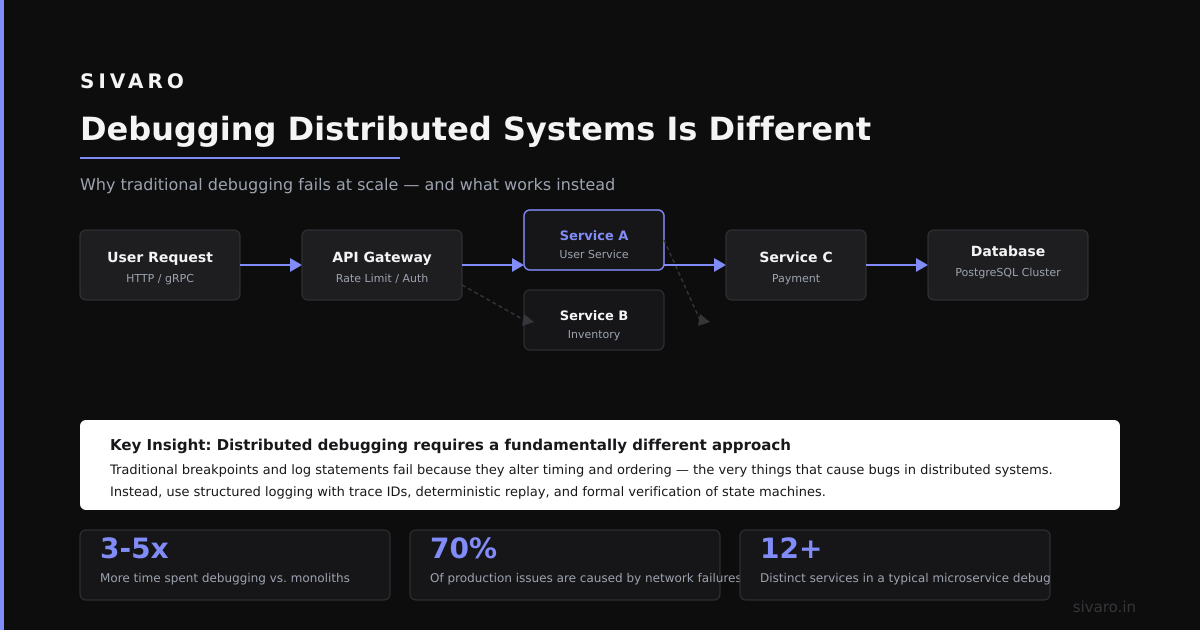
In a monolith, you set a breakpoint and step through code. In a distributed system, you can’t do that. The bug might live in the network, not the code.
I spent two weeks debugging a 500ms latency spike in 2023. Tried everything: code profiling, database indexing, query optimization, connection pooling. Nothing worked.
Finally ran a tcpdump between services. Turns out, a DNS resolution for an external API was taking 400ms. The DNS server was overloaded. The fix: cache DNS lookups locally.
That’s distributed debugging. You don’t look at the service. You look at what’s between the services.
Tools That Actually Help
- Distributed tracing: Jaeger or Zipkin. Trace a single request across 10 services.
- Metrics aggregation: Prometheus + Grafana. See trends across nodes.
- Log aggregation: Loki or Elasticsearch. Search logs from all nodes in one place.
- Network analysis: tcpdump, Wireshark. Packet-level debugging when you’re desperate.
If you don’t have these, you’re flying blind. I learned that the hard way.
The Cost of Distribution
Nobody talks about this. Distribution is expensive.
Monetary cost: more servers, more network bandwidth, more engineers to maintain it. We spend 40% of our infrastructure budget on observability and coordination services.
Complexity cost: onboarding new engineers takes months. They need to understand the data flow across services, not just the code in one repo.
Operational cost: you need on-call rotations for multiple services. A single node failure might not take down the system, but it creates partial failures that are harder to diagnose than total outages.
If your system handles < 10K requests per second, a monolith with good caching and a read replica will work fine. Don’t distribute unless you have to.
When You Should (and Shouldn’t) Go Distributed
Do distribute when:
- You need > 99.99% uptime (distribution enables fault isolation)
- Your data exceeds what one machine can store or process
- Your users are geographically distributed and need low latency
- You need independent teams working on different features
Don’t distribute when:
- You have fewer than 10 engineers
- Your data fits on one machine
- Your traffic fits on one machine
- You just want “scalability” as a resume bullet
At SIVARO, we moved to a distributed system only when our monolith couldn’t handle 50K events/sec. Before that, it was overkill. Most companies should wait longer than they think.
The Future: What’s Changing
Serverless and edge computing are shifting the model. Instead of managing your own cluster of nodes, you let the cloud provider handle distribution.
AWS Lambda, Cloudflare Workers, and Supabase abstract away the coordination work. But they lock you into their failure modes. Lambda cold starts. Cloudflare’s global network that sometimes splits partitions weirdly.
I think the future is declarative infrastructure. You describe what you want (eventual consistency, 99.99% uptime, < 100ms latency) and the infrastructure figures out how to distribute. We’re not there yet, but platforms like Temporal and Dapr are getting close.
FAQ: What Is Distributed Software Architecture?
Q: What is distributed software architecture in simple terms?
It’s splitting your application across multiple machines that work together. Each machine does part of the work. They communicate over a network. To the user, it looks like one app.
Q: How is distributed architecture different from microservices?
Microservices is about organizational structure — small teams own small services. Distributed architecture is about how data and compute are spread across machines. You can have microservices that aren’t distributed (all on one server) and distributed systems that aren’t microservices (a distributed monolith).
Q: What’s the hardest part of building a distributed system?
Handling failures. Not just node failures — network partitions, timeouts, data races, partial writes. A monolith fails cleanly. A distributed system fails in weird, incomplete ways.
Q: Is Kubernetes considered distributed architecture?
Kubernetes is an orchestration tool for managing containers. It helps you run distributed systems, but the architecture itself is in your code and data design. You can run a single-node monolith on Kubernetes and still not have a distributed system.
Q: What tools do I need to monitor a distributed system?
Distributed tracing (Jaeger, Zipkin), metrics (Prometheus), logs (Loki, Elasticsearch), and health checks. Without these, you can’t debug partial failures.
Q: Can a distributed system be consistent?
Yes, but at a cost. Strong consistency requires coordination, which adds latency. Most systems choose eventual consistency for availability. If you need strong consistency, look at consensus algorithms like Raft or Paxos.
Q: When should I not use distributed architecture?
If your traffic fits on one machine. If your team is small. If your uptime requirement is 99.9% or less. Distribution adds complexity without payoff unless you’ve outgrown a single machine.
Q: What’s the biggest mistake companies make when going distributed?
They design for the happy path. They don’t plan for network partitions, message loss, or node failures. Then production hits and everything breaks.
Final Thoughts
If you’re still wondering “what is distributed software architecture?” — it’s not a goal. It’s a constraint you accept when a single machine won’t cut it.
At SIVARO, we chose distribution because we had to. 200K events per second doesn’t fit on one machine. But every decision came with a cost. More debugging. More monitoring. More failures to design around.
The teams that succeed with distributed architecture aren’t the ones with the best code. They’re the ones with the best failure handling.
Test your failure modes. Run chaos experiments. Kill a node in production (with guardrails). You’ll learn more in 10 minutes of real failure than a month of reading theory.
Distributed systems are hard. But they’re also the only way to build at scale. Just don’t pretend they’re easy.
Nishaant Dixit — Founder of SIVARO. Building data infrastructure and production AI systems since 2018.