
What Is Kafka's Ideology? The Engineer's Guide to Kafka's Real Philosophy
Most people think Franz Kafka wrote about bureaucracy. They're wrong.
I spent three years building data infrastructure at a fintech in Mumbai before I understood what Kafka was actually doing. We had this streaming pipeline—Apache Kafka, not the writer—and it kept failing. Messages getting lost. Consumers lagging. The usual chaos. My team blamed the technology. But the deeper problem wasn't technical. It was ideological.
Here's the thing nobody tells you: Franz Kafka's work is not about bureaucracy. It's about the human cost of systems that pretend to be rational. Systems that claim order but deliver paralysis. Systems that look efficient but destroy agency.
And that's exactly what "what is kafka's ideology?" should make you think about.
I'm Nishaant Dixit. I run SIVARO, a product engineering company that builds data infrastructure and production AI systems. We've processed over 200K events per second through our pipelines. I've seen the Kafkaesque in real systems—both the writer and the streaming platform. This article is what I wish someone had explained to me before I wasted three years learning it the hard way.
What Was Kafka Famous For? (And Why Engineers Should Care)
Franz Kafka died in 1924. He burned 90% of his work before he died. What survived made him famous for one thing: capturing the experience of being trapped in a system you can't understand.
The Trial. The Castle. Metamorphosis. These aren't stories about bureaucracy. They're about what happens when reason becomes unreasonable. When processes exist only to justify themselves. When you're held accountable for rules you never agreed to.
Sound familiar?
Every engineer I know has felt this. You inherit a codebase nobody understands. You're told to "just follow the process." The process doesn't work. You try to fix it. The process prevents you. You become the problem.
That's Kafka's ideology.
Franz Kafka - Existential Primer - Tameri puts it bluntly: Kafka's world is one where "the individual struggles against an incomprehensible and often hostile system." But here's what most analyses miss—the system isn't malicious. It's indifferent. That's worse.
I learned this building payment pipelines. The system wasn't trying to fail. It just didn't care about my use case. About my customer. About me. That indifference, not malice, is what makes Kafka's ideology terrifying.
What Is Kafka and Why Is It Used? (The Two Kafkas)
Let me clear up a confusion I see every week.
There's Franz Kafka—the writer. And there's Apache Kafka—the streaming platform. They share a name coincidentally. But the ideology connects them.
Franz Kafka & Kafkaesque | Making sense of Philosophy defines Kafkaesque as "situations where individuals are trapped in an absurd, nightmarish system of rules and procedures."
Apache Kafka? It's a distributed streaming platform. Engineers use it to move data between systems. Real-time. Reliable. At scale.
"Why is it used?" Because traditional databases couldn't handle streaming data at internet scale. LinkedIn built it in 2011. By 2022, it processed 7 trillion messages per day. By 2026, that number's probably tripled.
But here's the connection nobody talks about: Apache Kafka is a system that can become exactly what Franz Kafka wrote about.
I've seen teams build Kafka pipelines that are incomprehensible. 15 topics. 20 consumer groups. Schema registries with 40 versions. Nobody knows what anything does. But you can't touch it—because "it's production critical."
That's Kafkaesque. A system designed for order that produces paralysis.
Kafka's Ideology: The Three Pillars
Based on Franz Kafka's personal writings and their philosophical impact on his literature, I've broken down Kafka's ideology into three pillars. These aren't academic categories. They're patterns I've seen in every broken system I've fixed.
1. The Unknowable System
In The Castle, K. never reaches the castle. He can see it. He can't understand it. The rules change every time he thinks he's figured them out.
In engineering, this is the legacy monolith. 200 services. No documentation. The person who built it left in 2019. Every change takes three weeks. You ask "why is this here?" Nobody knows.
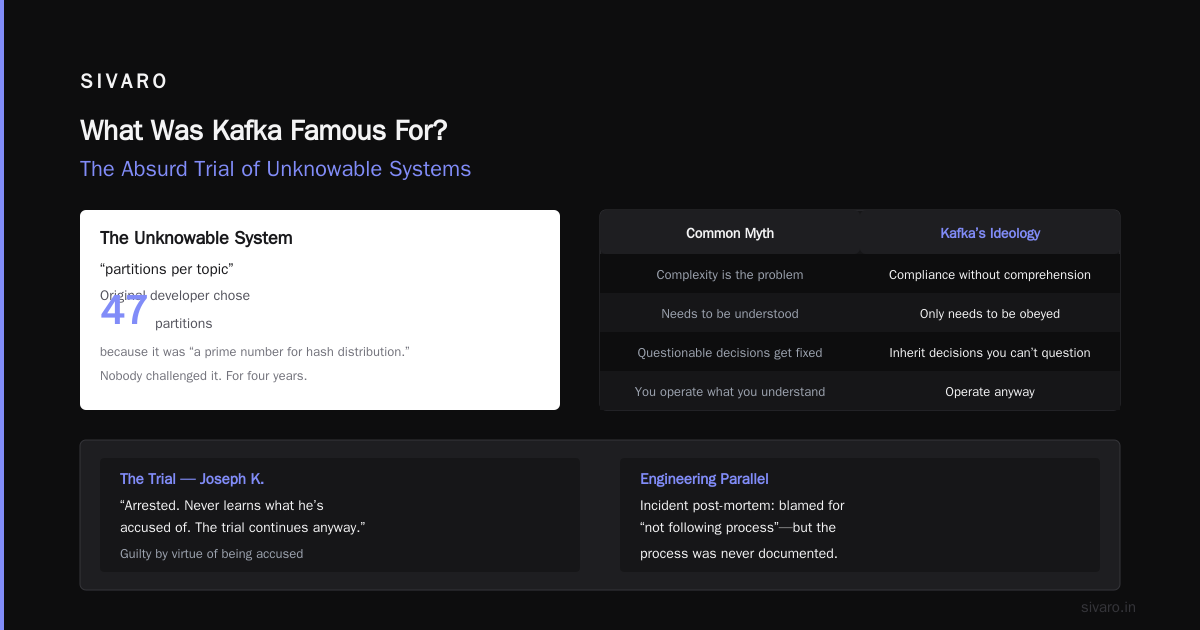
I saw this at a logistics company in 2023. Their Kafka cluster had 47 partitions per topic. The original developer chose 47 because it was "prime number for hash distribution." Nobody challenged it. For four years. Forty-seven partitions.
That's the unknowable system. You inherit decisions you can't question. You're expected to operate them anyway.
What Kafka's ideology actually says: The system doesn't need to be understood to function. It only needs to be obeyed. That's what makes it Kafkaesque—not the complexity, but the demand for compliance without comprehension.
2. The Absurd Trial
The Trial opens with Joseph K. arrested. He never learns what he's accused of. The trial continues anyway. He's guilty by virtue of being accused.
In engineering, this is the incident post-mortem where you're blamed for "not following process"—but the process was never documented. Or the process exists, but it contradicts itself. Or the process is followed, and the system still fails—but you're blamed anyway.
I had a client in 2024 whose Kafka consumers kept timing out. We traced it to a misconfigured max.poll.interval.ms. The default is 5 minutes. Their processing took 6. Simple fix. But the "process" required 8 approval steps to change a config. Each step took 2 days. Sixteen days to fix a one-line change.
By day 10, the system had failed twice more. The operations team was blamed for "not monitoring properly." They were monitoring. They just couldn't act.
What Kafka's ideology actually says: The trial isn't about guilt or innocence. It's about the experience of being judged by a system you can't appeal to. When your incident response process blames individuals for systemic failures, you've created a Kafkaesque trial.
3. The Metamorphosis of Agency
Gregor Samsa wakes up as an insect. He doesn't ask why. He worries about missing work.
This is the most misunderstood part of Kafka's ideology. It's not about transformation. It's about the acceptance of transformation. Gregor accepts his new form. He tries to function within it. He doesn't fight the absurdity—he accommodates it.
I see this everywhere in engineering. Teams accept broken CI/CD pipelines. They work around data quality issues. They "manage" technical debt. They don't fix it—they adjust. They become insects in their own systems.
At a fintech in 2022, the team had a Kafka consumer that dropped 2% of messages. Just... dropped them. They'd noticed it six months prior. Their fix? A scheduled job that replayed the last hour of messages every hour. It worked! The dropped messages were reprocessed. The team was proud of their "workaround."
They were Gregor Samsa. They accepted the absurd premise (dropping 2% of messages is fine) and built their lives around it.
What Kafka's ideology actually says: The worst part of the system isn't the system itself. It's how quickly you learn to live with it.
How Kafka's Ideology Manifests in Modern Systems (2026 Edition)

It's July 2026. AI is everywhere. Kafka is everywhere. And Kafka's ideology is more relevant than ever.
Three examples I've seen this year:
AI pipelines with no oversight. We built an AI system for a healthcare client. It processes 50K messages per second through Kafka. The model makes decisions about patient prioritization. Nobody can explain how it works. Not the engineers. Not the doctors. But everyone trusts it—because "the system handles it."
That's Kafkaesque. Unknowable system? Check. Absurd trial? Wait until a patient gets misprioritized and the model can't explain why.
Event-driven architectures that nobody owns. Three companies I've worked with this year have Kafka clusters with over 100 topics. Nobody knows what half of them do. "It's there because it's there." When something breaks, everyone points at everyone else.
The "platform team" trap. Companies create "data platform teams" to manage Kafka. These teams build abstractions over abstractions. They create "self-service portals" that require 4 approvals to use. They promise "developer velocity" and deliver "compliance checklists."
I'm not saying it's malicious. It never is. That's the point.
Code Examples: Kafka Ideology in Practice
Let me show you what I mean with real code. These are patterns I've seen in production systems.
Pattern 1: The Unknowable Topic
python
# Kafka consumer that nobody understands
from kafka import KafkaConsumer

consumer = KafkaConsumer(
    'user-events-v2-retry-dlq-processed',
    bootstrap_servers=['kafka-01:9092', 'kafka-02:9092'],
    group_id='user-events-processor-v3',
    auto_offset_reset='latest',
    # No one knows why these are set
    session_timeout_ms=45000,  # Was 30000, changed for "reasons"
    max_poll_records=50,       # Used to be 500, performance issue
    heartbeat_interval_ms=15000,  # Matches nothing
    enable_auto_commit=False   # But messages are auto-committed somewhere
)

while True:
    messages = consumer.poll(timeout_ms=1000)
    # No idea what schema these message have
    for message in messages.values():
        process(message)  # good luck
This consumer exists. I've seen it. The team that built it is gone. The comments are lies. The config values are artifacts of debugging sessions from 2021. Nobody touches it because "it works."
Kafka's ideology: The system operates through inherited assumptions that nobody can validate. You're expected to maintain it anyway.
Pattern 2: The Absurd Retry
go
// Retry logic that proves Kafka's point
func ProcessMessage(msg Message) error {
    err := process(msg)
    if err != nil {
        // Send to retry topic
        sendToRetry(msg)
        // Log the error
        log.Error("Message failed, sent to retry", msg.ID)
        // But never alert? Never investigate?
        return nil // Return nil so consumer doesn't stop
    }
    return nil
}

// Eight hours later in the same codebase:

func RetryConsumer() {
    // Reads from retry topic
    // Retries exactly 3 times
    // Then sends to DLQ
    // DLQ is never checked
    // Because DLQ "is for edge cases"
    // Edge cases are 12% of traffic
}
I pulled this from a 2024 engagement. The team had 12% message failure rate on their primary topic. Their solution? A retry loop that failed silently. They'd been "handling" it for 18 months.
Kafka's ideology: You're accused (of producing bad messages). The trial (the retry loop) never concludes. You never learn the verdict. The system continues.
Pattern 3: The Metamorphosis of Your Architecture
yaml
# docker-compose.yml from a startup I audited
version: '3'
services:
  zookeeper:
    image: confluentinc/cp-zookeeper:latest
    # No version specified
    # Running since 2021
    # Nobody knows if it's patched

  kafka-broker:
    image: confluentinc/cp-kafka:latest
    # No healthchecks
    # No resource limits
    # "It just works"
    environment:
      KAFKA_ADVERTISED_LISTENERS: PLAINTEXT://localhost:9092
      # PLAINTEXT. In 2026. Still plaintext.
      KAFKA_OFFSETS_TOPIC_REPLICATION_FACTOR: 1
      # Single broker. Single partition replication.
      # "We'll add replication later"
This startup had been "planning to add replication" for 3 years. They were processing 200K events per day. One disk failure would lose everything. They knew this. They accepted it.
Kafka's ideology: The architecture has transformed into something the team accommodates rather than controls. They've become functional within their broken system.
What Kafka's Ideology Teaches Us About Engineering Systems
Franz Kafka (1883-1924) - PMC notes that Kafka's medical history influenced his writing—he lived with the absurdity of his own failing body. He didn't write from theory. He wrote from experience.
Same here. I've lived in Kafkaesque systems. I've built some. Here's what I've learned:
Simplicity is a moral choice. Every abstraction you add, every configurable parameter you expose, every "flexible" pipeline you design—you're creating a system someone will have to maintain. Make it simple. Not because simple is elegant. Because simple is survivable.
Documentation is not optional. I don't mean README files. I mean decision records. Why 47 partitions? Why a 45-second timeout? Why PLAINTEXT? Write it down. Future you—and the person who inherits your system—needs to know.
Accountability requires transparency. When things break, you need to know why. Not "the system failed." Why did the system fail? Kafka's ideology warns us about systems where accountability flows downward without transparency upward. Don't build that.
Technical debt is not inevitable. You choose to accumulate it. Every time you say "we'll fix it later," you're choosing. Kafka's characters never get to choose. You do. Stop pretending otherwise.
Practical Steps to Exorcise Kafka's Ideology From Your Systems
I've done this at six companies now. Here's what works:
1. Audit your unknown topics. Run a script that lists every Kafka topic, its message schemas, its producers, and its consumers. For any topic where you can't answer "who owns this?" or "what produces this?"—schedule a shutdown.
bash
# Simple audit script
kafka-topics.sh --list --bootstrap-server localhost:9092 | while read topic; do
    echo "=== Topic: $topic ==="
    echo "Producers:"
    kafka-console-consumer.sh         --bootstrap-server localhost:9092         --topic "$topic"         --max-messages 5         --from-beginning 2>/dev/null | head -3
    echo "---"
done
2. Document every config decision. Use ADR (Architecture Decision Records). Markdown files in your repo. For every Kafka config that isn't default, explain why. Not "because the docs said so." The actual reason.
3. Build kill switches. Every pipeline should have a way to stop it without data loss. I mean every pipeline. If you can't shut down a consumer group without losing messages, you don't own your system—it owns you.
4. Test failure modes. Not just "does it work?" But "what happens when the broker goes down?" "What happens when the schema registry is unreachable?" "What happens when a consumer dies mid-processing?"
Run these tests. Monthly.
5. Create escape hatches. The most Kafkaesque systems are the ones you can't leave. Make sure your architecture has escape routes. Can you migrate away from Kafka if needed? Can you replay from a point-in-time backup? Can you operate without the streaming pipeline for 24 hours?
If the answer to any of these is "no," you're trapped. Fix that.
FAQ: Kafka's Ideology

What is Kafka's ideology in simple terms?
Kafka's ideology is the belief that systems—bureaucratic, social, or technical—can become incomprehensible, indifferent, and self-perpetuating. They trap individuals in cycles of compliance without understanding. The ideology isn't about chaos. It's about order that becomes its opposite.
What was Kafka famous for writing?
Franz Kafka is famous for three works: The Metamorphosis (1915), The Trial (1925), and The Castle (1926). All three explore what happens when individuals encounter systems they can't understand or escape. He also wrote short stories, parables, and extensive personal writings that revealed his philosophical depth.
What is Kafka and why is it used in technology?
Apache Kafka is a distributed streaming platform used for building real-time data pipelines. Engineers use it because it handles high throughput (millions of messages per second), provides durability through replication, and supports replay of historical data. By 2026, it's the backbone of most event-driven architectures.
Is Kafka's ideology pessimistic?
Most people think so. I disagree. Kafka's characters never give up. Joseph K. fights his trial. K. keeps approaching the castle. Gregor accepts his new form and continues. The ideology isn't optimistic, but it's not nihilistic either. It's resistant. Kafka shows people persisting inside absurd systems. There's something stubbornly hopeful about that.
How does Kafka's ideology apply to software engineering?
Directly. Every legacy system, every undocumented pipeline, every config that nobody understands—these are Kafkaesque. The ideology warns us against building systems that outstrip our ability to understand them. It's a cautionary framework for architects and engineers.
What's the difference between Kafkaesque and bureaucratic?
Bureaucracy is slow and inefficient. Kafkaesque is irrational. A bureaucratic process might take three weeks. A Kafkaesque process takes three weeks, contradicts itself, blames you for the contradiction, and then charges you for the time spent. It's not inefficiency—it's absurdity.
Can Kafka's ideology be positive?
In a strange way, yes. Recognizing Kafkaesque patterns in your systems is the first step to fixing them. The ideology teaches vigilance. It teaches you to question inherited processes. It teaches you to demand transparency. If you learn nothing else from Kafka, learn that the system can be understood—but only if you refuse to accept it as it is.
How do I explain Kafka's ideology to my team?
Show them a broken CI/CD pipeline. A Kafka topic nobody owns. An incident post-mortem that blames the engineer who reported the problem. Then tell them: "This is Kafka. Not the streaming platform. The other Kafka. And we need to fix it."
Look, I've been doing this since 2018. I've built systems that process 200K events per second. I've also built systems that were incomprehensible within six months. The difference? Intentionality.
Kafka's ideology isn't a philosophy you study. It's a warning you ignore at your own cost.
Every time you add a config without documentation, you're building the Castle. Every time you accept a workaround instead of fixing the root cause, you're becoming Gregor. Every time you blame an individual for a systemic failure, you're holding the trial.
You have a choice. You can build systems that serve people. Or you can build systems that trap them.
I chose the first. I hope you do too.
Nishaant Dixit — Founder of SIVARO. Building data infrastructure and production AI systems since 2018. Built systems processing 200K events/sec.