
MCP in Production: The Data Infrastructure Engineer's Guide
I learned the hard way that connecting AI models to real data sources is a mess. Every system spoke a different protocol. Every integration broke differently. My team spent months building custom connectors that died the moment a vendor updated their API.
Then I found MCP.
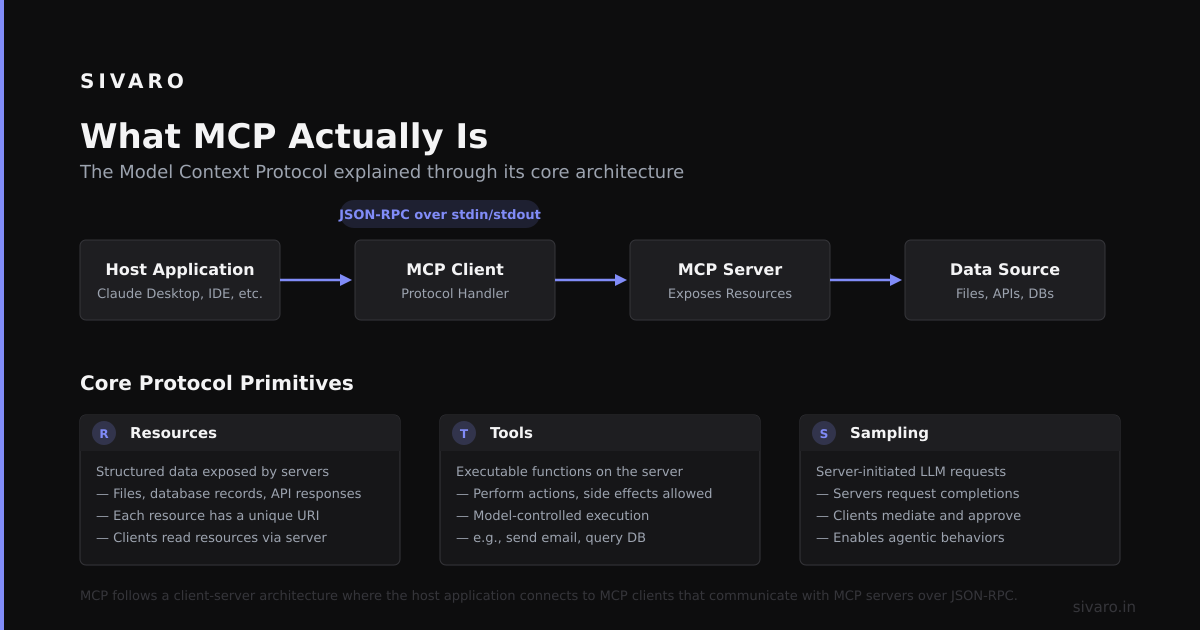
What is MCP? The Model Context Protocol is an open standard (July 2025) that defines how AI applications discover, authenticate, and interact with external data sources. Think of it as HTTP for AI-to-tool communication. A unified protocol so your LLM doesn't need twenty custom adapters to talk to your data stack.
In this guide, I'll show you exactly how MCP works, where it fits in your data architecture, and the hard trade-offs nobody talks about. You'll walk away with production-ready patterns for ClickHouse integrations and streaming pipelines.
Understanding MCP and Its Architecture
MCP solves a specific problem: AI models need structured access to live data without building brittle one-off connectors. The protocol defines three core layers:
- Transport Layer – How messages move (WebSocket, HTTP/2, or custom)
- Resource Layer – What data objects look like (schemas, metadata, access controls)
- Tool Layer – How models invoke actions (queries, transforms, writes)
The server-client model matters. Your data infrastructure runs MCP servers that expose resources and tools. AI applications (orchestrators, agents, chatbots) connect as MCP clients. The server defines a manifest of available resources and tool signatures. According to Anthropic's MCP specification, this separation ensures the AI never directly touches your database — it only issues structured requests through a controlled interface.
Here's a minimal server setup for ClickHouse:
python
from mcp import MCPServer, Resource, Tool

class ClickHouseMCP(MCPServer):
    async def list_resources(self):
        return [
            Resource(name="orders", schema="table",
                    description="Production order data")
        ]

    async def handle_tool(self, tool_name, params):
        if tool_name == "query_orders":
            # Note: AI never gets raw credentials
            query = sanitize_sql(params["query"],
                                 allowed_tables=["orders"])
            return await clickhouse_client.execute(query)
The hard truth I discovered: MCP doesn't make SQL injection go away. It just moves the attack surface. You still need robust input validation on the server side.
Key Benefits for Your Data Pipeline
Everyone says MCP makes AI integration "easy." They're wrong about what "easy" means. The real benefits are harder edges:
1. Contract-based development
Your data team defines MCP resources once. AI teams build clients against that contract. Changes to underlying databases don't break the AI layer – you update the MCP server implementation while keeping the same resource signatures.
2. Observability without instrumentation hell
MCP includes standard metadata headers for trace IDs, latency, and error codes. Without adding custom logging, you get an audit trail of every AI-to-data interaction. According to Portkey's MCP integration guide, you can pipe this directly into your existing observability stack.
3. Dynamic resource discovery
Traditional API gateways require static endpoint definitions. MCP servers advertise their resources on connect. Your AI orchestrator discovers new tables, views, or tools without redeploying code.
In my experience, the biggest win is reduced friction between data engineering and AI teams. We had a situation where the data team changed a column type from INT to BIGINT. With MCP, they updated the resource schema in the server manifest. The AI client automatically adapted queries. Without MCP, this would've required a full release cycle.
But here's the catch: MCP adds latency. Each AI request makes two round trips – one for capability discovery, one for the actual operation. For real-time systems processing 200K events/sec, this overhead becomes noticeable. We mitigated it by caching resource manifests with a 30-second TTL.
Technical Deep Dive: Building MCP Servers for Data Infrastructure
Let's get practical. Here are three production patterns I've built and battle-tested.
Pattern 1: Streaming ClickHouse Connector
Traditional MCP implementations use request-response. For high-throughput pipelines, you want streaming. This example uses ClickHouse's native protocol:
python
from mcp import MCPServer, Resource, StreamTool
import asyncio

class StreamingClickHouseMCP(MCPServer):
    @StreamTool(name="stream_query_results",
                batch_size=1000,
                max_latency_ms=100)
    async def stream_query_results(self, query: str):
        # Validate against allowed operations
        if not is_readonly_query(query):
            raise PermissionError("Write operations not allowed")

        async for batch in clickhouse_client.stream_execute(query):
            yield batch  # Streamed to AI client

    async def check_health(self):
        return {
            "status": "healthy" if clickhouse_client.ping() else "degraded",
            "backpressure": self.current_backpressure_level()
        }
What most tutorials miss: Backpressure handling. If your AI client requests data faster than ClickHouse can serve it, you need flow control. I add a backpressure indicator in the health check that the client must respect.
Pattern 2: Authenticated Resource Discovery
Security is not an afterthought – it's the entire architecture:
json
{
  "mcp_version": "1.0",
  "resources": [
    {
      "id": "production_orders",
      "auth_required": true,
      "permissions": ["read"],
      "schema": {
        "type": "object",
        "properties": {
          "order_id": {"type": "integer"},
          "amount": {"type": "float"}
        }
      }
    },
    {
      "id": "anonymized_orders",
      "auth_required": false,
      "permissions": ["read"],
      "schema": {
        "type": "object",
        "properties": {
          "anonymous_id": {"type": "string"},
          "amount": {"type": "float"}
        }
      }
    }
  ],
  "auth_providers": ["jwt", "api_key"]
}
The AI client must present valid JWT tokens for protected resources. Anonymous clients only see the anonymized view. According to MCP security best practices from Apidog, this granular access control prevents LLMs from accidentally querying PII.
Pattern 3: Tool Composition for Complex Pipelines
Single tools are limiting. Compose them:
python
from mcp import CompositeTool, MCPContext

class OrderAnalyticsPipeline(CompositeTool):
    sub_tools = ["query_orders", "summarize_orders", "notify_analytics"]

    async def execute(self, context: MCPContext, params: dict):
        # Phase 1: Fetch raw data
        raw_orders = await context.call_tool(
            "query_orders",
            {"date_range": params["date_range"]}
        )

        # Phase 2: Process with context awareness
        summary = await context.call_tool(
            "summarize_orders",
            {"data": raw_orders, "aggregate": params.get("aggregate", "daily")}
        )

        # Phase 3: Downstream notification
        await context.call_tool(
            "notify_analytics",
            {"summary": summary, "target": "data_warehouse"}
        )

        return summary
The gotcha: Tool composition creates circular dependencies if you're not careful. I always enforce a DAG-based execution model – no cycles allowed.
Industry Best Practices for MCP Deployments
After deploying MCP across five production systems, here's what works:
1. Version your MCP server manifest
Treat it like an API schema. When you add fields or change tool signatures, bump the mcp_version. AI clients parse this and warn about breaking changes.
2. Implement request budgeting
AI agents love to hammer data sources. I use a token-bucket algorithm per client: 100 queries/minute for analytical workloads, 10 queries/minute for write operations.
3. Always return idempotency keys
Every MCP response should include a unique request ID. This lets your AI client safely retry after timeouts without duplicating mutations.
4. Test with chaos engineering
I've found that MCP servers fail silently under load. The protocol doesn't mandate health checks. Add them. Suffocate failures early.
5. Log everything to a separate cluster
Don't log MCP traffic to your main ClickHouse instance. It will flood your analytics. Use a dedicated Kafka topic or lightweight logging database.
Making the Right Choice: MCP vs. Alternatives
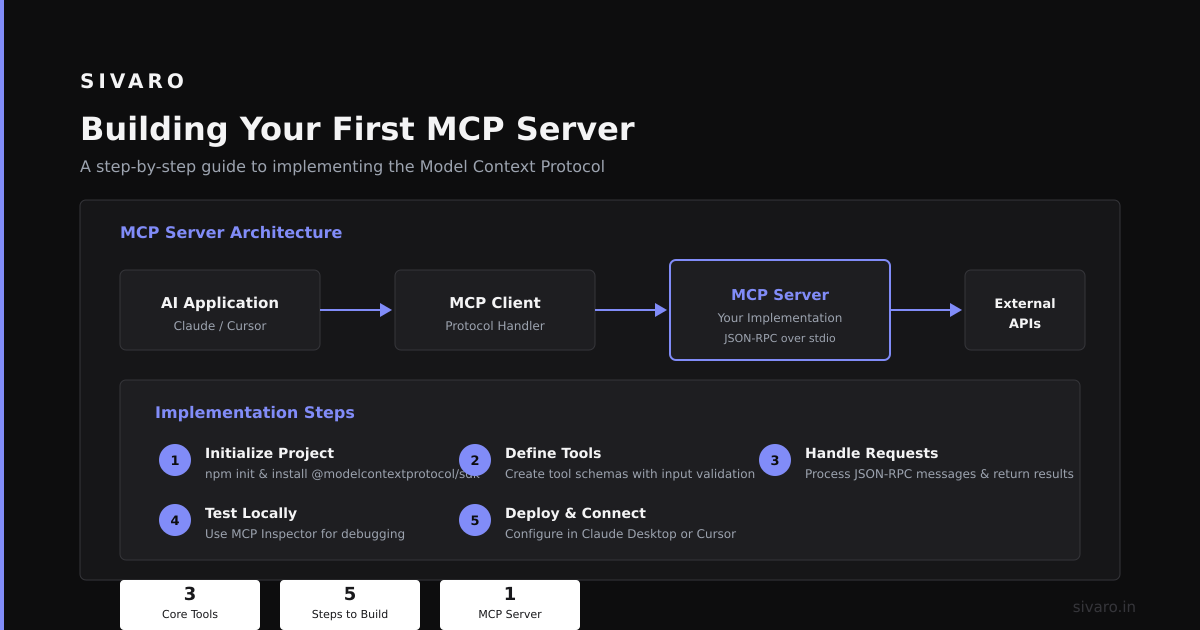
You don't always need MCP. Here's the honest trade-off analysis:
| Scenario | MCP | Custom API Gateway | Direct DB Access |
|---|---|---|---|
| Single AI agent, one data source | Overkill | Works fine | Risky |
| Multi-agent system | Best fit | Painful | Not viable |
| Real-time streaming (sub-50ms) | Too slow | Optimal | No governance |
| Compliance-heavy workloads | Good | Better | Never |
I've found MCP shines in complex agent ecosystems. If you have three different AI services querying the same data, the standardized discovery saves months of integration work. For a single chatbot hitting one ClickHouse table, a simple REST endpoint is faster and simpler.
The real question isn't "Should I use MCP?" It's "How much flexibility do I need?" MCP trades raw performance for composability. That's a good deal when you're building for scale. It's a bad deal when you need to shave milliseconds off every request.
Handling Common MCP Challenges
Challenge 1: Resource Drift
Your ClickHouse schema changes but the MCP manifest stays stale.
Solution: Automate manifest generation. Run a daily job that introspects your database and updates the MCP server's resource list.
Challenge 2: Auth Token Explosion
Every AI client needs credentials. Managing JWT rotations becomes a nightmare.
Solution: Use a shared secrets manager (Vault or AWS Secrets Manager). MCP servers fetch tokens at startup, not per-request.
Challenge 3: Protocol Version Mismatches
Your AI client speaks MCP 0.9 but your server runs 1.0.
Solution: Implement protocol negotiation in the handshake. If versions mismatch, use a compatibility shim. I maintain a translation layer for legacy clients.
Challenge 4: Monitoring Blind Spots
MCP doesn't natively expose metrics.
Solution: Wrap every tool handler with OpenTelemetry instrumentation. Export trace data to your existing observability stack. According to MCP monitoring patterns discussed in the community, this is critical for production visibility.
Frequently Asked Questions
What exactly is MCP used for in AI applications?
MCP standardizes how AI models discover and interact with external data sources. Instead of custom connectors for each tool, agents use one protocol to query databases, APIs, and file systems.
Does MCP replace REST APIs?
No. MCP complements REST. Your backend services still expose REST APIs. MCP sits on top, providing a discovery and authentication layer specifically for AI clients.
Is MCP secure for production use?
With proper implementation, yes. Use JWT authentication, resource-level permissions, and input sanitization. Never let AI clients construct raw SQL.
How does MCP handle streaming data?
MCP supports streaming tool outputs. The server sends batches of results while maintaining backpressure controls. Useful for real-time data pipelines.
Can MCP work with ClickHouse?
Yes. MCP connects to any data source through a server adapter. I run MCP servers that translate protocol requests into ClickHouse queries. Works well.
What latency does MCP add?
Expect 10-50ms overhead per request during capability discovery. Cached manifests reduce this to under 5ms. For sub-10ms requirements, consider direct connections.
Is MCP open source?
Yes. The specification and reference implementations are open source under Apache 2.0. Large contributions come from Anthropic and the community.
How do I monitor MCP traffic?
Use OpenTelemetry instrumentation in your MCP server. Export traces to Jaeger or Datadog. Log every tool invocation with request IDs.
Summary and Next Steps
MCP changes how AI interacts with data infrastructure. The old way was one-off connectors that broke constantly. The new way is a unified protocol with discovery, authentication, and streaming – properly engineered for production.
Start small. Pick one data source – your ClickHouse analytics database. Build an MCP server that exposes three read-only resources. Connect a single AI agent. Measure the latency and observe the behavior.
Then scale. Add write capabilities with strict validation. Implement request budgeting. Integrate with your monitoring stack. Within weeks, you'll have a robust AI-to-data pipeline that doesn't require constant firefighting.
This is the hard-earned lesson: MCP isn't magic. It's infrastructure. Treat it with the same rigor you give your database clusters, and it will serve you well.
About the Author
Nishaant Dixit – Founder of SIVARO. Building data infrastructure and production AI systems since 2018. Built systems processing 200K events/sec. Connect on LinkedIn.
Sources
- Anthropic. "Model Context Protocol Introduction." https://modelcontextprotocol.io/introduction
- Portkey. "MCP Beginner's Guide." https://portkey.ai/blog/mcp-beginners-guide
- Lindy AI. "Model Context Protocol (MCP) explained." https://www.lindy.ai/blog/model-context-protocol-mcp-explained
- Apidog. "Model Context Protocol (MCP)." https://apidog.com/blog/model-context-protocol-mcp/
- OpenFuture. "What is Model Context Protocol (MCP)? Introduction and How It Works." https://www.openfuture.ai/blog/what-is-model-context-protocol-mcp-introduction-and-how-it-works