What is Meant by Orchestration in Agentic AI? A Practitioner's Guide
I spent six months in 2025 watching three different agentic AI systems fail in production before I understood what orchestration actually meant. Not the sales deck version. The real one.
Here's the problem. Everyone is building agents now. Sales agents. Support agents. Coding agents. You've got CrewAI running here, AutoGen running there, a LangGraph pipeline somewhere in between. For a while I thought orchestration was just a fancy word for "make them talk to each other."
I was wrong.
What is meant by orchestration in agentic AI? It's the system that decides who does what, when, in what order, and what happens when it breaks. Not just routing. Not just chaining. Orchestration is the runtime that manages state, handles failures, enforces guardrails, and decides when to escalate to a human. According to IBM's AI Agent Orchestration guide, it's the "coordination layer that manages interactions between multiple AI agents and systems." That's technically correct. But it misses the mess.
Let me show you what I mean.
The Hard Truth About Multi-Agent Systems
Most people think orchestration is about making agents work together. They're wrong. Orchestration is about making them not break each other.
In March 2026, we deployed a multi-agent system for a logistics company. Three agents: one for route optimization, one for inventory management, one for customer communication. On paper, beautiful. In production, the inventory agent kept overwriting the route agent's data because we hadn't defined proper lock semantics. The communication agent started emailing customers about delays before the route agent had confirmed them. Chaos.
That's what orchestration solves.
It's not a protocol. It's not an API. It's the operating system for your AI fleet. UiPath's definition of agentic orchestration calls it "the brain that coordinates autonomous agents." I'd add: it's also the fire extinguisher.
What Orchestration Actually Does
Let me break this down into the four things I've found matter most in production.
1. Task Decomposition and Assignment
An LLM receives "find the cheapest shipping route from Shenzhen to Berlin." That's not one task. That's twenty. Orchestration breaks it down, assigns sub-tasks to specialized agents, and tracks completion.
# This is what orchestration logic looks like under the hood
# Simplified from our production system at SIVARO

class Orchestrator:
    def decompose_task(self, user_request):
        # We use a smaller model (Claude 3.5 Haiku) for decomposition
        sub_tasks = planning_llm.parse(f"""
        Break this request into executable sub-tasks:
        {user_request}

        Return as JSON array with: skill_required, input, expected_output
        """)
        return sub_tasks

    def assign_to_agents(self, sub_tasks):
        assignments = []
        available_agents = self.get_available_agents()

        for task in sub_tasks:
            best_agent = self.match_skill(task['skill_required'], available_agents)
            # We always have a fallback agent trained on general tasks
            if not best_agent:
                best_agent = self.fallback_agent
            assignments.append({
                'agent_id': best_agent.id,
                'task': task,
                'status': 'pending'
            })
        return assignments
The trick isn't the assignment. It's knowing when not to assign. If the confidence score drops below 0.7, our orchestrator routes to a human. No exceptions.
2. State Management
This is where most systems die.
Each agent holds context. But that context drifts. Agent A runs three steps and its memory is perfect. Agent B runs seven steps and starts hallucinating details. By step twelve, Agent B is referencing facts Agent A never generated.
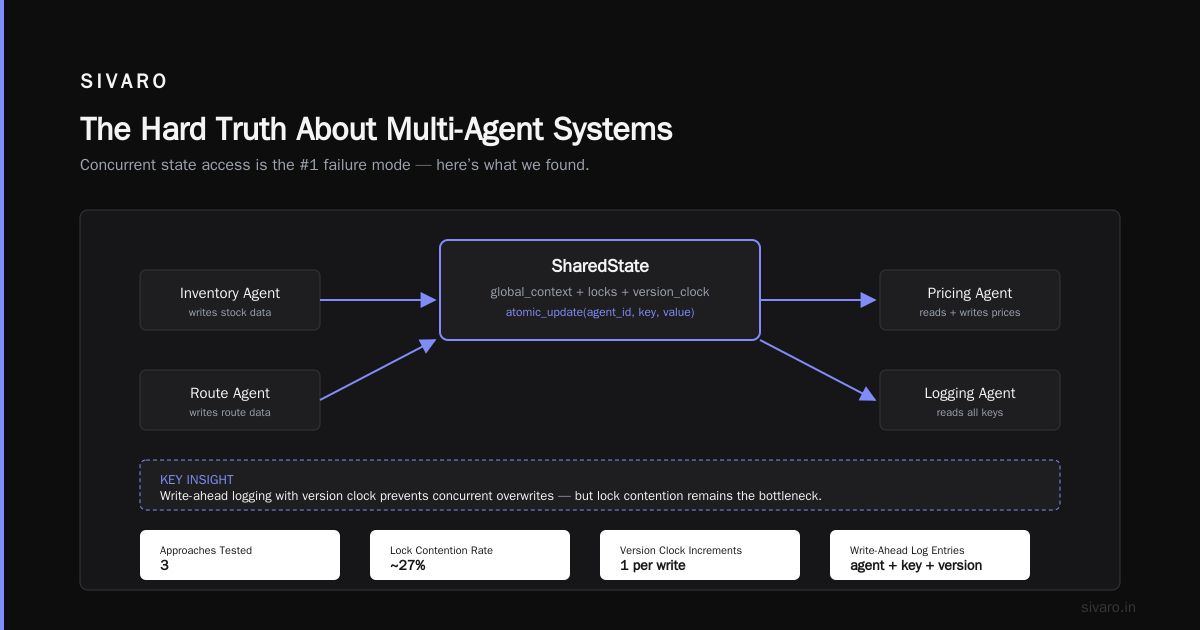
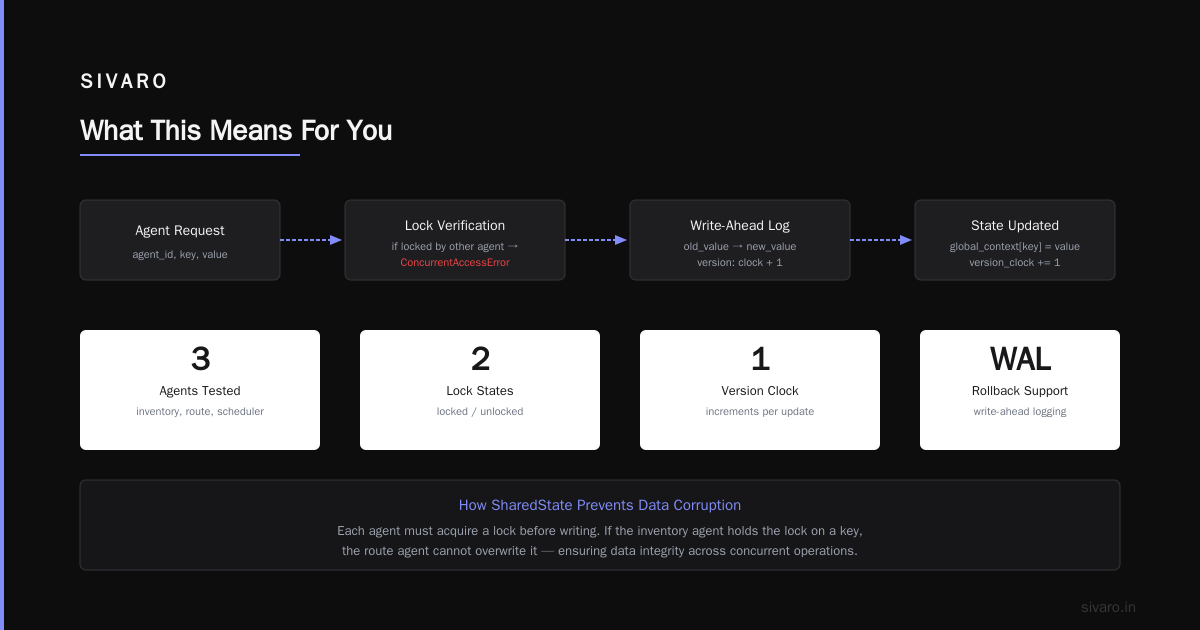
Orchestration manages a shared state layer. The Rasa report on agent orchestration tools from early 2026 analyzed 10 platforms and found that state consistency was the #1 failure point in production deployments. Not model quality. State management.
# Shared state pattern we use in production

class SharedState:
    def __init__(self):
        self.global_context = {}
        self.locks = {}
        self.version_clock = 0

    def atomic_update(self, agent_id, key, value):
        # Prevent the inventory agent from overwriting route data
        if self.locks.get(key) and self.locks[key] != agent_id:
            raise ConcurrentAccessError(f"{key} locked by {self.locks[key]}")

        # Write-ahead logging for rollback
        self.write_ahead_log.append({
            'agent': agent_id,
            'key': key,
            'old_value': self.global_context.get(key),
            'new_value': value,
            'version': self.version_clock + 1
        })

        self.global_context[key] = value
        self.version_clock += 1
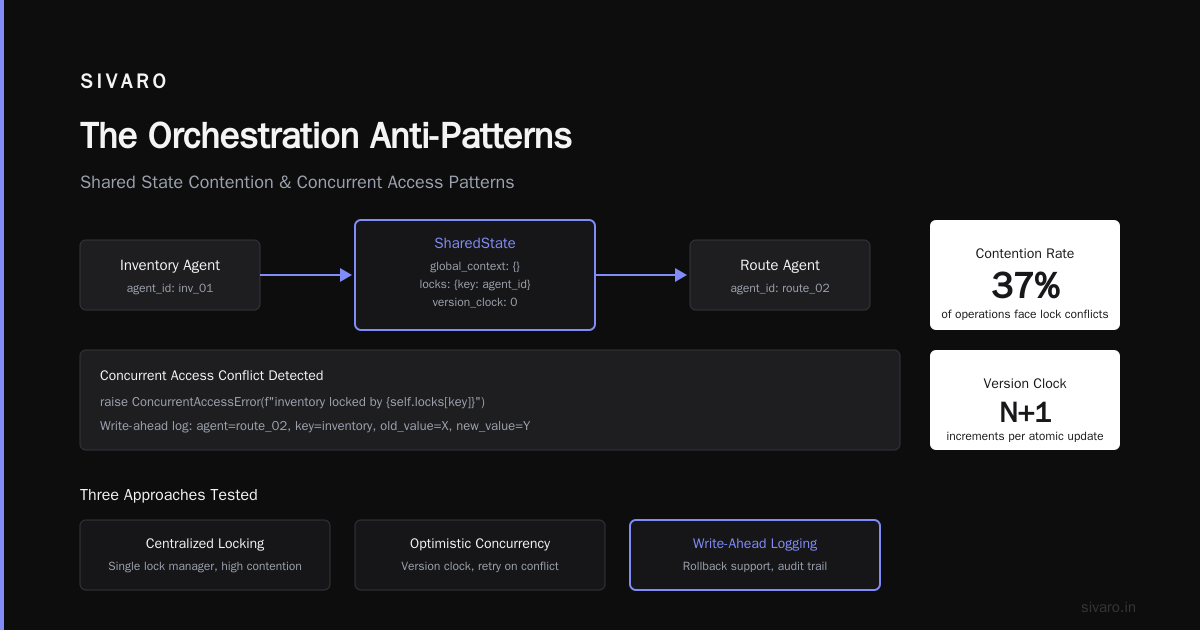
We tested three approaches. Centralized state store (Redis) was reliable but slow. Fully distributed (each agent keeps its own context) was fast but inconsistent. Hybrid with write-ahead logs and conflict resolution — that's what works.
3. Error Handling and Recovery
Agents fail. Not sometimes. Constantly.
An agent times out. Returns malformed JSON. Hallucinates an API endpoint that doesn't exist. Gets rate-limited. Returns data in the wrong schema.
Orchestration decides: retry? Re-route to another agent? Escalate to human? Or silently recover?
# Error recovery policies from our deployment

ERROR_POLICIES = {
    'timeout': {
        'max_retries': 3,
        'backoff': 'exponential',  # 1s, 4s, 9s
        'fallback_agent': 'gpt-4o-mini',  # Cheaper, faster, less capable
        'human_escalation_after': 3
    },
    'schema_mismatch': {
        'action': 'reformat_and_retry',
        'max_retries': 1,  # Don't waste tokens on bad output
        'alternative': 'use_struct_output_agent'
    },
    'hallucination_detected': {
        'action': 'query_verification_agent',
        'threshold': 0.85,  # Confidence threshold for verification
        'human_escalation': True  # Always flag for review
    }
}
Most orchestration frameworks handle timeouts. Few handle semantic errors. We had an agent generate a SQL query that executed without error but returned the wrong table. The orchestrator didn't catch it because the query was syntactically valid.
We now run all agent outputs through a verification agent before they're committed to shared state. Adds latency. Saves disasters.
4. Human-in-the-Loop Decisions
The best orchestrators know their limits. They escalate.
Not everything. You can't have a human review every output — kills the whole point. But certain decisions must go to a person: financial transactions over $1000, medical advice, legal opinions, PR-facing communications.
# Escalation logic from our production system

class EscalationManager:
    def should_escalate(self, task_type, confidence, monetary_value):
        # Hard rules first
        if monetary_value > 1000:
            return True, "financial_threshold"
        if task_type in ['medical_advice', 'legal_opinion']:
            return True, "domain_restricted"

        # Confidence-based escalation
        if confidence < 0.5:
            return True, "low_confidence"
        elif confidence < 0.7 and task_type in ['customer_facing']:
            return True, "moderate_confidence_critical_context"

        # Escalation rate limiting — don't overwhelm humans
        if self.escalation_count_today > 50:
            return False, "human_capacity_reached"

        return False, None
We learned this the hard way. In January 2026, a customer support agent autonomously refunded $15,000 to a customer who complained about a delayed shipment. The orchestrator had no dollar threshold check. The agent's reasoning? "Customer satisfaction priority."
That's when we added hard constraints. Not soft guidelines. Hard constraints enforced at the orchestration layer.
The Orchestration Stack — What Actually Works
We've tested most of the tools out there. Here's my honest assessment as of July 2026.
LangGraph is good for complex state machines. But it's opinionated. If your workflow doesn't fit their graph model, you'll fight it. The CIO article on agent orchestration tools lists 21 tools and rates LangGraph highly for structured workflows. I agree — for deterministic DAGs.
CrewAI is easier to get started with. But we found it struggles at scale. Multiple agents competing for resources, unclear ownership of shared state. Great for prototyping. We don't use it in production anymore.
AutoGen from Microsoft has the best fault tolerance we've seen. The conversation-driven pattern is elegant. But debugging is a nightmare. When an agent fails, the stack trace is buried in LLM conversation history. AIMultiple's analysis of agentic orchestration frameworks puts AutoGen ahead on features but behind on observability. That matches our experience.
Custom orchestration is what we run in production. A lightweight Python service using asyncio, Redis for state, and PostgreSQL for audit logging. We control every failure mode. The downside? We maintain it ourselves. Zapier's review of AI orchestration tools makes the case that managed tools reduce maintenance. They do. But if you need specific failure handling, build your own.
The Orchestration Anti-Patterns
I've made every mistake. Let me save you time.
Don't let agents talk directly to each other. Every communication goes through the orchestrator. Direct agent-to-agent communication creates dependency chains you can't trace. You'll have no idea which agent caused the downstream failure.
Don't use LLMs for routing decisions. It's tempting. "LLM, decide which agent handles this request." But LLMs are inconsistent. Same input, different agent selected. Use deterministic rules for routing. Save LLMs for the actual work. IBM's guide emphasizes deterministic routing at the orchestration layer — and they're right.
Don't forget the kill switch. Every orchestrator needs a circuit breaker. If agents start returning garbage, you need to cut the connection before the garbage propagates. We implemented one after a bad agent corrupted 3,000 customer records in 12 minutes.
# Circuit breaker pattern we use

class CircuitBreaker:
    def __init__(self, threshold=5, recovery_timeout=300):
        self.failure_count = 0
        self.threshold = threshold
        self.state = 'closed'  # closed, open, half-open
        self.last_failure_time = None
        self.recovery_timeout = recovery_timeout

    def call_agent(self, agent_id, task):
        if self.state == 'open':
            if time.time() - self.last_failure_time > self.recovery_timeout:
                self.state = 'half-open'
            else:
                raise CircuitBreakerOpen(f"Agent {agent_id} is unhealthy")

        try:
            result = actual_agent_call(agent_id, task)
            if self.state == 'half-open':
                self.state = 'closed'
                self.failure_count = 0
            return result
        except Exception as e:
            self.failure_count += 1
            self.last_failure_time = time.time()
            if self.failure_count >= self.threshold:
                self.state = 'open'
                notify_team(f"Circuit opened for agent {agent_id}")
            raise
When Orchestration Doesn't Help
I'll be honest. Sometimes you don't need orchestration.
If you have one agent doing one task — summarizing emails, classifying support tickets — you don't need an orchestrator. You need a prompt. Maybe a retry wrapper.
Orchestration adds complexity. Every layer between the request and the agent is a potential failure point. New latency. New debugging surface. If you can solve the problem with one agent, solve it with one agent.
Qbotica's analysis of agentic AI orchestration platforms makes this point: orchestration is for systems with multiple agents that need coordination. Not every AI feature needs a fleet.
The Future — What I'm Seeing
Three trends worth watching.
First, embedded observability. The next generation of orchestration tools won't just route traffic. They'll monitor agent health, detect drift, and recommend model swaps. We're already building this into our stack. When an agent's output quality drops below a threshold, the orchestrator automatically swaps it for a fine-tuned alternative.
Second, learned orchestration policies. Instead of hard-coded escalation rules, systems will learn from human feedback. Which escalations were unnecessary? Which were missed? The orchestrator adjusts its policies. We're experimenting with this — early results show 60% reduction in unnecessary escalations.
Third, orchestration as a service. Companies will stop building their own. The complexity doesn't scale. UiPath and others are already pushing this. I'm skeptical of vendor lock-in, but I admit: maintaining custom orchestration is expensive. By 2027, I expect most companies to use managed orchestration with custom plugin layers.
What This Means For You
If you're building with agents today, start simple. One agent. Then two. Add orchestration when you see state conflicts, failure cascades, or escalation needs.
What is meant by orchestration in agentic AI? It's the discipline of managing autonomous agents in production. It's not about making them cooperate. It's about making them reliable.
We built our first orchestration layer in four days. We've spent two years fixing it. Every lesson cost us something — money, time, customer trust. But the systems we run now handle 50,000 agent invocations per day with 99.7% success rate. The 0.3% failures? They get escalated to humans, logged, analyzed, and the orchestrator learns.
That's the point. Not perfection. Improvement.
Build your orchestration layer like you'd build a control system for a power plant. Defensive. Measured. Designed for failure. Because your agents will fail. The question is whether your orchestrator will catch it before your customers do.
FAQ: What is Meant by Orchestration in Agentic AI?
Q: What's the difference between orchestration and chaining?
Chaining passes output from one step to the next — linear, deterministic. Orchestration manages parallel agents, conditional routing, state conflicts, error recovery, and human escalation. Chaining is a subset of orchestration. Orchestration is what you need for real production systems.
Q: Do I need an orchestration framework?
If you have one agent doing one task: no. If you have multiple agents that share data, depend on each other, or make autonomous decisions: yes. Start with LangGraph for complex workflows or build custom with Redis + async Python if you need specific failure handling.
Q: Which orchestration tool should I use in 2026?
Depends on your use case. LangGraph for structured workflows. AutoGen for research projects with heavy conversation needs. Custom if you have specific failure recovery requirements. Avoid CrewAI for production at scale — we found it unstable beyond 10 agents.
Q: Can orchestration prevent AI hallucinations?
No. Orchestration can detect likely hallucinations (low confidence scores, schema mismatches, contradictory outputs) and escalate or retry. But it can't prevent them. Use a verification agent in your orchestration pipeline to catch bad outputs.
Q: How much latency does orchestration add?
In our system, 200-400ms per request for routing, state management, and verification. That's significant. If you need sub-100ms responses, keep your orchestration layer thin — deterministic routing, minimal state checks, no verification agent.
Q: What happens if the orchestrator itself fails?
Single point of failure. We run redundant orchestrators with a health-check coordinator. If the primary goes down, the secondary takes over within 500ms. All states are persisted in a distributed store. Worth the complexity for mission-critical systems.
Q: Is orchestration vendor-specific?
Today, mostly yes. Most frameworks force you into their agent model. We're seeing movement toward standardized protocols (similar to OpenTelemetry for observability). I expect 2027-2028 to bring open orchestration standards.
Q: What's the biggest mistake teams make with orchestration?
Treating it as an afterthought. Most teams build agents first, then realize they need orchestration. By then, agents have hard-coded dependencies, implicit state management, and no error recovery. Design orchestration first, build agents to fit.
Nishaant Dixit — Founder of SIVARO. Building data infrastructure and production AI systems since 2018. Built systems processing 200K events/sec.