 SIVARO

What Is Orchestration in Agentic AI? A Practitioner’s Guide
It’s late 2023. I’m sitting in a room with a CTO from a mid-sized logistics company. He’s just watched a demo of a multi-agent system booking freight, checking weather, and rerouting trucks in real time. His face says impressed. His mouth says: “So… we just buy this, right?”
Wrong.
What he didn’t see was the 400 lines of orchestration code underneath. The fallback logic when Agent A hallucinates a port closure. The rate limiter when three agents all hit the same API at once. The state machine that kills a runaway agent before it books 14,000 empty containers.
That hidden layer? That’s orchestration. And it’s the difference between a demo that works in a conference room and a system that survives production.
I’m Nishaant Dixit. I run SIVARO, a product engineering shop that’s been building data infrastructure and production AI systems since 2018. We’ve shipped agentic systems that process 200K events per second. We’ve also burned months on architectures that looked great on paper but failed at 3 AM on a Tuesday.
This guide is what I wish someone had handed me before we started. We’ll cover what is orchestration in agentic ai? — not as a concept, but as a concrete engineering discipline. You’ll see code. You’ll hear war stories. You’ll leave knowing how to build something that doesn’t collapse under its own complexity.
What Orchestration Actually Means (And Why It’s Not Just “Flow Control”)
Most people think orchestration is a fancy word for “connecting the pieces.” That’s like calling a heart surgeon “someone who cuts things open.”
Orchestration in agentic AI is the system of policies, state machines, and fallback logic that governs how multiple AI agents cooperate (or compete) to achieve a goal. It handles:
- Task decomposition: Breaking a user request into subtasks
- Agent selection: Choosing which agent handles which subtask
- Context passing: Making sure agent B knows what agent A just did
- Error recovery: What happens when an agent returns garbage
- Resource management: API rate limits, memory budgets, timeouts
- Safety enforcement: Killing agents that go off the rails
I’ve seen teams confuse orchestration with “a sequence of API calls.” They chain three LLM calls, add a try-except, and call it a day. That works until one agent returns {"status": "completed"} when it actually sent an API call to the wrong endpoint. Or until two agents deadlock each other. Or until a user prompt causes a cascade of 47 nested agent invocations that burn $300 in API credits before anyone notices.
Orchestration is the layer that prevents those failures. It’s not sexy. It’s essential.
The Two Families: Sequential vs. Mesh Orchestration
Let’s get concrete. There are two dominant patterns for agentic orchestration. I’ve shipped both. They serve different purposes.
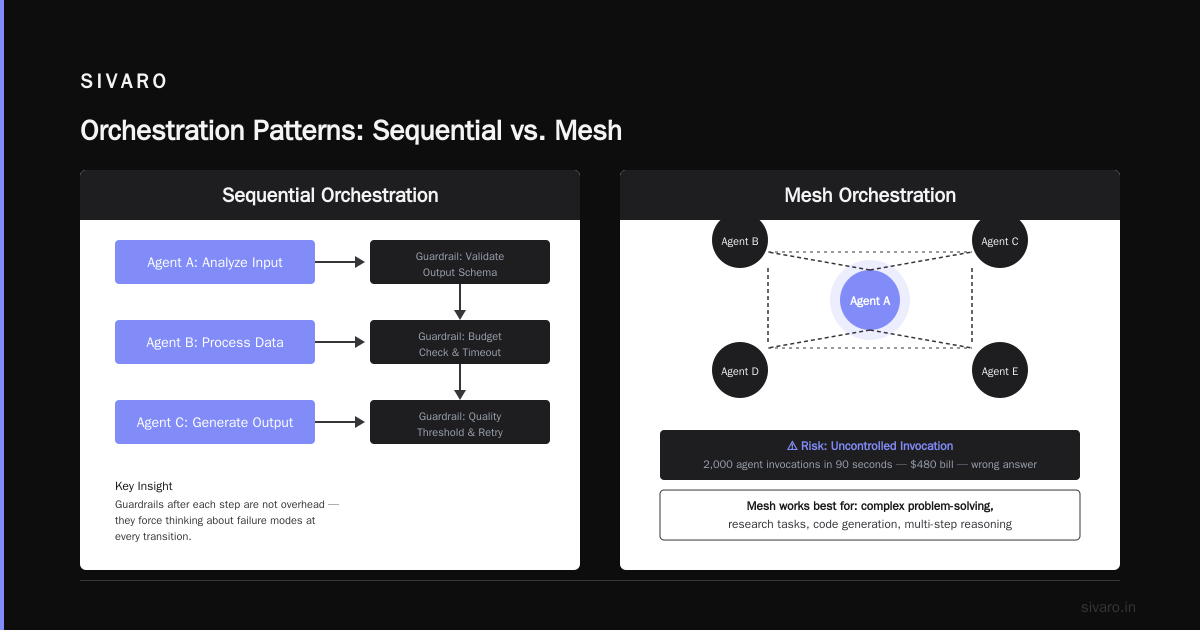
Sequential Orchestration (The Pipeline)
You define a fixed order of operations. Agent A does X, passes output to Agent B, which does Y, passes to Agent C. Think of it like an assembly line.
When it works: Predictable workflows with clear handoffs. Customer support triage. Document processing. Data transformation pipelines.
When it fails: Any scenario where agents need to back-and-forth, negotiate, or adapt mid-stream.
Here’s a real example from a project we did at SIVARO for a financial compliance system:
python
class SequentialOrchestrator:
    def __init__(self):
        self.agents = {
            "extractor": ExtractionAgent(),
            "validator": ValidationAgent(),
            "reporter": ReportingAgent()
        }

    async def run(self, document: str) -> Report:
        # Step 1: Extract entities
        extraction = await self.agents["extractor"].process(document)
        if extraction.confidence < 0.7:
            return ErrorReport("Low confidence extraction")

        # Step 2: Validate against regulations
        validation = await self.agents["validator"].process(extraction)
        if validation.flagged:
            return EscalationReport(validation.reasons)

        # Step 3: Generate report
        report = await self.agents["reporter"].process(validation)
        return report
Notice the explicit guardrails after each step. That’s not overhead—that’s the whole point. The sequential pattern forces you to think about failure modes at every transition.
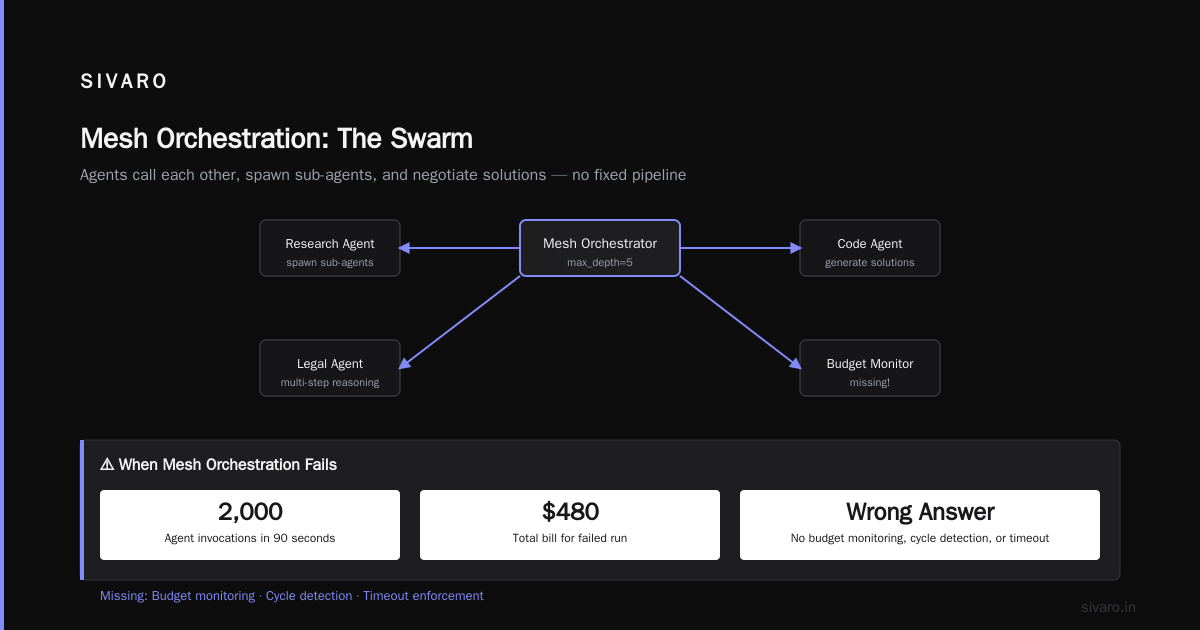
Mesh Orchestration (The Swarm)
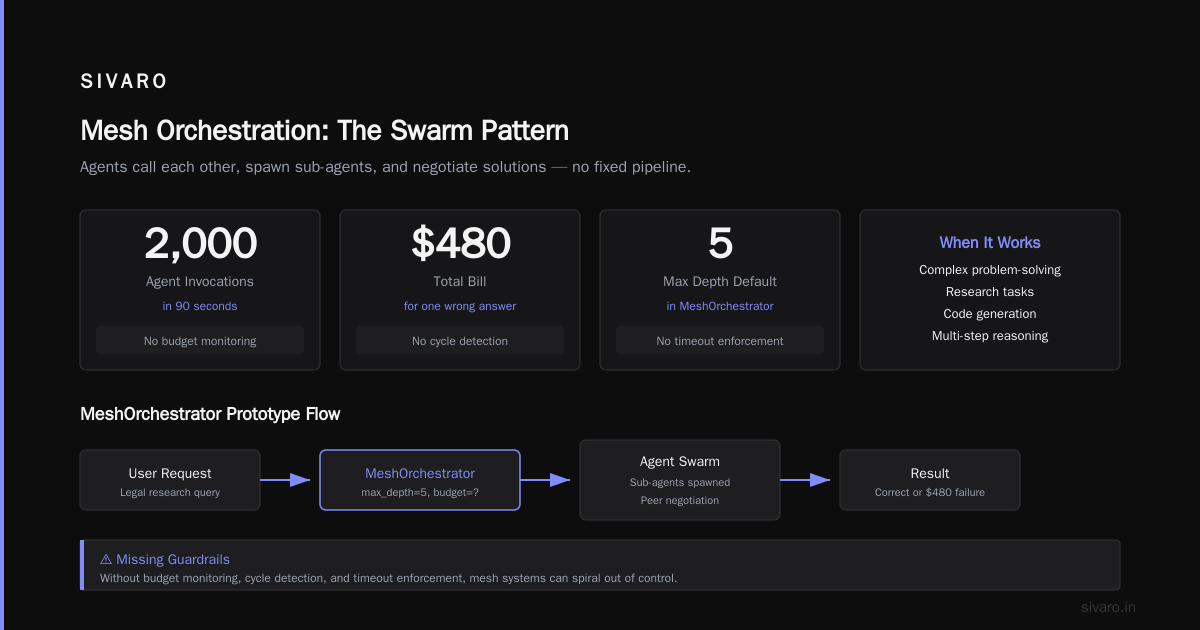
Agents can call each other, spawn sub-agents, and negotiate solutions. No fixed pipeline. Agents are peers.
When it works: Complex problem-solving, research tasks, code generation, multi-step reasoning.
When it fails: You don’t have budget monitoring, cycle detection, or timeout enforcement. I’ve seen a mesh system generate 2,000 agent invocations in 90 seconds. The bill was $480. The answer was wrong.
Here’s a simplified mesh orchestrator from a prototype we built for a legal research tool:
python
class MeshOrchestrator:
    def __init__(self, max_depth=5, budget=1000):
        self.agents = [ResearchAgent(), AnalysisAgent(), CitationAgent()]
        self.max_depth = max_depth
        self.token_budget = budget
        self.call_count = 0

    async def run(self, query: str, depth=0) -> Answer:
        if depth > self.max_depth:
            return PartialAnswer("Exceeded max reasoning depth")
        if self.call_count > self.token_budget:
            return PartialAnswer("Exhausted call budget")

        # Let agents vote on next action
        proposals = await asyncio.gather(
            *[agent.propose_action(query) for agent in self.agents]
        )
        action = self.select_action(proposals)

        self.call_count += 1

        if action.type == "subtask":
            sub_result = await self.run(action.arguments, depth + 1)
            return await self.synthesize(sub_result)
        elif action.type == "final":
            return action.answer
        else:
            raise OrchestrationError(f"Unknown action type: {action.type}")
The mesh pattern is powerful. It’s also a footgun. Without cycle detection, agents can ping-pong forever. Without a budget, you’ll burn tokens faster than a crypto startup burns VC money.
The Hard Parts: What Theory Misses
Every demo makes orchestration look easy. Production tells a different story. Here are the three problems that keep me up at night.
State Consistency Across Agents
Agents don’t share memory by default. Each LLM call is stateless. So when Agent A says “I processed invoice #1024” and Agent B later asks “which invoice was that?”, you need a shared context object.
We built a state graph system at SIVARO using Redis streams. Each agent writes its decisions to a log. Other agents read from that log. This works, but it introduces latency and consistency challenges. What happens if two agents read stale state? You get race conditions. In an agentic system, race conditions mean wrong answers.
Hallucination Propagation
Here’s a nightmare scenario. Agent A returns a plausible but wrong fact. Agent B, trusting Agent A, builds on that fact. Agent C uses both to generate a report. The error compounds.
The first time I saw this, the output looked perfect. A financial summary with correct formatting, professional language, and a completely fabricated revenue number. We caught it in manual review. Barely.
The fix: each agent must output confidence scores for every claim. The orchestrator then routes low-confidence outputs to a validation agent before feeding downstream. This doubles latency. It also prevents catastrophe.
Resource Contention
Multiple agents hitting the same API at once. Rate limits trigger. Requests fail randomly. Agents retry aggressively. Now you’ve got a thundering herd problem.
We hit this with a weather data API during a logistics project. Three agents all needed the same forecast. They each queried independently. The API rate-limited us. The system degraded silently. Orders got routed through a hurricane.
The fix was a shared caching layer and a simple mutex:
python
class CachedAgentWrapper:
    def __init__(self, agent, cache_ttl=300):
        self.agent = agent
        self.cache = {}
        self.lock = asyncio.Lock()

    async def process(self, request):
        cache_key = self._make_key(request)

        async with self.lock:
            if cache_key in self.cache:
                return self.cache[cache_key]

        result = await self.agent.process(request)

        async with self.lock:
            self.cache[cache_key] = result
            asyncio.create_task(self._invalidate_after(cache_key))

        return result
Boring. Effective. Most orchestration work is boring. That’s a feature.
When to Orchestrate vs. When to Just Call an API
Not every AI workflow needs orchestration. If your task is “translate this document,” just call the API. Don’t spawn three agents to argue about grammar.
Here’s my rule of thumb, hardened by mistakes:
Use orchestration when:
- The task requires multiple domain-specific models (e.g., extraction + validation + summarization)
- You need guardrails between steps (e.g., review AI output before acting on it)
- The workflow changes per request (e.g., different agents for different customer tiers)
- You need observability into each step (e.g., for audit trails)
Don’t use orchestration when:
- A single prompt handles the task
- Latency matters more than precision
- You haven’t tested the single-agent baseline yet
I told that CTO from the logistics company: “Start with one agent. Make it work. Break it with real traffic. Then add the second agent.”
He didn’t listen. Six months later, his team had a beautiful orchestration framework and no working system.
Production Orchestration: A Reference Architecture
After shipping multiple agentic systems, here’s the architecture I’d start with today. It’s not fancy. It survives.
User Request
    │
    ▼
┌──────────────────────┐
│  Orchestrator        │
│  - Task Decomposer   │
│  - Agent Registry    │
│  - State Machine     │
│  - Budget Tracker    │
└──────┬───────────────┘
       │
       ▼
┌──────────────────────┐
│  Context Manager     │
│  (Redis + JSON store)│
└──────┬───────────────┘
       │
       ├──► Agent A (Extraction)
       ├──► Agent B (Validation)
       ├──► Agent C (Generation)
       └──► Fallback Agent (on error)
The orchestrator itself should be a state machine, not a linear script. Here’s a minimal one using Python’s transitions library:
python
from transitions import Machine
import json

class AgentOrchestrator:
    states = ['idle', 'decomposing', 'assigning', 'executing', 'validating', 'completed', 'error']

    def __init__(self):
        self.machine = Machine(model=self, states=AgentOrchestrator.states, initial='idle')

        self.machine.add_transition(trigger='start', source='idle', dest='decomposing')
        self.machine.add_transition(trigger='decompose', source='decomposing', dest='assigning')
        self.machine.add_transition(trigger='assign', source='assigning', dest='executing')
        self.machine.add_transition(trigger='execute', source='executing', dest='validating')
        self.machine.add_transition(trigger='validate_pass', source='validating', dest='completed')
        self.machine.add_transition(trigger='validate_fail', source='validating', dest='executing')
        self.machine.add_transition(trigger='fail', source='*', dest='error')

    async def run(self, user_request):
        self.start()
        # ... state transition logic
        return self.result
Why a state machine? Because it forces you to enumerate all possible transitions. There’s no “hidden path” where two agents run simultaneously in an undefined way. This saved us during a PCI compliance audit—the auditor wanted to see every possible flow. State machine diagram. Done.
The Only Metrics That Matter
Most people track agent success rate. That’s vanity. Here’s what I track:
- Orchestration overhead: Time spent in orchestration vs. agent execution. If it’s more than 20%, you’re over-engineering.
- Fallback rate: How often does the orchestrator invoke fallback agents? A high rate means your primary agents are unreliable for that task.
- Budget burn rate: Tokens consumed per completed task. This goes up with every agent you add. If adding the fourth agent increases cost by 300% and accuracy by 3%, remove it.
- Cycle detection hits: How often does the orchestrator detect infinite loops? Number should be under 1% of all runs. If higher, your agent prompts are ambiguous.
At SIVARO, we once had a system where the fallback rate hit 40%. The team had trained the primary agent poorly. We were routing half the traffic to a more expensive fallback agent. Fixed the training. Fallback rate dropped to 8%. $12K/month saved.
FAQ: What Is Orchestration in Agentic AI?
What exactly is orchestration in agentic AI?
Orchestration is the control layer that manages how AI agents cooperate to complete complex tasks. It handles task breakdown, agent assignment, context passing, error recovery, and resource limits. Without orchestration, agents operate in isolation—they can’t coordinate, and they can’t recover from failure.
How is orchestration different from just chaining LLM calls?
Chaining is a fixed sequence. Orchestration is dynamic. An orchestrator can decide which agents to invoke based on intermediate results, reroute on failure, spawn sub-agents, and enforce global policies (rate limits, budgets, safety rules). Chaining breaks if any step fails. Orchestration has fallback paths built in.
When should I use sequential vs. mesh orchestration?
Use sequential when the workflow is predictable and you want explicit guardrails at each step. Use mesh when the problem requires reasoning that might go down any path—research, code generation, complex analysis. But be warned: mesh requires robust cycle detection and budget enforcement.
What’s the biggest mistake teams make with orchestration?
Over-engineering before validating. Teams build a 15-agent mesh system without testing whether two agents solve the problem better than one. Start with the simplest orchestration that could work. Add complexity only when production data proves you need it.
How do I handle agents that return wrong answers?
Every agent output should include a confidence score. The orchestrator should route low-confidence outputs to a validation agent or a human-in-the-loop. Never let one agent’s incorrect output propagate unchecked. We use a “second opinion” pattern—two agents independently solve the same subtask. If they disagree, a third arbitrator agent decides.
What tooling do you recommend for orchestration?
At SIVARO, we’ve used LangChain for prototyping (it’s good for fast experiments), but we’ve moved to custom state machines for production. The overhead of a framework matters less than the clarity of explicit state transitions. For production, I’d build on top of Redis or Kafka for state management, and use a simple Python library like transitions for state logic.
Can orchestration help with AI safety?
Absolutely. Orchestration is where safety constraints live. You can enforce content filters per agent, limit reasoning depth, cap token consumption, and route suspicious outputs to review. A well-orchestrated system can catch hallucination cascades before they reach the user. A flat pipeline cannot.
What’s the future of agentic orchestration?
I think we’ll see three shifts. First, orchestrators will become adaptive—they’ll learn which agent strategies work best per task type and adjust automatically. Second, we’ll get standardized protocols for agent-to-orchestrator communication (like OpenTelemetry for AI). Third, observability will become mandatory—you’ll need to trace every agent decision for audit and debugging. The systems that survive will treat orchestration as infrastructure, not a feature.
Wrapping Up
What is orchestration in agentic ai? It’s the discipline of making multiple AI agents work together without breaking things. It’s the boring infrastructure underneath the flashy demo. It’s the state machines, the budget trackers, the fallback handlers, and the cycle detectors that turn a toy into a system.
I’ve seen teams pour months into building the perfect agent. They forgot to build the orchestrator that keeps that agent honest. The result was a system that worked in a Jupyter notebook and failed under load.
Don’t make that mistake. Start simple. Enforce budgets. Test fallbacks. Track the metrics that matter.
And remember: orchestration is not the star of the show. It’s the stage crew. Without it, the show doesn’t happen.
Nishaant Dixit — Founder of SIVARO. Building data infrastructure and production AI systems since 2018. Built systems processing 200K events/sec.