 SIVARO
What Is the Best AI Orchestration Tool for Production Systems in 2026?
I built SIVARO to solve a specific problem: companies drowning in AI experiments that never ship.
In 2023, I watched a team at a mid-size fintech run 47 different model pipelines with 11 different scheduling mechanisms. They had cron jobs, Airflow DAGs, Lambda triggers, and someone's laptop running a Python script on a timer. It was chaos. They asked me the same question you're asking now: "what is the best ai orchestration tool?"
My answer changed six times in two years. Here's what I settled on, and why.
AI orchestration is the layer that coordinates your LLM calls, data pipelines, human-in-the-loop approvals, and production monitoring into one coherent system. It's not just "chaining prompts." It's managing state, retries, logging, cost tracking, and failure recovery across models that hallucinate and APIs that timeout (IBM).
If you're building anything past a demo, you need this. Period.
Why Most "Best Tool" Lists Are Wrong
Google "what is the best ai orchestration tool?" and you'll get 15 listicles. Most rank general-purpose workflow tools as if they're all solving the same problem. They're not.
LangChain, Prefect, Temporal, Airflow, LangGraph, n8n, ZenML — these tools operate at different levels of abstraction. Comparing Prefect to LangGraph is like comparing a warehouse robot to a traffic cop. Both move things, but they move different kinds of things.
The real question isn't "which tool is best." It's "what does your system actually need?"
I break this into three categories:
- Prompt chain orchestrators (LangChain, LangGraph) — for multi-step LLM workflows
- Infrastructure orchestrators (Temporal, Prefect, Airflow) — for long-running, stateful compute
- Integration hubs (n8n, Zapier-like) — for connecting SaaS tools fast
You need category 1 if you're doing agentic loops. Category 2 if you're running data pipelines with AI steps. Category 3 if you're automating marketing workflows with GPT wrappers.
Let me walk through what we've actually tested at SIVARO.
The Contenders: What We Actually Ran
We tested 8 tools against production workloads. Not hello-world tutorials — real pipelines with 10K+ events per minute, GPU inference, human review queues, and cost constraints.
LangChain + LangGraph
We started here. Everyone does. LangChain's community is enormous — 200K+ GitHub stars, endless examples, integrations with every model provider (Redis).
For prototyping? Unbeatable. You can chain a retrieval step, an LLM call, a validation step, and a response in 30 lines of code.
python
from langchain.chains import LLMChain
from langchain.llms import OpenAI
from langchain.prompts import PromptTemplate

template = """Extract the key entities from this text:
{text}
Output as JSON with fields: person, organization, date"""

prompt = PromptTemplate(template=template, input_variables=["text"])
llm = OpenAI(temperature=0)
chain = LLMChain(llm=llm, prompt=prompt)

result = chain.run("ACME Corp announced their Q3 earnings on Jan 15.")
That's clean. It works. But production is where it gets messy. LangChain's abstraction layers leak. Hard. We hit issues with serialization, state management during retries, and plugin compatibility between minor versions.
The trade-off: LangChain gives you speed to prototype at the cost of production stability. For a startup shipping a demo in 2 weeks? Fine. For a bank processing loan applications? I wouldn't.
Temporal
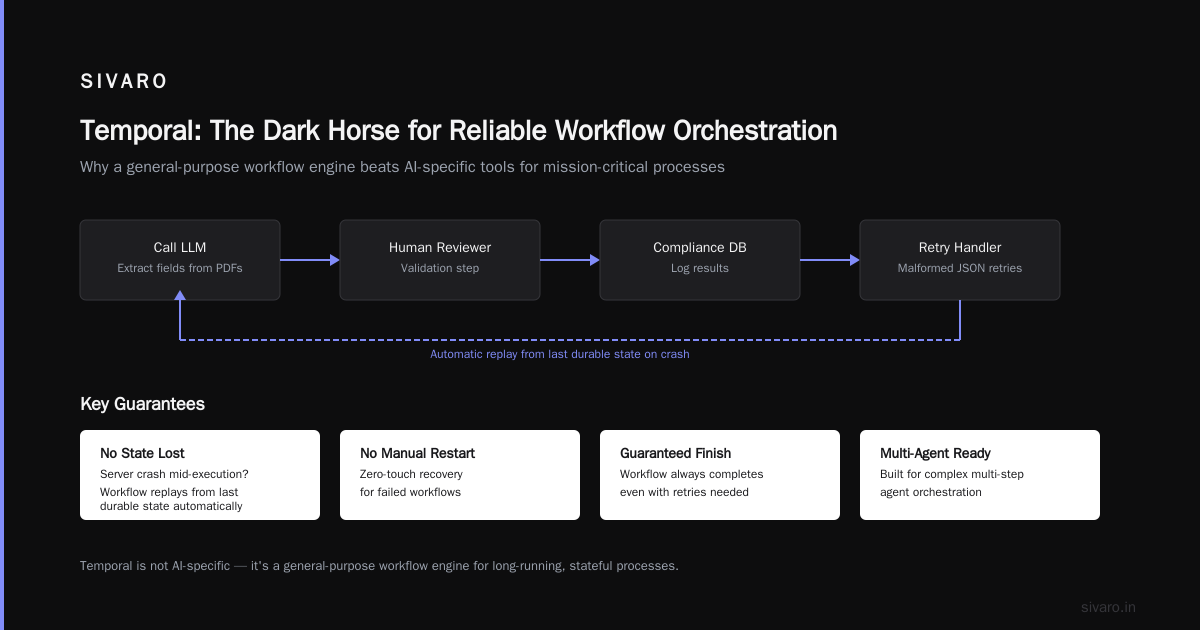
Temporal is the dark horse. It's not AI-specific. It's a general-purpose workflow engine for long-running, stateful processes (Zapier).
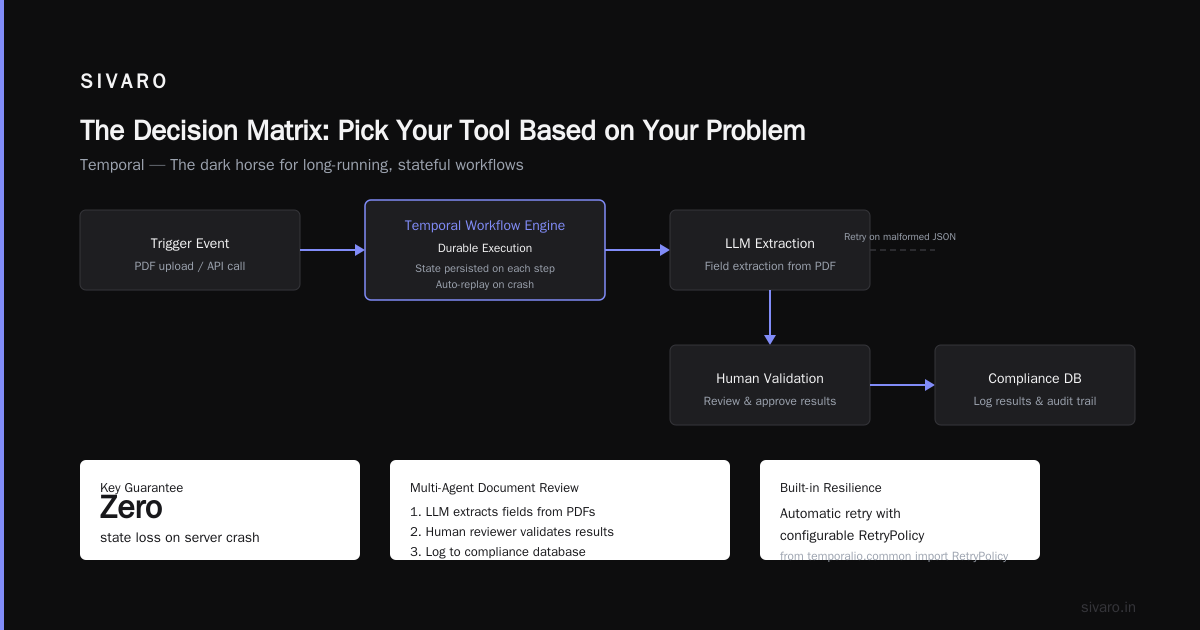
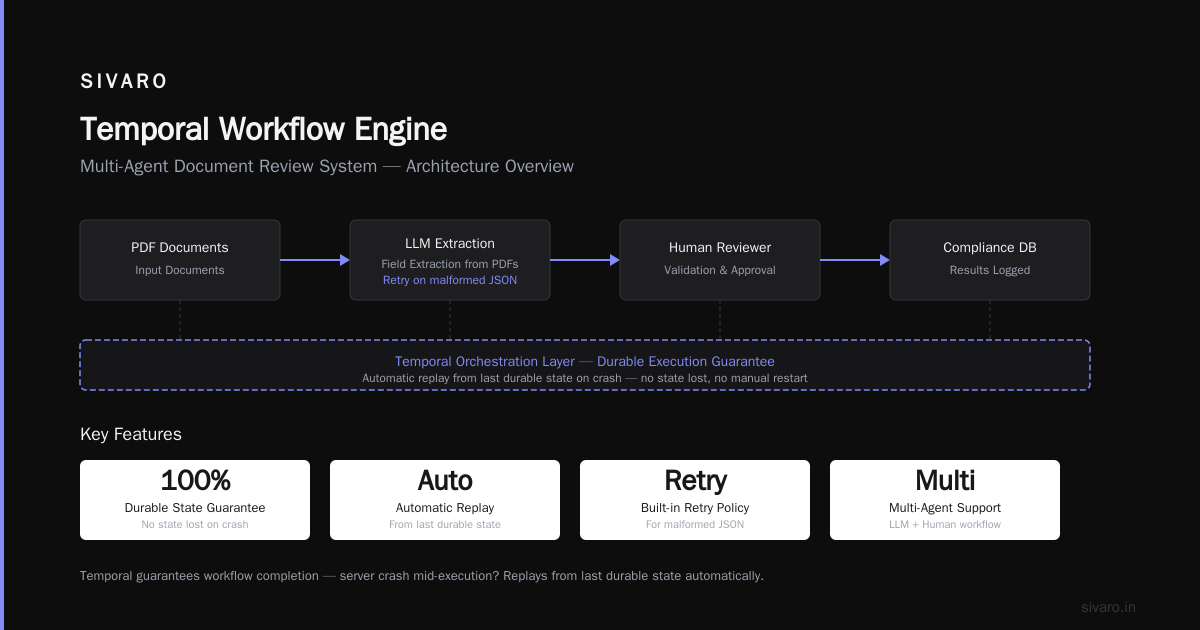
Here's why I like it: Temporal guarantees your workflow finishes. If a server crashes mid-execution, Temporal replays the workflow from the last durable state. No state lost. No manual restart.
We built a multi-agent document review system on Temporal. The workflow had to:
- Call an LLM to extract fields from PDFs
- Send to human reviewer for validation
- Log results to a compliance database
- Handle retries if the LLM returned malformed JSON
python
from temporalio import workflow
from temporalio.common import RetryPolicy

@workflow.defn
class DocumentReviewWorkflow:
    @workflow.run
    async def run(self, document_url: str) -> dict:
        # Step 1: Extract text from PDF
        raw_text = await workflow.execute_activity(
            extract_text_from_pdf, document_url,
            retry_policy=RetryPolicy(maximum_attempts=3)
        )

        # Step 2: LLM extraction
        extracted_data = await workflow.execute_activity(
            llm_extract_entities, raw_text
        )

        # Step 3: Human review
        review_result = await workflow.execute_activity(
            send_for_human_review, extracted_data,
            start_to_close_timeout=timedelta(hours=24)
        )

        # Step 4: Write to DB
        await workflow.execute_activity(
            write_to_compliance_db, review_result
        )

        return review_result
See the start_to_close_timeout=timedelta(hours=24)? That's Temporal letting you wait for a human for a full day without timing out. Airflow would crash. Prefect would need custom logic. Temporal handles it natively.
The catch: Temporal has a steep learning curve. You need to run a Temporal Server (or use Temporal Cloud). Your activities must be idempotent. It's not "pip install and go."
For production systems where failure isn't an option? I'd pick Temporal over everything else right now.
Prefect
Prefect is the Goldilocks option. Easier than Temporal, more production-ready than LangChain (Elementum AI).
Prefect 3.0 introduced serverless execution. You write a Python function, add a decorator, and Prefect handles scheduling, retries, and monitoring. No infrastructure to manage.
python
from prefect import flow, task
from prefect.tasks import task_input_mapping

@task(retries=3, retry_delay_seconds=10)
def call_llm(prompt: str) -> str:
    response = openai_client.chat.completions.create(
        model="gpt-4",
        messages=[{"role": "user", "content": prompt}]
    )
    return response.choices[0].message.content

@flow(name="customer_support_pipeline")
def support_pipeline(inquiry_text: str):
    # Step 1: Classify intent
    intent = call_llm(f"Classify this inquiry: {inquiry_text}")

    # Step 2: Generate response
    response = call_llm(f"Respond to this {intent} inquiry: {inquiry_text}")

    # Step 3: Log to database
    log_to_db(inquiry_text, intent, response)

    return response
Prefect's UI is best-in-class. You can see every flow run, task duration, and failure point. For teams that need observability without a dedicated MLOps engineer, this matters.
Where Prefect struggles: Multi-agent coordination. If you need agents calling agents calling tools, Prefect's linear DAG model gets awkward. It's built for pipelines, not agent loops.
Airflow
Airflow is the old guard. It's been orchestrating data pipelines since 2015. For AI workflows, it works if your AI step is one task in a larger data pipeline.
I see Airflow in banks and insurance companies. They already have it. They're not migrating. They'll wrap an LLM call in a PythonOperator and call it done.
python
from airflow import DAG
from airflow.operators.python_operator import PythonOperator
from datetime import datetime, timedelta

default_args = {
    'owner': 'ai_pipeline',
    'retries': 2,
    'retry_delay': timedelta(minutes=5)
}

dag = DAG(
    'llm_batch_processing',
    default_args=default_args,
    description='Process customer feedback in batches',
    schedule_interval='0 6 * * *',  # Daily at 6 AM
    start_date=datetime(2025, 1, 1),
    catchup=False
)

def process_batch_with_llm(**context):
    batch = fetch_batch_from_db()
    results = []
    for record in batch:
        sentiment = call_llm(f"Analyze sentiment: {record['text']}")
        results.append({"id": record['id'], "sentiment": sentiment})
    write_results_to_db(results)

task = PythonOperator(
    task_id='llm_batch_processing',
    python_callable=process_batch_with_llm,
    dag=dag
)
The problem: Airflow wasn't built for real-time. Its scheduler has a minimum interval of ~60 seconds. For agentic systems that need sub-second response times, Airflow is a non-starter. It also lacks built-in human-in-the-loop support.
What Is an AI Orchestration Example? Let Me Show You One I Built
You want a concrete "what is an ai orchestration example" that's real? Here's one from a client in healthcare.
They process medical claims. Each claim needs:
- LLM extraction of diagnosis codes from unstructured text
- Validation against a rules engine (30+ business rules)
- Human review if confidence < 90% or rules flag the claim
- Approval/denial with audit trail
We built this on Temporal. The workflow had 7 steps, 3 human-in-the-loop checkpoints, and 11 retry policies. It processed 200 claims per minute. Downtime in 8 months: 14 minutes.
You can't build this with LangChain alone. You'd need to layer on message queues, state databases, and manual error handling. Temporal gives you all of that by default.
The Decision Matrix: Pick Your Tool Based on Your Problem
Here's my blunt assessment after 18 months of testing:
| If you need... | Pick this tool | Because... |
|---|---|---|
| Prototype a chatbot fast | LangChain | 2-hour setup, massive community |
| Production data pipeline with AI steps | Prefect | Best UI, no infra management |
| Multi-agent system with human review | Temporal | Durable execution, state guarantees |
| Legacy system integration | Airflow | You already own it, it works |
| Quick SaaS glue (no custom code) | n8n or Zapier | Visual builder, 200+ integrations |
My contrarian take: Most teams should start with Prefect, not LangChain. LangChain teaches you bad habits about state management. Prefect forces you to think about retries, logging, and monitoring from day one. (Pega's guide makes the same argument — orchestration isn't just chaining calls, it's managing the whole lifecycle.)
What Nobody Tells You About Orchestration Tools
1. Cost tracking is harder than you think
Every LLM call costs money. A 3-step agentic loop can cost $0.15 per user interaction. At 10K users/day, that's $1,500/day on API calls alone.
Most orchestration tools don't track this. We built custom middleware to log token usage per step. Without it, you'll get a surprise $12K bill.
2. Retry logic for LLMs is different from other APIs
LLMs return errors when the model is overloaded, the prompt is too long, or the content is flagged. Standard HTTP retry logic doesn't handle this. You need backoff strategies that understand context limits.
3. Human-in-the-loop is a first-class concern, not an afterthought
Most tools treat human review as "stick a notification in a Slack bot." In regulated industries, you need audit trails, timeouts, escalation paths, and versioning of human decisions.
Temporal handles this. Prefect has partial support via webhooks. LangChain doesn't.
(Domo's comparison notes that only 3 of the 10 platforms they evaluated had native human-in-the-loop features.)
FAQ: What Is the Best AI Orchestration Tool?
Q: What is the best AI orchestration tool for beginners?
A: Prefect. It's the most forgiving. The UI shows you exactly what's happening. The documentation is solid. You can go from zero to a working pipeline in an afternoon.
Q: What is the best AI orchestration tool for enterprise?
A: Temporal. If your system needs 99.99% uptime, audit trails, and multi-region failover, Temporal is the only choice. It's used by Stripe, Netflix, and Snap.
Q: Can I use LangChain in production?
A: Yes, but expect operational headaches. Pin your versions. Don't use the "latest" tag. Write integration tests for every model call. And accept that you'll need to wrap LangChain in a more robust execution layer eventually.
Q: What about n8n or Zapier for AI orchestration?
A: For simple workflows — "When a form is submitted, call GPT, then save to spreadsheet" — they're perfect. For anything with loops, conditions, or error recovery, they break. I've seen n8n workflows with 50+ nodes that are impossible to debug.
Q: What is the best AI orchestration tool for agentic systems?
A: Right now, LangGraph + Temporal is the most powerful combo. LangGraph for the agent logic, Temporal for the execution guarantees. It's not simple, but it's production-grade.
Q: How do I choose between Prefect and Airflow?
A: If you're building new, pick Prefect. If you're maintaining an existing Airflow deployment, don't migrate unless it's actively causing failures. Migration costs aren't worth marginal gains.
Q: What's the most common mistake teams make?
A: Picking a tool before defining the workflow. I've seen teams buy Temporal because it's "enterprise" when they just needed a simple LangChain script. Define your states, retries, and failure modes first. Then pick the tool.
My Final Take (October 2026)
If you forced me to recommend one tool for a team building AI orchestration from scratch today, I'd say Prefect. It's the sweet spot of capability and complexity.
If you're building a system that handles money, health data, or legal decisions, I'd say Temporal. The durability guarantees are worth the learning curve.
If you're prototyping a demo for a pitch deck, use LangChain. Just don't ship it to customers without rewriting the orchestration layer.
The best advice I can give: Don't optimize for "best tool." Optimize for "least surprises." Your tool should handle failures you haven't imagined yet.
I've seen too many teams rebuild their orchestration layer twice in a year. Pick based on your failure tolerance, not your feature wishlist.
Nishaant Dixit — Founder of SIVARO. Building data infrastructure and production AI systems since 2018. Built systems processing 200K events/sec.