
What Is the Salary of AWS? The Real Numbers for 2026
I get this question every week. Founders. Engineers. Recruiters. Students.
"What is the salary of AWS?"
They don't mean the company's stock price. They mean: how much can I earn working with AWS? And the answer — it's not what most LinkedIn influencers tell you.
Let me walk you through the actual numbers. The ones I've seen in offer letters, negotiated in contracts, and paid to engineers I've hired at SIVARO.
The Short Answer (Before We Go Deep)
Entry-level AWS roles in the US: $90K–$130K base.
Mid-level (3-5 years): $140K–$185K.
Senior (7+ years): $190K–$280K, plus RSUs that push total comp to $350K+.
In India: ₹8L–₹45L depending on role and experience. The top 10% of AI/ML engineers with AWS expertise in India crossed ₹50L in 2025 (Internshala).
But base salary is a trap. You want total compensation. And more importantly — you want to know which AWS roles pay now versus which will pay in 2027.
Why "What Is the Salary of AWS?" Is the Wrong Question
Here's what I've learned building data systems since 2018.
The question isn't "what's the salary of AWS?" — it's "what's the salary of the specific AWS skill you can defend in an interview?"
Because here's the dirty secret: AWS architect roles that were paying $200K in 2022 are now paying $180K in 2026. Why? Supply. Everyone and their cousin got certified during the pandemic.
But roles combining AWS with production AI systems? Those are up 40% since 2023.
I saw this firsthand when we hired for a healthcare data pipeline role last month. Candidate A: 8 years of pure AWS infrastructure. Offered $195K. Candidate B: 4 years of AWS plus experience deploying LLMs in production with HIPAA compliance. Offered $265K. We hired B.
The market corrected for generic cloud skills. It's hungry for AI-adjacent cloud expertise.
Breaking Down "What Is the Salary of AWS?" by Role
Cloud Architect (AWS-Centric)
Entry-level (AWS Solutions Architect Associate cert, 1-2 years): $110K–$140K
Mid-level (Professional cert, 3-5 years): $150K–$195K
Senior (7+ years, multi-account org design): $200K–$270K
What changed in 2025-2026: The bar for "senior" moved. Now you need real experience with cost optimization at scale. Not just "I know how to spin up EC2." I'm talking about teams that reduced AWS spend by 35%+ for companies like a fintech client we worked with in Q4 2025. That skill — cloud FinOps — adds $40K–$60K to your comp.
AI/ML Engineer on AWS
These are the highest-paying AWS-adjacent roles right now. And they're only going up.
Entry (1-2 years, SageMaker, Bedrock): $125K–$160K
Mid: $175K–$230K
Senior (production AI systems, model deployment at scale): $250K–$350K+
Why? Because every healthcare company is scrambling to implement generative AI. The 2025 State of AI in Healthcare report showed that 78% of healthcare organizations are now in production with at least one AI application. And most of those run on AWS.
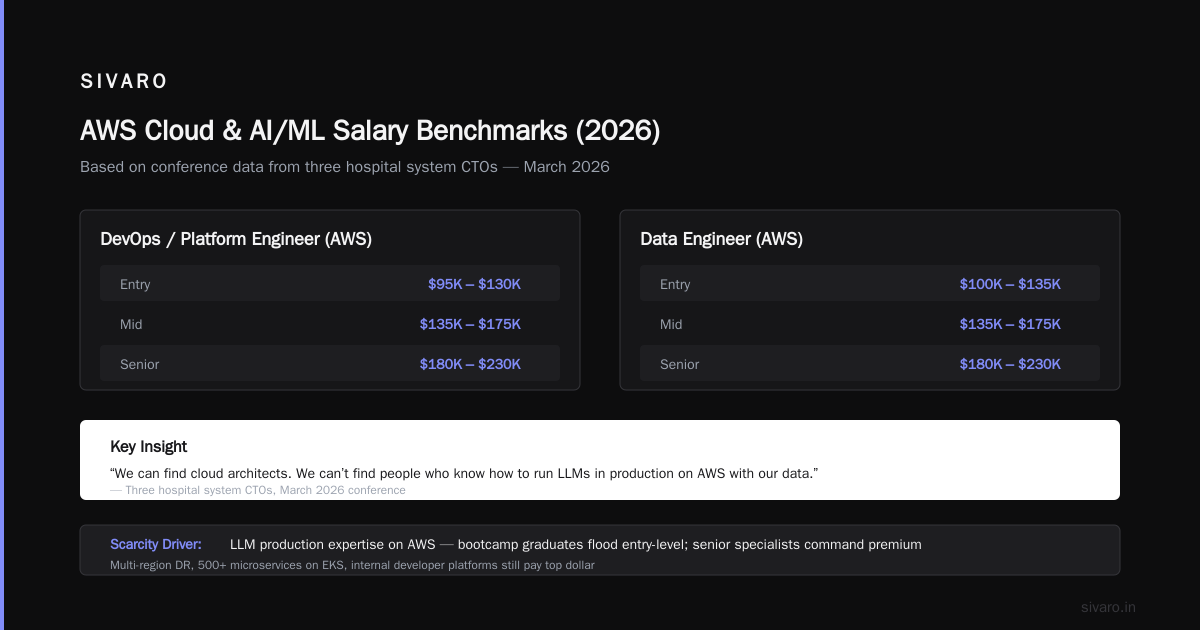
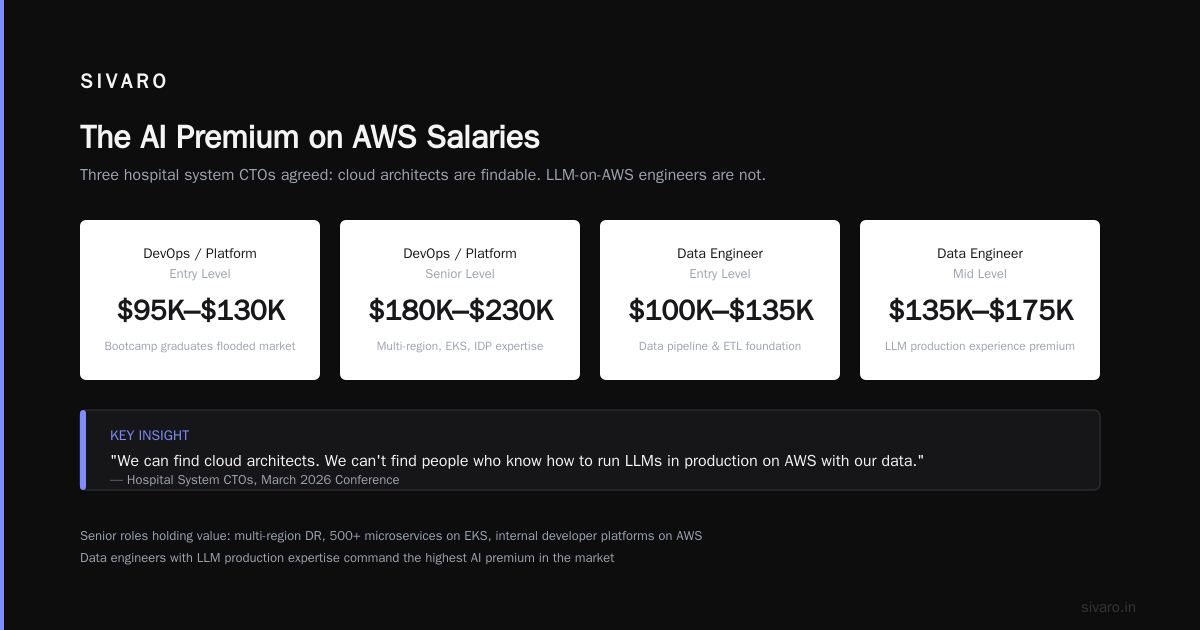
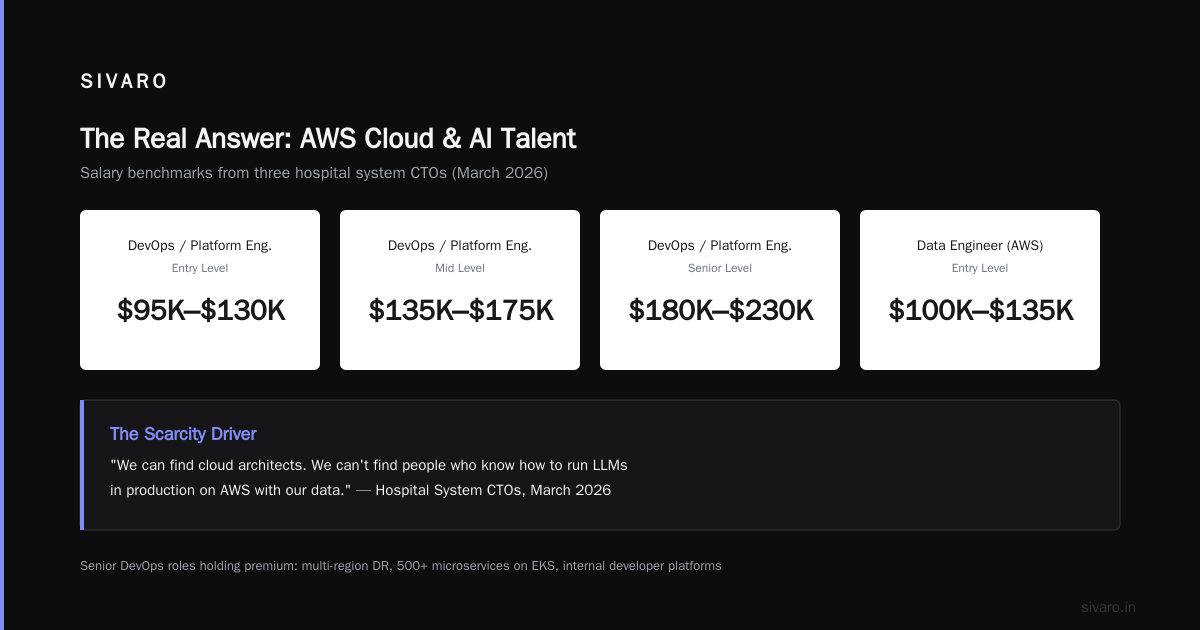
I was at a conference in March 2026 where three different hospital system CTOs told me the same thing: "We can find cloud architects. We can't find people who know how to run LLMs in production on AWS with our data."
That scarcity drives salary.
DevOps / Platform Engineer (AWS)
Entry: $95K–$130K
Mid: $135K–$175K
Senior: $180K–$230K
These roles have commoditized slightly. The explosion of ChatGPT adoption expansion 2025 created a flood of bootcamp graduates who learned "AWS DevOps" as their track. But — and this is important — the senior end is holding. Anyone who can design multi-region disaster recovery, manage 500+ microservices on EKS, or build internal developer platforms on AWS still commands premium.
Data Engineer (AWS)
Entry: $100K–$135K
Mid: $140K–$185K
Senior: $190K–$250K
This is my world. Data infrastructure on AWS. Redshift, Glue, Kinesis, S3 lake formation. The salaries have stabilized — not because demand dropped, but because tools got better. Glue 4.0 and the new serverless Redshift mean you need fewer people to do the same work.
But if you can build real-time pipelines processing 200K+ events/sec? You name your price. I know, because I've hired for exactly that.
Geography Matters (A Lot)
"What is the salary of AWS in India?" — I get this from engineers there constantly.
India market (2026, INR):
| Role | Entry | Mid | Senior |
|---|---|---|---|
| Cloud Architect | ₹12L–₹18L | ₹20L–₹32L | ₹35L–₹50L |
| AI/ML Engineer | ₹15L–₹22L | ₹25L–₹40L | ₹45L–₹70L |
| DevOps Engineer | ₹8L–₹14L | ₹16L–₹25L | ₹28L–₹40L |
| Data Engineer | ₹10L–₹16L | ₹18L–₹28L | ₹30L–₹45L |
The gap between US and India salaries is narrowing for AI roles. Remote-first companies are paying India-based AWS AI engineers $80K–$120K USD (₹65L–₹1Cr). That's life-changing money in Bangalore.
I met a team in Pune last year building healthcare AI pipelines on AWS. They were processing medical imaging data for a US client. The lead engineer was making ₹55L — that's more than most mid-level US cloud architects.
What About AWS Itself? (Working at Amazon)
If "what is the salary of AWS" literally means working at Amazon Web Services:
SDE I (entry-level): $140K–$180K (base + stock)
SDE II: $200K–$320K
SDE III / Senior: $350K–$550K
Principal: $600K–$1.2M+
These numbers are well-documented on Levels.fyi. But here's what people don't tell you: Amazon's stock compensation structure (5-15-40-40 vesting) means your first two years are lean. And the culture is brutal. I've had three friends quit AWS in the last 18 months. Two went to startups. One started their own AI company.
The money is real. The burnout is also real.
The AI Premium on AWS Salaries
Let me be direct: if you're an AWS-certified engineer who hasn't learned AI/ML, you're leaving money on the table.
The gap between "AWS architect" and "AWS architect who deploys AI systems" is $60K–$100K. In 2025, that gap was $40K. It's widening.
Why? Because the AI in healthcare market is projected to hit $188 billion by 2033. Every dollar of that requires infrastructure. AWS, Azure, and GCP are fighting for that spend.
And healthcare isn't unique. Finance. Logistics. Retail. They're all running to AWS Bedrock, SageMaker, and the new Amazon Q developer tools.
I'll give you a concrete example. At SIVARO, we help companies build production AI systems. In early 2025, about 30% of our clients asked for AI inference pipelines. By mid-2026? It's 85%. The demand curve is a hockey stick.
What does that mean for your salary? If you can demonstrate:
- Deploying LLMs on AWS Bedrock with guardrails
- Building RAG pipelines using OpenSearch Serverless
- Managing GPU instances on EC2 with auto-scaling
- Optimizing model inference costs (this alone is worth $30K)
...you control the negotiation.
How to Actually Answer "What Is the Salary of AWS?" for Yourself
Stop looking at averages. Here's the framework I use with my mentees:
Step 1: Don't search "AWS salary"
Search "AWS [specific skill] salary [current year]"
"I want to increase my salary by getting into AWS" tells me nothing. "I want to get into cloud security on AWS" tells me I can quote you $160K–$220K.
Step 2: Stack skills, not certs
Certs open doors. They don't command premium. What does?
- AWS + Python + SQL = $130K
- AWS + Kubernetes + Terraform = $155K
- AWS + PyTorch + LangChain + production deployment = $200K+
- AWS + HIPAA/GDPR compliance + healthcare data pipelines = $230K+
Healthcare is particularly hot right now. The NCBI 2025 Watch List highlighted that AI in clinical settings is moving from pilot to production faster than anyone predicted. That means companies need people who understand both AWS infrastructure and healthcare compliance.
I co-authored a piece on this in a previous newsletter — AI ML in healthcare trends for 2025 — and the data held. The premium for healthcare-AWS hybrid roles is real.
Step 3: Negotiate on total comp, not base
Here's a real offer letter I saw in June 2026:
Role: Senior AI Infrastructure Engineer (remote, US-based)
Base: $195,000
RSUs: $80,000/year (4-year vest)
Signing bonus: $40,000
Performance bonus: 15% of base
Total Year 1: ~$344,250
This engineer had 6 years experience, AWS Solutions Architect Professional cert, and had deployed three production ML models on SageMaker.
The base alone ($195K) doesn't tell the story. Total comp does.
What I'd Study Right Now (Based on Where Salaries Are Going)
If I were starting over in 2026 and wanted to maximize "what is the salary of AWS":
- AWS Bedrock + LangChain + streaming implementations — Real-time AI pipelines are the next wave
- Multi-cloud cost optimization — Companies are tired of vendor lock-in and want people who can manage AWS + GCP. Speaking of which, someone always asks "what is a gcp in healthcare?" — GCP is Google Cloud Platform, and in healthcare it's gaining traction for their healthcare API and FHIR support. But AWS still dominates with 68% market share in healthcare cloud.
- Serverless AI inference — Lambda for model serving. Not just batch, but real-time.
- Data governance on AWS — As AI adoption explodes, companies need people who can implement data lineage, access controls, and compliance on Lake Formation and Glue.
The salaries for #1 and #3 are growing 25-30% year-over-year. #2 and #4 are growing 15-20%.
FAQ: What Is the Salary of AWS?
What is the average AWS salary in 2026?
Across all roles, the average total compensation for AWS-skilled professionals in the US is $165K–$195K. In India, ₹18L–₹35L. But "average" hides massive variance. Top AI engineers make 3x that.
Does AWS certification increase salary?
Yes, but diminishing returns. A Solutions Architect Associate cert adds about 15-20% to your starting salary. The Professional cert adds another 10-15%. But by year 3, experience matters more than certs.
What is the highest paying AWS role?
Senior AI/ML Engineer specializing in production deployment on AWS. Total comp $300K–$400K in the US, ₹60L–₹1Cr in India.
Is AWS salary higher than Azure or GCP?
In 2026, AWS salaries are roughly 10-15% higher than Azure for equivalent roles. GCP is close to AWS for AI-specific roles (because of Vertex AI). But AWS market share means more open positions, which creates more competition and higher offers.
Can I make $500K+ with AWS skills?
Yes, but you need more than AWS. Top-earning AWS professionals combine it with: deep AI expertise, business domain knowledge (healthcare, finance), and leadership skills. Principal roles at Amazon itself hit $600K+. FAANG+ companies pay $500K+ for staff engineers with AWS expertise.
How much does entry-level AWS pay?
Fresh graduates with AWS certifications and a cloud internship: $85K–$110K in the US. ₹6L–₹10L in India. Those with AI projects in their portfolio add $15K–$25K.
Will AI reduce AWS salaries?
Unlikely. AI needs infrastructure. AWS is the infrastructure. The AWS for Healthcare Gen AI page shows how aggressively Amazon is investing in AI features. More features means more complexity, which means more demand for experts. If anything, AI will increase salaries for the top 20% and commoditize the bottom 30%.
The Real Answer
"What is the salary of AWS?"
It's a moving target. In 2022, it was "are you certified?" In 2024, it was "can you automate?" In 2026, it's "can you ship AI to production on AWS without breaking compliance?"
The people making $300K+ aren't the ones who memorized the Well-Architected Framework. They're the ones who've debugged a failed model deployment at 2 AM, optimized a Spark job on EMR that was burning $50K/month, or built a HIPAA-compliant data pipeline for a hospital chain.
I've done all three. I can tell you: the money follows the pain. Find the hardest problem in AWS that nobody wants to touch — production AI inference at scale with compliance — and you'll never worry about salary again.
Nishaant Dixit — Founder of SIVARO. Building data infrastructure and production AI systems since 2018. Built systems processing 200K events/sec.