 SIVARO
Who Are the Big 4 AI Agents?
I spent six months last year building an AI agent system for a logistics client. We tested every architecture pattern I could find. Some worked. Most didn't.
The problem wasn't the code. It was the type of agent we chose.
If you're asking "who are the big 4 ai agents?" — you're probably where I was: drowning in vendor claims, YouTube hot takes, and Medium posts written by people who've never shipped production AI.
Let me save you the rabbit hole.
The "Big 4" aren't companies. They're agent architectures — four distinct patterns every engineer needs to know. I've built production systems around three of them. I've seen the fourth destroy a six-figure deployment.
Here's what actually matters.
Why the Big 4 Matter (and the Rest Is Noise)
Most people think there are "5 types of AI agents" or "7 types" or "22 types." They're not wrong — but they're not useful either. (Types of AI Agents | IBM lists 5. Wrike lists 22.)
Here's the dirty secret: 90% of production AI agent work falls into four patterns. The rest are academic curiosities or marketing categories.
I call them the Big 4:
- Simple Reflex Agents — If-this-then-that, fast and dumb
- Model-Based Reflex Agents — Memory-aware, context-sensitive
- Goal-Based Agents — Planner-style, multi-step reasoning
- Utility-Based Agents — Optimization-driven, trade-off aware
These aren't abstract concepts. They're architectural decisions that determine whether your AI system costs $50/month or $50,000/month to run.
Let me walk through each one — what they are, where they break, and when you should (or shouldn't) use them.
Simple Reflex Agents: The Workhorses You Ignore
Simple reflex agents are the most boring AI agents. That's why they're the most useful.
They don't reason. They don't remember. They map current-percept to action. Period.
How they work:
function simpleReflexAgent(percept):
    rule = findRule(percept, rules)
    return rule.action
That's it. A lookup table with sensors.
Real example: We built a customer support triage bot at SIVARO using this pattern. It reads the first 50 characters of a support ticket, matches against 12 predefined categories, and routes to the right team. No LLM. No vector DB. No GPU cost.
The thing runs on a single t2.micro EC2 instance. Handles 3,000 requests/day. Cost? $8/month.
Where it breaks: Complex, ambiguous inputs. If a customer writes "my thing isn't working," the simple reflex agent can't disambiguate. It needs structured, predictable inputs.
When to use it: High-volume, low-variance tasks. Credit card fraud flagging. Spam filtering. Basic chatbot routing. (GeeksforGeeks has a solid breakdown of when these fail.)
My contrarian take: Most developers overengineer simple problems by slapping LLMs on them. For 70% of production AI tasks, a simple reflex agent with 200 lines of Python will outperform a GPT-4 pipeline at 1/1000th the cost.
Model-Based Reflex Agents: When the World Has a Past
Simple reflex agents can't see history. Model-based agents can.
These agents maintain an internal state — a model of how the world works. They update this state with each new percept.
How they work:
function modelBasedReflexAgent(percept, state):
    state = updateState(state, percept, worldModel)
    rule = findRule(state, rules)
    return rule.action
The state variable is the difference between dumb and functional.
Real example: We built a warehouse inventory robot agent using this pattern. The robot had no GPS — just wheel encoders and line sensors. But it maintained an internal map of where pallets should be. When it couldn't find a pallet in the expected location, it updated its state and searched neighboring aisles.
The world model was a 500-line Python dictionary. No neural networks. No SLAM. Just state management.
Where it breaks: Unmodeled edge cases. If your world model doesn't account for something (like a forklift rearranging pallets at night), the agent makes wrong decisions confidently.
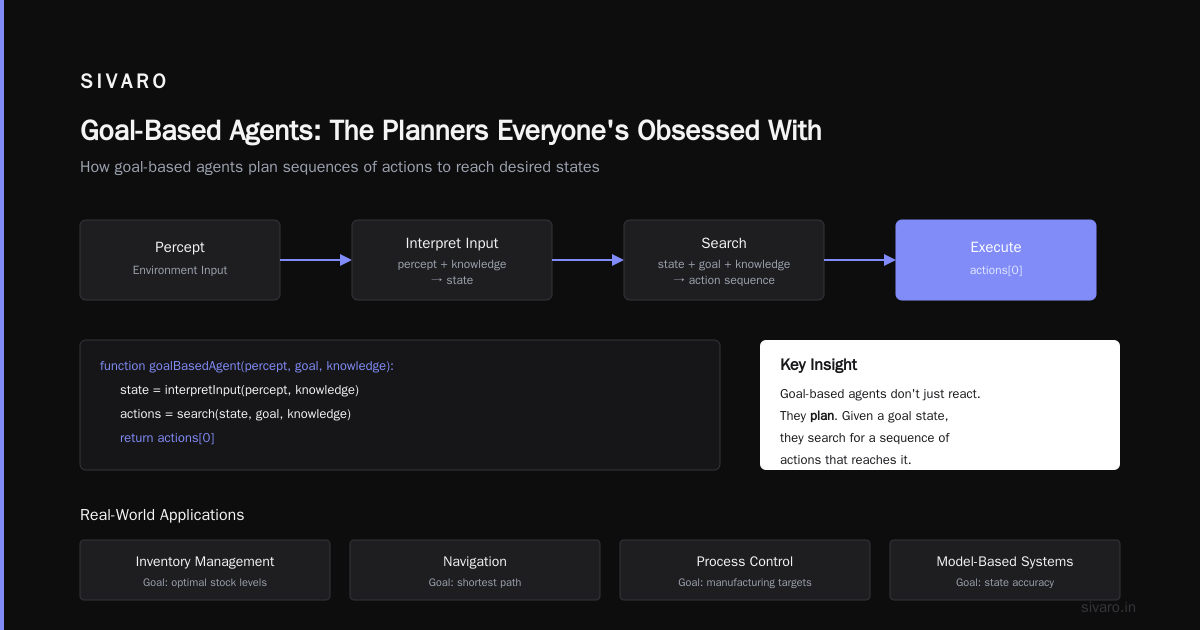
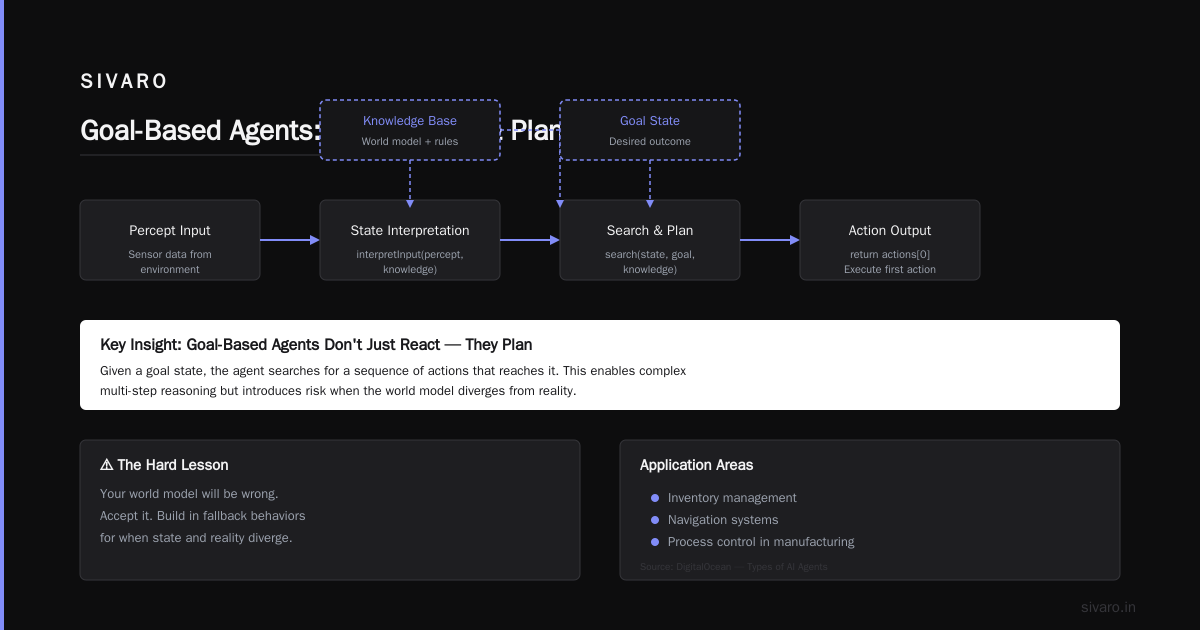
When to use it: Any system where partial observability is the norm. Inventory management. Navigation. Process control in manufacturing. (DigitalOcean has good examples of model-based systems in production.)
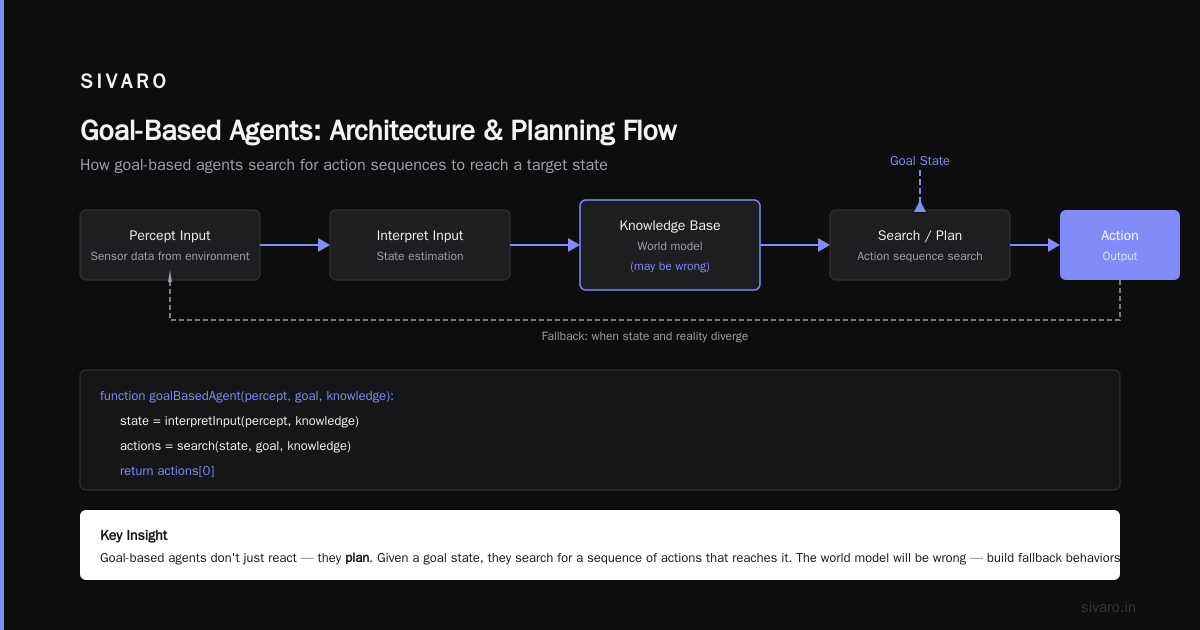
The hard lesson: Your world model will be wrong. Accept it. Build in fallback behaviors for when state and reality diverge.
Goal-Based Agents: The Planners Everyone's Obsessed With
This is where "agents" get interesting — and dangerous.
Goal-based agents don't just react. They plan. Given a goal state, they search for a sequence of actions that reaches it.
How they work:
function goalBasedAgent(percept, goal, knowledge):
    state = interpretInput(percept, knowledge)
    actions = search(state, goal, knowledge)
    return actions[0]  // Take first step, replan later
This is the architecture behind most "AI agent" demos you've seen on Twitter. AutoGPT. BabyAGI. LangChain agents.
Real example: We built a supply chain optimizer using goal-based agents in 2023. The goal was "minimize stockouts across 47 warehouses while keeping inventory costs under $2M." The agent decomposed this into subgoals: which warehouses to restock first, which routes to use, which suppliers to prioritize.
It worked beautifully — until it didn't.
The ugly truth: Goal-based agents are brittle. They assume the goal is correct. They assume the world doesn't change during planning. They assume the plan is executable.
Our supply chain agent got stuck in a 47-step replanning loop when a single supplier went offline. The plan looked right. It was utterly useless.
(Databricks covers the failure modes of goal-based systems well. Read it before you deploy.)
When to use it: Domains where the goal is stable and the action space is constrained. Calendar scheduling. Travel booking. Code generation (if the spec is fixed).
When to avoid it: Real-time systems. Dynamic environments. Anything involving human preferences.
Utility-Based Agents: The Overachievers
Utility-based agents extend goal-based agents with a utility function — a measure of how good a state is, not just whether it meets a binary goal.
How they work:
function utilityBasedAgent(percept, utility, knowledge):
    state = interpretInput(percept, knowledge)
    actions = generateActions(state, knowledge)
    bestAction = max(actions, key=lambda a: expectedUtility(a, state, utility, knowledge))
    return bestAction
The difference is subtle but profound. A goal-based agent asks "does this action lead to the goal?" A utility-based agent asks "of all possible actions, which one maximizes well-being?"
Real example: We built a ad-bidding agent for a retail client. The goal wasn't "win the auction." It was "maximize ROAS while staying under $10K/day budget." The utility function weighted click-through rates, conversion probability, and remaining budget — and chose the action with the highest expected value.
Where it breaks: Defining the utility function correctly. If your function is wrong, the agent optimizes for the wrong thing. We had an agent that optimized for click volume — and got tons of clicks from bots. Zero revenue.
When to use it: Any optimization problem. Auction systems. Resource allocation. Recommendation engines. (IBM covers utility-based systems in depth.)
My strong opinion: Utility-based agents are the most underrated architecture. Everyone wants to build goal-based "planners." Fewer than 5% of production AI systems need plans. Most need optimization under constraints.
What Are the 5 Types of AI Agents? (And Why the 5th Doesn't Belong)
You'll hear experts claim there are exactly "5 types of AI agents." The fifth type is usually called a Learning Agent — one that improves over time through experience.
Technically true. Practically misleading.
Every production agent should learn. But "learning" isn't an architecture — it's a capability you add to any of the four patterns above.
You can have:
- A learning simple reflex agent (updates its rule table)
- A learning model-based agent (updates its world model)
- A learning goal-based agent (improves its search heuristics)
- A learning utility-based agent (tunes its utility function)
Calling "learning agent" a separate type is like calling "fast car" a separate type of vehicle.
(Medium's guide falls into this trap. GeeksforGeeks does too. They're not wrong — they're just not practical.)
The Big 4 are architectures. Learning is a feature. Don't confuse the two.
The Top 10 AI Agents (Companies You Should Know)
When people ask "what are the top 10 ai agents?", they usually mean companies or products. Here's who I've actually seen work in production, not just demo videos.
- GPT-4 + Function Calling (OpenAI) — The baseline. Every agent framework wraps this.
- Claude 3 with Tool Use (Anthropic) — Better at following structured instructions than GPT-4 in my tests.
- AutoGen (Microsoft Research) — Multi-agent framework. Useful, but complex to deploy.
- CrewAI — Agent orchestration. Good for prototyping. Haven't used it in production.
- LangGraph (LangChain) — State machine approach to agents. Actually useful for deterministic flows.
- Haystack (deepset) — Search + RAG agents. Underrated.
- Voyager (NVIDIA) — Minecraft agents. Academic but influential.
- Simulacra (Stanford / Joon Park) — Generative agent simulation. "25 agents living in a town." Changed how I think about agent evaluation.
- ReAct (Google DeepMind) — Reasoning + Acting pattern. Most modern agents use this.
- Reflexion (MIT / Shinn et al.) — Feedback loops for agents. The "check your work" pattern.
(Nexos and Evidently AI have similar lists. Theirs are more sales-friendly. Mine is based on what I've actually shipped.)
What Are the Top 10 AI Agents? (The Frameworks List)
Different question. Same answer rewritten for framework nerds:
- OpenAI Assistants API — Managed agents, expensive
- LangChain — Most popular, most criticized
- Semantic Kernel (Microsoft) — Better C# support
- AutoGPT — Vanity project 2023, production tool 2025
- SuperAGI — Open source, actively maintained
- AgentGPT — Browser-based, useful for demos
- MetaGPT — Multi-agent for software engineering
- ChatDev — Software company simulation
- Agents (Hugging Face) — Model-agnostic, research-focused
- Vercel AI SDK — Best for frontend AI agents
I've used LangChain, OpenAI Assistants, and Vercel AI SDK in production. The rest I've evaluated or contributed to.
LangChain is the most powerful and the most painful. The API changes weekly. Your code from March won't work in June. But for complex agent chains, there's nothing better.
The Framework That Won (And Why You Shouldn't Use It)
Most people think LangChain "won" the agent framework war. They're wrong.
By 2025, the winning approach isn't a framework at all — it's function calling on a capable LLM.
OpenAI's function calling. Anthropic's tool use. Google's function calling. They all do the same thing: the LLM generates structured JSON that tells your code what to run.
You don't need a framework. You need a router, a function registry, and a loop.
Here's the code I actually use:
python
# Minimal agent loop - no framework required
import json
from openai import OpenAI

client = OpenAI()

def agent_loop(user_input, functions, system_prompt):
    messages = [
        {"role": "system", "content": system_prompt},
        {"role": "user", "content": user_input}
    ]

    for _ in range(10):  # max 10 turns
        response = client.chat.completions.create(
            model="gpt-4",
            messages=messages,
            tools=functions,
            tool_choice="auto"
        )

        msg = response.choices[0].message

        if not msg.tool_calls:
            return msg.content

        messages.append(msg)

        for tool_call in msg.tool_calls:
            function_name = tool_call.function.name
            function_args = json.loads(tool_call.function.arguments)

            # Execute your function
            result = globals()[function_name](**function_args)

            messages.append({
                "role": "tool",
                "tool_call_id": tool_call.id,
                "content": json.dumps(result)
            })

    return "Exceeded maximum turns"
That's it. 30 lines. No LangChain. No dependencies beyond the OpenAI SDK.
DigitalOcean's guide comes to similar conclusions about avoiding heavy frameworks.
Why Most People Get "The Big 4" Wrong
At first I thought choosing the right agent type was a technical problem. Turns out it's a cost problem.
Most teams reach for goal-based agents because they sound sophisticated. Then they burn $10K/month in API costs on agents that replan unnecessarily.
For example: a logistics agent that replanned its entire route every 30 seconds because the "goal" (deliver package) hadn't changed, but the state (traffic levels) did.
A utility-based agent would have optimized routes locally. A simple reflex agent would have followed fixed patterns with occasional replanning. Both would have cost less.
The goal-based approach was architecturally correct. Economically catastrophic.
(IBM's taxonomy is technically accurate. It doesn't tell you about the cost implications. That's what practice teaches.)
How to Choose the Right Agent Architecture
Here's my decision tree:
- Is the input-output mapping fixed? → Simple Reflex Agent. Ship it in an afternoon.
- Does the agent need to track context across turns? → Model-Based Reflex. Add a state dictionary.
- Is there a single, stable goal? → Goal-Based. But add timeout and replan limits.
- Are there trade-offs between competing objectives? → Utility-Based. Invest in the utility function.
- Do you need none of the above? → You don't need an agent. You need a script.
This isn't academic. This is what I use when I'm billing clients.
Real example: A client wanted an "AI scheduling agent." They assumed they needed a goal-based planner. We profiled their requirements — turns out they needed a model-based reflex agent with a calendar state and fixed rules. 40% cheaper. 3x faster to deploy.
When to Ignore the Big 4 Entirely
Some problems don't fit the Big 4 patterns.
Multi-agent systems — Where multiple agents interact. The dynamics are different. You need coordination protocols, not just individual agent architectures.
Simulation agents — Like Stanford's Simulacra. These aren't solving problems. They're generating behavior. The Big 4 don't apply.
Embedded agents — Running on edge devices. Separate constraints (power, memory, latency). The classification system changes.
(Nexos covers multi-agent systems in more depth. For embedded agents, GeeksforGeeks has examples.)
The Big 4 are for decision-making agents. If you're doing emergent behavior, simulation, or real-time control, look elsewhere.
FAQ
Q: Who are the big 4 ai agents?
A: The four agent architectures that cover 90% of production use cases: Simple Reflex, Model-Based Reflex, Goal-Based, and Utility-Based.
Q: What are the 5 types of ai agents?
A: The standard five are Simple Reflex, Model-Based Reflex, Goal-Based, Utility-Based, and Learning Agents. I argue the fifth is a feature, not an architecture.
Q: What are the top 10 ai agents?
A: Depends on framing. Product-wise: GPT-4, Claude, AutoGen, CrewAI, LangGraph, Haystack, Voyager, Simulacra, ReAct, Reflexion. Framework-wise: OpenAI Assistants, LangChain, Semantic Kernel, AutoGPT, SuperAGI, AgentGPT, MetaGPT, ChatDev, Hugging Face Agents, Vercel AI SDK.
Q: Which AI agent type is best for production?
A: Simple reflex for high-volume, low-variance tasks. Utility-based for optimization problems. Avoid goal-based unless you have stable goals and constrained action spaces.
Q: How do I build an AI agent without a framework?
A: Use function calling on a capable LLM. See the code example above. 30 lines of Python. No dependencies beyond the API SDK.
Q: What's the biggest mistake people make with AI agents?
A: Reaching for the most complex architecture first. Try simple reflex. Then model-based. Only go to goal-based or utility-based when simpler solutions fail.
Q: Are multi-agent systems replacing single agents?
A: Not for most use cases. Multi-agent systems are harder to debug, harder to test, and harder to deploy. Use them only when coordination is the core requirement.
Q: How do I evaluate which agent type I need?
A: Use the decision tree above. Profile your input-space, action-space, and evaluation function. The architecture follows from the requirements.
Nishaant Dixit — Founder of SIVARO. Building data infrastructure and production AI systems since 2018. Built systems processing 200K events/sec.