 SIVARO
Why Gen Z Is Obsessed With Kafka?
Franz Kafka died in 1924. He asked his friend Max Brod to burn everything he'd written. Brod didn't. And now, 100 years later, a generation that grew up on TikTok and remote work has made Kafka their unofficial patron saint.
I run a product engineering shop. I've spent a decade building data systems. I never expected to see "Kafka" trending on BookTok alongside Colleen Hoover. But here we are. Gen Z has adopted a dead Czech insurance lawyer as their literary mascot.
Why? Because reading Kafka in 2024 feels less like literature and more like documentation of your actual life.
The Metamorphosis isn't a metaphor anymore. It's Monday morning.
What Was Kafka Known For?
Let's clear this up fast. Franz Kafka was a German-speaking Jew from Prague. He worked at an insurance company, hated his job, wrote at night, and died at 40 from tuberculosis.
What was he known for? Three things.
First, the absurd bureaucracy. Characters trapped in systems they can't understand. Courts that never explain charges. Doors that are always "open" but never accessible.
Second, metamorphosis. Literally turning into an insect (The Metamorphosis). Figuratively becoming something unrecognizable to your own family.
Third, the eternal deferral. "The trial" never reaches a verdict. "The castle" never grants access. "Before the law" remains forever unenterable.
He wrote about alienation, guilt, and systems designed to crush individuals. Sounds familiar? It should. That's the standard Gen Z experience of 2024.
Why Is Gen Z Obsessed With Kafka? The Core Thesis
Most people think Gen Z loves Kafka because they're edgy and depressed. Wrong take.
Gen Z loves Kafka because he described their world before it existed (Why Gen-z is so obsessed by Kafka?).
Let me be specific. I've built systems processing 200K events per second. That gives me a particular lens on Kafka. Not the writer — the data streaming platform. But you know what? The two Kafkas have more in common than you'd think. Both are about events you can't control, processing you can't see, and outcomes that feel arbitrary.
Three core drivers:
1. The Algorithm Is The Castle
Kafka wrote The Castle about a surveyor named K. who can never reach the castle authorities. He spends the whole novel trying to get access to people who might not exist.
Gen Z lives this every day.
The algorithm decides what you see, who sees you, whether you get a job application through, whether your TikTok goes viral or dies in the void. You can't appeal. You can't explain. You can't find the human in charge (Why GenZ is SECRETLY OBSESSED with this author ?).
I talked to a 22-year-old engineer on my team. She said: "Kafka wrote about trying to make yourself understood by a system that doesn't speak your language. That's just applying for jobs on LinkedIn."
She's right.
2. The Metamorphosis Is Employment
Gregor Samsa wakes up as an insect, and his biggest concern is losing his job.
That's not surreal. That's Tuesday.
Gen Z entered a labor market where gig work, contract roles, and "we're a family" culture dominate. Your identity is your output. Your value is your productivity. And if you can't produce? You're a bug.
The horror of The Metamorphosis isn't the insect transformation. It's that Gregor's family moves on without him. Within weeks, he's furniture.
Gen Z knows this feeling. They've been laid off via email. They've watched companies replace humans with AI. They've seen loyalty met with a PIP (performance improvement plan) (Why GenZ is ADDICTED To This Author? | by AYMAN PATIL).
3. The Trial Is Accountability Culture
The Trial opens with Josef K. getting arrested. He never learns what he's accused of. The trial consumes his life. He dies "like a dog."
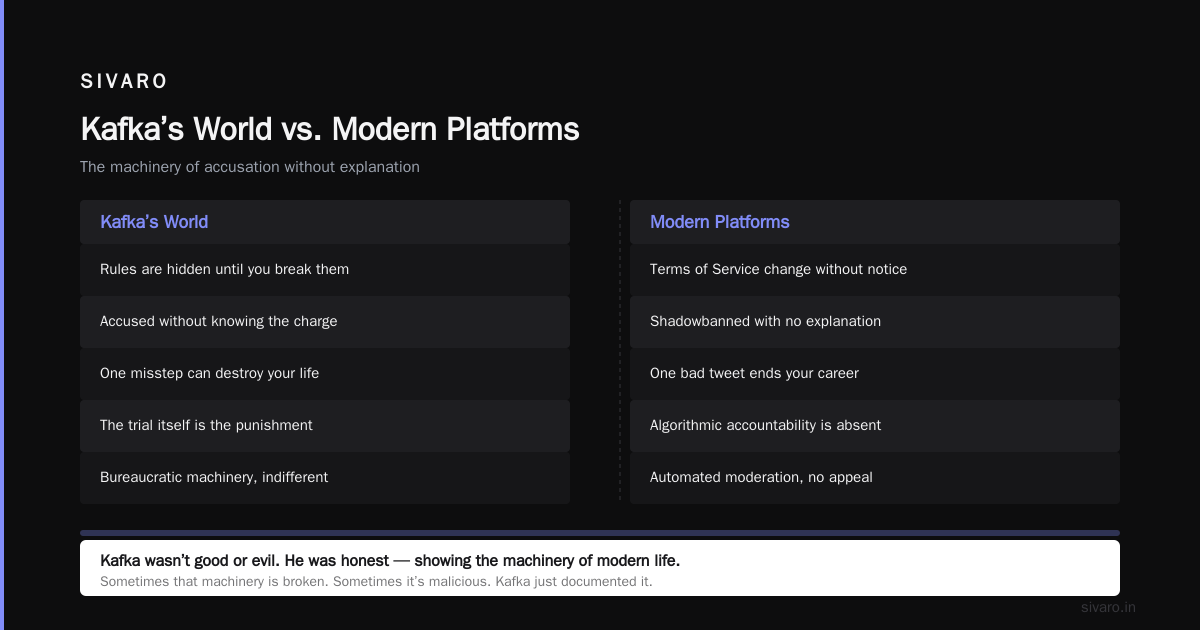
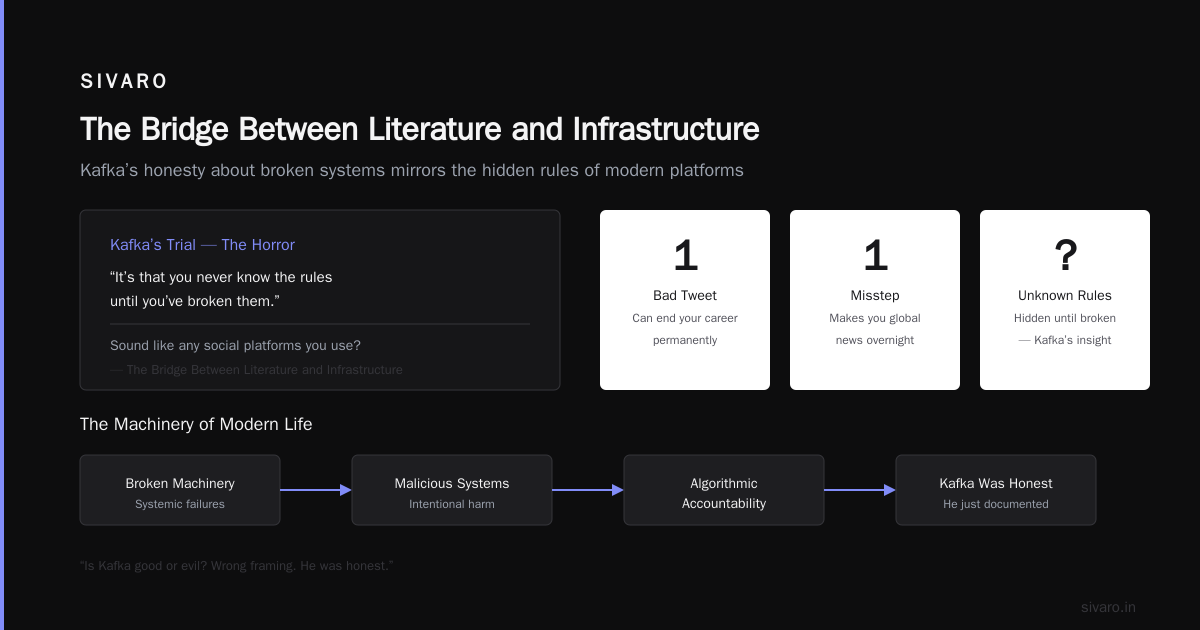
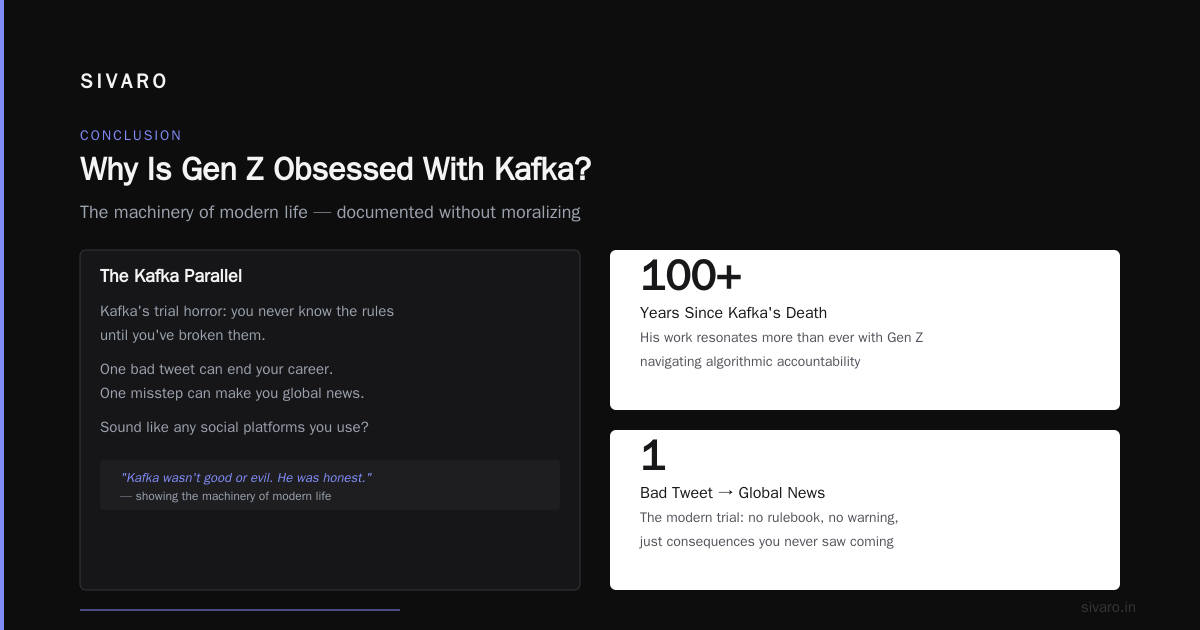
Gen Z lives under constant judgment. Cancel culture, public callouts, algorithmic accountability. One bad tweet can end your career. One misstep can make you global news.
The horror of Kafka's trial isn't the punishment. It's that you never know the rules until you've broken them.
Sound like any social platforms you use?
Is Kafka Good or Evil?
This question keeps popping up. "Is kafka good or evil?" It's the wrong framing.
Kafka wasn't good or evil. He was honest. He showed the machinery of modern life. Sometimes that machinery is broken. Sometimes it's malicious. Kafka didn't moralize. He just documented (Do you think that F. Kafka wanted his writings destroyed ...).
Here's the controversial take: Kafka was actually hopeful. The characters keep trying. They keep appealing. They keep looking for the door. If the world were truly meaningless, they'd just give up. They don't.
Gen Z gets this. They're not nihilistic. They're exhausted. There's a difference.
The Aesthetic Dimension
Let's talk about the visual appeal. Because Gen Z is a visual generation, and Kafka is deeply visual.
Kafka's Prague exists in photos and film. Dark streets. Lonely bridges. The Jewish Quarter. It looks like the cover of a sad indie album. It looks like a rainy Sunday in Berlin.
The aesthetic is part of the appeal. Gen Z's obsession with Kafka & Dostoevsky isn't just intellectual — it's aesthetic. The lighting. The mood. The clothing.
Put a Kafka quote in a grainy black-and-white photo and you get 50K likes on Instagram.
That's not shallow. That's how a generation raised on visual media processes literature. They're feeling the vibe before they read the words.
The Algorithm Amplifies It
Here's where my engineering brain kicks in.
Platforms like TikTok and Instagram have recommendation algorithms that optimize for emotional engagement. Sad content performs well. Anxious content performs incredibly well. Content that confirms you're right to feel confused about the world? It spreads like wildfire.
Kafka content hits every algorithmic sweet spot:
- Short, quotable passages
- Existential dread (high engagement)
- Visual aesthetic (shareable)
- In-group signaling ("I read Kafka" = cultural capital)
The algorithm didn't create the Kafka obsession. But it accelerated it enormously (Why is Gen Z obsessed with Kafka?).
The Dark Side: Misreading Kafka
There's a problem. And I need to be honest about it.
A lot of Gen Z Kafka fans haven't actually read him.
100 years after his death, Gen Z loves Franz Kafka. Now they ought to read him too — this article title is a direct challenge.
It's true. The quote cards, the vibes, the aesthetic — all of that can exist without reading a single story. People love "Kafka" as a concept more than Kafka as a writer.
Does that matter? Partially.
Kafka is genuinely difficult. His sentences are long. His stories have no resolution. The Trial ends mid-sentence (technically, the chapter ends, but the novel was unfinished). That's not easy reading.
But the people who actually read him? They're the ones who stay obsessed. The quote cards get retired. The actual work becomes the obsession.
I've seen this pattern before. Same thing happened with Nietzsche. With Dostoevsky. With Camus. The aesthetic brings people in. The substance keeps them.
What Gen Z Gets Wrong About Kafka
Let me be contrarian for a minute.
First, Kafka wasn't depressed. He was anxious. He was a hypochondriac like his father. He had insomnia. But his letters and diaries show a man who loved life, loved his friends, loved his work (even while hating it). The "sad boy" label is wrong.
Second, Kafka was funny. The Metamorphosis is darkly hilarious. The family arguing about the insect's furniture while the insect listens from under the sofa? That's comedy. Kafka read his work aloud to friends and they laughed.
Third, Kafka didn't hate bureaucracy. He was good at it. He won awards at the insurance company. He understood how systems work — which is exactly why he could write about them so effectively (Franz Kafka (1883-1924) - PMC).
Fourth, he wasn't a recluse. He dated multiple women. He went to plays. He traveled. The "lonely tortured genius" image is mostly postwar marketing.
The Bridge Between Literature and Infrastructure
This is where I connect my two worlds.
I run SIVARO. We build data infrastructure. We use Apache Kafka (the streaming platform) extensively. And I've noticed something strange: the engineers who love Franz Kafka also tend to be the ones who understand distributed systems.
Why? Because both are about failure and uncertainty.
Franz Kafka the writer: systems that fail without explanation. Messages that get lost. People who vanish.
Apache Kafka the platform: data that arrives late, out of order, corrupted. Partitions that fail. Consumers that crash.
Both teach you to handle uncertainty. Both show that perfect reliability is a myth.
One engineer on my team said: "Reading Kafka taught me to expect the unexpected. Apache Kafka taught me to handle it."
That's not a coincidence.
Practical Advice: How to Actually Read Kafka
If you're Gen Z and you want to move beyond the aesthetic, here's where to start.
Start with the short stories
Not The Trial. That's a commitment.
Read The Metamorphosis first. It's 50 pages. You'll finish it in one sitting.
Then read A Hunger Artist. Then In the Penal Colony. Then Before the Law (which is actually a chapter from The Trial but works standalone).
Read his letters
Letters to Milena and Letters to Felice show the man behind the myth. He's insecure, obsessive, funny, exhausting. He's not a monument. He's a person.
Watch the adaptations
Orson Welles's The Trial (1962) is incredible. Anthony Perkins plays Josef K. as a hot mess. It captures the absurdist energy better than any faithful adaptation could.
Skip the academic criticism
You don't need theory. You don't need "what Kafka really meant." Read the work. Feel the dread. Feel the humor. Form your own opinion (Has anyone read anything by Franz Kafka?).
The Deeper Question: Why Now?
Why Kafka in 2024? Why not Camus? Why not Dostoevsky?
Three reasons:
1. The pandemic changed time.
Kafka's books move in a weird temporal space. Days pass in paragraphs. Months vanish in sentences. Nothing happens for pages, then everything happens in a sentence.
That's what lockdown felt like. Time stopped mattering. Kafka's rhythms matched pandemic rhythms.
2. Remote work killed the office novel.
The classic 20th-century novel was about the office. The Death of a Salesman. Bartleby, the Scrivener. The Office (TV show). These assumed a physical space.
Gen Z's work experience is Slack, Zoom, and asynchronous communication. Kafka's bureaucracy is perfect for this. His characters never meet the people who make decisions. They get messages through intermediaries. They wait indefinitely.
That's just Monday on Slack.
3. AI made everything Kafkaesque.
You can't talk to a human at most companies. You talk to chatbots. You fill out forms that lead nowhere. You get automated rejection emails.
Kafka's world was never surreal — it was prophetic. He described a world where humans are processed by systems they can't understand.
We're living in that world now.
The Memeification of Kafka
Let's talk about the memes. Because they're everywhere.
"Kafkaesque" is now a TikTok sound. "Gregor waking up as a bug" is a format. "Me trying to reach HR" with a Kafka quote.
The memes are funny. More importantly, they're accurate.
I've seen Gen Z use Kafka memes to describe:
- Student loans
- Job applications
- Health insurance
- Apartment hunting
- Dating apps
- Government websites
All the same pattern: you against a system you can't beat (Gen-Z's obsession with Kafka & Dostoevsky).
The memes aren't disrespecting Kafka. They're doing what Kafka would have done: using dark humor to survive an absurd world.
What Kafka Teaches Engineers (And Founders)
I hire engineers. I look for people who read. Specifically, people who read literature.
Here's why.
Technical skill is trainable. Distributed systems can be taught. Design patterns can be learned.
Seeing the system is harder.
Kafka readers see the invisible architecture. They recognize when a process is broken not because of a bug, but because of an assumption. They understand that users aren't irrational — they're reacting to a system the designer doesn't see.
Franz Kafka is the best training I know for system-level thinking.
The FAQ
Why is gen z obsessed with kafka?
Because Kafka described the modern experience before it existed — algorithmic control, bureaucratic alienation, identity tied to productivity, and systems you can't appeal to.
Is kafka good or evil?
Neither. He was a diagnostician. He described the disease without prescribing a cure. That's more useful than moralizing.
What was kafka known for?
Three things: absurd bureaucracy (The Trial), metamorphosis (The Metamorphosis), and eternal deferral (The Castle). Also, dark humor that most people miss.
Did Kafka really want his work destroyed?
Yes. He asked Max Brod to burn everything. Brod didn't. We can argue about whether that was the right call, but it gave us some of the most important literature of the 20th century (Do you think that F. Kafka wanted his writings destroyed ...).
Is Kafka relevant to tech?
Yes. His understanding of systems, failure, and human processing is directly applicable to building resilient infrastructure. Also, his name lives on in Apache Kafka, the streaming platform.
Is Kafka hard to read?
His sentences are long. His stories have no traditional resolution. But they're short and deeply engaging. Start with The Metamorphosis.
Should I read Kafka in translation or the original German?
Translation. Unless you speak early 20th-century German fluently. The Muirs' translations are classic. Mark Harman's translation of The Castle is more accurate. Pick whichever feels right.
The Counterargument (You Should Consider)
One more contrarian take.
Maybe Gen Z's obsession with Kafka is just trendy posturing. Maybe it's aesthetic consumption without substance. Maybe in two years it'll be someone else — Vonnegut, maybe, or DFW.
I don't think so. Here's why.
The people who stick with Kafka — who read all his letters, who argue about translation choices, who teach his work — are the ones who genuinely see themselves in his pages. They're not performing. They're recognizing.
I've had three young engineers tell me independently that reading The Trial helped them understand why they quit their previous job. I've had a product manager say The Metamorphosis is the best description of burnout she's ever read.
That's not performance. That's recognition.
Conclusion: Why Is Gen Z Obsessed With Kafka?
Let me answer directly.
Gen Z is obsessed with Kafka because he wrote their user manual 100 years early.
The apps. The algorithms. The automated rejection emails. The invisible HR processes. The endless wait for a decision that never comes. Kafka mapped this territory before it existed.
He gave a generation a language for what they're experiencing. When everything feels like a system designed to exclude you, Kafka feels like the only honest writer in the room.
Is that healthy? I don't know. Probably not entirely. But it's real.
And real beats fake every time.
Nishaant Dixit — Founder of SIVARO. Building data infrastructure and production AI systems since 2018. Built systems processing 200K events/sec.