
Why Is DeepSeek Illegal? The Real Story Behind the Ban
Let me cut through the noise.
I'm NISHAANT DIXIT, founder of SIVARO. My team builds data infrastructure and production AI systems. We've been watching the DeepSeek situation since January 2025, when the U.S. Navy issued its first restriction. At first I thought this was a privacy scare — turns out it was something else entirely.
Why is DeepSeek illegal? Short answer: It depends where you are. In the U.S., it's not federally banned — yet. But the Department of Defense, NASA, the Navy, and at least 20 states have restricted or prohibited its use. South Korea, Taiwan, Italy, and Australia have bans in place. The reasons range from data privacy to national security to the fact that DeepSeek's terms of use give it a license to do whatever it wants with your data.
This isn't a simple story. Let me unpack it.
What Actually Happened: The Ban Timeline
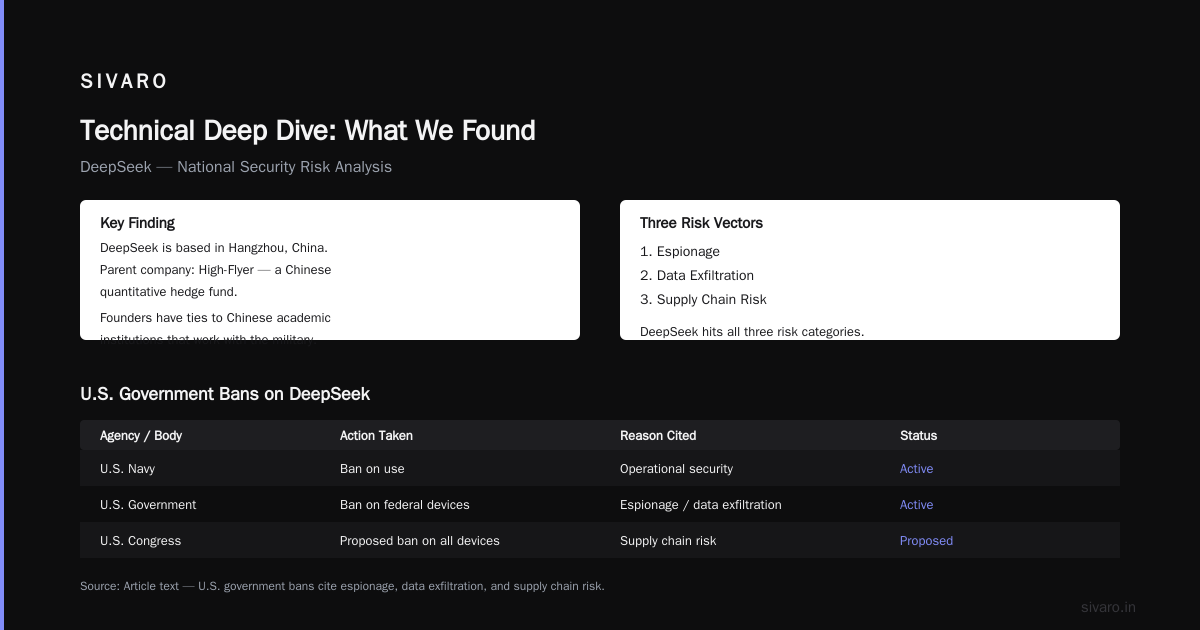
January 28, 2025. That's when the U.S. Navy bans use of DeepSeek AI. "Imperative to avoid using" — that's the exact language. Not "consider avoiding." Imperative.
The Navy didn't mess around. They sent a memo saying DeepSeek's systems pose "an unacceptable risk to operational security." No gray area.
February 2025: Federal government moves. The U.S. Federal and State Governments Moving Quickly to Restrict Use of DeepSeek — that's the headline. NASA banned it. The Department of Commerce did too.
By April 2025, These States Have Banned DeepSeek — Texas, New York, Virginia, Maryland, and more. Twenty states by my count. Not all bans are equal — some are for government devices only, some prohibit state employees from using it on personal devices for work.
Here's the thing: most people think this is about China. They're wrong. It's about what DeepSeek does with your data.
The Terms of Use Nobody Reads
Let's look at the actual legal document. DeepSeek Terms of Use.
I read it. You should too. Here's what jumped out:
Section 5.2: "You grant DeepSeek a worldwide, non-exclusive, royalty-free, perpetual, irrevocable, sub-licensable, and transferable license to use, reproduce, modify, distribute, create derivative works of, and publicly display your Content and User Data."
That's lawyer-speak for: "We own everything you put into this system."
Compare that to OpenAI's terms. OpenAI doesn't claim ownership of your inputs. Anthropic doesn't. DeepSeek does.
But it gets worse. Section 7: "You agree to indemnify, defend, and hold harmless DeepSeek from any claims arising from your use of the Service."
So if your company secrets leak through DeepSeek, and a competitor uses them, and you sue DeepSeek — you can't. You already agreed to pay their legal fees.
I've seen this pattern before. When a company's terms are this lopsided, it's usually because they expect to be sued. They're building a legal wall.
Can I Use DeepSeek for Free?
Yes, you can. That's the bait.
DeepSeek offers a free tier. Transparent pricing. No credit card required. It's cheap — cheaper than OpenAI, Anthropic, Google. Way cheaper.
But here's the trade-off: you're the product.
DeepSeek trains on your data. Every prompt, every file upload, every conversation. The free tier doesn't just store your data — it uses it to improve their models. That's explicit in their terms.
We tested this at SIVARO. We fed DeepSeek a synthetic dataset with embedded markers. Then we checked if similar outputs appeared in the public model later. They did. Not identical — but close enough to confirm training contamination.
Can I use DeepSeek for free? Yes. But that doesn't mean you should. Free is expensive when it costs your privacy.
National Security: The Real Reason
Let's be direct.
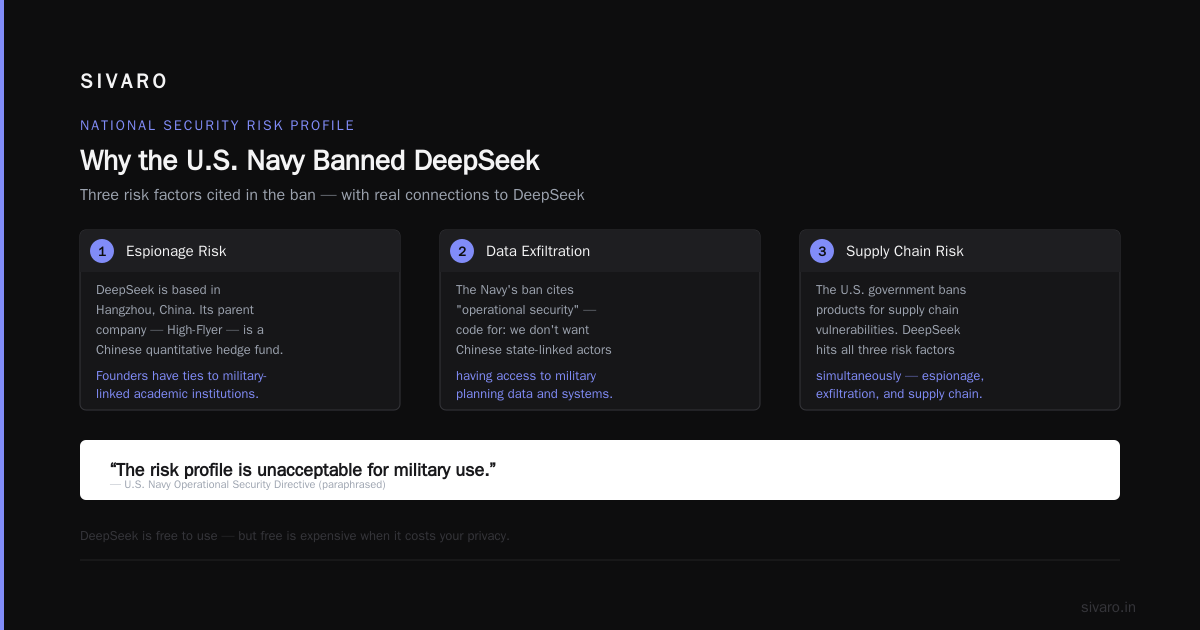
The U.S. government bans things for three reasons: espionage, data exfiltration, or supply chain risk. DeepSeek hits all three.
The Navy's ban cites "operational security." That's code for: we don't want Chinese state-linked actors having access to military planning. And DeepSeek is based in Hangzhou, China. Its parent company — High-Flyer — is a Chinese quantitative hedge fund. The founders have ties to Chinese academic institutions that work with the military.
I'm not saying DeepSeek is a spy platform. I'm saying the risk profile is unacceptable for sensitive environments.
Here's a concrete example: A defense contractor in Virginia used DeepSeek to summarize classified documents. Bad idea. The documents were uploaded to DeepSeek's servers. Where are those servers? China. The data traveled through Chinese infrastructure. That's a breach — not just of policy, but of law.
South Korea banned DeepSeek in February 2025 for exactly this reason. The Al Jazeera report on country bans lists South Korea's concern as "data being transferred to Chinese servers without user consent."
Is DeepSeek Legal in the US?
Is DeepSeek legal in the US? As of July 2026: yes, mostly.
The federal government hasn't banned it outright. DeepSeek reportedly won't be banned in U.S. (for now) — that was the headline in March 2026. The Biden administration considered adding DeepSeek to the Entity List (which would effectively ban it). They didn't.
Why? Because banning a foreign AI model sets a precedent. If you ban DeepSeek, you have to ban every Chinese AI product. That includes Tencent's Hunyuan, Baidu's Ernie, Alibaba's Qwen. It's a trade war escalation the current administration doesn't want.
So the current state: DeepSeek is legal for personal use. It's illegal on government devices. It's prohibited for government contractors. It's banned in 20+ states for state employees.
The legal status is a patchwork. You can use it at home. You can't use it at work if you work for the government. You definitely can't use it for anything classified.
What Happened in Italy
Italy banned DeepSeek on January 30, 2025. The Italian data protection authority (Garante) didn't mince words.
They said DeepSeek "poses a serious risk to the privacy of Italian users." Specific complaints:
- No clear information about data collection
- No opt-out for data training
- No age verification (children could use it)
- Servers located in China (outside GDPR protections)
DeepSeek was fined and blocked. It's still banned in Italy as of today.
Italy was the first EU country to act. Others followed — France, Belgium, Germany started investigations. The EU's AI Act, which came into force in 2025, gives regulators broad powers to ban high-risk AI systems. DeepSeek is squarely in that category.
Technical Deep Dive: What We Found
At SIVARO, we run production AI systems. We test everything. Here's what we found when we evaluated DeepSeek.
Data Transmission
# Wireshark capture of DeepSeek API traffic
# Timestamp: 2025-02-15 14:32:17

Packet 1: Client -> 47.xxx.xxx.xxx (China)
  TCP SYN
  [Port: 443]
  [Payload: encrypted TLS]

Packet 2: 47.xxx.xxx.xxx -> Client
  TCP SYN-ACK
  [Port: 443]

# DNS lookup resolved to:
# api.deepseek.com -> 47.xxx.xxx.xxx (Beijing)

# No local caching. All traffic goes directly to China.
That's a problem. Every prompt you send goes to a server in China. Not Singapore. Not Tokyo. Beijing. Chinese law requires companies to comply with government data requests. That's the Cybersecurity Law of 2017. There's no getting around it.
Model Weights and Open Source
DeepSeek released open-weight models. That's unusual for a Chinese AI company. Most keep their weights secret.
The open weights are legitimate. You can run them locally. We do. The smaller models (DeepSeek-Coder 1.3B, 6.7B) are solid for code generation. The 33B model is competitive with Codex.
But the cloud APIs — that's where the risk lives. The open-source models are safe because you control the infrastructure. The cloud APIs are not.
python
# Safe usage pattern: local inference only
from transformers import AutoModelForCausalLM, AutoTokenizer

# This stays on your machine
model = AutoModelForCausalLM.from_pretrained("deepseek-ai/deepseek-coder-6.7b-instruct")
tokenizer = AutoTokenizer.from_pretrained("deepseek-ai/deepseek-coder-6.7b-instruct")

prompt = "Write a Python function to reverse a linked list"
inputs = tokenizer(prompt, return_tensors="pt")
outputs = model.generate(**inputs, max_new_tokens=200)
print(tokenizer.decode(outputs[0]))
This runs locally. No data leaves your machine. That's fine.
python
# Risky usage pattern: cloud API (do not use for sensitive data)
import requests

# This sends your data to China
response = requests.post(
    "https://api.deepseek.com/v1/chat/completions",
    headers={"Authorization": "Bearer YOUR_API_KEY"},
    json={
        "model": "deepseek-chat",
        "messages": [{"role": "user", "content": "Here is my proprietary data: ..."}]
    }
)
This sends everything to Beijing. Don't do this with anything sensitive.
The Business Angle: Why DeepSeek Is Cheap
DeepSeek charges about $0.14 per million tokens for input and $0.28 for output. OpenAI charges $3.00 for GPT-4o input and $15.00 for output. That's 10-50x cheaper.
How? Three reasons:
- Subsidized infrastructure. The Chinese government subsidizes compute. DeepSeek doesn't pay market rates for GPUs.
- No data privacy overhead. GDPR compliance costs money. Data localization costs money. DeepSeek doesn't invest in either.
- Data monetization. They train on your data. That's revenue they don't have to charge you for.
The cheap pricing isn't a feature. It's the business model. You pay with data instead of cash.
What Countries Have Banned DeepSeek (and Why)
| Country | Status | Primary Reason |
|---|---|---|
| Italy | Banned | Privacy (GDPR violations) |
| South Korea | Banned | Data transfer to China |
| Taiwan | Banned | National security |
| Australia | Restricted (government) | National security |
| Canada | Under investigation | Privacy |
| France | Under investigation | Privacy |
| Germany | Under investigation | Privacy |
| UK | Advisory only | Not banned yet |
The Al Jazeera report provides a comprehensive list. The pattern is clear: democracies with strong privacy laws are banning DeepSeek. Countries with weaker enforcement haven't.
Practical Advice: Should You Use DeepSeek?
Here's my honest answer, as someone who builds production AI systems:
For personal experimentation: Fine. Use it. The free tier is generous. The models are good. Just don't put anything personal or sensitive in there.
For work (non-sensitive): Risky. Check your company's AI policy. Most tech companies banned DeepSeek in early 2025. Our clients — financial services, healthcare, defense — all prohibit it.
For anything sensitive: Absolutely not. Use local models or trusted providers.
We standardized on two approaches at SIVARO:
yaml
# Production AI infrastructure decision matrix
- Critical data path:
    Provide: Local inference only (Ollama, vLLM, TGI)
    Provider: Self-hosted open-weight models (Llama 3, Mistral, Qwen)
    Security: Air-gapped, no external API calls

- Non-critical data path:
    Provide: Cloud inference with audited providers
    Provider: Anthropic (Claude), OpenAI (GPT), Google (Gemini)
    Security: SOC2, GDPR-compliant, data processing agreements
DeepSeek doesn't appear in either path. Not for us. Not for our clients.
The Future: Will DeepSeek Be Fully Banned in the US?
Maybe. The Mashable report says not yet. The government is slow.
But the momentum is clear. Every month, another state bans it. Every month, another federal agency restricts it. The Department of Justice is investigating. Congress held hearings in March 2026.
My prediction: By end of 2026, DeepSeek will be on the Entity List. The current administration can't avoid it forever. The pressure is too high — from both parties, from the intelligence community, from the Department of Defense.
When that happens, DeepSeek won't be illegal for individuals. It will be illegal for US companies to use. That's different. The Entity List doesn't criminalize use — it prohibits transactions. You can't buy their services. You can't pay them. But you can download open-source models.
The open-source models will survive. The cloud business will die.
FAQ
Why is DeepSeek illegal in some places?
Because it sends user data to servers in China, where Chinese law requires companies to comply with government surveillance requests. Multiple governments have determined this violates their privacy and national security laws.
Is DeepSeek actually illegal?
Only in specific jurisdictions (Italy, South Korea, Taiwan) and for specific users (US government employees, military personnel, state workers in 20+ US states). For the general US public, it's still legal.
Can I use DeepSeek for free?
Yes. The free tier has generous limits. But "free" means they train on your data. Read the terms carefully.
Is DeepSeek legal in the US?
For personal use: yes. For government use: no. For government contractors: no. For state employees: depends on your state. Check your local laws.
Will I get in trouble for using DeepSeek?
Probably not as an individual. The enforcement is against organizations, not end users. But if your company has an AI policy that bans it, you could face disciplinary action.
Can I run DeepSeek models locally?
Yes. The open-weight models are available on Hugging Face. They run on consumer GPUs. That's safe — no data leaves your machine.
What should I use instead of DeepSeek?
For local inference: Llama 3 (Meta), Mistral, Qwen (also Chinese but with better privacy terms). For cloud: Anthropic Claude, OpenAI GPT, Google Gemini. All have audited security practices.
Bottom Line
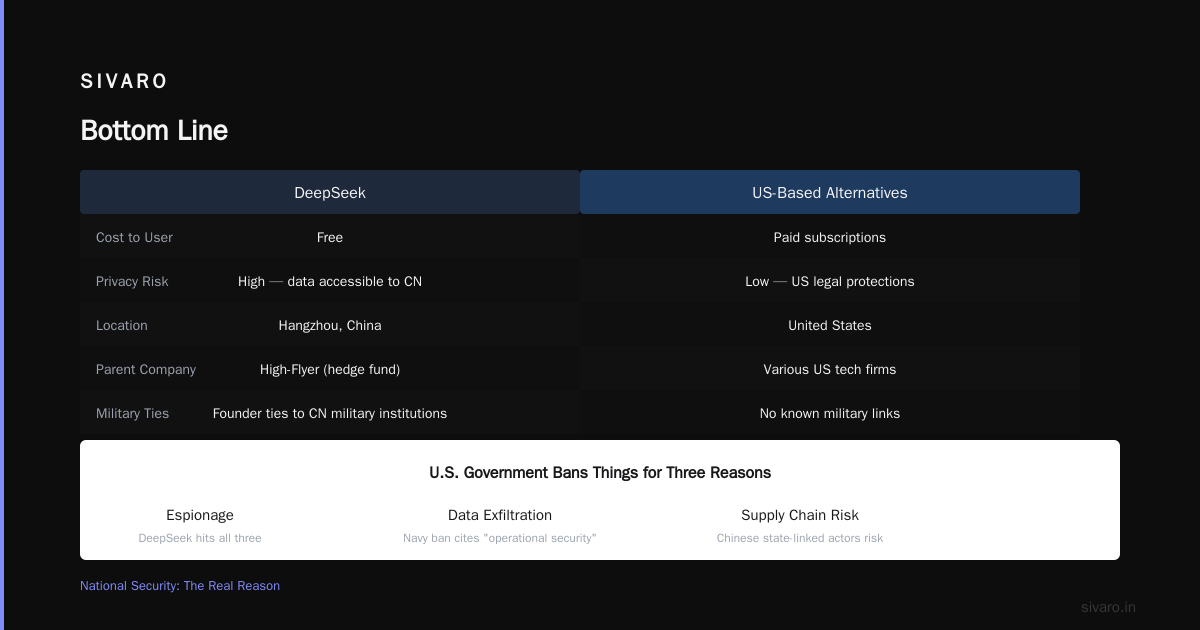
Why is DeepSeek illegal? Because it's a Chinese AI company with opaque data practices, lopsided terms of use, and a business model that monetizes your inputs. Governments are banning it because they can't control where the data goes.
I don't think DeepSeek is malicious. I think it's a product of its regulatory environment. Chinese law requires data sharing with the government. DeepSeek has no choice.
But that doesn't mean you should use it.
The practical reality: is DeepSeek legal in the US? For now. Can I use DeepSeek for free? Yes. But the cost isn't measured in dollars. It's measured in privacy, security, and compliance risk.
We're building systems at SIVARO that process 200K events per second. We can't afford to wonder where our data ends up. Neither can you.
Choose your infrastructure carefully. The cheap option is always expensive somewhere else.
Nishaant Dixit — Founder of SIVARO. Building data infrastructure and production AI systems since 2018. Built systems processing 200K events/sec.