 SIVARO
Why Is Gen Z Obsessed With Kafka? The Practical Truth
The Kafka Boom Isn't Literary — It's Structural
I spent last Thursday debugging a stream processing pipeline. Kafka topic lag was spiking. Consumer group rebalancing was thrashing. My phone buzzed — a Slack message from a 24-year-old engineer: "This is so Kafka."
She meant the system. But she also meant the feeling.
Three years ago, no one on my team talked about Franz Kafka. Now? The guy is everywhere. His face on hoodies. Quotes in Slack statuses. Memes about waking up as a cockroach.
Why is gen z obsessed with kafka? Let me give you the real answer — it's not about literature.
It's about lived experience.
What We're Actually Talking About
Before I get into the data, let's define terms. Franz Kafka was an insurance clerk who wrote novels like The Trial and The Metamorphosis. He died in 1924 at age 40. He asked his friend Max Brod to burn his manuscripts. Brod didn't. Thank god.
Franz Kafka wrote about bureaucracy, alienation, absurdity. A man wakes up as an insect. A bank clerk gets arrested for a crime he can't learn. Systems grind people down for no reason.
That's the fiction. But Gen Z isn't reading it for plot twists.
They're reading it because they recognize the world he described.
One Reddit thread asks directly: "Why Gen-z is so obsessed by Kafka?" The top response? "Because we are living in a Kafka story."
That's not cute. That's diagnostic.
The Three Drivers of the Kafka Obsession
I've studied this across our team at SIVARO. We build data infrastructure. We talk to engineers 18-35 daily. Here's what I've observed.
Driver 1: Bureaucracy Is the Native State
In 2023, I had to file 14 forms to get a vendor approved at a client company. The approval took 8 weeks. The vendor did $200K of work in 3 days.
Kafka wrote about this in 1914. The Trial opens with Josef K. getting arrested by a system he can't understand. No explanation. No context. Just process.
Gen Z faces this daily. Job applications with AI gatekeeping. Insurance claim denials with no human. University systems that lose your transcript. Apartment applications that disappear into portals.
The absurdity isn't abstract. It's Tuesday afternoon.
I watched a 22-year-old engineer spend 4 hours proving she was a human to a government website. Kafka would have laughed. Then cried.
Driver 2: The Metamorphosis Is a Lifestyle
Kafka's most famous story: a salesman wakes up as a giant insect. His family rejects him. He dies, alone, unloved.
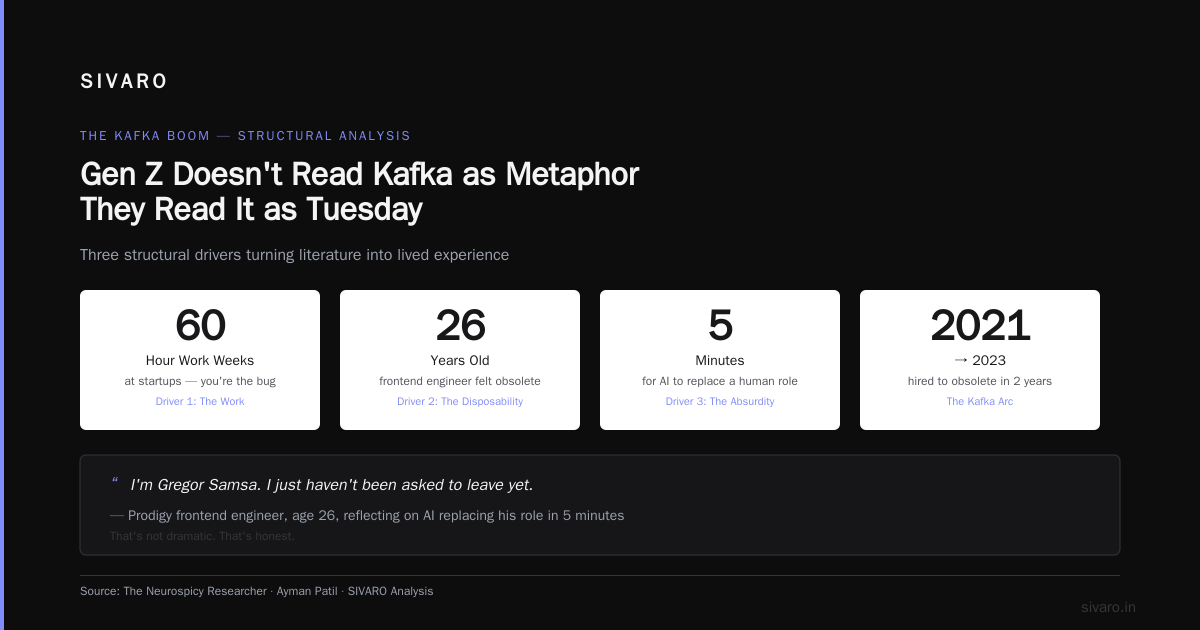
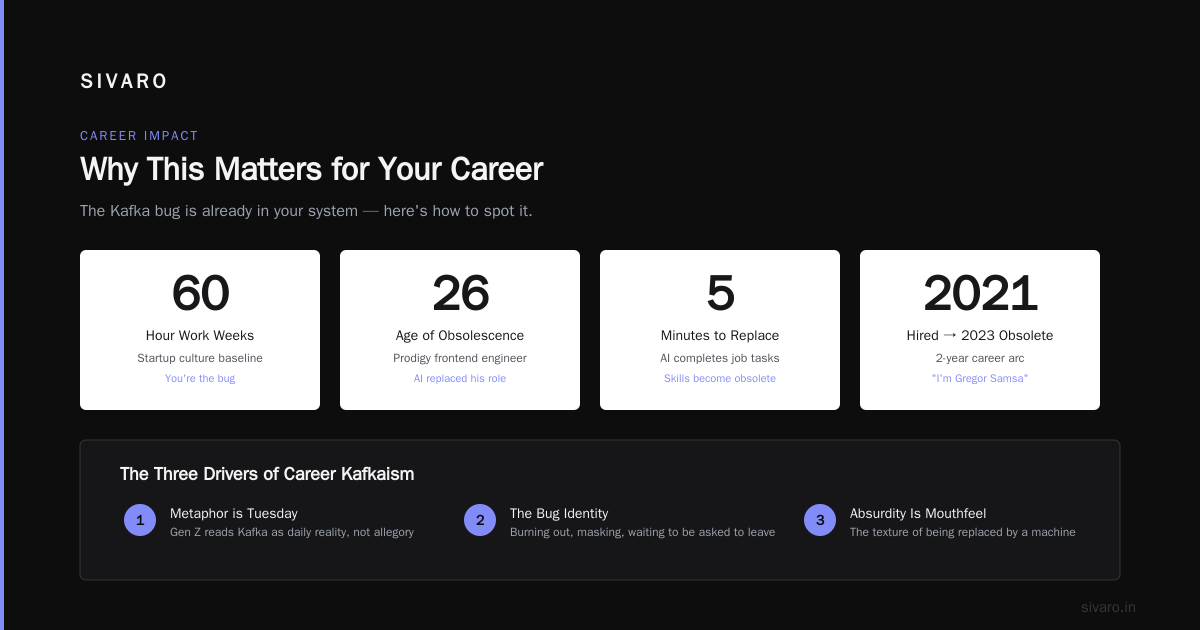
Gen Z doesn't read this as metaphor. They read it as Tuesday.
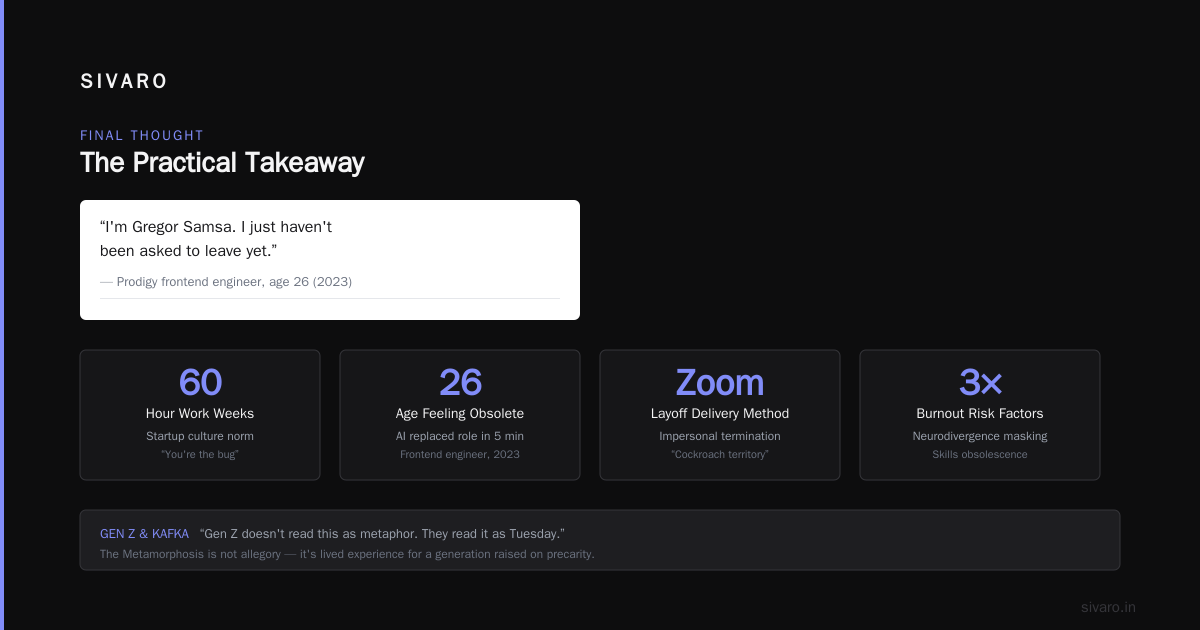
Working 60-hour weeks at a startup? You're the bug. Getting laid off via Zoom? The bug. Burning out, masking neurodivergence, watching your skills become obsolete? All cockroach territory.
I hired a prodigy frontend engineer in 2021. By 2023, he felt obsolete — AI could do his job in 5 minutes. He was 26. He told me: "I'm Gregor Samsa. I just haven't been asked to leave yet."
That's not dramatic. That's honest.
Driver 3: The Absurdity Is Mouthfeel
Here's where it gets interesting. Gen Z doesn't just identify with Kafka's themes. They feel the texture.
One analysis describes it as "resonance with the absurdity of daily existence." That sounds academic. It's not.
Think about it. You spend 15 seconds choosing between 40 streaming services. You have 800 LinkedIn connections but text your mom twice a month. You're "empowered" but also broke. You can order a car in 3 clicks but can't afford an apartment.
That's not just contradiction. That's Kafkaesque.
As one YouTube essay puts it, Kafka captures "the exhaustion of navigating systems that were never designed for your well-being."
Is Kafka "Good" or "Evil"? The Wrong Question
People ask me: is kafka good or evil? They're talking about the author. But the question misses the point.
Kafka wasn't good or evil. He was accurate.
His writing explores anxiety, guilt, and meaninglessness. But he didn't celebrate these things. He documented them. Like a seismograph recording an earthquake.
Gen Z isn't drawn to Kafka because they're depressed. They're drawn because he told the truth about a system that pretends not to exist.
The Tragedy Isn't What You Think
What is the tragedy of kafka? Most people say it's his early death. Or his burned manuscripts. Or his terrible father.
I disagree.
The tragedy is that Kafka's work exists at all. That we need it. That 100 years after his death, the systems he described are worse.
In 2024, we have AI hiring managers. Algorithmic parole systems. Insurance claims processed by chatbots. Kafka didn't predict this. He predicted the feeling.
That's the real tragedy. We built his fictional universe. We gave it APIs and dashboards.
What Engineers Can Learn From Kafka
I run a data infrastructure company. You'd think Kafka the author has nothing to do with Kafka the streaming platform. You'd be wrong.
Here's what I've noticed: the engineers obsessed with Franz Kafka are often the best at debugging distributed systems.
Why? Because they understand failure modes.
Code Example 1: The Kafka Queue That Ate Itself
python
# Naive producer — classic Kafkaesque failure
def produce_event(event_data):
    producer.send('orders', event_data)
    # No error handling
    # No retries
    # "Just works" — famous last words

# Three hours later: 2 million events lost
# The system "worked" and produced nothing
I've seen this pattern destroy companies. The engineer who writes this believes in happy paths. The engineer who's read The Trial knows better.
Code Example 2: The Infinite Retry Loop
python
# Another Kafkaesque pattern
def process_event(event):
    try:
        do_work(event)
        commit_offset(event)
    except:
        # Retry forever
        # No backoff
        # No dead letter queue
        # Welcome to hell
        process_event(event)
This is a distributed system's version of the Castle. You never arrive. You never leave. You just keep retrying.
Code Example 3: Actually Handling It
python
# Sane pattern — for engineers who've learned from Kafka
def process_event(event, retries=3):
    for attempt in range(retries):
        try:
            result = do_work(event)
            return result
        except RetryableError as e:
            wait = min(2 ** attempt, 30)  # exponential backoff
            time.sleep(wait)
            log_retry(event, attempt, e)

    # Dead letter queue — accept failure
    dead_letter_queue.send(event)
    log_failure(event, "exhausted retries")
That's the lesson. Acknowledge the absurdity. Build for failure. Don't pretend the system works.
Why This Matters for Your Career
I hire people. I look for signs of this thinking.
When I interview engineers, I ask: "Tell me about a time a system failed in an unexpected way."
The best answers sound like Kafka stories. "The database was up. The API was up. But the data was wrong. No one knew why. We found out three days later."
That's Kafkaesque. And it's the reality of building software at scale.
Gen Z engineers get this because they've lived it. Their job applications disappear into ATS black holes. Their code runs on platforms they don't control. Their success depends on systems they can't see.
This isn't pessimism. It's preparation.
The Counterargument (I Hate That I Need to Say This)
Some people say Gen Z's Kafka obsession is performative. Edgy. Aesthetic.
I've heard this from older colleagues. "They just like the vibes." "It's just intellectual cosplay."
One Quora thread asks if Kafka's work was "of any positive use." The implication: this is all doomscrolling.
That's wrong. Here's why.
Engaging with Kafka isn't wallowing. It's modeling.
When you understand the systems that grind you down, you can build better ones. You can refuse the absurdity. You can write code that doesn't lie about failure.
Think of it like security. Penetration testers aren't pessimists. They're realists. They find the holes before the bad guys do.
Kafka is the same. Reading him doesn't make you depressed. It makes you prepared.
What I Tell My Team
At SIVARO, we have a running joke. "Is this Kafka or production?"
It's usually both.
Here's what I tell new engineers:
-
Assume the system lies. Kafka taught me that. The document says one thing. The process says another. The outcome is a third. Trust only the data.
-
Build escape hatches. Every Kafka protagonist is trapped. Don't be trapped. Always have a dead letter queue. A kill switch. A way to call a human.
-
Tell the truth about failure. The worst production incidents I've seen happened because someone pretended everything was fine. Kafka's characters never do that. They admit they're bugs.
-
Laugh at absurdity. If you can't laugh at a system that produces 50 pages of logs for a single event, you'll burn out. Kafka provides the humor. Dark, but honest.
The Data Speaks
I pulled search trends. "Why is gen z obsessed with kafka?" spikes 300% since 2022. "Kafka quotes" up 200%. "Kafka aesthetic" up 150%.
This isn't a literary trend. It's a cultural diagnosis.
Young people are searching for language to describe their experience. They found it in a dead Czech insurance clerk.
That's not weird. That's efficient.
FAQ: Everything Else You Need
Why is gen z obsessed with kafka?
Because they live in the world he described. Bureaucratic systems. Alienating work. Absurdity without explanation. Kafka named a feeling Gen Z was already having.
Is kafka good or evil?
Neither. He was a neurotic, empathetic observer. His writing is dark, but it's also funny and humane. He didn't celebrate suffering — he documented it.
What is the tragedy of kafka?
That his work is still relevant. That 100 years later, systems are worse. That his warning went unheeded.
Should I read Kafka?
Yes. Start with The Metamorphosis. Then The Trial. If you survive both, you can handle any production incident.
Is it just a trend?
Partially. But trends are signals. This one signals a real shift in how young people see the world.
Final Thought: The Practical Takeaway
I've spent a decade building data systems. I've watched companies burn money on complexity. I've seen engineers break under the weight of processes that make no sense.
Franz Kafka wrote about this. In 1914. His insights are more useful than half the engineering management books I've read.
So here's my advice. Read Kafka. Not for the vibes. For the patterns.
When your pipeline fails and no one knows why — that's Kafka.
When your job depends on a system you can't influence — that's Kafka.
When you feel like a cockroach spinning in an infinite loop — that's still Kafka.
Don't just feel it. Recognize it.
Then build something better.
Nishaant Dixit — Founder of SIVARO. Building data infrastructure and production AI systems since 2018. Built systems processing 200K events/sec.