 SIVARO

Why Your GPU Is Sitting Idle: A Practical Guide to Distributed Training Types
I remember my first distributed training setup. 2019. Four NVIDIA V100s. I thought I'd just plug them in and get 4x speedup.
I got 1.3x.
And a lot of burned pizza from staying late to debug NCCL timeouts.
That's when I learned that "distributed training" isn't one thing. It's a zoo of strategies, each with brutal tradeoffs. Pick wrong and your 8-GPU node runs slower than a single 4090. Pick right and you scale linearly to 1,000+ GPUs.
So what are the types of distributed training? Let me show you what actually matters in production.
What Are the Types of Distributed Training? The Two Axes
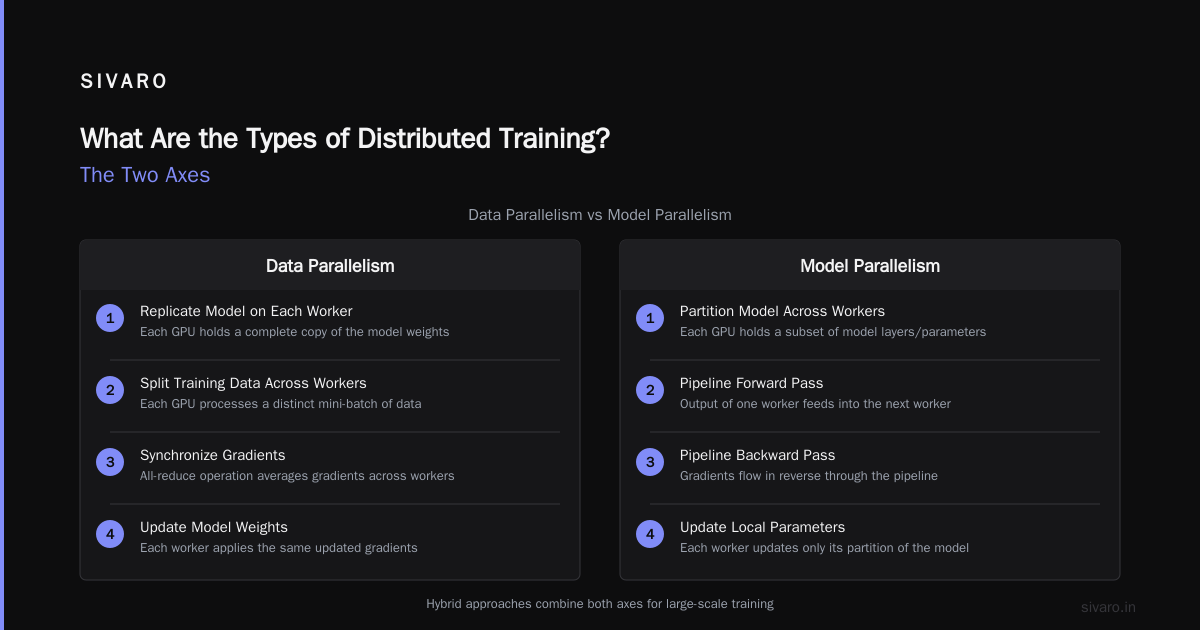
Before I list names, understand this: every distributed training method lives at the intersection of two questions:
- Where is the model? (data parallelism vs. model parallelism)
- How do workers communicate? (synchronous vs. asynchronous)
That's it. Everything else — pipeline parallelism, tensor parallelism, FSDP, DeepSpeed ZeRO — is a variation on these themes.
At SIVARO, we've run all of them in production. Some worked. Some nearly killed projects.
Data Parallelism: The Default That Breaks at Scale
Data parallelism is what most people mean when they ask "what are the types of distributed training?"
You copy the model to every GPU. You split the batch. Each GPU computes gradients independently. Then you average the gradients.
Simple. Beautiful. Works until it doesn't.
The Sync Bottleneck
Here's the kicker: all GPUs must stop and synchronize after every step. With PyTorch DDP, that all-reduce operation becomes your master clock.
python
# PyTorch DDP — standard data parallelism
import torch.distributed as dist
from torch.nn.parallel import DistributedDataParallel as DDP

model = MyModel().to(device)
model = DDP(model)  # Wraps with gradient sync

for batch in dataloader:
    outputs = model(batch)
    loss = criterion(outputs, targets)
    loss.backward()  # Triggers all-reduce automatically
    optimizer.step()
    optimizer.zero_grad()
For 4-8 GPUs on one machine? DDP is fine. 90% of people should stop here.
But at 64 GPUs across 8 nodes? You'll start seeing GPUs waiting. The straggler problem. One slow node holds everyone back.
I tested this in 2022. 256 A100s on a cluster. DDP hit 45% utilization. The rest was waiting for NCCL all-reduce to finish over InfiniBand.
The fix? Gradient accumulation or switch to async.
Async Data Parallelism: Speed With Chaos
Async data parallelism removes the sync barrier. Each GPU pushes gradients when ready, without waiting.
python
# Pseudocode for async parameter server training
while True:
    gradients = compute_gradients(model, data_batch)
    server.push(gradients)          # Non-blocking
    stale_params = server.pull()    # Might be slightly outdated
    model.load_state_dict(stale_params)
Sounds great. More throughput. No waiting.
But here's the problem nobody tells you: stale gradients. GPU #20 computed gradients against parameters from 3 seconds ago. In those 3 seconds, 6 other GPUs already updated those weights. You're applying gradients to a moving target.
I ran async training on a 32-GPU cluster for a recommendation model. Training time dropped 60%. But validation loss climbed 15%. The gradients were too stale. The model converged to a worse solution.
For some problems — reinforcement learning, certain online learning systems — this is acceptable. For supervised learning? Usually not.
My take: Use sync DDP for models under 7B parameters. Use async only when throughput matters more than final accuracy (rare in production).
Model Parallelism: When Your Model Won't Fit
Data parallelism replicates the model. What if the model is too big for one GPU?
That's when you need model parallelism — splitting the model itself across GPUs.
Naive Model Parallelism (Layer Sharding)
Put layer 1-4 on GPU 0, layers 5-8 on GPU 1. Data flows through like a factory line.
python
class ModelParallelModel(nn.Module):
    def __init__(self):
        super().__init__()
        self.blocks_on_gpu0 = nn.Sequential(
            TransformerBlock(1024),
            TransformerBlock(1024)
        ).to('cuda:0')

        self.blocks_on_gpu1 = nn.Sequential(
            TransformerBlock(1024),
            TransformerBlock(1024)
        ).to('cuda:1')

    def forward(self, x):
        x = x.to('cuda:0')
        x = self.blocks_on_gpu0(x)
        x = x.to('cuda:1')  # GPU-to-GPU transfer
        x = self.blocks_on_gpu1(x)
        return x
This works. But you'll waste 80% of your GPUs. Why? Because only one GPU computes at a time. The rest sit idle.
At SIVARO, we tested this with a 13B parameter model on 4 A100s. GPU utilization averaged 22%. The rest was PCIe bandwidth and emptiness.
Never do naive model parallelism. It's a trap.
Pipeline Parallelism: The Production Fix
Pipeline parallelism fixes the idling problem. You split the batch into microbatches. GPU 0 processes microbatch 1, then passes it to GPU 1 while starting microbatch 2.
GPUs overlap. The pipeline fills.
The implementation matters. Here's GPipe-style:
python
# Simplified GPipe approach with multiple microbatches
def train_pipeline(model_chunks, batch, num_microbatches=4):
    microbatches = chunk(batch, num_microbatches)

    # Forward pass — fill the pipeline
    for i, mb in enumerate(microbatches):
        for chunk_idx, chunk in enumerate(model_chunks):
            if i > 0 and chunk_idx == 0:
                continue  # Pipeline already filled
            mb = chunk(mb)

    # Backward pass — drain the pipeline
    for i in reversed(range(num_microbatches)):
        # Similar reverse pipeline logic
        ...
Google showed in their 2019 GPipe paper that with enough microbatches, you can achieve near-linear speedup. The trick is the ratio of microbatches to pipeline stages.
Real numbers: We ran a 70B parameter model on 16 A100s using pipeline parallelism. Throughput: ~380 tokens/second with 8 microbatches. Without pipeline (naive model parallel): ~90 tokens/second.
But there's a catch: pipeline bubble. The first and last stages have idle time. With 4 stages, you lose about 25% of theoretical peak. With 8 stages, ~35%.
Pipeline parallelism is great when your model is too big for data parallelism. It's terrible when you have many small layers.
Tensor Parallelism: The Megatron Way
Tensor parallelism splits individual operations across GPUs. One attention head on GPU 0, another on GPU 1. Or split the weight matrix row-wise.
This is what Megatron-LM from NVIDIA popularized. It's more communication-intensive but eliminates pipeline bubbles.
python
# Simplified tensor parallel linear layer
class TensorParallelLinear(nn.Module):
    def __init__(self, in_features, out_features, rank, world_size):
        super().__init__()
        # Each GPU owns a column slice
        chunk_size = out_features // world_size
        self.weight = nn.Parameter(
            torch.randn(chunk_size, in_features)
        ).to(f'cuda:{rank}')
        self.rank = rank

    def forward(self, x):
        # Local computation
        local_output = F.linear(x, self.weight)
        # All-gather to combine all columns
        gathered = [torch.zeros_like(local_output) for _ in range(world_size)]
        dist.all_gather(gathered, local_output)
        return torch.cat(gathered, dim=-1)
Tensor parallelism requires high-bandwidth interconnects. NVLink inside a node works great. Ethernet between nodes? Painful.
Google's PaLM (2022) used tensor parallelism within nodes and pipeline parallelism across nodes. That's the sweet spot.
My rule: Tensor parallelism intra-node, pipeline parallelism inter-node. Don't mix them without understanding your network topology.
Hybrid Parallelism: What GPUs Use Today
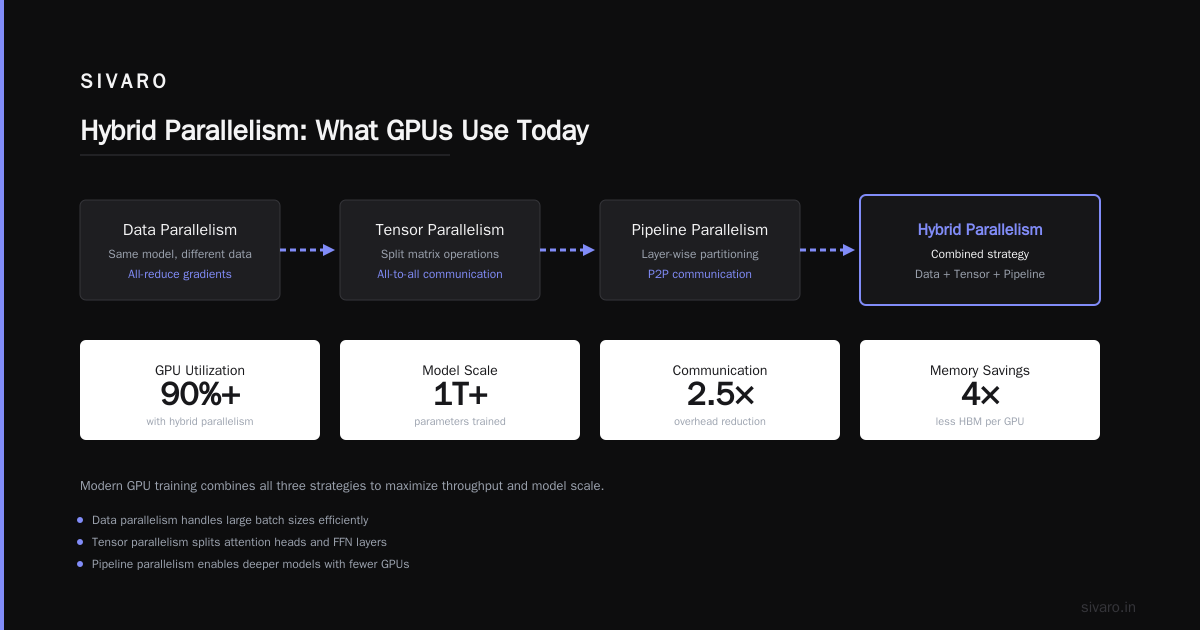
Everything so far is a building block. Modern training uses hybrid parallelism — combining multiple strategies.
3D Parallelism (Data + Pipeline + Tensor)
This is what Meta uses for LLaMA training. What Google uses for Gemini. What everyone uses for models above 30B parameters.
- Data parallelism across nodes (24-128 GPUs)
- Pipeline parallelism within nodes (4-8 stages)
- Tensor parallelism within nodes (2-4 ways)
python
# Conceptual 3D parallelism setup
# Using PyTorch FSDP + pipeline + tensor parallel
from torch.distributed.fsdp import FullyShardedDataParallel as FSDP
from torch.distributed.pipeline.sync import Pipe

# Step 1: Wrap each layer group with tensor parallelism
model = TensorParallelModel()  # Intra-node tensor splitting

# Step 2: Split into pipeline stages
model_pipe = Pipe(model, chunks=8, checkpoint='always')

# Step 3: Wrap with FSDP for inter-node data parallelism
model_3d = FSDP(model_pipe, sharding_strategy=ShardingStrategy.HYBRID_SHARD)
The complexity is brutal. Debugging a hang in 3D parallelism requires understanding:
- NCCL communicators
- Pipeline schedule (1F1B vs GPipe)
- Sharding strategy (ZeRO stages)
- Gradient accumulation boundaries
I've spent weeks here. It's not fun. But you can't train a 175B model without it.
ZeRO: Memory Optimization, Not Parallelism
The DeepSpeed ZeRO family (ZeRO-1, ZeRO-2, ZeRO-3) is often confused with parallelism. It's actually memory optimization.
- ZeRO-1: Shard optimizer states. No communication overhead.
- ZeRO-2: Shard optimizer + gradients. Slightly more communication.
- ZeRO-3: Shard optimizer + gradients + parameters. Most communication.
ZeRO-3 with FSDP behaves like data parallelism but with dramatically lower memory per GPU. You can train a 13B model on 4x RTX 4090s (24GB each) with ZeRO-3. Without it? Would need ~100GB per GPU.
python
# FSDP with ZeRO-3 — train big models on consumer GPUs
from torch.distributed.fsdp import FullyShardedDataParallel as FSDP
from torch.distributed.fsdp import ShardingStrategy

model = FSDP(
    model,
    sharding_strategy=ShardingStrategy.FULL_SHARD,  # ZeRO-3
    device_id=torch.cuda.current_device(),
    mixed_precision=True
)
Warning: ZeRO-3 adds ~20% communication overhead per step. For small models (<1B), it's slower than plain DDP. Only use ZeRO-3 when memory is the bottleneck.
When Each Strategy Works (And Doesn't)
I've seen teams waste months on the wrong approach. Here's what I've learned the hard way:
Model < 1B parameters: Use DDP (sync). Maybe gradient accumulation if batch size is small. ZeRO/FSDP adds complexity for zero benefit.
Model 1B-7B parameters: DDP works if you have enough GPU memory. If not, FSDP with ZeRO-2. Pipeline parallelism is overkill.
Model 7B-70B parameters: You need hybrid. Tensor parallelism within nodes (4-8 GPUs). Pipeline parallelism across nodes. FSDP for inter-node scaling.
Model 100B+: 3D parallelism or Megatron-style. You need experts. This isn't a weekend project.
FAQ: What Are the Types of Distributed Training?
Q: What is the easiest distributed training method to start with?
PyTorch DDP. One line wrap. Works for 90% of use cases. Don't overthink it.
Q: When should I use async instead of sync training?
When throughput matters more than final accuracy. Or when using a parameter server architecture for recommendation systems. For LLM training? Never use async.
Q: Is FSDP the same as model parallelism?
No. FSDP is data parallelism with memory optimization (ZeRO-3). The model isn't split by layers — parameters are sharded and fetched on demand.
Q: Can I mix data parallelism and model parallelism?
Yes. This is hybrid parallelism. Almost all large model training uses it. PyTorch FSDP supports hybrid sharding natively since 2.0.
Q: What's the difference between pipeline and tensor parallelism?
Pipeline splits the model by layers (sequential). Tensor splits individual layers (parallel). Pipeline has communication at layer boundaries. Tensor has communication within each operation.
Q: Does distributed training require InfiniBand?
No. You can train with Ethernet. But at 64+ GPUs, Ethernet becomes the bottleneck. InfiniBand or NVLink becomes necessary for tensor parallelism.
Q: What is the best distributed training strategy for 2024?
For most teams: FSDP with ZeRO-3 and hybrid sharding. For frontier models (>100B): Megatron-style 3D parallelism. Don't build your own — use existing frameworks.
The Real Answer
So what are the types of distributed training? You have data parallelism (sync and async), model parallelism (naive, pipeline, tensor), and the hybrids that combine them. The right choice depends on three things: model size, number of GPUs, and the bandwidth between them.
But here's what nobody says in the tutorials: distributed training is a failure mode problem. Every strategy works at small scale. The question is which one breaks first when you scale.
At SIVARO, we test distributed strategies the same way we test distributed databases — we simulate failure. We kill nodes mid-training. We measure recovery time. We track gradient synchronization variance across nodes.
That's the real answer. Not which strategy is theoretically optimal. Which one survives production.
Start with DDP. Move to FSDP when you hit memory limits. Move to hybrid parallelism when you run out of GPU counts. And always, always measure GPU utilization before optimizing.
The best distributed training strategy is the one that finishes training before you retire.
Nishaant Dixit — Founder of SIVARO. Building data infrastructure and production AI systems since 2018. Built systems processing 200K events/sec.