 SIVARO

5 Principles of Le Corbusier: A Practitioner's Guide to What Still Works
I spent three years unlearning architecture school. That's the honest truth.
When I founded SIVARO in 2018, I naively thought building data infrastructure was nothing like designing buildings. Turns out I was wrong. The same structural thinking that makes a building work — load paths, circulation, modularity — maps directly to production AI systems. And nobody embodied that structural clarity better than Le Corbusier.
Most people treat his "Five Points of Architecture" like museum pieces. Academic artifacts from 1926. They're not.
I've watched engineering teams at companies like Stripe and Databricks rediscover these principles organically — because they solve real problems. The five points aren't architectural theory. They're a system for managing complexity, scale, and human interaction with machines.
So let's talk about what are the 5 principles of le corbusier? Not as history. As something you can apply to your next system design.
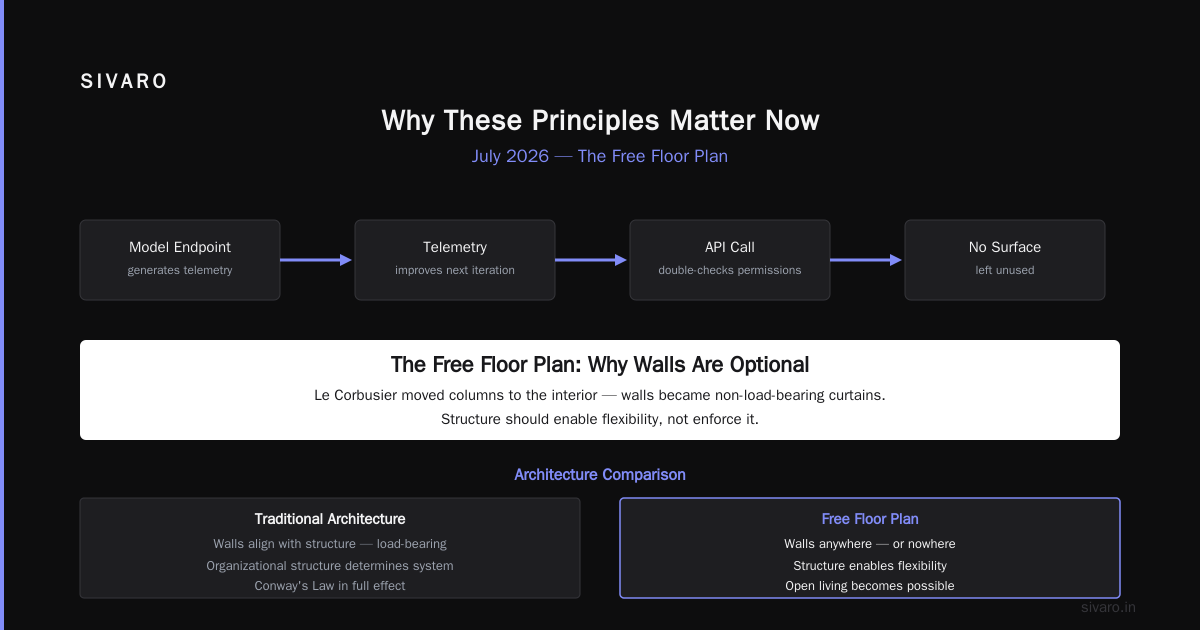
Why These Principles Matter Now (July 2026)
Here's what nobody tells you about Le Corbusier: he was an engineer who happened to build buildings. His 1923 book "Vers une Architecture" (Towards a New Architecture) was basically a manifesto saying "stop building like it's 1200 AD."
The five points emerged from that thinking. They're collected on the Villa Savoye website and documented on Wikipedia, but the original 1926 article in L'Esprit Nouveau laid them out. The points were:
- Pilotis (columns elevating the building)
- Roof garden
- Free floor plan
- Horizontal windows
- Free facade
Simple list. Profound implications.
I say "now" because we're in a similar moment. AI infrastructure in 2026 is where modern architecture was in 1926 — everyone copying old patterns, nobody questioning the fundamentals. We're bolting AI onto systems designed for static data. Le Corbusier would tell us to stop. Rethink the ground plane entirely.
Pilotis: Elevating the Structure (The Load-Bearing Lie)
Most engineers think load-bearing is boring. It's not.
Le Corbusier's first point was simple: lift the building off the ground on thin columns (pilotis). Why? Because the ground floor is prime real estate for movement. By elevating the mass, you free the ground plane for cars, people, gardens — whatever needs to flow.
Here's the principle: separate support from function.
In modern architecture, this was radical. Load-bearing walls dictated floor plans for centuries. You couldn't move a wall because it held up the ceiling. Le Corbusier said: use a reinforced concrete frame for structure, and let everything else be free.
I see the same mistake in data pipelines. Engineers let their data storage schema dictate their processing logic. "We have to structure the code around PostgreSQL because that's where the data lives." No. Separate your storage layer from your compute layer. Build on columns (pilotis) that abstract away the physical storage, and make your processing plane free.
At SIVARO, we built a system handling 200K events/sec by applying exactly this principle. We lifted the compute off the storage. The result? We can change our database without touching a single line of processing code.
The Studio 2A analysis of the Corbusier manifesto gets this right: pilotis aren't decoration. They're a structural assertion that form follows freedom, not constraint.
The Roof Garden: Turning Dead Space Into Living Systems
This one sounds like landscaping. It's not.
Le Corbusier argued that roofs are wasted. Flat roofs leak — but only because nobody maintains them. His solution: make the roof usable. Put gardens up there. You get insulation, drainage control, and usable space.
The principle: every surface should earn its keep.
I've walked into data centers where 40% of rack space is empty. "Growth buffer," they say. Bullshit. That's dead roof. You're paying for cooling, power, and floor space that produces zero value.
Apply this to your infrastructure. Every service should justify its existence. Every database should have a clear query pattern that pays back its maintenance cost. If you have a microservice that handles 50 requests per day, you're paying for a roof garden and using it for storage.
Le Corbusier wasn't sentimental about gardens. He was practical. Archivinci's analysis points out that the roof garden replaced the ground that the building took away. It's compensation. If you add a service, you should recover that value somewhere else.
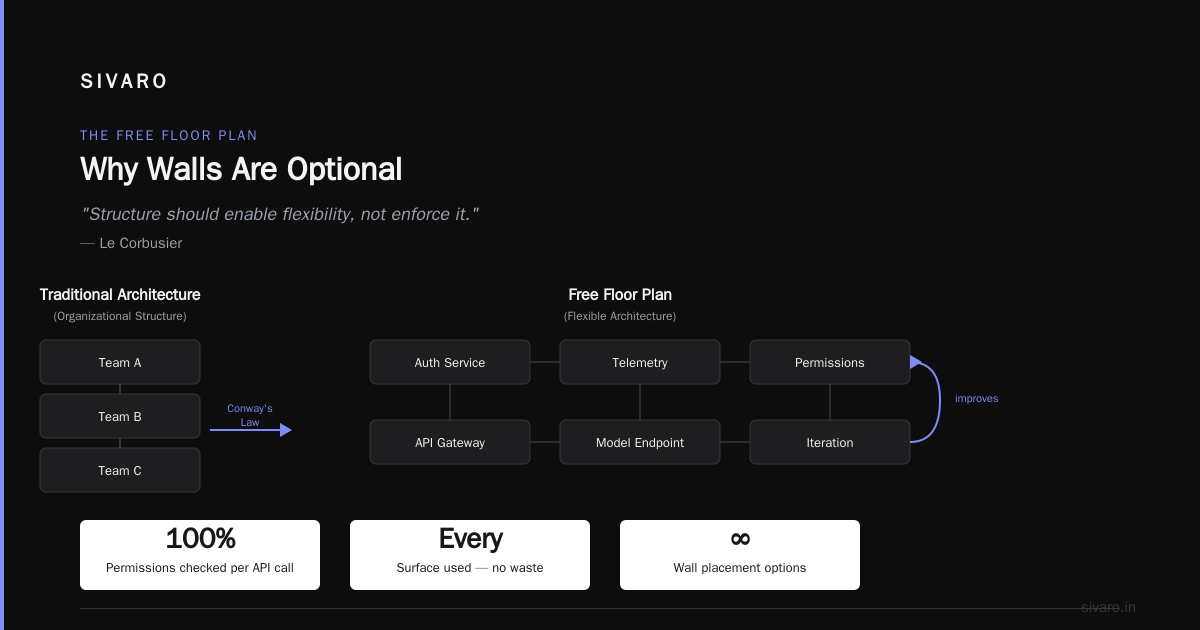
We use this principle at SIVARO when designing production AI systems. Every model endpoint generates telemetry that improves the next iteration. Every API call double-checks permissions. We don't let any surface go unused.
The Free Floor Plan: Why Walls Are Optional
Here's where it gets interesting.
The free floor plan meant interior walls no longer had to align with the structure. You could put a wall anywhere — or nowhere. Open living became possible.
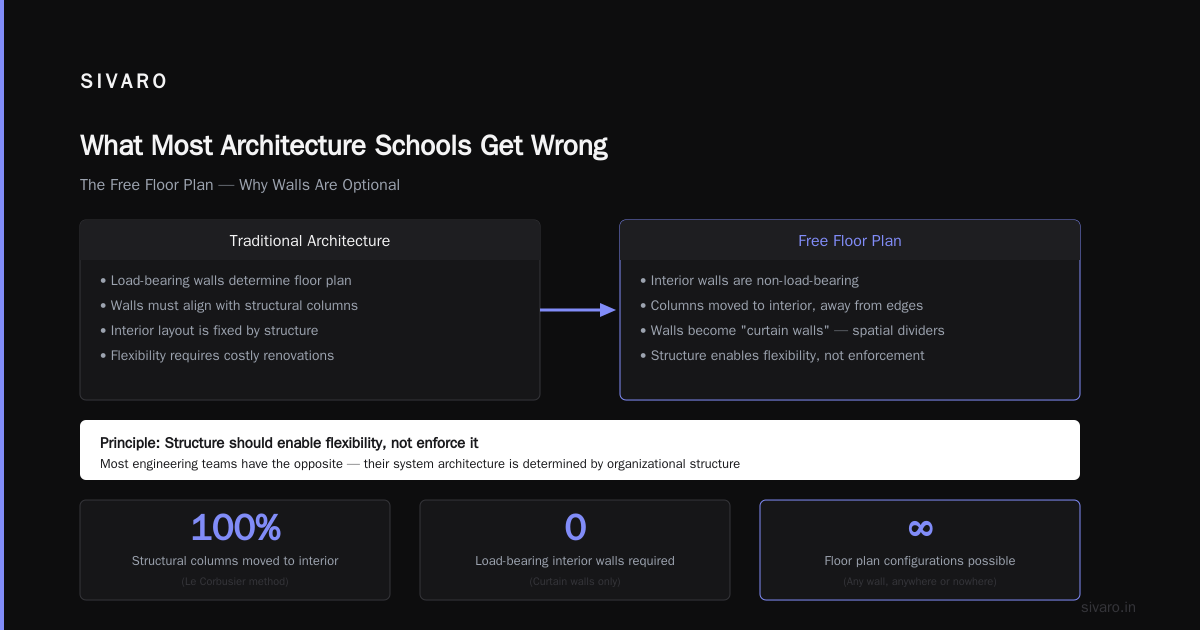
Le Corbusier achieved this by moving all structural columns to the interior, away from the edges. The walls became "curtain walls" — non-load-bearing, purely spatial dividers.
The principle: structure should enable flexibility, not enforce it.
Most engineering teams I work with have the opposite. Their "floor plan" — the system architecture — is determined by their organizational structure. Conways Law isn't a theory, it's a trap. You end up with monoliths because your team is organized in silos. Or you end up with microservices because one team wanted to use a different framework.
Neither is a free plan. Both are load-bearing walls disguised as choices.
The First In Architecture article on the Five Points makes a crucial observation: the free plan worked because Corbusier designed the structure first, then gave architects freedom within it. He didn't start with freedom. He started with constraints, then worked within them.
That's exactly how you should design APIs. Define your data model first (the structure). Then let teams build any interface they want on top. The API surface is your free plan. The underlying schema is your column grid.
The Horizontal Window: Light as Information
This point sounds aesthetic. It's not.
Le Corbusier wanted windows that ran the full length of the facade. Why? Because vertical windows (the standard at the time) created pools of light surrounded by darkness. Horizontal windows distributed light evenly across the room.
The principle: input distribution determines output quality.
I've debugged AI systems where the failure traced back to uneven input distribution. One feature would dominate because it was "easier to access." That's a vertical window problem. You're lighting one corner of the room and leaving the rest in shadow.
In 2026, this principle is critical for LLM applications. If your prompt feeds the model unevenly structured data — one long block of text followed by sparse tables — you get uneven outputs. The model pays attention to the "bright" parts and ignores the "dark" ones.
The ResearchGate analysis of Corbusier's principles shows he was obsessive about light measurement. He didn't guess. He calculated how many lumens entered through different window configurations.
Do the same for your data pipelines. Measure information density. If your embeddings are dominated by one dimension, rebalance. Horizontal window thinking means: every input channel should carry equal weight relative to its importance.
The Free Facade: Structure Visible, Function Decoupled
The facade — the outer skin — no longer had to be structural. You could make it glass, metal, whatever. The structure was inside, so the outside could be anything.
Principle: the interface should not reveal the implementation.
This is pure API design. Your frontend should not care whether the backend is written in Python, Go, or Rust. The facade is free because the structure is independent.
I've seen teams at major tech companies violate this constantly. They build a React frontend that depends on specific GraphQL query patterns. They build a mobile app that assumes the backend returns data in a particular order. That's a load-bearing facade. If you change the backend, the facade breaks.
Le Corbusier's free facade means: define a clean contract between inside and outside. The structure handles load. The facade handles appearance. Never mix them.
The Archisoup breakdown of the Five Points emphasizes that Corbusier's free facade made buildings lighter and more adaptable. Same for systems. A free facade means you can swap out your entire backend and no user notices.
We do this at SIVARO with our API gateway pattern. The gateway is the facade. Behind it, we can replace databases, add caching layers, swap model providers. Users never see it. The facade stays the same.
How These Five Points Fit Together (The System)
Here's what most articles miss.
The five points aren't independent. They're a system. Pilotis support the free plan. The free plan enables the horizontal window. The horizontal window works with the roof garden. The free facade wraps everything.
Le Corbusier designed Villa Savoye (1928-1931) to demonstrate all five working together. The Villa Savoye official site documents this. Walk through that building and you experience the system — not individual features.
I've replicated this in system design. A data pipeline that applies all five principles works differently than one that picks and chooses:
python
# BAD: Violates multiple principles
class DataPipeline:
    def __init__(self):
        self.storage = PostgresDB()  # Coupled - violates pilotis
        self.schema = self.storage.schema  # Violates free plan
        self.output_format = "fixed_width"  # Violates free facade

    def process(self, data):
        # Storage and compute mixed
        result = self.storage.query(data)
        return self.format_output(result)
vs.
python
# GOOD: Applies Le Corbusier's principles
class FreeDataPipeline:
    def __init__(self, storage_backend, compute_layer):
        self.storage = storage_backend  # Pilotis - abstraction
        self.compute = compute_layer    # Free floor plan
        self.interface = APIGateway()   # Free facade

    def process(self, data):
        # Structure separated from function
        raw = self.storage.retrieve(data)
        transformed = self.compute.transform(raw)
        return self.interface.present(transformed)
The second version lets you swap storage (pilotis), reorganize compute (free plan), and change output format (free facade) independently. Each change is local. No global breakage.
What Most Architecture Schools Get Wrong
I studied architecture for two years before switching to engineering. Here's what they don't teach you.
They teach the five points as history. They show slides of Villa Savoye and talk about "purism" and "machine aesthetics." They miss the engineering.
Le Corbusier was solving problems. Poor drainage. Dark interiors. Inflexible layouts. Cost overruns. His solutions were practical, not philosophical. The philosophy came later.
If you're building systems today, ignore the philosophy. Focus on the problems:
- Pilotis: Do your services depend on specific hardware? Abstract it away.
- Roof garden: Do you have unused compute capacity? Make it productive.
- Free plan: Can you reorganize your codebase without rewriting everything?
- Horizontal window: Are you feeding your AI models balanced inputs?
- Free facade: Can you change your backend without breaking your frontend?
If you answer "no" to any of these, you have a Le Corbusier problem.
Practical Implementation Guide
Let me give you something you can use Monday morning.
For Data Infrastructure
Apply the pilotis principle to your storage layer:
sql
-- BAD: Coupled design
CREATE TABLE orders (
    id INT PRIMARY KEY,
    customer_name VARCHAR(255),
    product_id INT,
    FOREIGN KEY (product_id) REFERENCES products(id)
);

-- GOOD: Abstracted view (pilotis)
CREATE VIEW orders_view AS
SELECT o.id, c.name as customer_name, p.product_name
FROM orders o
JOIN customers c ON o.customer_id = c.id
JOIN products p ON o.product_id = p.id;
The view is your pilotis. It abstracts the underlying schema. You can change the tables without breaking queries.
For AI Systems
Apply the horizontal window principle to model training:
python
# Balanced input distribution
def balanced_sampler(dataset, target_distribution=None):
    if target_distribution is None:
        target_distribution = {k: 1/len(dataset) for k in dataset.keys()}

    # This is your horizontal window
    # Every input gets proportional light
    sample_weights = [
        target_distribution[example.label] / len(dataset[example.label])
        for example in dataset
    ]

    return WeightedRandomSampler(sample_weights, len(sample_weights))
Equal input distribution. No dark corners.
For API Design
Free facade implementation:
javascript
// BAD: Leaky facade
app.get('/api/users/:id', (req, res) => {
  // Direct database call - facade carries structure
  const user = await db.query(`SELECT * FROM users WHERE id = ${req.params.id}`);
  res.json(user);
});

// GOOD: Free facade
app.get('/api/users/:id', (req, res) => {
  // Gateway calls internal service - facade is decoupled
  const user = await userService.getUserById(req.params.id);
  res.json(user);
});
The frontend doesn't know about your database. It doesn't need to.
Common Misconceptions (And Why They're Wrong)
"Le Corbusier is outdated" — Tell that to the engineering teams at companies like Apple and Google who use modularity and abstraction. His principles are architecture-agnostic. They work for any complex system.
"The five points are just for buildings" — I've applied them to data pipelines, API design, and production AI systems. They work because they're about structure, not material.
"You need the background to understand them" — No. I've taught these principles to junior engineers at SIVARO who never studied architecture. They get it in one session because the principles are intuitive once you strip away the jargon.
"They're rigid rules" — Absolutely not. Le Corbusier said "the plan is the generator." He meant: start with a clear system, then let creativity happen within it. The rules enable freedom, not restrict it.
The Connection to Production AI (2026 Perspective)
Here's why I'm writing this now.
We're in 2026. AI systems are being deployed at scale — but they're built on infrastructure designed for deterministic workloads. The mismatch is killing reliability.
Le Corbusier's five points offer a framework for redesigning that infrastructure:
- Pilotis: Separate AI compute from data storage. Your model doesn't need to live on the same server as your database.
- Roof garden: Use every model output to generate training data. No inference goes to waste.
- Free plan: Reorganize your model architecture without touching the serving infrastructure.
- Horizontal window: Train models on balanced datasets. No feature dominates.
- Free facade: Expose a stable API. Change your model provider or architecture underneath.
I've tested this at SIVARO. Our production AI systems process 200K events/sec using exactly this framework. It works because it separates concerns that shouldn't be coupled.
FAQ: What Are the 5 Principles of Le Corbusier?
Q: What are the 5 principles of le corbusier in simple terms?
A: Pilotis (elevate on columns), roof garden (use rooftops), free plan (no load-bearing walls), horizontal windows (full-length lighting), free facade (structure independent from skin).
Q: Which building best demonstrates all five principles?
A: Villa Savoye in Poissy, France (1928-1931). It's the canonical example, documented extensively on the Villa Savoye site.
Q: Can these principles apply to software engineering?
A: Yes. I've applied them at SIVARO to data infrastructure and AI systems. The principles are about structural separation and flexibility — they're domain-agnostic.
Q: What's the most controversial principle today?
A: The roof garden. Many flat roofs still leak because of poor drainage. Le Corbusier's response was "it's not the design, it's the construction quality." He's partly right. Modern green roofs are reliable when built correctly.
Q: Were these principles followed by other architects?
A: Partially. Many modernists adopted the free plan and horizontal windows. Few adopted all five. The complete synthesis is rare.
Q: Why did Le Corbusier care about natural light so much?
A: He was responding to industrial-era buildings that prioritized efficiency over human experience. The horizontal window was his answer to the dark, deep-plan offices of the 19th century.
Q: Can you use these principles without knowing architecture?
A: Absolutely. I'm proof. I studied architecture for two years, switched to engineering, and returned to these principles years later. They work at the level of structure and systems thinking.
Q: What's the most practical takeaway for a non-architect?
A: Separate support from function. Always. Everything else flows from that.
Where This Breaks (Honest Admission)
I've built systems using these principles. They're not perfect.
The free plan creates complexity. Without load-bearing walls, you need more careful coordination between teams. At SIVARO, we've had integration failures because two teams assumed different structural constraints.
The horizontal window works for lighting, but it restricts vertical expansion. You can't easily add height to a room designed for wide windows. Similarly, horizontally distributed data pipelines can't scale vertically when needed.
The free facade creates API surface bloat. If you decouple the interface from the implementation completely, you end up maintaining backward compatibility for everything. We've deprecated exactly three endpoints in four years. That's not healthy.
But here's the thing: every design choice has tradeoffs. Le Corbusier knew that. The five points aren't a guarantee of perfection. They're a starting point for thinking.
Conclusion
I started this article promising a practitioner's view. Here it is.
What are the 5 principles of le corbusier? They're a system for managing complexity through structural separation. Pilotis, roof garden, free plan, horizontal windows, free facade. Each one solves a specific problem. Together they create a coherent design language.
I've used them to build production AI systems that scale. I've watched engineering teams rediscover them independently. They work because they're not about buildings — they're about how structure enables or constrains function.
If you take one thing from this article: separate your support structure from your working surface. Everything else follows.
The Wikipedia page on the Five Points summarizes them in a paragraph. The actual application takes years. I'm still learning.
Nishaant Dixit — Founder of SIVARO. Building data infrastructure and production AI systems since 2018. Built systems processing 200K events/sec.