HomeAI
“Did you make this with AI?” is an insult now. With AI, anyone can ship a mediocre product.
We build the other kind.
For an idea or a problem with no structure yet. We sell product audits and improvement processes. Try the kind of thing we build: ask our project library anything. It answers from 20 real project files, shows which ones it used, and says so when it doesn't know.
The library: 20 project filesMatching files lift out, ranked
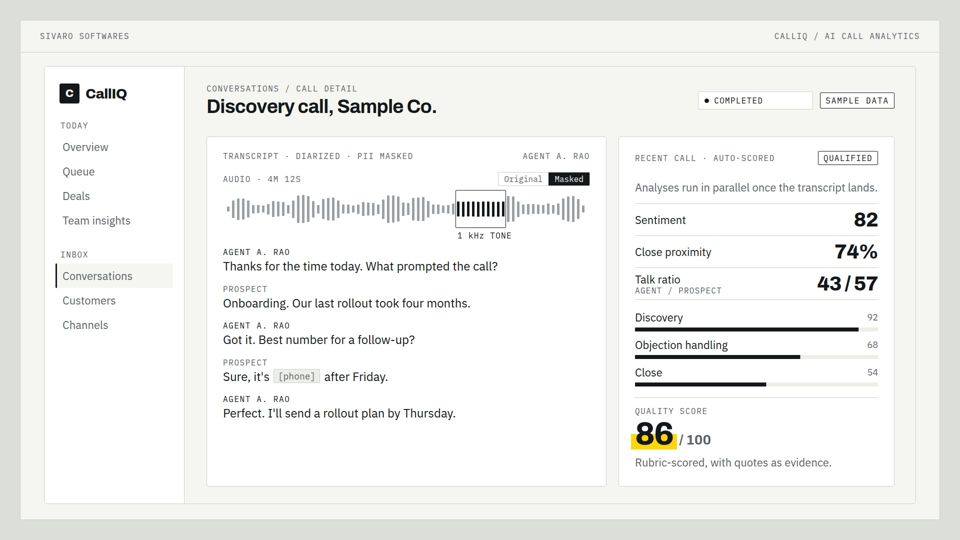
We’re building one now: a live call copilot that transcribes a sales call as it happens and pulls the right past project from a case-study library, using vector and full-text search, rank-fused, in Postgres with pgvector. Every claim traces to a stored source, and when nothing matches it says it won't guess. This demo is the same pattern, pointed at our own projects. [1] Related: Ask-the-team Slack bot. [2]
Show the scores
- Ask-the-team Slack bot5.1
- Live call copilot4.7
- Founder-led video1.7
terms: retrieval · production
Keyword search and character similarity, rank-fused, running in your browser. The production version uses pgvector embeddings. It answers only from what it finds.
15 builds. Watch them run.
Each recording is under 30 seconds, on sample data. Hover a title to preview it, click to watch with the details.
A product audit, then an improvement process.
We test your AI product the way your users and your bill will: answers checked against their sources, the cases where it fails, what each answer costs, how fast it is, and what breaks when a model is retired. You get the findings ranked, and the fixes in order.
- AuditPrescribed tests on quality, cost, speed and failure cases
- RankWhat's worth fixing first, against what it costs you to leave it
- ImproveEvals, retrieval, prompts, caching or a different model, one change at a time
- Re-testThe same tests again, so you can see what changed
Six rules, each from a build above.
Cite, or stay quiet
Answers trace to a source, or say there's nothing to cite.
The gate isn't a model
Checks that decide what ships are plain code.
No switch without your evals
A cheaper model replaces a dearer one only after it passes.
Pass, fail or blocked
Agents report what they couldn't reach. Never a guess.
Failures don't cascade
Retries and dead-letter queues. One failing step never blocks the rest.
Budgets and loop guards
Hard caps on paid calls, so nothing burns a month overnight.
What an AI would suggest. What actually works.
| Ask an AI assistant | What works in production |
|---|---|
| Put all our documents in a vector database. | Keyword and vector search together, every answer citing its passage, and a refusal when nothing matches. |
| Use the biggest model for everything. | The smallest model that passes your own evals, with the big one kept for the cases that need it. |
| Fine-tune a model on our data. | Fix retrieval and prompts first. Fine-tune when the evals show a gap they can't close. |
| Let an agent handle it end to end. | Agents that report pass, fail or blocked, with hard budgets, and plain code deciding what ships. |
| Self-host to save money. | Self-host for control over your data or over when a model is retired. On cost alone, the API usually wins. |
| Add retries until it works. | Retries with a dead-letter queue, so one failing step never blocks the rest. |
What AI leads ask first.
How does the process work?
A free call, then an audit: prescribed tests on your product. You get the findings ranked by what they cost you, then we fix them one at a time and re-test after each change.
How long does it take?
It depends on how many tests your product needs. We tell you the tests, the timeline and the price before the audit starts.
What does it cost?
The audit is priced by the number of tests it needs. The improvement work is a fixed price, quoted before we start.
Can't I do it myself using AI?
You can ship it with AI. Anyone can now, which is why it's no longer enough. The audit finds where your product is mediocre, and the fixes make it the other kind.
Will a cheaper model be worse?
Only if it fails your evals, and then we don't switch.
Can you build RAG on our documents?
Yes, with retrieval you can inspect: every answer cites its passage, and it declines when nothing matches, like the library at the top of this page.