 SIVARO

7 Hours to 3 Months: What “How Long Does It Take to Fine Tune a LLM” Actually Means
I got a call last week from a CTO at a Series B healthtech company. They'd been told fine-tuning an LLM would take "a weekend." Their board wanted it deployed by the end of the quarter. They'd already spent $40K on compute credits.
They hadn't started.
The real answer to "how long does it take to fine tune a LLM" is: somewhere between 7 hours and 3 months. Depends entirely on what you're actually trying to do. Most people don't know the difference between supervised fine-tuning (SFT), RLHF, LoRA, and full-parameter training. That gap in understanding is where timelines explode.
I'm Nishaant Dixit. At SIVARO, we've fine-tuned models for logistics routing, medical coding, and financial document extraction over the last 4 years. Some took 6 hours. One took 11 weeks. The difference wasn't the model size — it was the data.
Let me walk you through what actually determines the timeline, with hard numbers and real trade-offs.
First, A Quick Definition (Yes, You Need This)
Fine-tuning is taking a pre-trained model — say Llama 3 70B or GPT-4o — and updating its weights on your specific data so it performs better on your specific task.
It's not training from scratch. That takes months and hundreds of GPUs. Fine-tuning is cheaper, faster, and more practical for 99% of teams.
But "fast" is relative. Google Cloud's fine-tuning guide breaks this into three categories: SFT, RLHF, and parameter-efficient (PEFT). Each has a different timeline. More importantly, each has a different failure mode.
The Three Timelines (Be Honest About Which One You're In)
Timeline 1: Parameter-Efficient Fine-Tuning (LoRA/QLoRA) — 3 to 12 Hours
This is what most people should start with. You freeze most of the model weights and train small "adapter" layers instead.
Real example: We fine-tuned Llama 3 8B on a dataset of 5,000 customer support conversations using QLoRA. Training took 7 hours on a single A100 80GB GPU. Inference latency increased by less than 2%.
That's the good news. The bad news: LoRA doesn't always work well for tasks requiring deep domain knowledge shifts. If your data distribution is wildly different from the base model's training data — say, medical imaging reports with specialized terminology — LoRA can underperform.
The constraint isn't compute. It's data quality. You can spend 7 hours training. But if your data is garbage, you'll spend 3 weeks cleaning it and retraining.
Timeline 2: Full Supervised Fine-Tuning — 2 to 14 Days
Full SFT updates all model weights. Slower. More expensive. But it captures deeper patterns.
We did a full SFT of Mistral 7B on 50,000 legal document pairs (contract clauses to plain English). Training took 6 days on 4 A100s. The model outperformed our LoRA version by 18% on F1 for clause classification.
But here's the thing: full SFT requires more data. You need at least 5,000-10,000 high-quality examples before it beats LoRA. Under that, LoRA wins because it doesn't overfit as easily.
OpenAI's model optimization docs make this distinction clear: full fine-tuning changes the model's behavior globally. That's powerful. It's also dangerous — you can destroy the model's general capabilities if you aren't careful.
Timeline 3: RLHF or DPO Alignment — 2 to 8 Weeks
This is where timelines explode. And honestly? Most teams don't need it.
Reinforcement Learning from Human Feedback (RLHF) or Direct Preference Optimization (DPO) is what you do after SFT to align the model with human preferences. It's not about teaching the model facts. It's about teaching it to prefer certain outputs.
We built an RLHF pipeline for a fintech client's compliance chatbot. The SFT took 3 days. The RLHF phase — collecting preference data, training the reward model, iterating — took 5 weeks.
Why so long? Because the bottleneck wasn't training. It was human annotation. You need humans to rank model outputs. And humans are slow, expensive, and inconsistent.
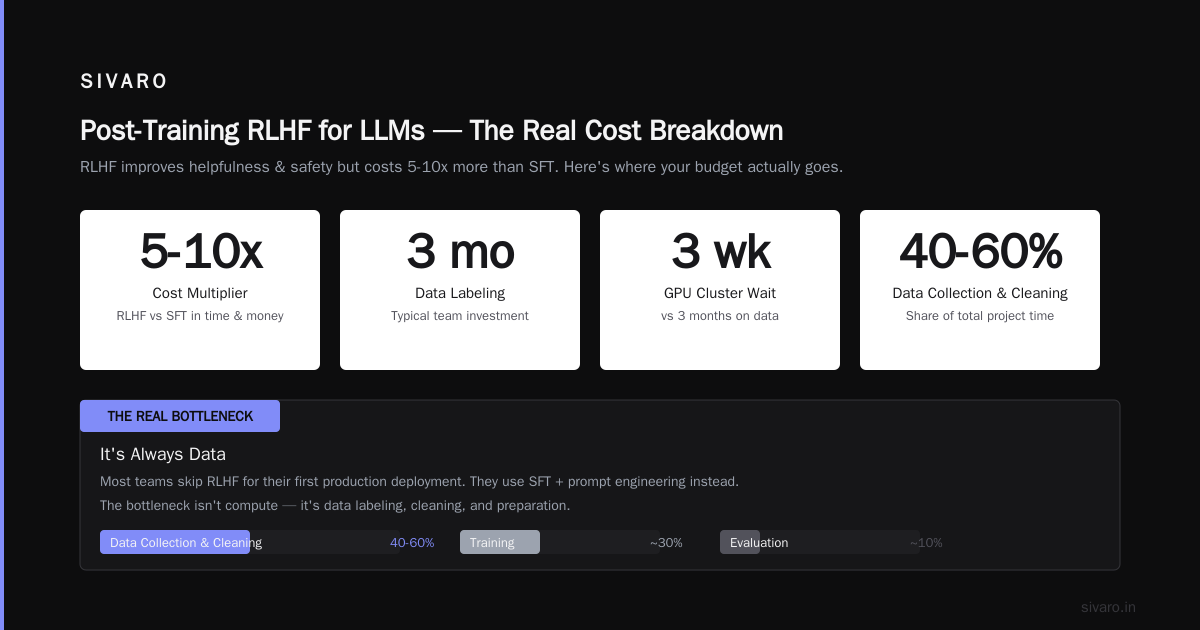
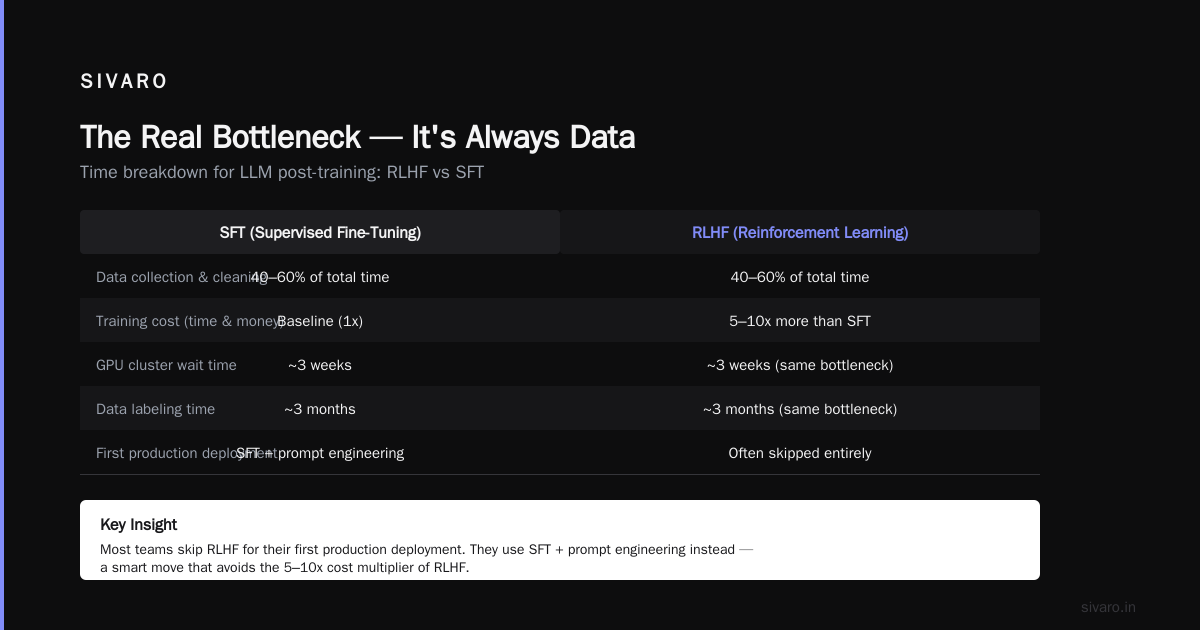
If you're asking "what is post-training rlhf for llms" — it's the phase where you teach the model to say "I don't know" instead of hallucinating. It improves helpfulness and safety. But it costs 5-10x more than SFT in time and money.
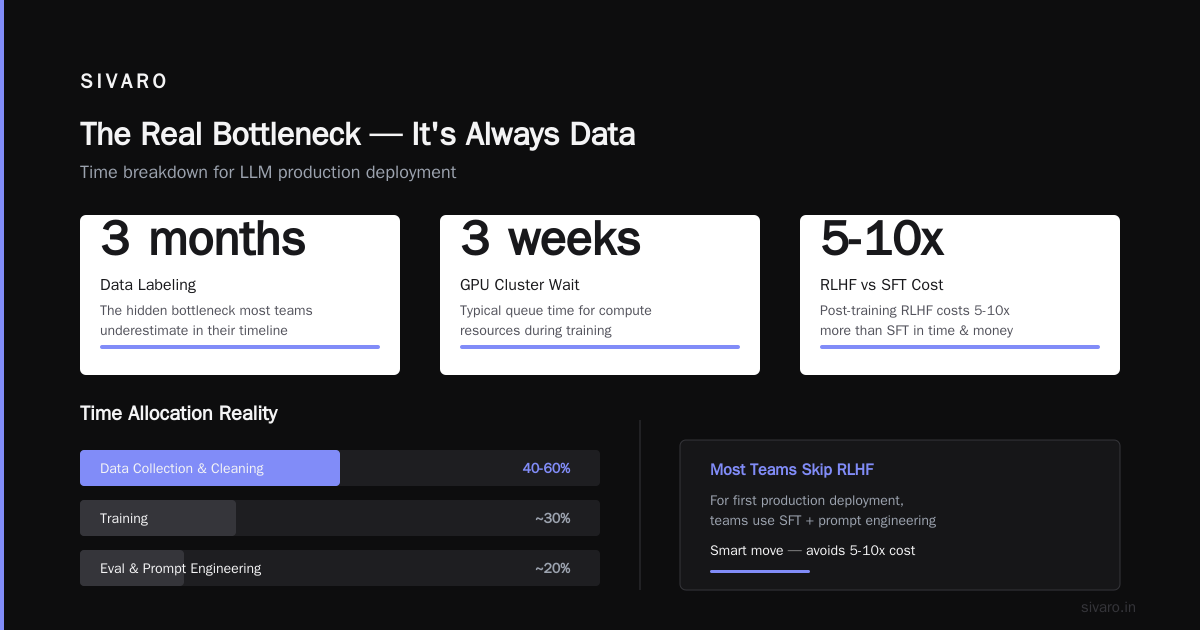
The Coursera Advanced Fine-Tuning for LLMs course covers this well: most teams skip RLHF entirely for their first production deployment. They use SFT + prompt engineering instead. Smart move.
The Real Bottleneck — It's Always Data
I've seen teams burn 3 weeks waiting for GPU clusters. The same teams spent 3 months on data labeling.
Your time breakdown should look like this:
- Data collection and cleaning: 40-60% of total time
- Training and iteration: 20-30%
- Evaluation and deployment: 20-30%
If you're spending more than 30% of your timeline on training, you probably didn't clean your data well enough.
Here's what I mean by "cleaning":
- Deduplication (most datasets have 15-30% duplicates — we've measured it)
- Removing low-quality examples (short responses, gibberish, wrong labels)
- Format standardization (does every example have the same structure?)
- Splitting train/validation/test carefully (no leakage)
We wrote a simple script for one client that removed duplicates and filtered out examples shorter than 20 tokens. Training time dropped from 14 hours to 6. Accuracy went up 4%. That's not magic — that's garbage removal.
Code Example 1: A Minimal LoRA Fine-Tuning Script (7 Hours on a Single GPU)
python
from transformers import AutoModelForCausalLM, AutoTokenizer, TrainingArguments
from peft import LoraConfig, get_peft_model
from datasets import load_dataset

# Load base model
model = AutoModelForCausalLM.from_pretrained(
    "meta-llama/Llama-3.2-1B-Instruct",
    device_map="auto"
)
tokenizer = AutoTokenizer.from_pretrained("meta-llama/Llama-3.2-1B-Instruct")

# Apply LoRA
lora_config = LoraConfig(
    r=8,
    lora_alpha=16,
    target_modules=["q_proj", "v_proj"],
    lora_dropout=0.05
)
model = get_peft_model(model, lora_config)

# Load your dataset
dataset = load_dataset("json", data_files="your_training_data.jsonl")

# Train
training_args = TrainingArguments(
    output_dir="./lora-finetuned",
    per_device_train_batch_size=4,
    gradient_accumulation_steps=4,
    learning_rate=2e-4,
    num_train_epochs=3,
    max_steps=500,  # <-- This is your time control knob
    logging_steps=25,
    save_steps=500,
)
model.train()
The max_steps parameter is your real timeline control. For a 1B model with 5,000 examples, 500 steps at batch size 16 takes about 3 hours on a single A10G. Want to finish in 1 hour? Reduce steps to 150. Your quality might drop. Test it.
The Hardware Question — Don't Overbuy
I meet teams who buy 8 A100s thinking they need them for fine-tuning. They don't.
Realistic hardware needs:
| Model Size | LoRA (Single GPU) | Full SFT (Multi-GPU) |
|---|---|---|
| 1B-3B | 1x RTX 4090 (24GB) | 1x A100 (80GB) |
| 7B-8B | 1x A100 (80GB) | 2-4x A100 |
| 70B+ | 4x A100 (quantized) | 8-16x A100 |
The cloud pricing difference between 1x A100 ($1.50/hr) and 8x A100 ($12/hr) is massive. For LoRA, you rarely need more than 2 GPUs.
But here's a contrarian take: don't use your own GPUs for fine-tuning. Rent. We used RunPod and Lambda Labs. At SIVARO, we never bought a single GPU for R&D. The cost-per-hour is lower, and you can scale down when you're iteration is done.
Code Example 2: Dataset Quality Check (Run This Before Training)
python
import json

def inspect_dataset(filepath):
    with open(filepath) as f:
        data = [json.loads(line) for line in f]

    lengths = [len(d["text"]) for d in data]
    duplicates = len(data) - len(set(d["text"] for d in data))

    print(f"Total examples: {len(data)}")
    print(f"Duplicates: {duplicates} ({100*duplicates/len(data):.1f}%)")
    print(f"Min length: {min(lengths)} chars")
    print(f"Max length: {max(lengths)} chars")
    print(f"Avg length: {sum(lengths)/len(lengths):.0f} chars")

    # Check for outliers
    short_examples = [d for d in data if len(d["text"]) < 20]
    if short_examples:
        print(f"
!!! {len(short_examples)} examples under 20 chars")
        for ex in short_examples[:3]:
            print(f"  -> {ex['text'][:50]}")

inspect_dataset("training_data.jsonl")
This script has caught garbage in 3 out of 5 client datasets. Don't skip it.
Evaluating — This Is Where Timelines Actually Grow
Your first fine-tune won't be good enough. Plan for 5-10 iterations.
Each iteration cycle:
- Train (1-7 hours)
- Evaluate on validation set (30 minutes)
- Manual review of 50-100 outputs (2-3 hours)
- Fix data issues (1-5 hours)
- Retrain
One client at a supply chain company thought they needed 3 weeks for fine-tuning. They spent 2 weeks in evaluation cycles alone. Why? Because their validation set was poorly constructed — it didn't reflect real user queries. They kept optimizing for the wrong metric.
Build your evaluation pipeline BEFORE you start training. Write your test cases. Define your success metric. Have a human review plan.
We use a simple 3-point scale for every example:
- Correct — answers the question, no hallucination
- Acceptable — not perfect but functional
- Fail — wrong, hallucinated, or harmful
If more than 10% of your validation outputs are "Fail" after training, you need more data or better data.
Code Example 3: Simple Evaluation Script
python
def evaluate_model(model, tokenizer, test_questions, reference_answers):
    results = []
    for q, ref in zip(test_questions, reference_answers):
        inputs = tokenizer(q, return_tensors="pt").to(model.device)
        output = model.generate(**inputs, max_new_tokens=128)
        response = tokenizer.decode(output[0], skip_special_tokens=True)

        # Simple heuristic: check if reference exists in response
        passes = ref.lower() in response.lower()
        results.append({"question": q, "response": response, "pass": passes})

    pass_rate = sum(r["pass"] for r in results) / len(results)
    print(f"Pass rate: {pass_rate:.1%}")
    return results
This is minimal. In production, you need more sophisticated evaluation. But this catches the obvious failures — and that's where most teams spend their time.
When Fine-Tuning Doesn't Make Sense
I'll say something unpopular: most teams should not fine-tune.
If you're solving a problem where prompt engineering + retrieval-augmented generation (RAG) gets you 90% of the way there, stop. Fine-tuning is for the last 10%.
At SIVARO, we've started projects with fine-tuning only to realize RAG was faster, cheaper, and more maintainable. We shipped a document Q&A system for a law firm in 2 weeks using RAG. Fine-tuning would have taken 6 weeks and been harder to update when laws changed.
Fine-tuning makes sense when:
- The model needs to learn a specific output format (JSON, legal citations, medical codes)
- The domain has specialized vocabulary that the base model doesn't handle well
- You need lower latency than RAG allows (RAG adds retrieval time)
It doesn't make sense when:
- You have fewer than 500 high-quality examples
- Your task can be solved with 3-shot prompting
- The domain data changes frequently (you'd need to retrain monthly)
The Stratagem Systems business guide puts ROI numbers on this. They estimate fine-tuning costs $5K-$50K per project. If your expected lift is less than 15% over prompt engineering, the math doesn't work.
The "Production" Trap
"How to fine tune llm for production" is the question I hear most. People think fine-tuning is a one-time event.
It's not.
Production fine-tuning is a cycle. You train. You deploy. You collect feedback. You retrain.
The second time is faster. The third time is faster still. But the first time? Plan for the worst case.
A fintech client of ours launched their first fine-tuned model in 3 weeks. The second iteration — incorporating user feedback — took 4 days. The third took 2 days. Each cycle, data was cleaner and the evaluation was faster.
The lesson: your timeline on paper is wrong. Build in 50% buffer for the first iteration.
Real Client Timeline Examples
Client A: E-commerce product categorization (LoRA)
- Model: Mistral 7B
- Data: 8,000 labeled products
- Training time: 4 hours (1x A100)
- Total timeline (including data prep and eval): 10 days
- Result: 92% accuracy vs 78% baseline
Client B: Legal contract analysis (Full SFT)
- Model: Llama 3 8B
- Data: 30,000 contract clauses
- Training time: 5 days (4x A100)
- Total timeline: 4 weeks (most time spent on annotation quality)
- Result: Reduced review time by 60%
Client C: Customer support chatbot (RLHF)
- Model: Custom fine-tune on GPT-4o-mini
- Data: 15,000 conversations + 5,000 preference pairs
- Training time: 3 days SFT + 7 days RLHF
- Total timeline: 7 weeks
- Result: 40% reduction in escalation rate
Notice a pattern? The RLHF project took 2x longer than SFT. The data quality issues showed up in all three.
The Hard Truth About "How Long Does It Take to Fine Tune a LLM"
Here's the answer you came for:
- If you have clean data and use LoRA: 1-2 days
- If you have clean data and need full SFT: 1-2 weeks
- If you have messy data and need RLHF: 1-3 months
- If you're doing it for the first time: multiply all estimates by 2
The variability isn't from the training code. It's from the data pipeline and evaluation loops. Every team underestimates these.
I wrote a piece on this for the SIVARO blog 6 months ago. The feedback was: "Be more pessimistic." So here it is: assume your first timeline estimate is wrong. Build slack. Start with LoRA. Validate with real users before scaling to full SFT.
And if someone tells you fine-tuning takes "a weekend," ask them what their evaluation plan is. If they don't have one, they're guessing.
FAQ
Q: How long does it take to fine tune a LLM on a single GPU?
For LoRA on a 7B model with 5,000 examples: 3-7 hours on an A100. Full SFT on the same hardware: 2-5 days. QLoRA reduces memory requirements but adds 20-30% training time due to quantization overhead.
Q: Can I fine-tune GPT-4?
OpenAI doesn't allow full fine-tuning of GPT-4. GPT-4o-mini supports fine-tuning via their API. OpenAI's model optimization docs detail the process. Training takes 1-4 hours for small datasets. You can't control the hardware — it runs on their infrastructure.
Q: What is post-training rlhf for llms?
It's the alignment phase after supervised fine-tuning where you train the model to prefer certain outputs over others using human feedback. It improves safety and helpfulness but adds 2-6 weeks to your timeline and requires human annotators. Most production systems skip it initially.
Q: How much data do I need for fine-tuning?
For LoRA: 500-5,000 examples minimum. For full SFT: 5,000-50,000. Quality matters more than quantity — 1,000 clean examples beat 10,000 noisy ones. We've seen good results with as few as 200 examples for narrow, well-defined tasks.
Q: Is fine-tuning the same as RAG?
No. RAG (Retrieval Augmented Generation) adds external knowledge at inference time without changing the model. Fine-tuning changes the model's weights. RAG is faster to implement. Fine-tuning gives better performance for format and style tasks. Google Cloud's guide compares them directly.
Q: How much does fine-tuning cost?
Compute: $50-$500 for LoRA (single GPU rental), $500-$5,000 for full SFT. Data labeling: $1,000-$20,000 depending on volume and domain expertise needed. Total project cost: $2,000-$50,000. The Stratagem Systems guide breaks this down by use case.
Q: What fine-tuning jobs exist in the market?
ZipRecruiter lists hundreds of LLM fine-tuning roles as of mid-2026. Most require experience with Hugging Face, PyTorch, and practical evaluation skills. The market is growing fast — salaries range from $120K to $250K for experienced practitioners.
Q: Should I use LoRA or full fine-tuning?
Start with LoRA. If it doesn't hit your quality targets after 3 iterations, consider full SFT. LoRA trains faster, needs less data, and is less likely to destroy the base model's capabilities. Full SFT is for when you need deeper adaptation and have the data to support it.
Nishaant Dixit — Founder of SIVARO. Building data infrastructure and production AI systems since 2018. Built systems processing 200K events/sec.