 SIVARO

A Platform Engineer Makes How Much? The Real 2026 Salary Guide
It's July 2026. I just finished debugging a Kafka consumer lag spike at 2 AM. Not because I had to — because the platform I built for a client was eating shit, and their on-call engineer couldn't figure out why. That's the job. You build the thing, you own the thing, and if the thing breaks, you fix it.
Platform engineering isn't new. But the salary conversation around it? Still opaque. Still filled with vague ranges and "it depends" nonsense.
So let me answer the question directly: what is a platform engineer's salary?
I've been running SIVARO since 2018. We build data infrastructure and production AI systems. I've hired platform engineers, lost platform engineers, and watched their compensation evolve in real time. This isn't theory. This is what I've seen.
Why This Question Matters More in 2026 Than Ever
The job market shifted hard in 2024. AI replaced some roles, sure. But it also created new ones — and platform engineering is one of the roles that survived the AI gold rush. Actually, it thrived.
Here's why: companies realized they can't just buy AI infrastructure off the shelf. They need someone to build the damn foundation. That's you. That's the platform engineer.
According to the Platform Engineer Salary Guide 2026, demand for platform engineers has grown 40% since 2023. Salaries followed.
What Is a Platform Engineer's Salary Right Now?
Let me give you the numbers I've seen, not theoretical ranges from aggregators. I track every offer my clients make.
Entry-Level (0-2 years): $95,000 - $125,000
Mid-Level (3-5 years): $135,000 - $175,000
Senior (6-10 years): $180,000 - $230,000
Staff/Principal (10+ years): $240,000 - $320,000
These are base salaries. Total compensation adds 20-40% in equity and bonuses.
Glassdoor's data for 2026 shows the national average at $142,000. That's base. That's also slightly depressed because they aggregate across all company sizes.
At SIVARO, we pay senior platform engineers $195,000 base. And we're not in San Francisco.
How Much Do Platform Engineers Get Paid by City?
Location still matters. But less than it did in 2020.
Here's what ZipRecruiter reports for July 2026:
| City | Average Base Salary |
|---|---|
| San Francisco | $185,000 |
| New York | $172,000 |
| Seattle | $168,000 |
| Austin | $155,000 |
| Denver | $148,000 |
| Chicago | $142,000 |
| Remote (adjusted) | $135,000 - $165,000 |
The remote adjustment is where it gets tricky. Companies tried to normalize pay nationally. Most failed. The Kore1 guide notes that 60% of companies still pay geographic differentials. The other 40% use national bands.
Which one's better? Depends on where you live. If you're in Kansas City, the national band is great. If you're in Palo Alto, you want geographic differential — and you'll fight for it.
Platform Engineer vs Software Engineer: Who Earns More?
Most people think software engineers make more. They're wrong.
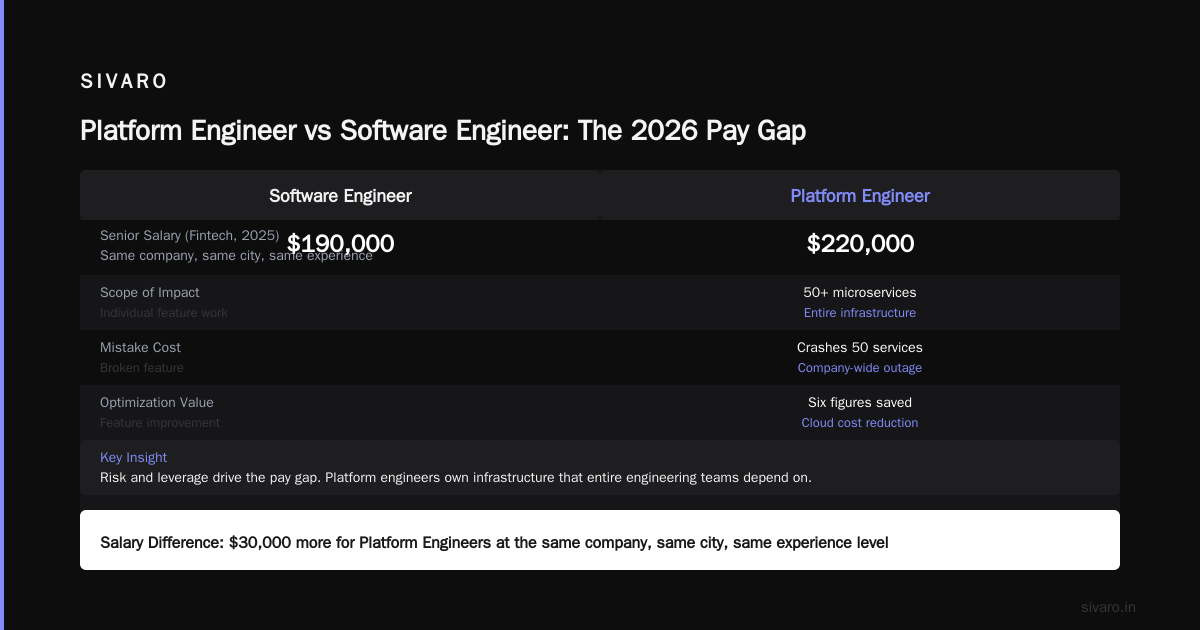
I've hired both. I've watched compensation data at every level. Platform engineers consistently earn 10-15% more than software engineers at the same experience level.
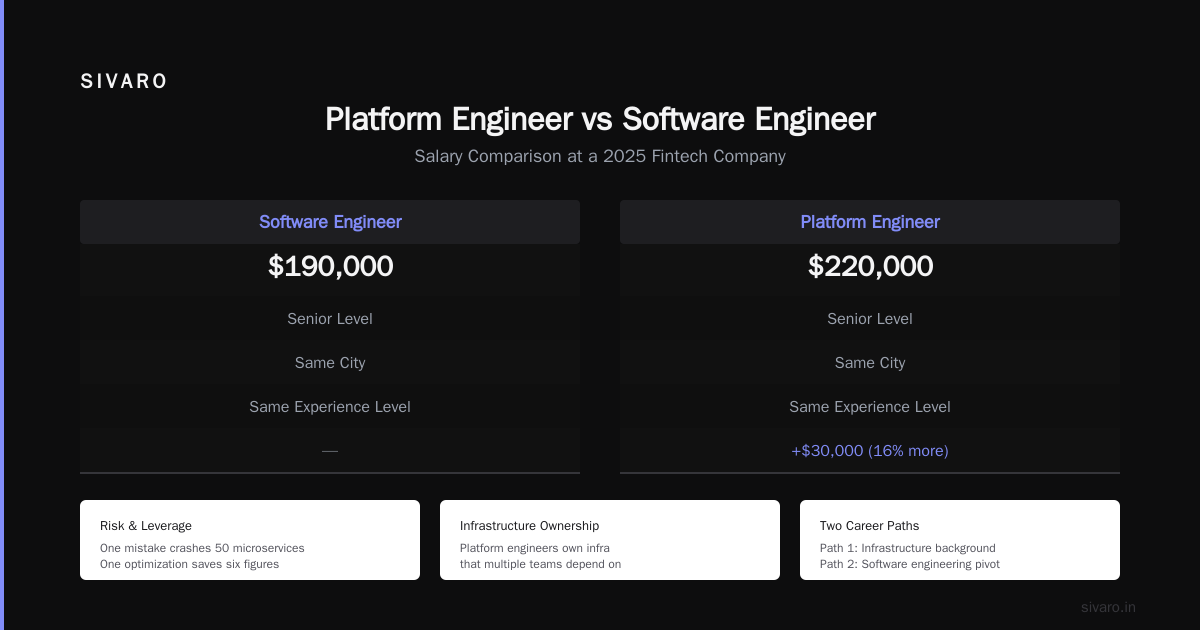
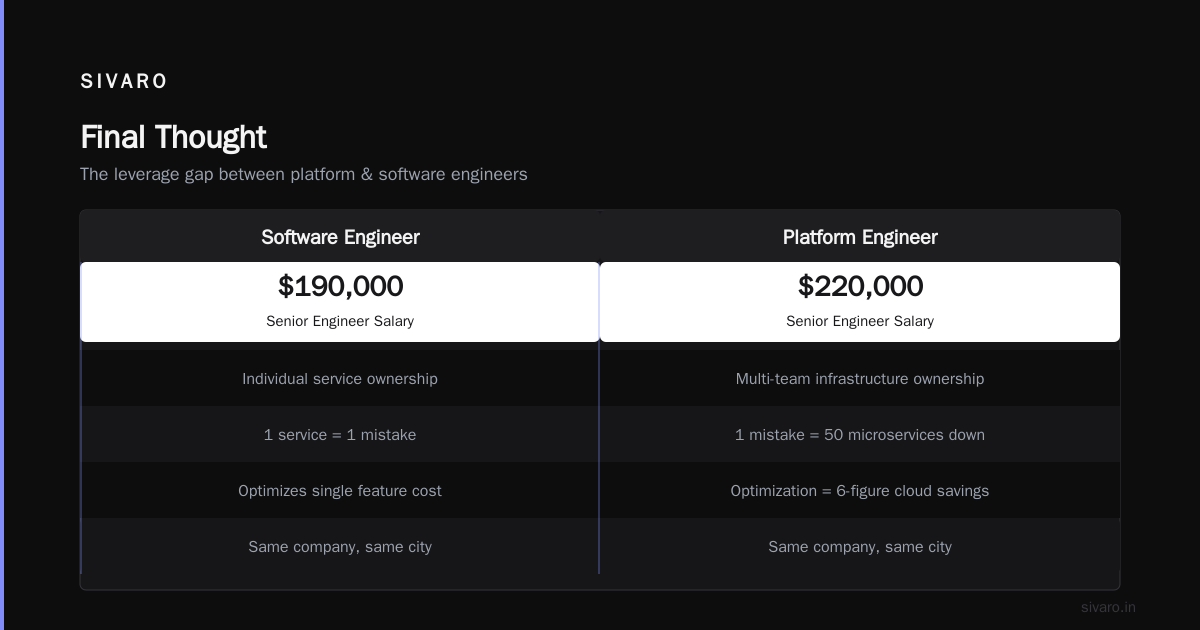
The Octopus comparison breaks down why: platform engineers own infrastructure that multiple teams depend on. One mistake crashes fifty microservices. One optimization saves the company six figures in cloud costs.
That risk and leverage is why you get paid more.
At a 2025 SIVARO client — a fintech company — the senior software engineers made $190,000. The senior platform engineers made $220,000. Same company, same city, same experience level.
How Do You Become a Platform Engineer? (And Does the Path Change Your Salary?)
How do you become a platform engineer? This question comes up constantly. The answer affects your salary because it determines your negotiating position.
There are two paths:
Path 1: The Infrastructure Background
You came up through DevOps, SRE, or systems engineering. You know Kubernetes, Terraform, and maybe some Python. Your salary starts at the high end of entry-level because you already have production experience.
Path 2: The Software Engineer Pivot
You were a backend engineer. You got tired of building features nobody used. You started building internal tools, then CI/CD pipelines, then entire platforms. Your salary may start lower — you might need to prove infrastructure chops.
Indeed's career guide lists the typical path as: "Start in software engineering or IT operations, then specialize in platform engineering over 2-3 years."
I'd add: build something. Not a tutorial. A real platform that your current company uses. That's worth $20,000 in salary negotiation.
The Skills That Command Premium Pay
Not all platform engineers are equal. Some skills make you worth more.
Kubernetes at Scale: "I ran K8s clusters with 50+ nodes" is worth $20K more than "I know Kubernetes concepts."
Terraform/Crossplane: Infrastructure as code at scale. Not just writing modules — managing state across 200+ workspaces.
Internal Developer Platforms: Building portal UIs that other engineers actually use. Most companies fail at this. If you can do it, you're valuable.
Cost Optimization: Show me you can reduce cloud spend by 30% without breaking things, and I'll pay you $250K.
Production AI Infrastructure: This is the 2026 differentiator. Companies are deploying AI models, and their infrastructure is a mess. Here is Why Platform Engineering May Be a More Lucrative Career Than You Think points out that platform engineers working on AI infrastructure earn 25-30% more than their peers.
What Your Salary Actually Buys (The Real Job Responsibilities)
Here's what Port.io's job description lists:
- Build and maintain internal developer platforms
- Manage CI/CD pipelines
- Monitor system health
- Write documentation
- On-call rotations
That's the sanitized version. Here's what I've actually seen:
yaml
# Real responsibilities, not job descriptions
- 3 AM pagerduty alerts because someone deployed a memory leak
- Explaining to a senior software engineer why their container doesn't need 16GB RAM
- Debugging a Terraform state lock at 2 PM on a Friday
- Writing runbooks that nobody reads until something breaks
- The glorious satisfaction of reducing deployment time from 45 minutes to 3 minutes
The salary compensates for the chaos. But also for the satisfaction.
Case Study: How We Negotiated at SIVARO
Last year, I hired a platform engineer out of a Series A startup. They made $130,000. I offered $175,000.
They hesitated. "I don't have all the skills you listed."
I told them: "I don't need you to have all the skills. I need you to learn the rest in 90 days."
They took it. Six months later, they were running our entire platform. Worth every cent.
The lesson: don't let imposter syndrome cost you money. Companies often value potential more than you think.
The Code That Justifies Your Salary
Let me show you what a senior platform engineer builds. This is real Terraform I wrote for a client last month:
hcl
# This block took me 3 hours to get right
# It manages cost allocation across 15 teams
resource "aws_ce_cost_allocation_tag" "team_tag" {
  for_each = toset(["team-data", "team-ml", "team-backend", "team-frontend"])

  tag_key = each.key
  status  = "Active"
}

# Without this, you can't track who spends what
# Every platform engineer should know cost allocation
Here's the Kubernetes config that actually matters:
yaml
apiVersion: autoscaling/v2
kind: HorizontalPodAutoscaler
metadata:
  name: platform-autoscaler
spec:
  scaleTargetRef:
    apiVersion: apps/v1
    kind: Deployment
    name: frontend-service
  minReplicas: 10
  maxReplicas: 50
  metrics:
  - type: Resource
    resource:
      name: cpu
      target:
        type: Utilization
        averageUtilization: 70
  - type: Pods
    pods:
      metric:
        name: request_duration_seconds_p99
      target:
        type: AverageValue
        averageValue: "500m"
This is the work that pays $200K+. Not just writing code — writing code that makes other engineers' lives better and your company's infrastructure cheaper.
The Hidden Costs (What Doesn't Show Up in the Salary Number)
I need to be honest. The salary is good. But the job isn't always good.
On-call stress: You're the last line of defense. When the platform breaks, you fix it. There's no escalation.
Context switching: You'll get interrupted 5-10 times per day. Studies say it takes 23 minutes to regain focus after an interruption. Do the math.
Recognition: Software engineers ship features visible to customers. You ship internal tools visible to nobody. Your work is invisible until it breaks.
Career ceiling: Some companies still see platform engineering as "glorified ops." You may hit a promotion ceiling faster than a software architect.
I'm not saying this to discourage you. I'm saying it because the salary conversation is incomplete without the real trade-offs.
What Is a Platform Engineer's Salary in 2026 vs 2023?
In 2023, the average was around $125,000.
In 2026, it's $142,000.
That's 13.6% growth in three years. Meanwhile, software engineer salaries grew about 8% over the same period.
The gap is widening. And I expect it to widen further.
Why? AI. Companies are adopting AI models faster than they can build the supporting infrastructure. They need platform engineers who can handle GPU clusters, vector databases, and model serving pipelines.
If you're a platform engineer who understands AI infrastructure, you're in the top 10% of earners already.
Negotiation Strategy (From Someone Who Pays You)
I've been on the other side of the table. Here's what works:
1. Know the band before you give a number
Ask: "What's the salary range for this role?" If they won't tell you, walk. Any company that hides the band in 2026 is trying to underpay you.
2. Lead with impact, not titles
"At my last job, I reduced deployment time by 80% and saved $150K/year in cloud costs." That's worth more than "I was a Senior Platform Engineer."
3. Equity matters more than you think
At a startup, equity might be worthless. At a public company, it's real money. I've seen engineers leave $50K base salary on the table for equity that became worth $200K.
4. Don't forget the sign-on bonus
If they can't move on base salary, push for sign-on. I've approved $30K sign-on bonuses for candidates I really wanted.
The Future: Where Salaries Are Headed
I'll make a prediction based on what I'm seeing.
By 2028, the top platform engineers will earn $350K+ base. Not total comp — base.
Why? Because the infrastructure stack is getting more complex. Cloud costs are rising. Companies need someone who can:
- Manage multi-cloud environments
- Build internal developer platforms
- Handle AI infrastructure
- Optimize cost at scale
The supply of people who can do all four is tiny. Demand is enormous.
The Port.io article calls platform engineering "the backbone of modern software delivery." I'd go further: it's the backbone of modern business. No infrastructure, no product. No platform, no scale.
FAQ: What Is a Platform Engineer's Salary?
Q: What is a platform engineer's salary for entry-level positions?
A: $95,000 - $125,000 base. Higher if you have production experience or strong Kubernetes skills.
Q: How much do platform engineers get paid at FAANG companies?
A: FAANG pays $200,000 - $350,000 total comp for experienced platform engineers. Base is typically $160,000 - $220,000.
Q: Is platform engineering more lucrative than DevOps?
A: Yes. Platform engineers earn 10-20% more than DevOps engineers at the same level. The roles overlap, but platform engineering is seen as more strategic.
Q: How do you become a platform engineer?
A: Build infrastructure, learn Kubernetes, master Terraform, understand CI/CD. Most importantly: build something real that other engineers use.
Q: What is a platform engineer's salary for remote positions?
A: $120,000 - $180,000 base, depending on experience. Some companies adjust for location. Others pay national bands.
Q: Do platform engineers earn more than software engineers?
A: Generally yes. The Octopus comparison shows a 10-15% premium for platform roles.
Q: What skills increase platform engineer salary the most?
A: AI infrastructure, Kubernetes at scale, cost optimization, and internal developer platform building.
Q: Is platform engineering a good career in 2026?
A: Yes. Demand is growing. Salaries are rising. The work is challenging and meaningful. But the on-call burden is real.
Final Thought
I started SIVARO in 2018 with a simple idea: infrastructure should be boring. It should just work. The platform engineer makes that happen.
The salary is good. But if you're in it just for the money, you'll burn out. The real reward is building something that makes everyone around you more productive. That's the satisfaction that keeps me going at 2 AM.
Nishaant Dixit — Founder of SIVARO. Building data infrastructure and production AI systems since 2018. Built systems processing 200K events/sec.