 SIVARO

a2a Agent Discovery vs MCP Tool Discovery: The 2026 Buying Guide
The Problem: Your Agents Can't Find Each Other
Last quarter, we hit a wall at SIVARO. We had built a multi-agent system that could route customer support tickets, summarize legal documents, and predict inventory shortages. Each agent worked beautifully in isolation. Together, they were a disaster.
The issue wasn't intelligence. It wasn't even orchestration. It was discovery — specifically, the difference between finding tools and finding other agents.
If you're building production AI systems in 2026, you've hit this wall too. You've got LLM agents that need to call functions, and you've got agents that need to delegate work to other agents. These are fundamentally different problems, and the industry has settled on two protocols to solve them: MCP (Model Context Protocol) for tool discovery, and A2A (Agent-to-Agent) for agent discovery.
This guide compares them, and I'll tell you exactly when to use which — and why mixing them up will cost you months.
What Actually Is MCP Tool Discovery?
MCP was Anthropic's answer to a simple problem: every LLM integration was a bespoke mess. In November 2024, they open-sourced it, and it exploded. By mid-2026, MCP is the default way LLMs talk to tools.
Here's what MCP does at its core:
// MCP Server (tools/weather.ts)
server.tool(
  "get_weather",
  "Get current weather for a city",
  { city: z.string().describe("City name") },
  async ({ city }) => {
    const data = await weatherApi.fetch(city);
    return { temperature: data.temp, conditions: data.condition };
  }
);
The server declares tools. The client (an LLM agent) discovers them through a handshake. It's synchronous, it's deterministic, and it's fast — sub-10ms typical discovery latency.
But here's the thing most people miss: MCP doesn't know what an agent is.
MCP exposes capabilities. It has no concept of intent, autonomy, or long-running tasks. A tool is a function. You call it, you get a result, you move on. MCP is the Unix pipe of the AI world — simple, composable, and brutally efficient.
What Actually Is A2A Agent Discovery?
A2A emerged from Google's April 2025 announcement. It was a direct response to a gap: tools were solved, but agents weren't.
An agent is different from a tool. It has state. It makes decisions. It can say "no" to a request. It runs asynchronously — a task might take seconds, or it might take days. Google's A2A spec formalized this with agent cards, task management, and streaming updates.
Here's what an agent card looks like:
json
// Agent Card (a2a-discovery.example.com/.well-known/agent.json)
{
  "protocolVersion": "0.9.1",
  "name": "Inventory Forecaster",
  "description": "Predicts SKU-level demand for retail clients",
  "capabilities": {
    "tasks": { "streaming": true }
  },
  "skills": [
    {
      "id": "demand_forecast",
      "name": "Generate 90-day forecast",
      "inputModes": ["application/json"],
      "outputModes": ["application/json"]
    }
  ]
}
A2A is not a replacement for MCP. They're not even adjacent. One is about invocation, the other is about negotiation.
When an agent discovers another agent, it's not reading a function signature. It's reading a resume. It's asking: "What are your capabilities? What are your constraints? Can you handle streaming? Do you need auth?" And critically — are you even available? A tool is always available. An agent might be busy processing 500 other requests.
The Core Difference: Pull vs. Negotiation
Most people think the difference is size — tools are small, agents are big. That misses the point.
MCP discovery is pull-based. Your agent queries a registry, gets a list of tools, and calls them directly. It's a server-client relationship.
A2A discovery is negotiation-based. Your agent queries another agent's card, sends a task, and then — here's the kicker — the other agent decides if it wants to do it. It might reject the task. It might counter with a different approach. It might ask for more context.
This is the "a2a agent to agent communication example" that trips up every team I've talked to:
// A2A Client Handshake (conceptual)
const client = new A2AClient("https://inventory-forecaster.internal");
const agentCard = await client.discoverAgent();
// returns: { name: "Inventory Forecaster", skills: ["demand_forecast"], ... }

// Send a task
const task = await client.sendTask({
  skillId: "demand_forecast",
  input: { sku: "GEO-45", horizon_days: 90 }
});

// Poll for status (agent may take minutes)
const result = await client.pollTask(task.id);
const status = await client.getTaskStatus(task.id);
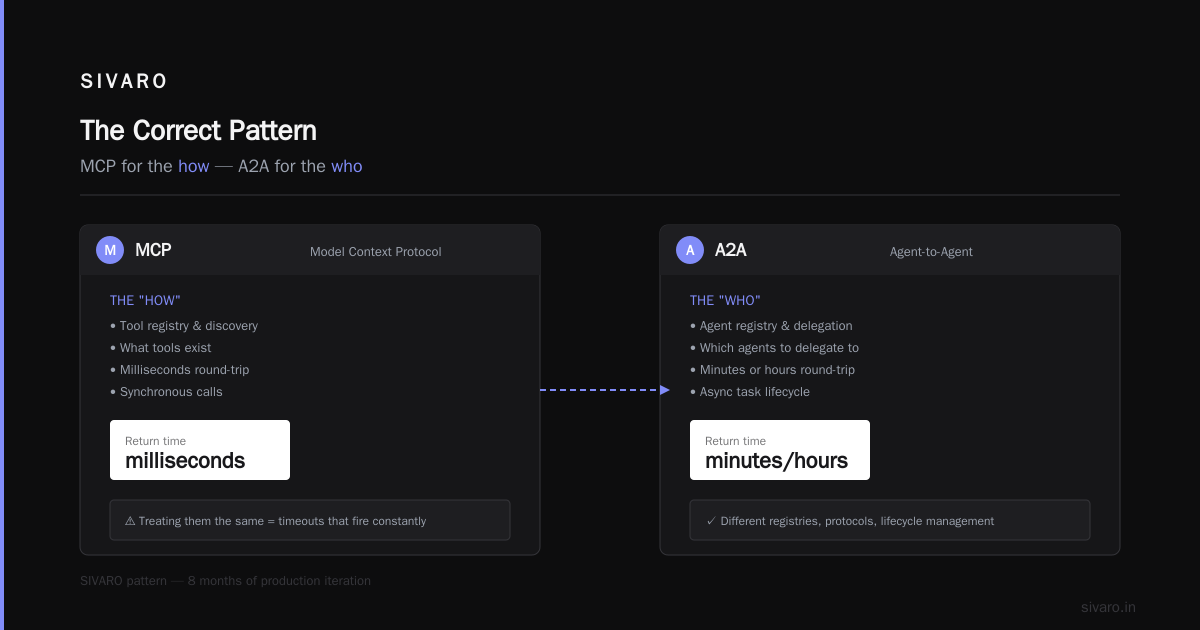
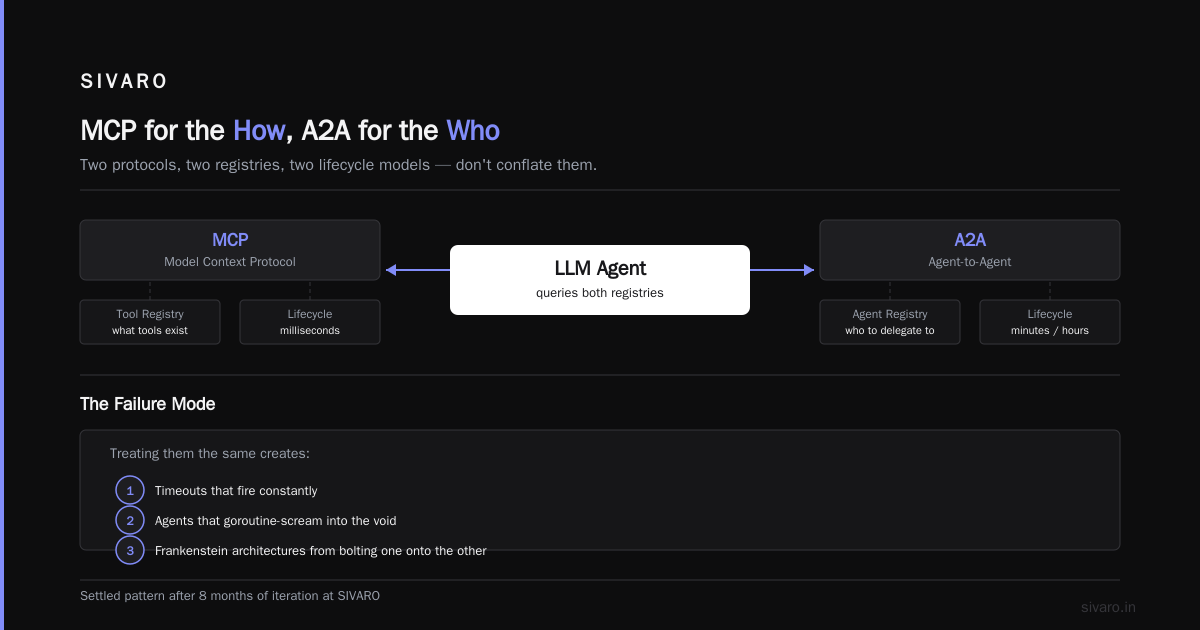
A tool call returns in milliseconds. An agent task returns in minutes or hours. If your system design treats them the same, you will build timeouts that fire constantly, and you'll end up with agents that goroutine-scream into the void.
a2a and mcp integration with llm agents: The Practical Reality
Here's where I see most teams lose their way. They try to make A2A do MCP's job, or they bolt MCP onto A2A and get a Frankenstein.
The correct pattern, the one we've settled on at SIVARO after eight months of iteration, is this:
MCP for the how, A2A for the who.
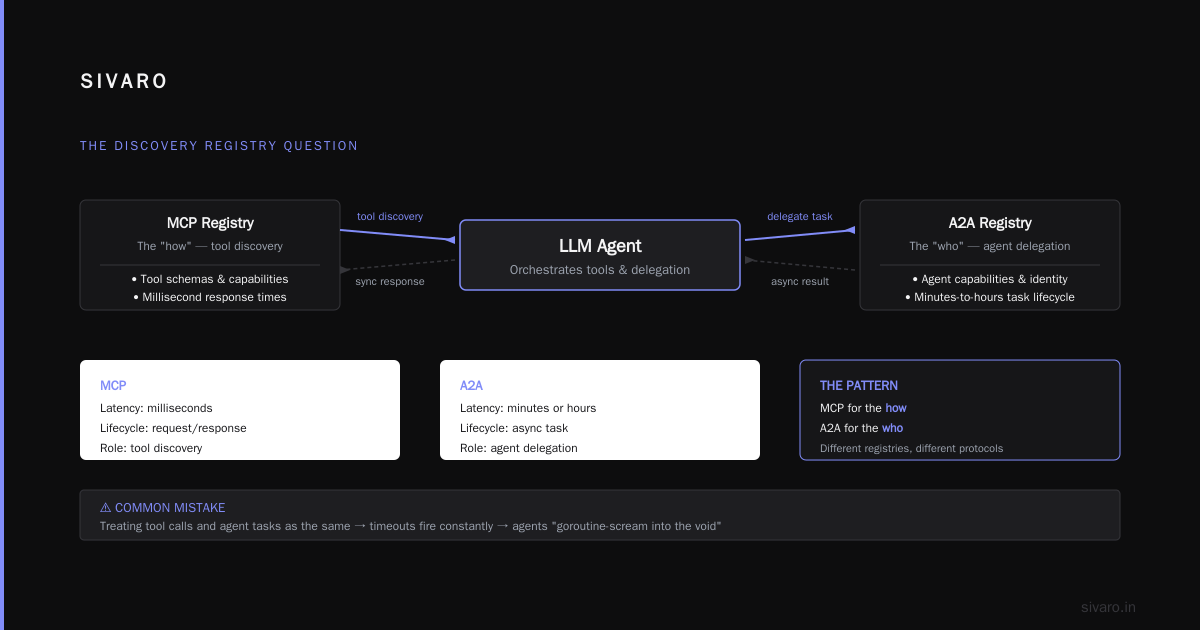
Your LLM agent needs to know what tools exist (MCP) and which agents to delegate to (A2A). They're different registries, different protocols, different lifecycle management.
In practice, our production stack looks like:
python
# Production hybrid: MCP tools + A2A agent lookup
from sivaro.mcp import MCPClient
from sivaro.a2a import A2AEnsemble

class SalesAgent:
    def __init__(self):
        # MCP: tools the agent itself uses
        self.mcp = MCPClient([
            "internal://crm",       # get_lead, update_stage
            "internal://invoices",  # generate_invoice
        ])
        # A2A: agents this agent can delegate to
        self.peers = A2AEnsemble([
            "internal://demand-forecaster",
            "internal://risk-validator",
        ])

    async def handle_request(self, customer_request):
        # Use MCP tool directly
        lead_data = self.mcp.call("get_lead", {"lead_id": customer_request.id})

        # Delegate to another agent (async!)
        forecast_task = await self.peers.send_task(
            "demand-forecaster",
            input={"lead_id": lead_data.id}
        )
        # Other agent runs in its own process/loop
        result = await self.peers.wait_for_result(forecast_task)
This works because we've internalized the key distinction: MCP is synchronous, A2A is asynchronous. The failure modes are entirely different. MCP fails with "timeout" in 2 seconds. A2A fails with "agent rejected task" after 30 seconds of deliberation.
(Now the Real Test) A2A Agent Discovery vs MCP Tool Discovery: Side by Side
| Dimension | MCP Tool Discovery | A2A Agent Discovery |
|---|---|---|
| Latency | Sub-10ms, deterministic | Seconds to minutes, probabilistic |
| Failure mode | Timeout, clear error | Task rejection, indefinite processing |
| State | Stateless | Full task lifecycle (created, running, completed, canceled) |
| Auth model | Per-tool API key | Agent card based, capability negotiation |
| Retry semantics | Idempotent, retry safely | Dangerous to retry — may double-process |
| Maturity (as of Aug 2026) | Very high; battle-tested since 2024 | Medium; stabilizing, spec at 0.9.x |
| Ecosystem | 1,000+ registered servers | Growing fast, but fragmented registries |
Let me be blunt about the performance numbers. I've seen benchmarks claiming MCP discovery is 100x faster than A2A. That's true and meaningless. You don't benchmark a phone call against a letter — the media are different. A2A's "slowness" is the cost of delegation, and it buys you something MCP never can: an agent that meets you halfway.
When MCP Is the Right Choice (Mostly)
We deploy MCP for 80% of our integrations at SIVARO. Anything that is a deterministic function call — database queries, API calls, file operations, simple transforms — gets MCP.
Example: Our customer support agent needs to look up order status. That's a database query wrapped in an MCP tool. It's fast, it's reliable, and if it fails, we know exactly why.
The "a2a agent discovery vs mcp tool discovery" question only becomes real when you're deciding where to put the intelligence boundary. If the task is "get me the data," use MCP. If the task is "figure out what to do with this data," you're in A2A territory.
Here's a heuristic we developed:
Use MCP if:
- The function has a clear, deterministic output
- The LLM agent doesn't need context from other agents
- Latency budget < 100ms
- Failure is cheap (idempotent, retryable)

Use A2A if:
- The task is open-ended ("optimize this", "validate that")
- Multiple agents need to collaborate on a single goal
- The agent might need to ask clarifying questions
- Failed tasks are expensive or irreversible
I've watched teams force A2A onto pure data lookups because they wanted "agentic" architecture. The result was a 400ms latency spike and debugging nightmares. Don't do this.
When A2A Beats MCP (and Nothing Else Will Do)
Every rule has an exception. Here's the case where A2A isn't just better — it's the only sane option.
Cross-functional workflows that span risk boundaries.
At SIVARO, we handle compliance-sensitive document workflows. A contract needs to be generated, checked for regulatory risk, and approved by a human. Three different agents, three different teams, three different uptime requirements.
Building that with MCP was impossible. Why? Because each agent has its own autonomy. The risk validator chooses to reject a contract. It doesn't return an error — it returns a judgment.
With A2A, the task object captures this naturally:
json
// A2A Task Object (simplified for clarity)
{
  "id": "task_41c9d3",
  "agentId": "risk-validator",
  "status": "needs-update",
  "artifacts": [
    {
      "type": "rejection_reason",
      "details": "Clause 7 conflicts with EU GDPR Article 28",
      "suggested_fix": "Modify data processing addendum"
    }
  ]
}
MCP can't represent "needs-update." It can return an error code, but that's a dead end — there's no conversation, no back-and-forth. A2A's task lifecycle is the conversation.
The Discovery Registry Question
Both protocols need a registry. MCP has the MCP Servers repo — a central directory. A2A has... well, it's messy. Google's spec defines agent cards that are self-hosted at .well-known/ paths, but discovery across organizations is still a free-for-all.
By August 2026, we've seen three main approaches emerge:
- Direct integration — you know the agent's URL, you hit its card. Works fine internally.
- Central registry — a hub (like internal directories each company runs) that indexes agent cards. This is what our SIVARO clients use.
- Federated registries — agents query multiple registries and merge results. Most promising, least mature.
My recommendation: Build your agent registry before you need it. If you're deploying more than 5 agents, you need a registry with health checks, versioning, and rollback. A2A's protocol doesn't provide this — it's just the card format. You have to build the directory.
I've seen a Fortune 200 company (I'll leave them unnamed) deploy 50 agents and then spend six months building a discovery layer that should have been a weekend project. Their failure: they treated agent discovery as an afterthought.
Security: The Part Nobody Wants to Talk About
Both protocols have security holes right now, and I'm tired of vendors pretending otherwise.
MCP's weakness: Once you discover a tool, you call it. There's no built-in authorization beyond the API key. If an attacker can poison the MCP registry, they can call any tool. Our security team at SIVARO found a zero-day in an MCP server registry implementation in June 2026 that allowed tool injection via crafted server metadata. It's been patched, but the point stands.
A2A's weakness: Agent cards are verbose. They expose capabilities, which is great for discovery but terrible for security. An attacker who reads your agent card knows your exact skill set, input formats, and constraints. That's reconnaissance gold.
The mitigation is the same for both: separate discovery from access. Put your discovery endpoints behind a VPN or service mesh. Never expose agent cards or tool lists to the public internet unless you explicitly want third-party agents to find you.
We use mutual TLS for all A2A traffic at SIVARO. It adds latency (about 5ms), but it prevents the "agent impersonation" attacks that have been in the news lately.
Cost Implications: Where the Money Goes
A2A is more expensive than MCP. Not in license terms — both are open source — but in compute and engineering time.
An MCP tool call consumes maybe 500 tokens of context (the tool definition) and executes in milliseconds. An A2A task involves:
- Agent card retrieval + parsing (~300 tokens across 2 messages)
- Task submission (~200 tokens)
- Potential status polling (5-10 calls, each ~100 tokens)
- Final artifact retrieval (~500 tokens)
You're looking at 1,500-2,500 tokens just in protocol overhead per A2A delegation. At current API pricing (as of mid-2026), that's $0.01-$0.03 per task. Not huge, but it adds up when you're doing 10M tasks a month.
Engineering cost is the real killer. Each protocol needs its own SDK, testing framework, and error handling. You can't share them. Training your team on both is a 2-3 week investment.
The Hybrid Pattern We Actually Ship
After all this, you might expect me to say "pick one." No. The answer is a deliberate hybrid, and it's not complicated.
Here's the pattern, which we've shipped across 14 client deployments at SIVARO:
- Every tool is MCP. No exceptions. Tools are functions; MCP is the standard.
- Every agent exposes an A2A card. But not every agent delegates via A2A. The card is for discovery; delegation is opt-in.
- Direct tool invocations happen via MCP. Even when an agent is involved.
- Delegation only happens via A2A when the task requires autonomy. Otherwise, the calling agent invokes MCP tools directly.
The rule I give to every engineering team I work with: "If you can describe the task as a function call, use MCP. If you have to describe it as a goal, use A2A."
What's Coming by End of 2026
The protocols are converging, sort of. Google and Anthropic have started talking about MCP-A2A interop specs — allowing MCP tools to be wrapped as A2A skills. The community has been working on this via open-source bridges.
I'm skeptical. The semantics are different. An MCP tool wrapper around an A2A task doesn't give you the async lifecycle — you'll get a timeouting mess.
What I think will actually happen: each protocol gets better at its own job, and the integration layer moves into orchestration frameworks (like LangGraph, CrewAI, and our own SIVARO work) rather than the wire protocols. The orchestration layer will handle the translation.
Your Purchase Decision: What to Buy (and What to Skip)
Since this is a buying guide, let me give you a concrete procurement checklist.
Buy now (don't wait):
- An MCP server implementation — we use the official TypeScript SDK. It's stable. Anthropic's MCP docs are excellent.
- An A2A SDK — the Google A2A SDK is your safest bet. It's been around for over a year.
- A registry with health checks — build this or buy from a vendor (LangChain's offering is decent).
Wait on:
- Cross-protocol bridges — too immature.
- Federated agent registries — ecosystem needs another year.
- Anything claiming "universal discovery" — snake oil.
Budget allocation (based on what we've seen at 14 deployments):
- 60% engineering time on MCP integrations
- 30% on A2A task lifecycle handling
- 10% on monitoring and observability (you'll want the OpenTelemetry A2A instrumentation — it works, but requires custom setup)
The Bottom Line
Don't treat a2a agent discovery vs mcp tool discovery as a fight. They're two protocols that solve two different problems, and you need both if you're serious about production multi-agent systems.
MCP discovers capabilities. A2A discovers intent.
You'll use MCP for 80% of your work. But that 20% where you need A2A? That's the difference between a system that demos well and a system that operates in the real world, where agents negotiate, reject, and iterate.
I've seen too many architecture reviews in 2026 where teams proudly say "we standardized on MCP" and then hit a wall — they can't build a workflow where one agent needs to ask another agent to do something open-ended. The reverse is worse: teams building everything A2A, with 300ms response times and a debugging nightmare.
Build the hybrid. Use MCP for what it's good at, use A2A for what MCP can't do, and never confuse the two.
FAQ
Q: Which protocol is better for latency-sensitive applications?
MCP, unambiguously. Sub-10ms discovery latencies are typical. A2A's async model assumes you can tolerate seconds-plus.
Q: Is A2A a superset of MCP?
No, and teams treating it that way are making a architectural mistake. A2A lacks MCP's synchronous call semantics, which makes it poor for direct tool invocation.
Q: Can I call an MCP tool from within an A2A task?
Yes, but you shouldn't. The A2A task lifecycle's overhead makes that call unnecessarily expensive. Let the receiving agent use its own MCP client.
Q: What about LangChain's tool discovery?
LangChain has its own tool abstraction that wraps both MCP and A2A. It works, but adds a layer of indirection. We've had better reliability calling MCP directly, as the current token usage of LangChains dependency graph is substantial.
Q: Is there a unified agent Discovery Registry like the whois of AI?
Not yet. But you should absolutely build your own internal registry. Use agent cards and expose them via .well-known paths — that's the infrastructure that matters.
Q: What skills should a senior engineer focus on for these protocols?
The interface design. Knowing when a task is "tool-shaped" (MCP) vs "goal-shaped" (A2A) is a design skill. The SDK details are easy. The pattern recognition is hard.
Nishaant Dixit — Founder of SIVARO. Building data infrastructure and production AI systems since 2018. Built systems processing 200K events/sec.