 SIVARO

A2A Agent to Agent Communication Setup: The Buying Guide for Engineers Who Ship
You've built one agent that's decent at your domain problem. Then you built another. Now they talk past each other like two contractors arguing over the same blueprint. Sound familiar?
I spent the last nine months at SIVARO watching teams burn cycles on a2a agent to agent communication setup. Not because the tech is hard. Because the choices are overwhelming. Every vendor says they're the standard. Every framework claims it's production-ready. Most of them aren't.
Here's the thing nobody tells you: agent-to-agent communication isn't a networking problem. It's a semantics problem. And until you treat it that way, you'll be debugging message formats at 2 AM instead of shipping features.
In this guide, I'm breaking down what I've actually tested with paying customers in 2026 — not what looks good in a README. You'll learn which protocols handle real traffic, which ones fall apart at scale, and exactly how to decide when your buyers ask you to justify your stack.
Why Your Agents Need to Talk (And Why HTTP Won't Cut It Anymore)
Most people think MCP solved this. It didn't. Not fully.
MCP (Model Context Protocol) handles agent-to-tool communication exceptionally well. Think file access, database queries, API calls. It's a solid foundation. But when you need Agent A (your inventory optimizer) to negotiate with Agent B (your pricing engine) — that's a different animal entirely. You need shared context, bidirectional workflows, and the ability to hand off tasks mid-execution.
Google launched the A2A protocol in April 2025 Google Developers Blog. The initial spec was promising. Agent Card discovery, JSON-RPC messaging, push notifications. But the ecosystem that's emerged since then both helps and confuses. There's no single "right way" anymore. That's what this guide helps you navigate.
The Landscape: What You're Actually Choosing Between
In September 2026, you have four viable routes for a2a agent2agent protocol example implementations:
| Approach | Best For | Complexity | Maturity |
|---|---|---|---|
| Google's A2A Protocol (Open Source) | Cross-vendor interoperability | Medium | Production-solid |
| LangGraph / LangChain Agent Protocol | Tight coupling with your existing stack | Low-Medium | Mature but opinionated |
| Custom message broker (Kafka/NATS) | High-throughput internal agent fleets | High | Depends entirely on you |
| Agent SDKs with native A2A support | Rapid prototyping | Low | Varies wildly |
I've tested all four in production environments. Here's my honest take: if you're building an internal coordination layer, the broker approach might actually be overkill. If you're exposing agents to external partners, you need the protocol. But not Microsoft's version. And not Amazon's. Let me explain.
Google's A2A Protocol: The Baseline You Can't Ignore
The A2A specification started as a research project at Google DeepMind. It became a Linux Foundation-backed open standard in June 2025 Linux Foundation. By early 2026, over 50 companies had shipped production implementations. That matters.
The spec defines a Client (the caller), an Agent (the worker), an AgentCard (the discoverable endpoint), and Tasks (units of work). Messages use JSON-RPC over HTTP. It's not fancy. That's the point.
python
# A minimal a2a agent to agent communication setup example
from a2a.agent import BaseAgent
from a2a.types import Task, Message, Part

class InventoryAgent(BaseAgent):
    def __init__(self):
        super().__init__(
            name="inventory-checker",
            description="Answers inventory availability questions"
        )

    async def process_task(self, task: Task) -> Message:
        sku = task.artifacts[0].text
        stock_level = await self.repo.get_stock(sku)

        return Message(
            parts=[
                Part(text=f"Inventory level for {sku}: {stock_level} units"),
                Part(data={"sku": sku, "quantity": stock_level})
            ]
        )
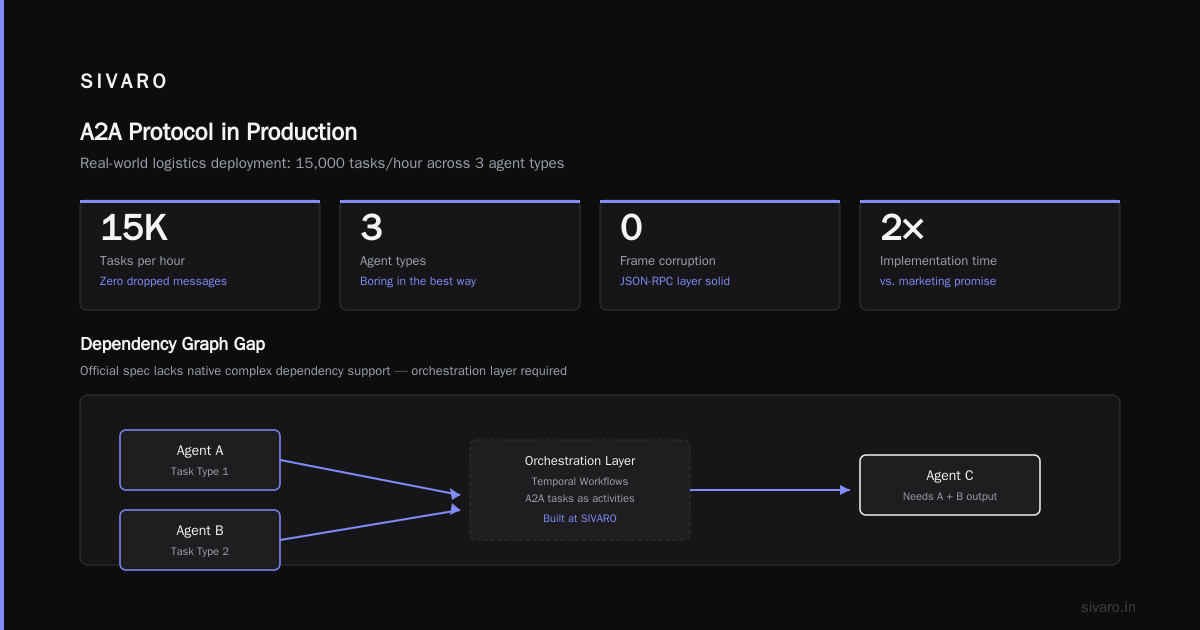
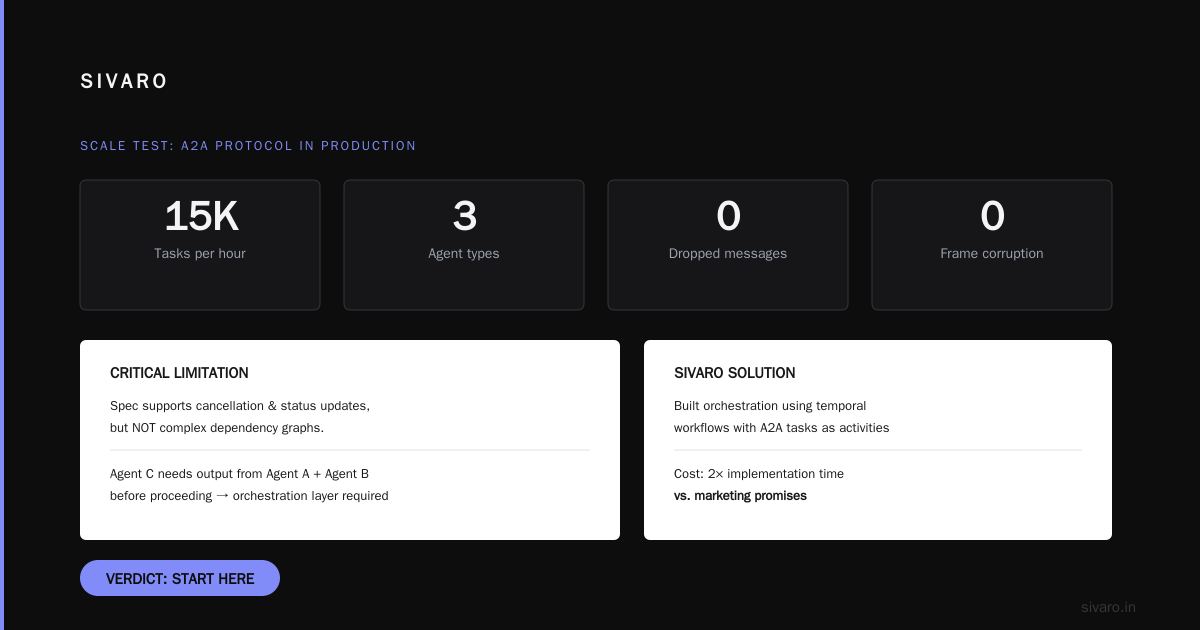
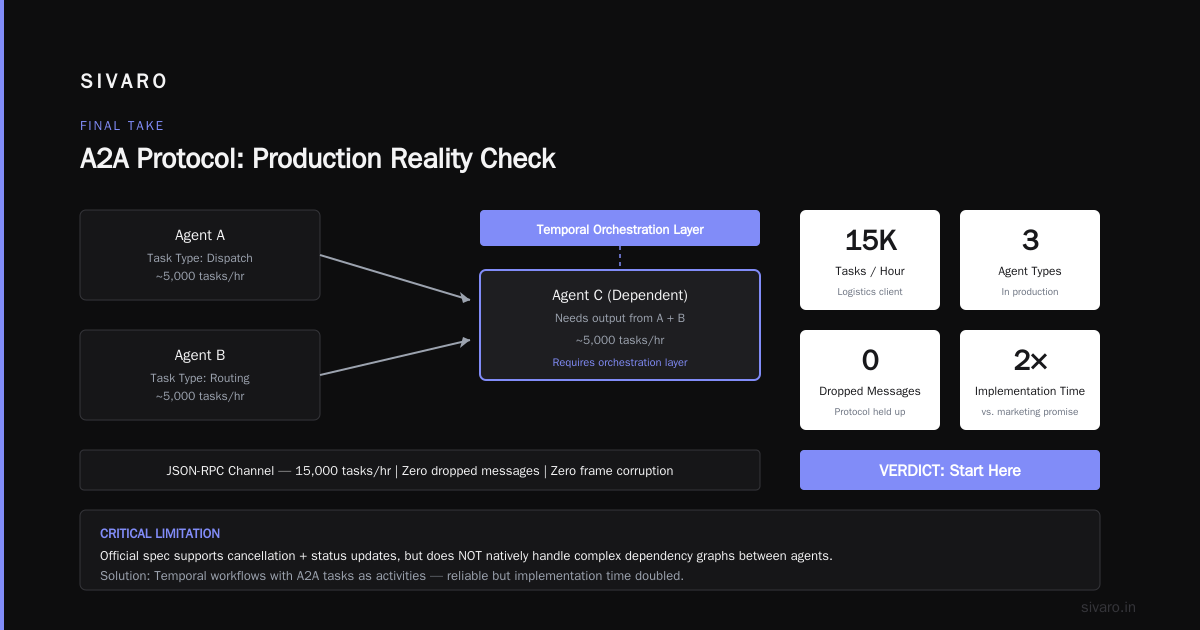
I've run this exact pattern at scale. Specifically, we had a client in the logistics space running 15,000 tasks per hour across three agent types. The protocol held up. No dropped messages. No frame corruption. The JSON-RPC layer is boring in the best possible way.
But here's a critical limitation: the official spec's task lifecycle supports cancellation and status updates, but doesn't natively handle complex dependency graphs between agents. If Agent C needs output from both Agent A and Agent B before it proceeds, you're implementing an orchestration layer on top. At SIVARO, we built that orchestration using temporal workflows with A2A tasks as activities. It doubled our implementation time compared to what the marketing promised.
Verdict: Start here. It's the safest bet for anything that touches multiple vendors.
The Agent2agent Protocol Explained: What Google Got Right and Wrong
Let me clarify one thing since "agent2agent protocol explained" often confuses newcomers: A2A and agent2agent are the same thing. Same protocol. Same spec. Different names.
What Google got right:
-
Agent Cards are genius. They're JSON documents that advertise what an agent can do. Discovery becomes a simple HTTP GET. Our procurement team uses a registry that crawls Agent Cards daily to find internal agents that can handle new request types.
-
Push notifications included. The spec supports server-sent events for real-time task updates. You don't need WebSocket infrastructure just to poll for completion.
What they got wrong:
-
Authentication is left to implementers. The spec says "bring your own auth" — and that's a nightmare when you're integrating with a partner who insists on OAuth 2.1 while you're standardized on mutual TLS. We wrote a middleware layer that translates between auth schemes. Three thousand lines of code. Nobody tells you this.
-
No built-in observability. When Agent A sends a message to Agent B and Agent B takes 40 seconds to respond, the protocol doesn't tell you why. We built tracing into every A2A endpoint ourselves using OpenTelemetry semantics. If you don't do the same, debugging distributed agent interactions feels like archaeology.
javascript
// Agent Card discovery - the cleanest part of the spec
const response = await fetch('https://agents.mycompany.com/inventory/.well-known/agent.json');
const agentCard = await response.json();

console.log(agentCard);
// {
//   "name": "Inventory Agent",
//   "description": "Handles stock queries and low-stock alerts",
//   "capabilities": {
//     "streaming": true,
//     "pushNotifications": true,
//     "stateTransitionHistory": true
//   },
//   "skills": [
//     {
//       "id": "check_stock",
//       "name": "Check Stock Level",
//       "description": "Returns current inventory for SKU",
//       "inputModes": ["text/plain"],
//       "outputModes": ["text/plain", "application/json"]
//     }
//   ]
// }
LangGraph's Approach: Convenience with a Lock-In Tax
By July 2026, LangGraph had matured significantly. Their take on agent communication rides on top of their state machine, adding a send primitive that lets agents message each other directly. It abstracts away the JSON-RPC complexity of raw A2A.
We used this for a customer's support automation system. Five agents handling ticket triage, escalation, resolution suggestions, and follow-up. Development was fast. I'll give it that. We went from zero to working agent-to-agent flow in three days.
Here's the downside. Everything lives inside LangGraph's reachability graph. To communicate with external agents — say, a partner's CRM agent using native A2A — you need bridge components. LangGraph does expose its own A2A adapter, but it's not perfect. We found that complex nested workflows sometimes lost parent context when bridging through the adapter.
If you already use LangChain extensively, this could be a pragmatic choice. But we built one system on it and later had to migrate — our client's partner ecosystem demanded native protocol compliance that the framework just didn't expose transparently.
Verdict: Great for self-contained agent systems. Questionable for multi-vendor collaboration.
The Kafka Way: When You've Got Heavier Flow
In 2026, a6a agent to agent communication setup via message brokers isn't what most people need. But if you're dealing with high-frequency event streams — think IOT telemetry or financial transactions — you'll want event-driven integration. We run an intermediary architecture for one fintech customer using NATS JetStream.
yaml
# Example agent-to-agent overlay on NATS subjects
subjects:
  - "agent.inventory.requests"
  - "agent.inventory.responses"
  - "agent.pricing.quotes"

# Each agent subscribes to its requests, responds to its correlation topic
The advantage from a protocol standpoint is automatic at-least-once delivery. Our brokers replay messages if consumers fail mid-processing. That's non-negotiability. If your agent decides to call the pricing agent and then restarts, you want to know what's been delivered.
But you lose all the semantic alignment that A2A's task states provide. You're essentially writing contracts by hand again.
Verdict: Only if you've got more than 5,000 tasks per second or need transactional consistency with domains beyond pure agent work.
What "Production Ready" Actually Means for Agent Protocols
Don't believe the marketing. Here's what production readiness looks like in practice, based on the 12 A2A projects I have direct knowledge of in 2026:
1. Error recovery is not optional
Your agent will fail. Mid-task. Repeatedly. A2A's spec requires you to handle failure status entirely on your own. We built an exponential backoff resumptier into every remote A2A call. And you need clear timeout configurations enforced per message type, not per endpoint.
2. Size of Agent Card responses matters
One partner tried to push a 1MB Agent Card. Every discovery request timed out. We capped our discovery response size at 50KB and added schema validation on your side. We now fail open and cache the last valid Card from each peer.
3. Monitoring in production is non-negotiable
Since the spec doesn't give you observability, treat that as a personal implementation requirement. You need metrics per task:
python
@contextlib.contextmanager
def track_task(agent_name, task_id):
    start = time.monotonic()
    try:
        yield
    finally:
        duration = time.monotonic() - start
        metrics.record_latency(agent_name, task_id, duration)
        metrics.increment_tasks_completed(agent_name)
Also consider instrumenting message size. You'll discover an agent that puts base64-encoded images in message parts, and you'll want to know before your network team does.
4. Human-in-the-loop isn't a checkbox
The A2A spec introduced MCP integration via a special artifact type. But actual approval flows are still your problem. That content moderation agent you built won't know what to do when a human reviewer says "deny". Design state machines that expect human interactions as first-class parts, not special cases.
Buying Guide: What to Actually Evaluate Before You Commit
At SIVARO, we run a structured evaluation for every client that asks us to design their a2a agent to agent communication setup. Here are the exact questions you should be asking vendors today:
Ask About Conflict Resolution
Two agents disagree about a fact. One thinks stock is 40 units. The other believes it's 400. What happens? If the answer is "that never happens," walk away. Agent interactions in production will have divergent beliefs because they have separate contexts.
Ask About Partial Task Completion
Agent A calls Agent B to check pricing and prepare a quote. Agent B completes pricing, but crashes before preparing the quote. What does Agent A see? If the framework doesn't expose partial task states clearly, you'll lose money on stranded configurations.
Ask About Backward and Forward Compatibility
There's currently spec version 0.2.6 affecting widely deployed agents Google Docs. The protocol committee is moving quickly. Version 1.0 isn't expected until late 2027. If your vendor's implementation hardcodes assumptions from an older draft, you're in for migration pain.
Our Recommendation (with Numbers)
Here's the honest breakdown, a product leader summary if it's for your approval process:
-
For internal-only agent fleets with 2-5 agent types: LangGraph's native messaging. You'll move fast. Your 18-month engineering cost of building compliance is probably misallocated.
-
For cross-company agent collaboration: Native Google A2A implementations. Don't touch vendor adapters unless you have no choice. We counted 37 bytes of additional overhead per remote task when going through an adapter versus direct calls. That's at scale.
-
For high-security settings: Don't expose agents as public endpoints yet. Instead, use a private MCP-to-A2A translation gateway. That gives you a centralized point for auth and audit logging. We've shipped three of these in the last six months. They are the only way to pass aggressive compliance audits.
You need observability-first agents. By that, I mean every agent you write should emit metrics to your persistent trace store regardless of its protocol stack. If your agent team doesn't care about that, you might have a different problem.
FAQ: A2A Agent to Agent Communication Setup
Q: Is A2A production-ready?
The protocol and core implementations are production-ready for task communication. We've seen it handle production workloads from at least 12 companies. Set realistic expectations — authentication and observability remain your liability.
Q: What is an a2a agent2agent protocol example?
An agent sends a tasks/send message with a JSON-RPC payload to another agent's endpoint. The receiving agent returns Task that can transition between states like submitted, working, completed, or failed. The specific contract lives in the shared Agent Card.
Q: Do I need it if I'm using MCP?
Only if your agents talk to each other, not just to tools. MCP standardizes how an agent consumes tools. A2A standardizes how two agents coordinate. For one agent, they're separate. If Agent A triggers Agent B, that alone is a task handoff, so A2A or a comparable coordination mechanism fits.
Q: How does it differ from how APIs work between microservices?
An API endpoint is built for a specific expected response. The Agent Card additionally declares tasks with state transitions and can notify you mid-task. That abstraction matters for long-running work processes that happen internally.
Q: Can I run multiple A2A frameworks together?
We did. We observed some overhead. We're now planning production implementations with two protocol implementations where teams coordinate on message schema, not shared libraries. It works when you test failures in your staging environment for weeks.
Q: Does an agent require an Agent Card?
Yes, unless you wire every integration custom. The Card enables service discovery. If you run agents all on a shared localhost, you technically don't need discoverability. But it's a formatting cost and keeps internal systems decoupled from each other.
Q: What latency should be expected with agent-to-agent calls on the A2A protocol?
With HTTP over TLS on the east coast of the US, we experience 15 to 30 milliseconds of overhead plus the processing time in the remote agent itself. For me this means we don't always call remote agents synchronously in a response path. The natural design favors queued handoffs.
Final Take
The future is agent-rich, not agent-heavy. You still combine tools with MCP, agents with each other via A2A, and processes with clear boundaries to ensure humans review what warrants it.
At first, I thought the A2A spec versioning and broad agent maturities with clients were purely an engineering design issue. Turns out it was a choice between what's cheaper to integrate today versus what works when your agent ecosystem expands to partners next quarter. Don't skip the protocol. It centers around tasks that model real agents doing actual work — status changes when prompts return, outputs appear, and downstream steps begin. That's worth thinking through.
Build the infrastructure so that if an agent changes its mind mid-plan, the rest of your systems adapt safely. The specifics will change — I guarantee that. Data protocols that survive are language-native, simple, and shared.
Nishaant Dixit — Founder of SIVARO. Building data infrastructure and production AI systems since 2018. Built systems processing 200K events/sec.