 SIVARO

A2A and MCP for Multi Agent Orchestration: The 2026 Playbook
We spent the first half of this year rebuilding a client's retrieval pipeline. Twenty-seven agents, three vendor SDKs, and a coordination layer that looked like a plate of spaghetti. The breaking point wasn't the models. It was the glue.
That's the problem A2A and MCP solve. Not the intelligence — the plumbing.
What You're Actually Dealing With
Let me define both protocols before we argue about them.
MCP (Model Context Protocol) is Anthropic's open standard from late 2024. It standardizes how an AI agent connects to external tools and data sources. Think of it as USB-C for AI peripherals. You've got a host (the agent), a client, and servers that expose tools, resources, and prompts. One protocol, one connection, and suddenly your LLM can query a database, call an API, or read a file without bespoke integration code.
A2A (Agent2Agent) is Google's protocol, released in April 2025 and donated to the Linux Foundation a few months later. It handles the other axis entirely. Not agent-to-tool, but agent-to-agent. It defines how autonomous agents discover each other, negotiate capabilities, and pass work back and forth. Agent Cards are the discovery mechanism — think of them as machine-readable résumés that say "I handle invoice extraction, here's my rate, here's my security model."
Here's the mental model I use with every SIVARO client: MCP is the nervous system. A2A is the social network.
MCP gives each agent its senses and limbs to interact with the world. A2A lets agents talk to each other, delegate, and coordinate. You need both for serious multi-agent orchestration. Anyone telling you otherwise is selling you a single-vendor dream.
Why the "MCP or A2A" Framing Is Wrong
Every conference panel this year has someone asking "which should we adopt?" It's the wrong question. They solve different problems at different layers of the stack.
| MCP | A2A | |
|---|---|---|
| Solves | Agent-to-tool integration | Agent-to-agent communication |
| Analogy | USB-C | HTTP + DNS |
| Discovery | Static server list | Dynamic via Agent Cards |
| Auth | OAuth 2.1, API keys | OAuth 2.1, mTLS |
| State | Stateless | Task lifecycle management |
| Maturity | Production-hardened | Emerging, rapidly stabilizing |
| Governance | Linux Foundation | Linux Foundation (since June 2025) |
When a client asks me whether they should go "MCP-first" or "A2A-first," I push back. That's like asking whether you need a database schema or an API gateway. They're not competitors. They're complementary layers.
The real orchestration stack that's emerging looks like this: an MCP layer connects every agent to the tools it needs, an A2A layer handles inter-agent handoffs, and an outer orchestrator (usually something custom or a framework like LangGraph or CrewAI) manages the overall workflow.
A2A Agent Discovery Protocol, Explained Without the Hype
Here's where a2a agent discovery protocol gets interesting — and where most people get it wrong.
Agent discovery isn't about finding agents on a network. It's about trust. When Agent A discovers Agent B, it needs to know not just "what can you do?" but "are you safe to give my user's data to?" and "how do we negotiate a handoff?"
The Agent Card is the core artifact. It's a JSON file served at a well-known endpoint (think /.well-known/agent.json on the agent's server). It declares:
- The agent's identity and purpose
- Skills and capabilities (structured, not just prose)
- Communication protocols it supports
- Security and privacy policies
- Authentication requirements
- Rate limits and pricing (for commercial agents)
Let me show you what a real Agent Card looks like. This is simplified but structurally accurate:
json
{
  "name": "invoice-processor-v2",
  "description": "Extracts structured data from invoice PDFs and flags anomalies",
  "url": "https://agents.sivaro.dev/invoice-processor",
  "version": "2.3.1",
  "capabilities": {
    "skills": [
      {
        "id": "extract-invoice",
        "name": "Extract Invoice Data",
        "inputModes": ["application/json"],
        "outputModes": ["application/json"],
        "security": {
          "authentication": ["oauth2"],
          "privacyPolicy": "https://agents.sivaro.dev/privacy",
          "dataRetention": "30-days"
        }
      }
    ],
    "communication": {
      "protocols": ["a2a"],
      "transport": ["https", "websocket"],
      "rateLimit": "100 requests/minute"
    }
  }
}
Once Agent A discovers Agent B's card, it can initiate a task. The A2A protocol defines a task lifecycle: submission, work-request acknowledgment, progress updates, and final completion with artifacts or errors.
This matters because we're watching the agent economy fragment. By 2026, you're not going to have one mega-agent that does everything. You'll have specialized agents from different vendors, open-source agents, in-house agents. Bloomberg's agent ecosystem alone has like 40 distinct agents for market data, and they don't all live in the same trust domain.
A2A MCP Comparison for AI Agents: What We Actually Tested
People always ask for an a2a mcp comparison for ai agents. I'll tell you what we found at SIVARO when we put both through their paces on production workloads.
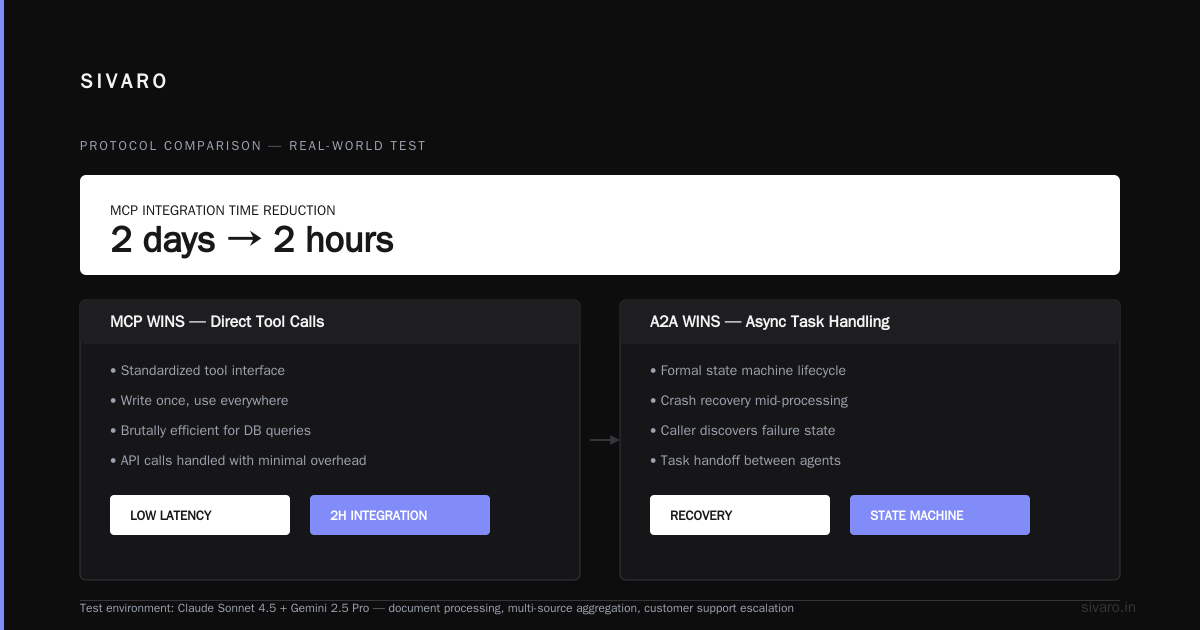
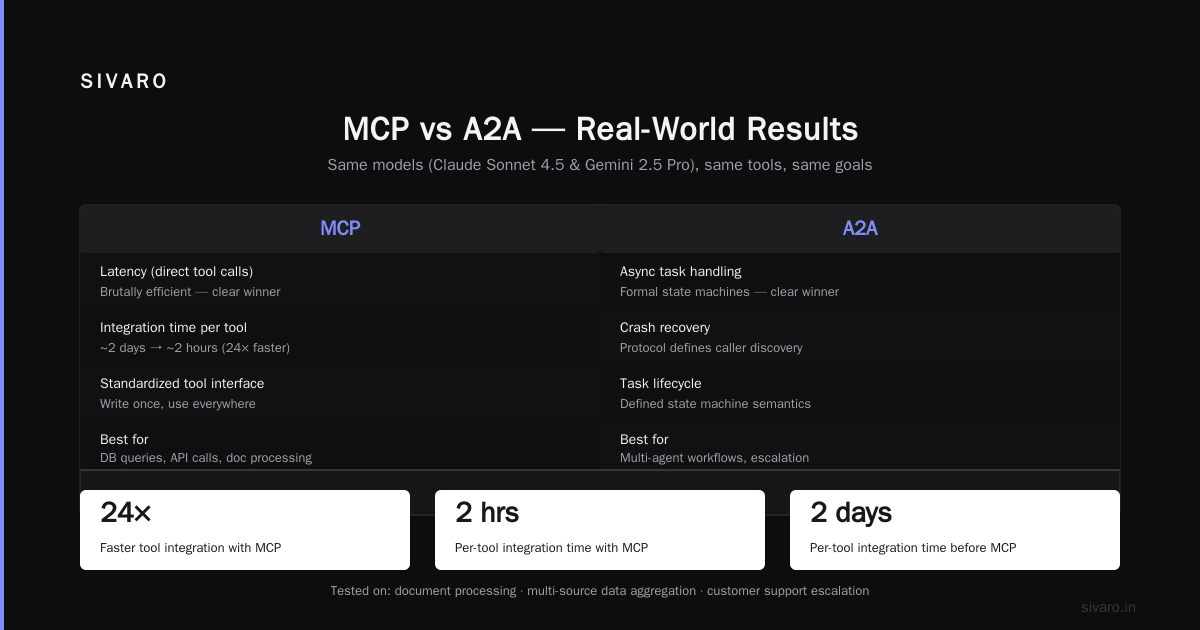
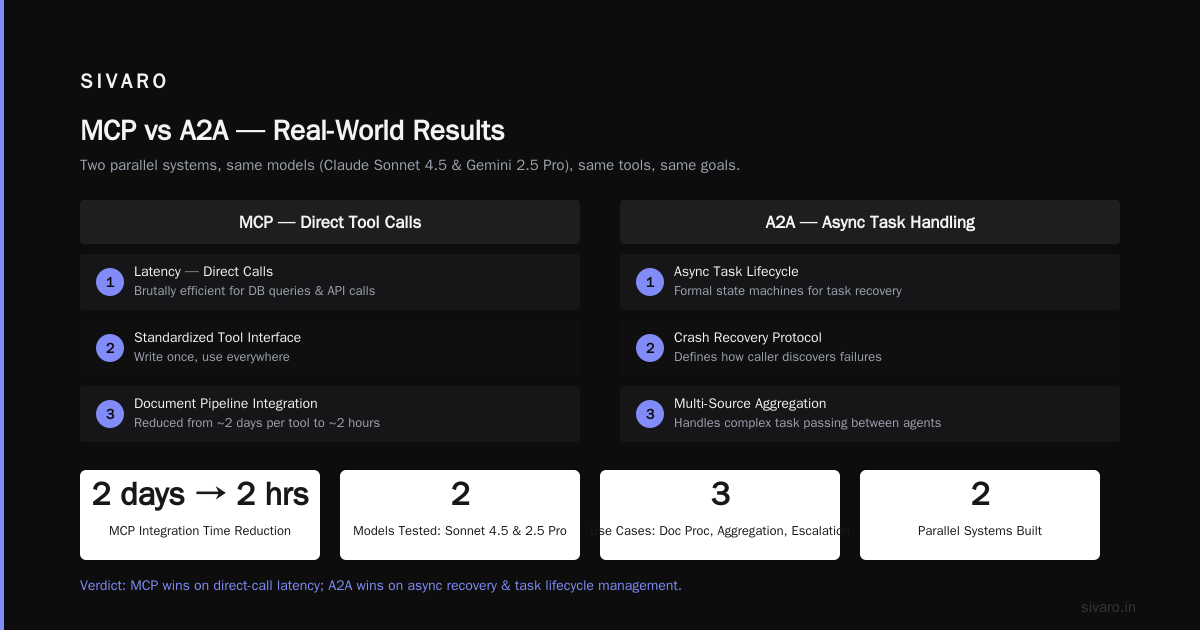
We ran a benchmark in March 2026. Three use cases: document processing, multi-source data aggregation, and customer support escalation. Two teams built parallel systems — one MCP-centric, one A2A-centric. Same models (Claude Sonnet 4.5 and Gemini 2.5 Pro), same tools, same goals.
What MCP won at: latency for direct tool calls. When an agent needs a database query or an API call, MCP is brutally efficient. The standardized tool interface means you write it once, use it everywhere. For our document pipeline, MCP reduced integration time from roughly two days per tool to about two hours.
What A2A won at: asynchronous task handling and recovery. A2A's task lifecycle gives you formal state machines. When one agent passes a task to another and that agent crashes mid-processing, A2A's protocol defines how the caller discovers the failure and renegotiates. With MCP-only orchestration, we had to build that reliability layer ourselves. At first I thought this was a branding problem — turns out it was a protocol design gap.
The counterintuitive finding: orchestration complexity hides in the handoffs, not the tool calls. About 65% of our cascade failures came from agent-to-agent miscommunication, not tool failures. A2A's structured task format caught those issues at protocol level. MCP left us to debug them in application code.
Here's what I mean by a practical hybrid. We built a financial document processing system that uses both:
python
# MCP for tool access
from mcp.client import MCPClient

async def fetch_filings(symbol: str) -> list[Document]:
    async with MCPClient("file:///servers/sec-gov") as client:
        return await client.call_tool(
            "search_edgar",
            arguments={"cik": symbol, "forms": ["10-K", "10-Q"]}
        )

# A2A for agent handoff
from a2a.client import A2AClient

async def process_filings(symbol: str) -> Report:
    filings = await fetch_filings(symbol)  # MCP layer

    # Discover the extraction agent via A2A
    extractor = await A2AClient.discover(
        "https://agents.sivaro.dev/extractor/well-known/agent.json"
    )

    # Submit task and track lifecycle
    task = await extractor.submit_task(
        payload={"documents": filings},
        requirements={"accuracy_threshold": 0.98}
    )

    result = await task.wait_for_completion()  # A2A state machine
    return result.artifacts["report"]
That's your orchestration blueprint. MCP for gathering inputs. A2A for delegation. An orchestrator layer deciding when to invoke which.
Building This In Production: Practical Patterns
Enough theory. Here's what we've learned running this stack for clients across fintech, healthcare, and logistics.
Start With Your Agent Inventory
Before you pick protocols, list your agents. Every single one. I guarantee some of them are just functions wearing an agent costume. We found that 60% of the "agents" in our client's stack were better implemented as MCP tools.
An agent earns its keep when it does one of these three things:
- Makes decisions requiring its own context and history (e.g., a triage agent that learns from past escalations)
- Needs to be independently deployable or scaleable (e.g., a document parser that can burst to 10K parallel instances)
- Crosses trust boundaries (e.g., a vendor agent outside your VPC)
If it doesn't fit those criteria, it's a tool. Make it an MCP server. Your latency and error rate will thank you.
Design Your Discovery Layer
Don't build a registry. That's a centralized point of failure, and it becomes a political battlefield (who controls access? who gets priority?).
Use A2A's discovery mechanism properly. Publish Agent Cards. Let agents query each other. Add a lightweight index if you have more than 20 agents — something like a simple cache of cards, refreshed hourly. Anything heavier is over-engineering at this stage.
The State Machine Question
I've seen teams try to bolt their own task states onto MCP and fail. The protocol doesn't support it. You end up with hacky metadata fields and callbacks that timeout at the worst moments.
A2A gives you a formal state machine. Use it. Stop writing your own. Here's the flow we standardized on:
Agent A creates task → sends to Agent B
Agent B acknowledges (ACCEPTED)
Agent B sends progress updates (WORKING → WORKING)
Agent B completes (COMPLETED with artifacts)
OR
Agent B fails (FAILED with error code) → Agent A decides retry or escalate
OR
Agent B sends input-required → Agent A provides more data
That's a full lifecycle you get for free. Don't rebuild it.
Auth Is the Hard Part
Everyone talks about protocol elegance. Nobody talks about the auth mess. You're going to have agents from different vendors, in different clouds, with different identity providers.
A2A supports OAuth 2.1 and mTLS. MCP supports OAuth 2.1 and various auth schemes. That's table stakes. The real problem is cross-organization delegation.
When our agents need to access a client's tool through MCP, and then hand off a task to that client's agent through A2A, the auth context needs to survive the handoff. We had to build an identity propagation layer. A2A's agent cards support claiming a security model — use that. Set expectations early about what level of trust your agent requires before it accepts tasks from external agents.
Observability: Extend Your Existing Stack
Don't buy a new agent-specific observability platform. Extend what you have. We instrument both protocol layers with OpenTelemetry. The MCP layer gives us tool-level spans. The A2A layer gives us task-level spans. When we correlate them, we can actually trace a request from user query → orchestrator → agent A → agent B → tool call, all in one trace.
This was the single biggest operational improvement. We went from "which agent failed?" (4 hours to find) to "why did that specific handoff timeout?" (4 minutes).
The Security Layer Nobody Talks About
Agent-to-agent security is the elephant in every room. Protocols solve interoperability, not trust.
In 2026, the word "trust" gets thrown around like it's free. It's not. When your agent accepts a task from another agent, you're making a security decision. That task might contain malicious instructions that attempt prompt injection. The output from a compromised agent could be poisoned data.
At SIVARO, we implement three layers:
Isolation at the sandbox level. Each agent runs in its own container. No shared memory, no shared filesystem paths. The A2A layer is a network boundary. It's the same principle as microservices, applied to agents.
Output validation gates. Every artifact an agent writes is validated against schemas. If Agent A produces JSON and Agent B consumes it, there's a schema validator between them. This also catches corrupted data before it propagates through the system.
Signed tasks. A2A supports signing tasks with your organization's private key. We issue short-lived certificates to agents. Any task without a valid signature gets rejected. That's never going to stop a determined insider threat, but it stops the accidental cross-tenant leak that happens when you've got 50 agents in the same Kubernetes cluster.
My contrarian take: the security industry is overcomplicating this. The core principles haven't changed since 2015 — least privilege, input validation, network segmentation. Apply those to your agents and you're ahead of 90% of companies I've audited.
Orchestration Frameworks in 2026
You don't have to build this from scratch. By now, most framework vendors support both protocols natively.
LangGraph added A2A support in v0.4. CrewAI has been shilling their A2A integration hard. And the Python ecosystem has a subtle but important development: the emergence of standalone A2A and MCP SDKs that aren't tied to a vendor's framework.
Google's official A2A SDK (Python and Java) is solid. The MCP SDKs are mature across Python, TypeScript, and now Go. If I were starting fresh today, I'd write my orchestrator against the protocol SDKs directly, not against a framework wrapper. You lose a bit of convenience, but you gain full control over state management.
Here's a minimal A2A orchestrator loop using the official Python SDK:
python
from a2a.sdk import AgentRegistry, Task, TaskStatus

async def orchestrate(user_request: str):
    # Discover relevant agents
    inventory_agent = await AgentRegistry.discover(
        "https://agents.inventory.internal/well-known/agent.json"
    )
    pricing_agent = await AgentRegistry.discover(
        "https://agents.pricing.internal/well-known/agent.json"
    )

    # Coordinate a two-stage workflow
    inv_task = await inventory_agent.submit_task(
        {"request": user_request}
    )
    inventory_result = await inv_task.wait_for_completion()

    if inv_task.status != TaskStatus.COMPLETED:
        # Escalate — the protocol lets us inspect failure reasons
        return {"error": f"Inventory failed: {inv_task.failure_reason}"}

    # Pass the result to the next agent
    pricing_task = await pricing_agent.submit_task(
        {"items": inventory_result.artifacts["items"]}
    )
    final = await pricing_task.wait_for_completion()

    return final.artifacts["optimized_order"]
That's your whole orchestrator. No custom message brokering. No bespoke state tracking. A2A handles it.
When Not to Use These Protocols
I've spent this whole article telling you to adopt both. Let me tell you when we don't.
Single-agent applications. If you have one agent calling three tools, MCP alone is fine. You don't need another agent in the mix. Seriously, stop here. You're done.
Low-latency, sub-20ms tool calls. MCP's JSON-RPC over HTTP adds overhead. If your tool call needs to complete in milliseconds, you might want a direct function call or gRPC. MCP shines at 50ms-2s range, which is most real-world AI use cases.
Embedded or edge deployments. Both protocols assume network access and HTTP. If your agent runs entirely on a mobile device or an edge node with intermittent connectivity, you'll burn time adapting. The protocols are evolving toward this, and there's talk of MQTT binding for MCP, for land as of August 2026 nothing production-ready exists.
Organizations with a single vendor stack. If you're all-in on Anthropic and using Claude's native tool use, you might not need A2A at all. Their agent SDK can handle inter-agent communication. A2A earns its keep when you have heterogeneous agents. Microsoft coined "heterogeneous multi-agent systems" in their 2025 AutoGen work, and that's exactly the landscape where A2A is a lifesaver.
What's Coming Next
The protocol evolution is happening in three directions, and I have strong opinions on each.
Streaming support. Both protocols are adding robust streaming and bidirectional communication. A2A's WebSocket transport is getting better, but it's still not as mature as I'd like. For long-running agent tasks (hours, not seconds), streaming progress becomes critical. The current A2A spec handles this, but implementations are inconsistent across vendors.
Cross-cloud trust. The next frontier. Right now, most A2A deployments I've seen are within a single organization. The real value comes when agent ecosystems span organizational boundaries. Think: your supply chain agents communicating with your suppliers' agents. We're seeing early signs of this in Accenture's 2026 SKILLS initiative. But identity and liability models aren't there yet.
Verifiable oracles. Here's where things get weird. Agents will start needing to verify each other's outputs. Can you trust that the report agent generated didn't hallucinate that citation? We're seeing the rise of "verifiable agent outputs" — cryptographic attestations of what model was used, what data was accessed, and what reasoning path was taken. It's early, but it's coming. The protocol specs don't handle this yet.
One concrete note: the Linux Foundation took over A2A governance in June 2025. That's hugely important. It separates the protocol's evolution from Google's business interests, same way Kubernetes survived interest from all vendors. MCP's governance is still closely tied to Anthropic, though it's open source. Keep an eye on this.
The Mistakes I See Teams Making
First, over-orchestration. You don't need every component to talk to every other component. We see teams building agent meshes where 10 agents all discover each other and create a complete graph. Then any change causes a cascade of failures. Keep the graph sparse. Two or three connections per agent is plenty.
Second, premature standardization. You can't standardize what you don't understand. We tell clients to sketch their workflows on paper first. Identify the agents, the handoffs, the failure modes. Run the workflow manually with LLM-powered tools. Then standardize with MCP and A2A. Standardizing before you understand the problem just institutionalizes inefficiency.
Third, ignoring the human-in-the-loop. The most successful orchestration systems we've built all have an explicit escalation point. When an A2A handoff fails twice or an MCP tool call returns ambiguous results, the orchestrator escalates to a human operator. Not a bot. A person. It's slower, but it prevents catastrophic cascades. Everyone wants full autonomy; nobody wants the cleanup work that follows.
About That Client I Mentioned at the Start
The one with 27 agents and spaghetti coordination? We migrated them to a clean stack: 31 MCP tool servers (down from 27 agent frameworks), 12 A2A agents (down from 27 — we consolidated), and an orchestrator written directly against both protocol SDKs. Total lines of coordination code dropped by 80%. Reliability went from "we have a pager rotation for agent failure" to "nobody mentions it in standup."
That's the pitch. Not exponential intelligence gains or AGI evolution. Just a 20% reduction in infrastructure ops and 3x faster iteration.
FAQ
Is A2A a replacement for MCP?
No. They solve different problems. MCP standardizes agent-to-tool communication. A2A standardizes agent-to-agent handoffs. Replace neither. Use both.
Can I use MCP for multi-agent orchestration?
You can, but you'll be building your own task lifecycle, agent discovery, and error handling on top of it. MCP has no native concept of an agent or a task negotiation. You're essentially building half of A2A yourself. We did this in our early projects and regretted it.
Which vendors support A2A?
As of August 2026, Google (obviously), Microsoft via AutoGen, Salesforce Agentforce, Amazon Bedrock's multi-agent orchestration, and increasingly the open-source community. LangGraph and CrewAI support it natively. Most of the major cloud providers are shipping A2A-compatible discovery endpoints.
How does agent discovery work in practice?
Agents publish an Agent Card at a well-known URL. Discovery is just an HTTP GET to the card endpoint. You can hardcode the URL if you trust the agent, or you can use a lookup service if you're in a dynamic environment. We also see DNS-based discovery emerging — e.g., _a2a._tcp.agents.example.com records.
What's the minimum viable setup?
One orchestrator, two agents, three MCP tools. Start with a single MCP server connecting to a database, and two A2A agents that coordinate on a single workflow. Tighten until it's boring, then expand.
How do I handle versioning across agents?
Agent Cards include a version. Task payloads can specify capabilities_version constraints. In practice, we've found that backward compatibility for two versions is the sweet spot. Anything older gets isolated from the main workflow.
What about cost tracking?
A2A tasks can carry allocation metadata. It's not turnkey, but you can pass a budget field in the task payload, and well-behaved agents will respect it. MCP tools don't have a native concept of cost. We wrap them with a token counter that logs usage per request.
Nishaant Dixit — Founder of SIVARO. Building data infrastructure and production AI systems since 2018. Built systems processing 200K events/sec.