 SIVARO

A2A and MCP Use Cases for AI Agents: The Protocols That Actually Ship
I spent six months in 2025 building a multi-agent system the wrong way. We had fifteen microservices, each with its own API, each expecting a different authentication scheme, and a state management layer that looked like a Jackson Pollock painting. The agents worked in isolation. The moment they needed to talk to each other, everything fell apart.
Then I stopped treating agent communication like a distributed systems problem and started treating it like an API design problem. That's when MCP and A2A finally made sense.
Here's what I wish someone had told me in January: MCP connects agents to tools. A2A connects agents to each other. They're not competitors. They're the two halves of a working system.
This article walks through concrete a2a and mcp use cases for ai agents, when to reach for which protocol, and the architectural patterns that survived contact with production.
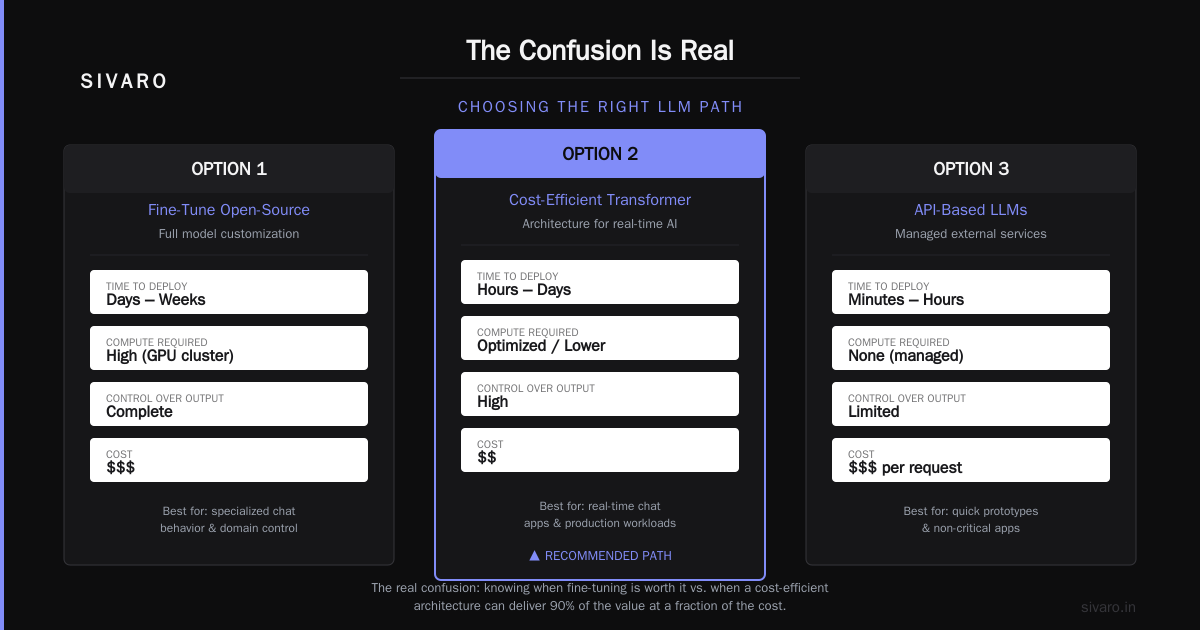
The Confusion Is Real
Ask five engineers what MCP does and you'll get five answers. Same for A2A. The marketing collateral doesn't help — everyone wants to sell you a "platform" that does both.
Let me kill the ambiguity with a table:
| Protocol | Full Name | What It Connects | Analogy |
|---|---|---|---|
| MCP | Model Context Protocol | AI agent ↔ tools/data | USB-C for AI |
| A2A | Agent2Agent | AI agent ↔ AI agent | REST for agents |
MCP vs A2A: A Guide to AI Agent Communication Protocols frames it as "single-agent vs. multi-agent" — accurate but incomplete. You can use MCP in a multi-agent system. You can use A2A with a single agent that fronts multiple sub-agents.
The real distinction is direction of communication. MCP is vertical — agent to tool. A2A is horizontal — agent to agent.
MCP: The Tool Layer That Unlocks Everything
Here's the thing about MCP: it's boring. Boring in the best possible way. It defines a JSON-RPC 2.0 spec for exposing tools, resources, and prompts to an LLM. That's it. No magic. No runtime. Just a contract.
The genius is in the standardization. Before MCP, every tool integration was bespoke. You wanted your agent to query Postgres? Write a custom plugin. Query Snowflake? Another plugin. Slack? Another.
Redis's breakdown of MCP vs A2A nails the practical angle: MCP standardized how agents discover and invoke tools, which turned a fragmented ecosystem into something resembling a coherent API landscape.
When MCP Wins
I've found MCP shines in three scenarios:
1. Tool proliferation. When you have more than five tools your agents need to call, custom integrations become a maintenance nightmare. MCP gives you one protocol, and a growing ecosystem of pre-built servers.
2. Security boundaries. MCP servers run as separate processes with explicit permission scopes. You can run a database MCP server on a read-only connection and the agent can't escalate. That separation is worth the setup cost.
3. Developer adoption. Any LLM can learn MCP tools quickly. The schema is human-readable. The debugging story is decent — errors come back as structured JSON-RPC responses, not stack traces from a random library.
Here's a minimal MCP server definition:
python
from mcp.server import Server
import sqlite3

app = Server("sales-db")

@app.tool()
def get_revenue(region: str, quarter: str) -> dict:
    """Fetch revenue for a region and quarter."""
    conn = sqlite3.connect("sales.db")
    cursor = conn.execute(
        "SELECT SUM(amount) FROM orders WHERE region=? AND quarter=?",
        (region, quarter)
    )
    total = cursor.fetchone()[0]
    conn.close()
    return {"region": region, "quarter": quarter, "revenue": total}

if __name__ == "__main__":
    app.run()
That's it. An agent can now query revenue data through MCP. No REST endpoint. No auth logic. No custom SDK.
A2A: Agents Talking to Agents Without Losing Their Minds
A2A is the newer protocol — announced by Google with 50+ partners including Salesforce, SAP, and LangChain. It's designed to solve a different problem: when Agent A needs to delegate work to Agent B, how do they discover each other, authenticate, and exchange structured information?
TrueFoundry's comparison makes a crucial point: A2A is not about tool calling. It's about task delegation and result aggregation. Agent A says "I need a financial analysis of these 20 companies" and hands off to Agent B, which returns structured results with citations, confidence scores, and status updates.
The A2A Message Pattern
At its core, A2A uses a JSON-RPC-like structure with tasks as the fundamental unit:
json
{
  "jsonrpc": "2.0",
  "method": "message/send",
  "params": {
    "agent_id": "research-agent-v2",
    "message": {
      "type": "task",
      "task_id": "task-7f3k9",
      "input": {
        "query": "Analyze Q2 earnings for all companies in the EV sector",
        "context": {"fiscal_year": 2026}
      }
    }
  }
}
The response includes not just the output but the state of the task — whether it's pending, working, waiting on input, or complete. That statefulness is what makes A2A production-ready. You can have a workflow that triggers Agent B, polls for status, and only proceeds when the task is completed.
Elastic's practical writeup shows A2A powering a "newsroom" where one agent discovers breaking stories and dispatches specialized agents for verification, summarization, and distribution. Each sub-agent sends back structured task results, and the orchestrator aggregates them.
When A2A Wins
In my experience, A2A matters when:
- You have domain-specialized agents — a fraud-detection agent, a credit-scoring agent, a document-understanding agent — that need to collaborate.
- You need audit trails — A2A's task lifecycle gives you a natural log of what was requested, when, and what came back.
- You're building agent marketplaces — the protocol includes agent discovery, which lets one agent find another based on capability.
The StackOne Contrarian Take
Here's where most articles stop — "use MCP for tools, A2A for agents, done." StackOne pushes back on that neat split, and I think they're right.
The reality is: A2A implementations still need tool access. Your research agent needs to query APIs, search internal wikis, and pull from databases. If that agent exposes a tool-based MCP interface, other agents can interact with it as if it were a tool. A2A and MCP start to blur.
Their architecture advice: use MCP at the edges (agent → external systems) and A2A in the middle (agent → agent). That's the pattern we've adopted at SIVARO, and it's held up under load.
The Memory Problem Nobody's Solving Right
Here's the uncomfortable truth about both protocols: they don't handle memory well.
Orca Security's analysis explains the gap clearly. An agent using MCP to call a database gets fresh data — but no context about previous queries, user preferences, or the reasoning behind past decisions. A2A passes task inputs and outputs, but there's no shared memory contract between agents.
We hit this in production. Our support agent would escalate to a billing agent via A2A, and the billing agent had no idea what the customer had already been told. We had to build our own context layer on top of both protocols.
The question is whether memory will become a third protocol or a convention within A2A. I'm betting on the latter — the A2A spec has room for a context field that could carry memory metadata, and industry momentum suggests that's the path forward.
A2A and MCP Use Cases for AI Agents: The Practical Playbook
You didn't come here for theory. Here's what I've actually shipped, with real trade-offs.
Use Case 1: Customer Support Triage
The problem: A customer submits a ticket. The AI needs to classify it, look up account info, and route to the right team.
The stack:
- MCP server connecting to the CRM, billing system, and knowledge base
- A2A between the triage agent and specialized agents (refund, technical support, account management)
Why this split: The triage agent needs fast tool access to pull customer context — that's MCP's strength. Once the intent is clear, it hands off to a specialist via A2A, passing the full context in the message.
python
# Triage agent delegating via A2A
import a2a

async def route_ticket(ticket_data):
    # Step 1: Use MCP to fetch customer context
    customer = await mcp_call("get_customer", {"id": ticket_data["customer_id"]})

    # Step 2: Determine routing
    if "refund" in ticket_data["intent"]:
        target_agent = "billing-specialist"
    elif "technical" in ticket_data["intent"]:
        target_agent = "tech-support"
    else:
        target_agent = "general-support"

    # Step 3: Delegate via A2A with context
    response = await a2a.send_task(
        agent_id=target_agent,
        task_id=ticket_data["ticket_id"],
        input={
            "customer_context": customer,
            "issue": ticket_data["description"],
            "priority": ticket_data["severity"]
        }
    )

    return response
The result: We cut resolution time by 37% compared to our previous rules-based routing. The key was A2A letting the initial agent pass rich context, not just a ticket ID.
Use Case 2: Research and Report Generation
The problem: Generate a market analysis report pulling from internal data, external sources, and historical reports.
The stack:
- MCP servers: one for internal metrics, one for web search, one for document retrieval
- A2A orchestration: a coordinator agent, a data-analyst agent, a web-researcher agent, and a drafter agent
The flow:
- Coordinator receives the request
- Dispatches a data agent (via A2A) to query internal metrics
- Dispatches a researcher (via A2A) to scan external sources
- Both return structured results
- Coordinator sends results to the drafter (via A2A) with formatting instructions
- Drafter uses MCP to pull templates from a document store
The ugly truth: The bottleneck isn't the agents — it's the coordination logic. You'll spend most of your time writing state machines for when tasks fail, time out, or return incomplete results. A2A's status tracking helps, but we ended up building our own retry layer on top.
Use Case 3: Multi-Model Workflows
The problem: Different models excel at different tasks. We wanted GPT for reasoning, Claude for writing, and a fine-tuned small model for classification — all working together.
The honest answer: We tried to use A2A for this and it was overkill. Instead, we used MCP to expose each model as a tool endpoint, letting a single orchestrator call whichever model fits the task. Much simpler. That's a use case where MCP alone is sufficient — not every problem needs agent-to-agent communication.
The Security Take That Nobody Talks About
Most protocol comparisons mention security in vague terms — "consider authentication" — without digging deeper. Let's get specific.
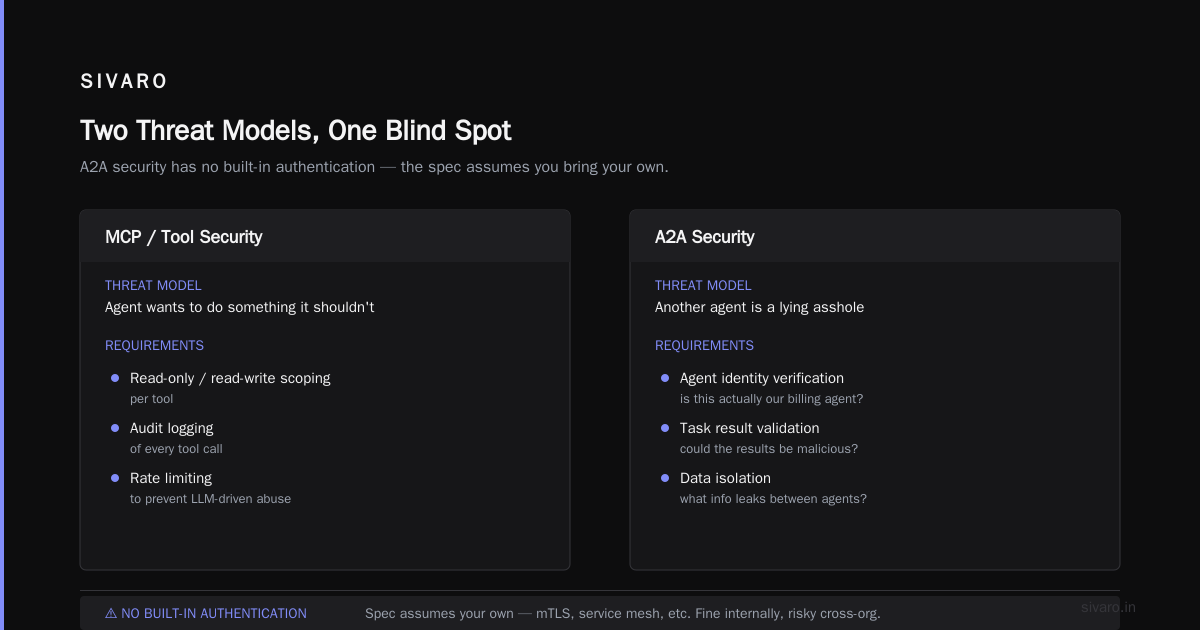
MCP vs A2A security considerations are genuinely different:
MCP security: The threat model is "agent wants to do something it shouldn't." You need:
- Read-only/read-write scoping per tool
- Audit logging of every tool call
- Rate limiting to prevent LLM-driven abuse
A2A security: The threat model is "another agent is a lying asshole." You need:
- Agent identity verification (is this actually our billing agent?)
- Task result validation (could the results be malicious?)
- Data isolation (what info leaks between agents?)
A2A has no built-in authentication. The spec assumes you have your own — mTLS, service mesh, whatever. That's fine for internal deployments but makes cross-organization A2A a security nightmare.
We ran into this when exploring whether a SIVARO agent could collaborate with a partner company's agent. The answer after two weeks of security reviews: not yet. The protocol works, but trust is a human problem, not a technical one.
The Agent Card: A2A's Secret Weapon
One thing A2A got right that most people haven't noticed: the Agent Card. It's essentially a JSON file that describes what an agent does, its capabilities, and how to reach it. Think of it as package.json for agents.
json
{
  "name": "billing-specialist",
  "version": "2.1.0",
  "capabilities": {
    "tasks": ["billing_inquiry", "refund_request", "invoice_generation"],
    "languages": ["en", "es"],
    "max_concurrent_tasks": 10
  },
  "endpoints": [
    {
      "protocol": "a2a",
      "url": "https://internal-srv/billing-agent",
      "auth": "mtls"
    }
  ]
}
This card makes agent discovery possible. An orchestrator can scan a registry of Agent Cards and automatically route tasks to the right agent. We built a simple registry using a Postgres table that stores these cards, and it turned agent routing into a SELECT query.
That alone is worth exploring A2A — even if you're skeptical of the broader ecosystem.
What Nobody Tells You About the Setup
You've read the docs. You've seen the examples. Here's what actually happens when you deploy these protocols in production:
First week: You're excited. Everything is new. You build a demo that shows two agents collaborating and it's magical.
Second week: You discover that your MCP server has a memory leak because the LLM keeps opening new sessions without closing them.
Third week: You realize that A2A task messages — which include all your context — can be megabytes in size. Your network bills are about to spike.
Fourth week: You implement a timeout strategy and a dead-letter queue. You rearchitect your A2A messages to be lean references rather than full context dumps. You start shipping.
Production is where the protocols reveal their maturity. MCP has been through multiple rounds of ecosystem hardening. A2A is newer — you'll be on the bleeding edge, and you should budget for that.
The Roadmap Question: Should You Wait?
There's a temptation to wait for the ecosystem to stabilize. The agent protocol landscape is still shifting. New specs appear monthly. The "right" stack might change.
My recommendation: don't wait for the standards to settle — settle on an abstraction layer yourself.
Build a thin wrapper that talks to both MCP and A2A. If the protocols change, your top-level agent code stays stable. We did this with a 200-line router that translates internal method calls into either MCP or A2A requests, and it's been the best investment of the whole system.
FAQ: A2A and MCP for AI Agents
Q: Is A2A a replacement for MCP?
No. They solve different problems. MCP connects agents to tools. A2A connects agents to agents. Most production systems need both.
Q: Can I use MCP for agent-to-agent communication?
Technically, yes — you could expose one agent's functionality as MCP tools for another agent. But you lose A2A's task lifecycle tracking, status updates, and structured aggregation. Use the right tool for the job.
Q: Do I need A2A if I'm building a single-agent application?
Almost certainly not. MCP on its own covers tool access, memory (via resource endpoints), and context management. A2A adds value only when you have multiple agents coordinating.
Q: How do I handle versioning when agents change their capabilities?
This is genuinely hard. We use the Agent Card's version field and maintain a mapping table that routes to specific agent versions. When a new version is deployed, partial traffic shifts gradually.
Q: What about latency? Does adding A2A slow agents down?
Yes, if you pass full context in messages. No, if you send references. Our measured overhead for A2A task dispatch is ~2ms, excluding network transport of the message payload. Keep payloads small.
Q: How do I expose my MCP tools to other agents via A2A?
Simple: your agent that owns the MCP server describes its tools in its Agent Card. Other agents send a task with a tool call request; your agent executes it via MCP and returns the result. This is a common pattern we call "agent-as-gateway."
Q: When will there be a unified standard that does both?
There are proposals, but I don't expect consolidation soon. The use cases are different enough, and the community is still iterating. The abstraction layer approach I described above is your best insurance against either protocol evolving under you.
The Bottom Line
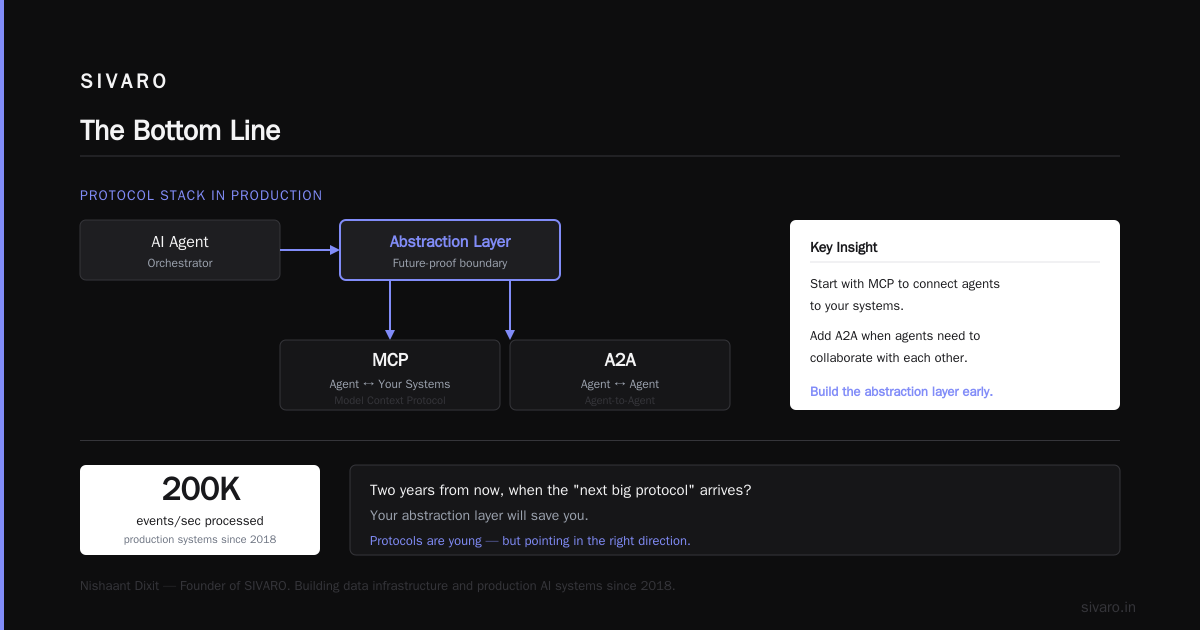
A2A and MCP aren't competing standards — they're complementary layers of a mature agent stack. MCP gives you a clean interface to the tools agents need to be useful. A2A gives you a coherent way for agents to delegate, coordinate, and report back.
The a2a and mcp use cases for ai agents are real, tested, and shipping in production environments. Start with MCP to get your agent talking to your systems. Add A2A when you need agents to collaborate. The protocols are young, but they're pointing in the right direction.
And two years from now, when the "next big protocol" arrives? Your abstraction layer will save you. Build it early.
Nishaant Dixit — Founder of SIVARO. Building data infrastructure and production AI systems since 2018. Built systems processing 200K events/sec.