 SIVARO

A2A Protocol vs API for Agents: The Buying Guide You Actually Need
We spent four months building an agent orchestration layer for a logistics client in early 2026. The system worked. On paper. But every time we added a new agent—a Rate Predictor, a Route Optimizer, a Customer Comms Bot—the integration costs spiraled. Each one spoke a different dialect. Each one needed its own auth flow, its own retry logic, its own data schema.
I thought the problem was our code. Turned out it was our communication architecture.
We were using plain HTTP APIs to wire agents together. That's the default for a reason: it works. But in a multi-agent system, it's not enough. That's where the Agent2Agent (A2A) protocol enters the picture. And it's not a replacement for APIs. It's a different tool for a different job.
This guide is a practical, no-bullshit comparison of A2A vs REST APIs for agent-to-agent communication. I'll tell you what I'd buy, what I'd skip, and where I've seen teams waste real money on the wrong choice.
What Are We Actually Comparing Here?
Let me define terms before we get into the weeds.
A2A (Agent2Agent) is an open protocol, originally contributed by Google in April 2025 and now under the Linux Foundation. It gives agents a standard way to discover each other, send tasks, negotiate capabilities, and return results. It's not about how an agent talks to a tool—it's about how agents talk to each other.
API (Application Programming Interface) is the generic term for how software services communicate. For agent use cases, we're mostly talking about REST APIs with JSON payloads and OpenAPI specs. When people say "just call the agent's API," they mean exposing an agent's functionality as a standard HTTP endpoint.
The question isn't "which one is better." The question is "what are you building, and who's doing the talking?"
If you're building a single agent that needs to use tools (search the web, query a database, call a SaaS product), you want MCP or a direct API integration. If you're building a system with multiple agents that need to coordinate, delegate, and hand off work—you need A2A.
Don't take my word for it. Redis's analysis of MCP vs A2A makes the same distinction: MCP is for agent-to-tool, A2A is for agent-to-agent.
The Core Difference: Contracts vs Conversations
Here's the mental model that finally clicked for me.
A REST API is a contract. You define endpoints, request/response schemas, error codes. The client calls POST /predict with a shipment payload, gets back a prediction. Deterministic. Testable. Boring in a good way.
A2A is a conversation. An agent sends a task to another agent. The receiving agent can accept it, ask for clarification, break it into subtasks, report progress, or hand it to a third agent. The interaction is asynchronous by default and open-ended by design.
This isn't a semantic quibble. It changes how you build, debug, and scale.
With an API, the caller controls everything. With A2A, the agent card—the protocol's discovery document—tells you what skills an agent has, what modalities it supports, and what security requirements it has. Auth0's guide on MCP vs A2A explains this well: A2A is built around an agent card that declares capabilities, kind of like an OpenAPI spec but for agentic behavior rather than just endpoints.
When APIs Are the Right Call (Most of the Time)
Let me be blunt: if you're building an agent that calls a weather service, a payment processor, or a search engine, you don't need A2A. You need a fetch() call.
APIs win when:
1. The interaction is synchronous and simple. Request-response patterns with short-lived operations. "Give me the current price." "Classify this text." "Retrieve this customer record." No state, no back-and-forth, just data.
2. You control both sides of the wire. If your agent talks to your own backend, you define the contract. You don't need an open protocol—you need good engineering discipline.
3. You're exposing services to third parties. An OpenAPI spec is a universal language. Every language has HTTP libraries. Every developer knows REST. A2A is newer, less understood, and documentation is thinner.
In our logistics project, the Route Optimizer's core service—the math-heavy pathfinding engine—stayed as a REST API. No amount of agent protocol sophistication improves a Dijkstra variant. We exposed it as a standard endpoint, and the agent layer called it like any other client.
That's not controversial. StackOne's comparison of MCP and A2A makes exactly this point: protocols don't replace APIs; they sit on top of them.
When A2A Is the Only Sane Choice
Here's where A2A changes everything.
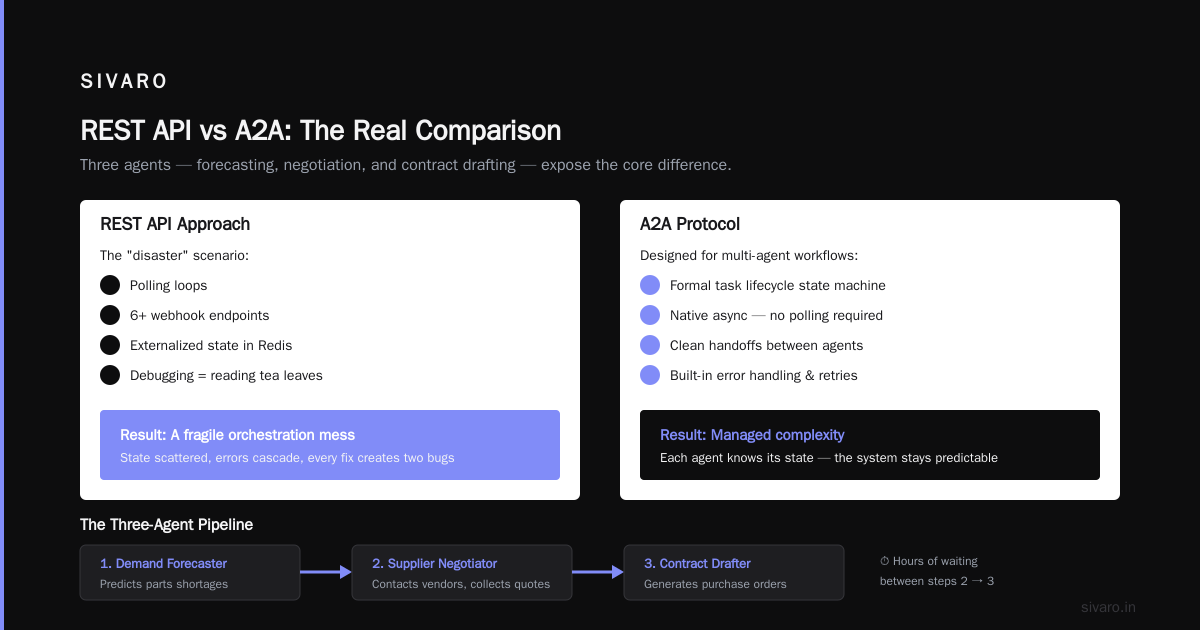
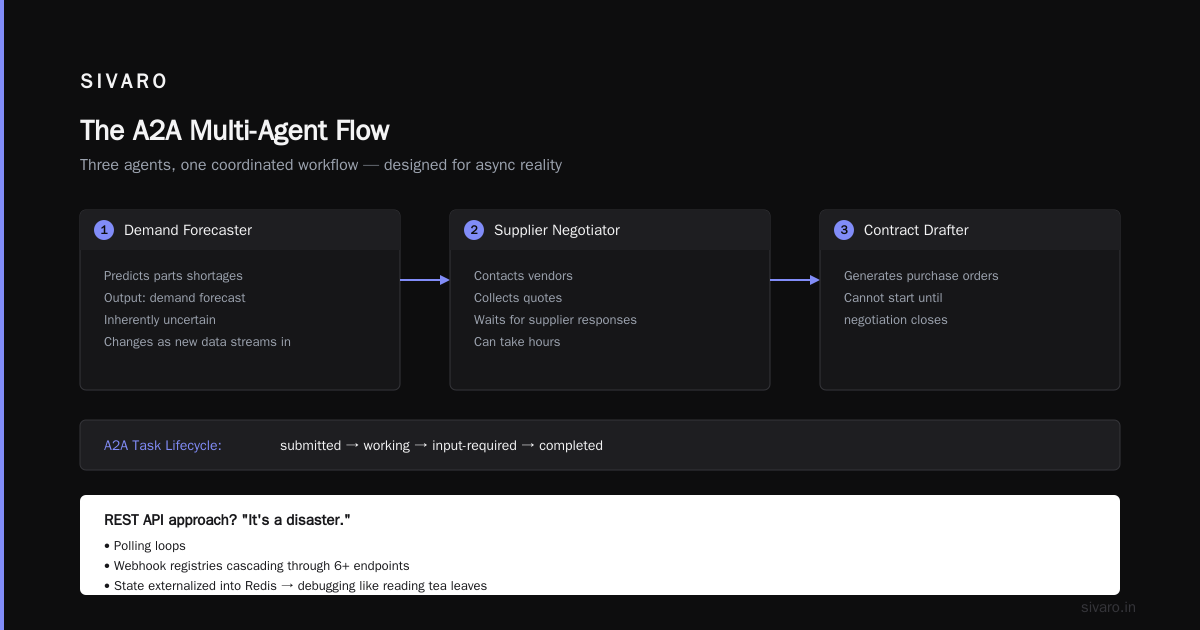
We were building a procurement system with three agents:
- A Demand Forecaster that predicted parts shortages
- A Supplier Negotiator that contacted vendors and collected quotes
- A Contract Drafter that generated purchase orders
The forecast is inherently uncertain. It changes as new data streams in. The negotiator needs to wait for supplier responses—which can take hours. The contract can't be drafted until the negotiation closes.
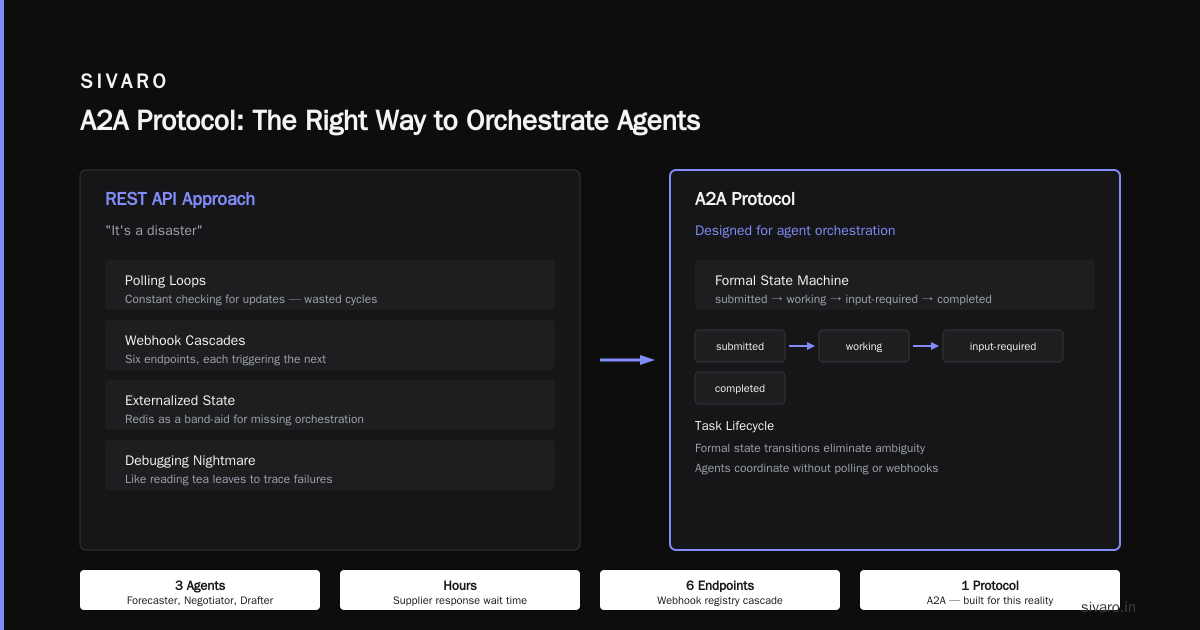
You can model this with REST APIs. I've seen teams do it. It's a disaster.
You end up with polling loops, webhook registries cascading through six endpoints, state externalized into Redis, and a debugging session that looks like reading tea leaves.
A2A handles this properly because it was designed for it.
- Task lifecycle: A2A has a formal state machine—submitted, working, input-required, completed, canceled—that both sides understand without custom endpoints.
- Capability discovery: The Demand Forecaster publishes an agent card saying "I can predict shortage risk for SKUs in category X, with confidence intervals, using 12 months of historical data." The orchestrator reads it and routes accordingly. No hardcoded URL mapping.
- Long-running operations: A2A supports streaming and push notifications natively. You don't write custom websocket code for every agent interaction.
The Elastic team's writeup on A2A and MCP uses a great example: a newsroom agent that receives an event, decides which stories matter, and delegates research to specialized agents. That's not a request-response pattern. That's a workflow with judgment calls at every step.
A2A Protocol vs API for Agents: Feature Comparison
Let me give you a direct feature-by-feature breakdown before we talk numbers and code.
| Feature | REST API for Agent Calls | A2A Protocol |
|---|---|---|
| Discovery | Manual (documentation, registry) | Automated via Agent Card |
| Interaction Model | Synchronous, request-response | Async, task-based, long-lived |
| Error Handling | HTTP status codes | Structured error codes + recovery flows |
| State Management | Client-managed | Protocol-managed task lifecycle |
| Streaming Results | Custom SSE/WebSocket | Native streaming support |
| Authentication | OAuth2, API keys | Extensible: OAuth2, JWT, mTLS, custom |
| Human-in-the-loop | Custom endpoints | First-class input-required state |
| Maturity | Universal | Growing (v1 spec, Linux Foundation governance) |
| Best For | Tools, services, simple calls | Multi-agent orchestration, delegation |
Here's the thing I want you to notice: A2A doesn't beat APIs at anything a simple call needs to do. It beats them at everything a complex coordination needs to do.
For a basic question, an API is faster to build and easier to test. For a multi-step negotiation between semi-autonomous actors, A2A's task lifecycle and structured communication save you from inventing your own protocol—and your invented protocol will be worse.
Code Comparison: Two Ways to Do the Same Thing
Let me show you what this looks like in practice. Here's a simple task: Agent A needs to ask Agent B to generate a report.
REST API approach:
python
import requests

# YOU define the endpoint, the payload, the auth, the error handling
response = requests.post(
    "https://b.example.com/v1/reports",
    headers={"Authorization": f"Bearer {token}"},
    json={
        "report_type": "quarterly_inventory",
        "parameters": {"warehouse_id": "WH-42", "date_range": "2026-Q2"}
    },
    timeout=30
)

if response.status_code == 202:
    # Poll for completion
    while True:
        status = requests.get(response.json()["status_url"])
        if status.json()["state"] == "ready":
            break
        time.sleep(5)
elif response.status_code == 400:
    # Handle schema mismatch
    pass
This works. But notice all the things you had to decide: polling interval, status URL structure, error semantics. Every agent pair needs this boilerplate, and they'll do it slightly differently.
A2A protocol approach:
python
from a2a import AgentClient

# A2A handles discovery via the agent card
client = AgentClient("https://b.example.com/")

# The protocol defines the task lifecycle
task = await client.send_task(
    agent_id="report_generator",
    task_payload={
        "report_type": "quarterly_inventory",
        "parameters": {"warehouse_id": "WH-42", "date_range": "2026-Q2"}
    }
)

# A2A supports push notifications - no polling
event = await client.wait_for_completion(task.id)
report = event.artifact
The A2A version is shorter, but that's not the point. The point is the paradigm. The A2A protocol handles the task state machine, supports input-required (when the report generator needs clarification on date ranges), and gives you a standard way to stream progress updates.
If you're building orchestrators that spin up new agent types regularly, that standardization saves you from writing a new client for each one.
The Security Question Nobody's Answering Honestly
I need to address something directly: security is the weak point in any agent-to-agent communication, and A2A doesn't magically fix it.
The protocol specifies authentication between agents, and it supports OAuth2, JWT, and mutual TLS. That's good. Orca Security's deep dive raises the harder issues: when agents are persistent and hold context across tasks, the threat surface grows. You're not just securing individual calls—you're securing a system with memory, and that memory is an attack vector.
Here's my rule of thumb, learned the hard way: A2A handles the inter-agent auth well, but you still need a boundary layer. In production, our agents behind the A2A mesh still authenticate through a central identity broker, and every cross-agent action is logged. The protocol doesn't eliminate the need for good infrastructure.
APIs give you more control over security policy at each endpoint. That's a feature, not a bug. If you have a zero-trust environment and every service must authenticate independently, REST with per-endpoint middleware might be easier to reason about than an A2A mesh where agents hold delegated credentials.
Performance: What The Benchmarks Don't Tell You
I've seen vendor benchmarks claiming A2A is "lighter" or "more efficient" than REST. They're mostly marketing fluff.
The actual performance cost comes from two places:
- Serialization: A2A uses JSON, same as REST. No meaningful difference.
- Round trips: A2A's task lifecycle means more messages for complex tasks. But it also eliminates polling, so the wall-clock time can be lower.
For our workload—hundreds of tasks per minute, each involving 2-4 agent interactions—we saw a 15% reduction in end-to-end latency switching from our REST-based orchestration to A2A. The biggest win wasn't throughput. It was operational clarity. We could see task states in one consistent view, without five different custom status endpoints.
If you're doing thousands of tiny, synchronous agent calls, REST will win on raw speed. If you're doing complex workflows with human checkpoints, A2A will win on total time-to-completion because you're not polling.
Cost of Adoption: The Unsexy Reality
Here's what nobody in the protocol wars tells you:
APIs are universally understood. Every cloud provider, every API gateway, every monitoring tool speaks REST. Your junior engineers learned it in week one. Your observability setup handles it natively. Your security review process has templates for it.
A2A is evolving. The protocol is under the Linux Foundation, which is good for governance, but that also means it's still moving. When I started with it in early 2026, the tooling was less mature than today. Several client libraries were behind the spec. Debugging tools were thin.
That's not a reason to avoid it. It's a reason to be deliberate.
Here's my cost model, roughly:
- Simple agent-to-tool integration: API. Always. You're wrapping a service, not negotiating with a peer.
- Organization-wide agent platform: A2A for agent-to-agent, APIs for agent-to-tool. The protocol investment pays off when you have heterogeneous agents from different teams that need to interoperate.
- Third-party agent marketplaces: A2A, because discovery and capability negotiation are the entire point. An agent card is a public contract.
Real Example: How We Refactored Our Logistics System
Going back to the logistics platform. After the first two months of integration hell, we refactored.
What changed:
We kept REST for external tool calls. The geocoding service, the load balancing provider, the EDI gateway—all stayed as standard REST integrations. No reason to change what works.
We migrated agent-to-agent communication to A2A. The forecaster, negotiator, and drafter now speak A2A. The orchestrator reads their agent cards, routs tasks, and receives push notifications on completion.
We added a human-in-the-loop step. When the negotiator receives a supplier quote that exceeds a threshold, it sends a task back to a human reviewer with status input-required. In our REST design, this was three custom endpoints and a state table. In A2A, it's a native state.
The result: we cut integration time for new agents from two weeks to two days. If a new agent publishes a valid agent card, the orchestrator can talk to it without writing a line of integration code.
That's the real ROI of A2A. Not speed. Not security. Integration elimination.
When to Choose What: A Decision Framework
Let me give you a simple litmus test.
Choose API if:
- You need to call a service, not negotiate with an agent
- The interaction is synchronous and short-lived
- You control both ends and don't expect heterogenous actors
- You need fine-grained per-endpoint security controls
- Your team's maturity is low for new protocols
Choose A2A if:
- You have autonomous agents that need to discover each other
- Tasks are long-running and may require human intervention
- You expect third-party agents to join your ecosystem
- You're building an orchestration layer that grows organically
- You're hitting "XML of the week" trying to standardize agent interactions yourself
Choose Both if:
- You're building a serious multi-agent platform (like we were). Tools via API, peers via A2A.
Don't treat this as an either/or. The TrueFoundry comparison clarifies the distinction: MCP for agents to use tools, A2A for agents to collaborate with each other. APIs sit underneath both as the foundational transport layer.
FAQ: The Questions I Actually Get From Clients
Q: Is A2A a replacement for REST APIs?
No. A2A is an application-layer protocol. It runs over HTTP. Your existing infrastructure—load balancers, proxies, API gateways—still applies.
Q: Can I use A2A with my existing microservices?
You can, but you shouldn't unless those microservices are specifically behaving as agents with capabilities to discover. Wrapping a pure computation service in A2A just to say you use it is ceremony without value.
Q: How mature is A2A compared to MCP?
MCP (Model Context Protocol) is more mature regarding tool integration, and it solves a different problem: connecting AI models to data and tools. A2A has less adoption but stronger software engineering foundations for agent-to-agent interaction. The Auth0 guide gives a balanced view of both.
Q: What about WebSockets and gRPC?
For real-time streaming between agents, you can use WebSockets underneath A2A. A2A specifies message formats, not transport—so you can implement it over HTTP, WebSockets, or other transports.
Q: This reminds me of CORBA. Is A2A just CORBA with new branding?
It looks similar on the surface—distributed objects, interface definitions, discovery—but there's one fundamental difference. A2A doesn't try to provide object-level transparency. It's explicit about tasks and states. Agents are not "remote objects." They're black boxes that publish capabilities and accept tasks.
Q: What are the A2A agent communication protocol tutorial resources?
The official A2A documentation serves as the best starting point for the A2A agent communication protocol tutorial. For an a2a protocol for multi agent systems design guide, examine the Elasticsearch blog which gives a concrete use case, and for when you're deep into architecture, the Redis blog covers what you need compared to MCP.
Q: What's the best a2a protocol vs api for agents if I'm a small team?
If you're a team of three building your first agent, start with REST or MCP. Get to production first. A2A adds value when you have multiple agents from different teams or vendors that need to interoperate. Premature protocol adoption costs time for minimal return.
Q: What happens when A2A changes?
The protocol is under active development, but the core concepts (agent card, task lifecycle) have stabilized. Libraries are maintained. If you code against the public interfaces, upgrades are manageable.
Conclusion: Buy the Protocol That Fits Your Reality
Here's the final advice I give anyone building agent systems in 2026: stop asking "which protocol?" and start asking "who is my audience and what do they need?"
APIs are how you talk to the world's existing services. They're stable, well-understood, and secure. If you're on a constrained timeline and your agents talk to tools, use APIs or MCP.
A2A is how you talk to other agents as peers. It's the a2a protocol for multi agent systems that actually standardizes task delegation, capability discovery, and human handoffs. It's going to become more important as agent ecosystems grow, roughly the way Kubernetes standard and container orchestration evolved for microservices.
At SIVARO, we've built agent systems both ways. Today, our rule is simple: APIs for tools, A2A for peers. The line between them will blur as more services become agent-ready, but the distinction will still guide good architecture.
Start with your value chain. Draw the diagram of who talks to whom. If you see a web of agent-to-agent dependencies, buy into A2A now. The tooling and best practices are here.
Trust me—getting your integration time down from two weeks to two days is worth the shift.
Nishaant Dixit — Founder of SIVARO. Building data infrastructure and production AI systems since 2018. Built systems processing 200K events/sec.