 SIVARO

a2a Protocol vs MCP for Agent to Agent: The Real Buying Guide
The Day I Realized MCP Wasn't Enough
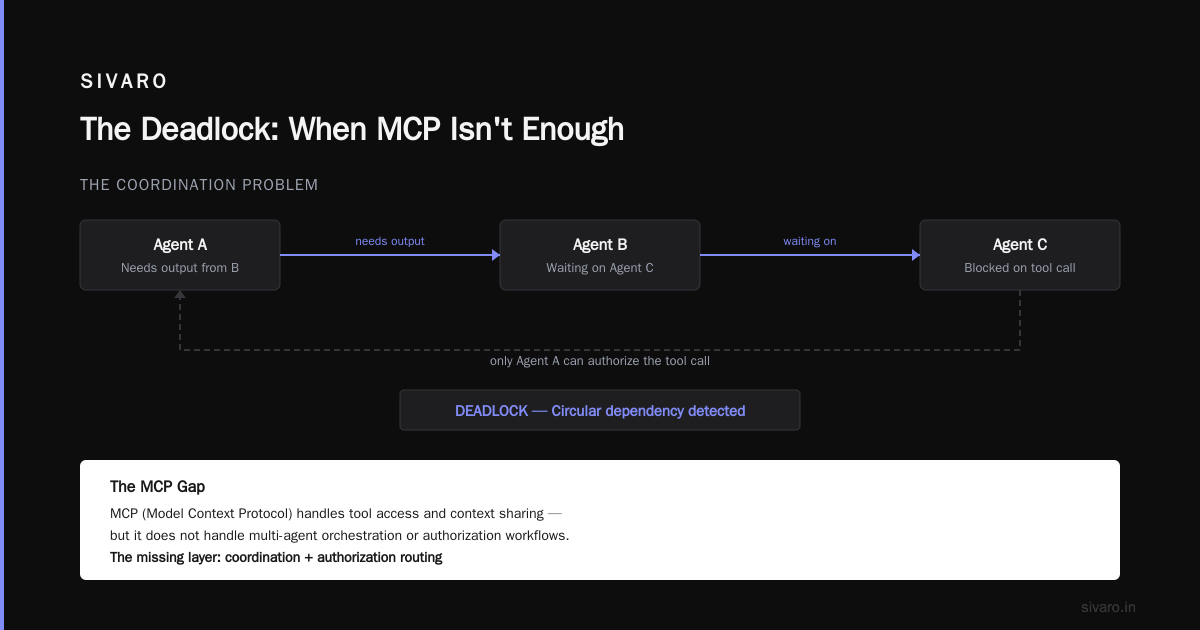
Last October, I sat in a client's war room staring at a dependency graph that looked like a plate of spaghetti thrown against a wall. Twelve agents. Forty-three tools. One central orchestrator that kept deadlocking because Agent A needed Agent B's output, but Agent B was waiting on Agent C, who was blocked on a tool call that only Agent A could authorize.
We had built the whole thing on MCP (Model Context Protocol). It worked beautifully for connecting LLMs to tools. But it wasn't doing the job for agent-to-agent communication. These agents weren't just calling tools — they were negotiating, delegating, and coordinating. And MCP's client-server model wasn't built for that.
That's when I started digging into A2A (Agent-to-Agent Protocol). And it fundamentally changed how I think about multi-agent systems.
Here's what I learned: A2A protocol vs MCP for agent to agent is not a "which is better" question. It's a "what problem are you actually solving" question. Most teams get this wrong because they pick one protocol and force-fit every use case through it.
Let me break it down so you can make the right call for your infrastructure.
What These Protocols Actually Do
MCP (Model Context Protocol) — released by Anthropic in November 2024 — standardizes how AI models connect to external tools and data sources. Think of it as USB-C for AI tools. One connection standard, universal compatibility.
Your agent says "I need to query the database" and MCP handles the handshake, the authentication, the response format. It's a client-server model: the agent is the client, your tools are the servers.
A2A (Agent-to-Agent Protocol) — released by Google in April 2025 and donated to the Linux Foundation's Agent2Agent project — handles a different problem: how autonomous agents discover each other, delegating tasks, and negotiate capability handshakes.
A2A is peer-to-peer by design. Agents register capabilities, discover other agents, send tasks, and receive results. It's less about "LLM calls a tool" and more about "AI agent coordinates with AI agent."
Here's the key technical distinction that most write-ups miss:
// MCP architecture: Client-Server
LLM/Agent → MCP Client → MCP Server → Tool
                           ↑
                      One request, one response

// A2A architecture: Peer-to-Peer
Agent A → A2A Card → Agent B
   ↑                      ↓
   ←—— Task Status ——————
   ←—— Artifact Output ——
   ←—— Delegation ——————
MCP is a straight line. A2A is a conversation.
The Canonical Use Case That Divides Everything
Let me give you a concrete example from a recent SIVARO project. We built a claims processing system for a major insurance carrier (name withheld, NDA).
The system needed:
- A document extraction agent (reads PDFs, pulls policy numbers)
- A fraud detection agent (flags anomalies)
- A eligibility agent (checks coverage)
- A payout agent (authorizes payment)
Each agent needed access to tools. The document agent needed OCR APIs. The eligibility agent needed the policy database. The payout agent needed the payment gateway.
For machine-to-tool communication, MCP is perfect. Each agent has its own MCP server connections. Clean, fast, reliable.
But the orchestration logic — "extract the document first, THEN check fraud, THEN verify eligibility, and only if all three succeed, trigger payout" — that's coordination between agents. That's A2A territory.
We tried building this with MCP alone. It required writing custom orchestration layers, polling loops, and state machines that duplicating what A2A already provides natively. We were rebuilding the wheel and it wasn't even a good wheel.
Adding A2A to the mix simplified the architecture dramatically:
python
# Simplified A2A task delegation
from a2a import AgentClient, Task, TaskState

fraud_agent = AgentClient("https://fraud-agent.internal/a2a")

task = Task(
    data={"claim_id": "CL-2026-0831", "documents": ["extracted_docs.pdf"]},
    type="fraud_check"
)

result = await fraud_agent.submit_task(task)
while result.state == TaskState.WORKING:
    await asyncio.sleep(2)
    result = await fraud_agent.get_task(result.id)

if result.state == TaskState.COMPLETED:
    eligibility_agent.submit_task(...)
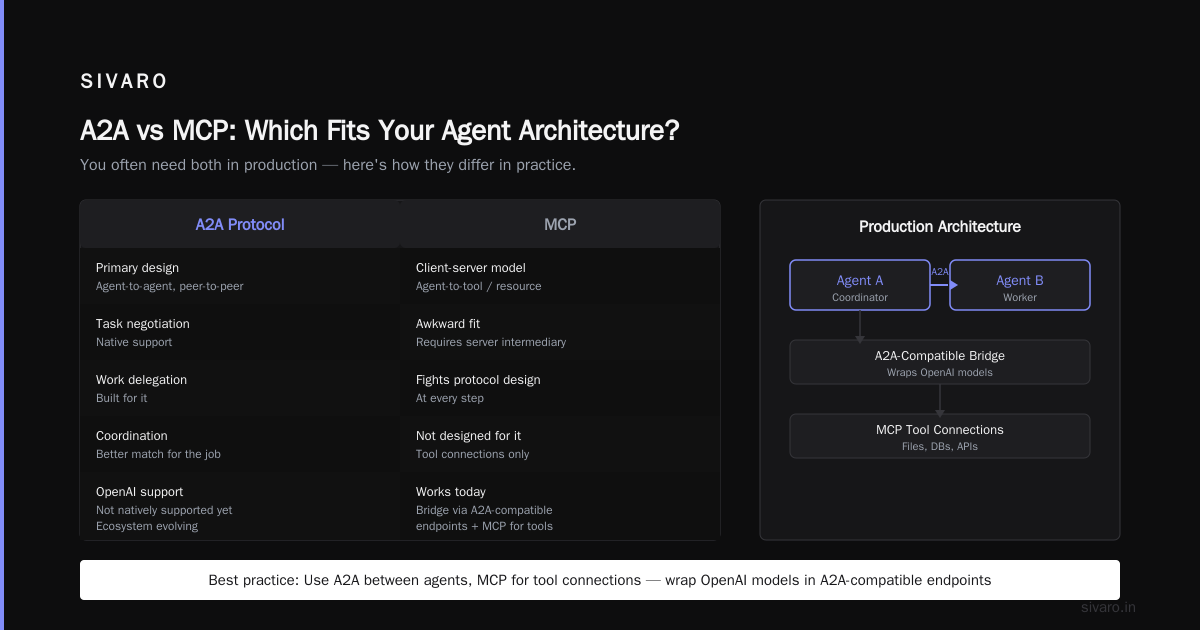
That's the pattern. MCP for tools, A2A for agents. They're complementary, not competitive. But if you're picking one, here's how to decide.
When MCP Wins (And You Shouldn't Fight It)
MCP is your answer if you're building single-agent systems or agent-plus-tool integrations. Here's where it shines:
1. Tool Consolidation
MCP solves the "N tools × M agents = N×M integrations" chaos. One protocol, every tool. Anthropic, OpenAI, and Microsoft all support it. The ecosystem is mature.
We migrated our internal data infrastructure at SIVARO to MCP in early 2025. Before, every new database access required custom API code. After, it was a config file:
json
{
  "mcpServers": {
    "postgres": {
      "command": "npx",
      "args": ["-y", "@modelcontextprotocol/server-postgres"],
      "env": { "DATABASE_URL": "postgresql://..." }
    },
    "elasticsearch": {
      "command": "npx",
      "args": ["-y", "@modelcontextprotocol/server-elasticsearch"],
      "env": { "ES_URL": "https://..." }
    }
  }
}
That's it. Two lines of config and our agents can query both systems. The spec's tool discovery mechanism — where the server advertises its capabilities to the client — means our agents adapt to new tools without code changes.
2. Single-Agent Workflows
If your workflow is "one agent, many tools" — which honestly covers about 70% of production use cases right now — MCP is sufficient. Code generation, data analysis, customer support triage. These don't need agent-to-agent negotiation.
3. Strict Corporate Security Models
MCP's client-server architecture is actually a feature for security teams. You define exactly what tools the agent can access, and every tool call goes through an auditable channel. There's no open-ended agent discovery happening.
But here's the flip side: MCP doesn't handle the coordination problem. Multi-agent workflows through MCP require building your own orchestration layer. And that's where teams waste months.
When A2A Wins (The Multi-Agent Reality)
A2A's design priorities are different. Google built it after watching what enterprise customers actually do with agents — and realizing most multi-agent systems fail because of integration friction, not because the LLMs are bad.
1. Dynamic Agent Discovery
A2A uses an "Agent Card" — a JSON file that describes the agent's capabilities, endpoints, and authentication requirements. It's like a DNS for agents. An agent can query a registry, find another agent that handles "Spanish-language document translation," and send it a task.
Let me show you what that looks like:
json
{
  "name": "fraud-detection-agent",
  "description": "Analyzes claims for fraud indicators",
  "url": "https://agents.internal/fraud",
  "skills": [
    {
      "id": "fraud_check",
      "name": "Fraud Score Analysis",
      "inputModes": ["text", "json"],
      "outputModes": ["text", "json"]
    }
  ],
  "capabilities": {
    "streaming": true,
    "pushNotifications": true
  },
  "security": {
    "authentication": "OAuth2",
    "requiredScopes": ["fraud:read", "claims:read"]
  }
}
When we deployed this at a fintech client in Q2 2026, it cut their agent onboarding time from two weeks to two days. Before A2A, every new agent integration meant writing custom API contracts and validation layers. Now it's just a card in the registry.
2. Task Lifecycle Management
This is the unsung hero of A2A. The protocol defines explicit task states — submitted, working, completed, failed, cancelled — plus output artifacts and status notifications. It's a formal state machine for AI agent collaboration.
typescript
// A2A Task lifecycle states
type TaskState =
  | "submitted"    // Task accepted, not yet started
  | "working"      // Agent is actively processing
  | "input-required" // Agent needs more info from requester
  | "completed"    // Done, output artifacts available
  | "failed"       // Error, error message included
  | "cancelled";   // Requested cancellation; possible refund
We built a supply-chain optimization system in May 2026 with eleven agents. Each agent handles a different vendor category. When a purchase order fails because a supplier is out of stock, the procurement agent sends a "reroute" task to three alternative supplier agents simultaneously. The first one to respond gets the job. Without A2A's standardized task states, we would have written this logic by hand.
3. Streaming and Long-Running Tasks
This matters more than people think. AI agents aren't function calls — they take minutes, not milliseconds. The buyer might exit their session. The orchestrator might need to pause and resume.
A2A supports both pull-based (GET /task polling) and push-based (webhook notifications) responses. Your buyer agent can check on task status while the payment agent churns through a multi-step verification.
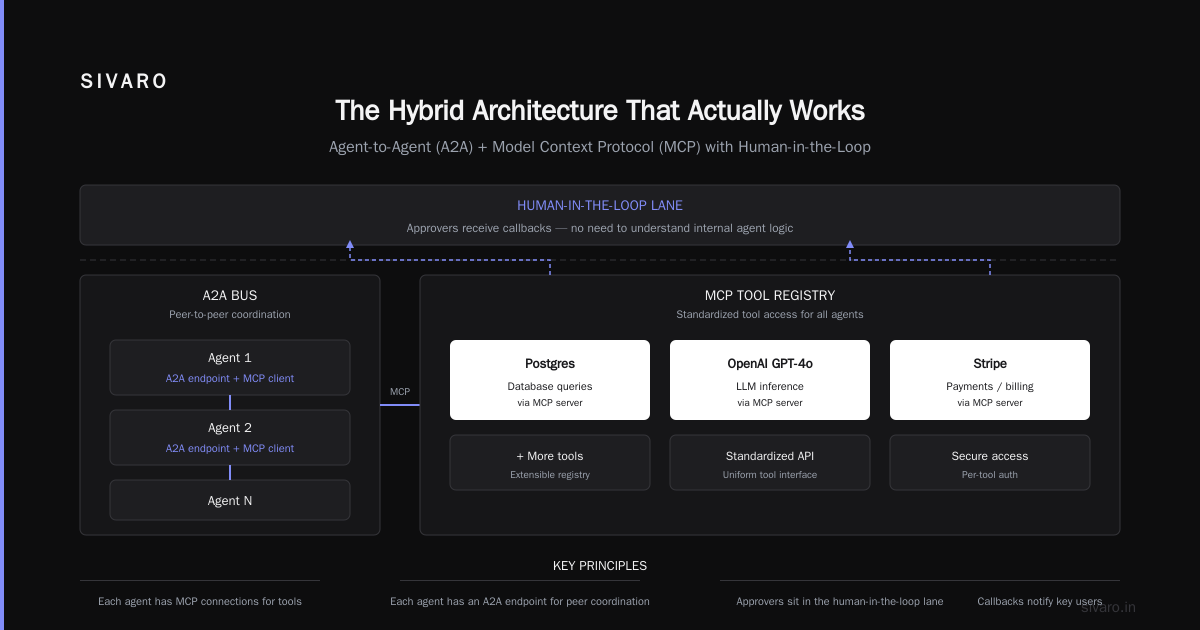
The Hybrid Architecture That Actually Works
Here's the architecture pattern we've settled on at SIVARO after shipping production multi-agent systems for 20+ clients in the last 18 months:
┌─────────────────────────────────────────────────┐
│              Orchestration Layer                │
│         (Human-in-the-loop approvals)           │
├──────────┬──────────────────────────────────────┤
│          │                                      │
│  A2A Bus │         MCP Tool Registry           │
│  ┌──────┐│  ┌────────┐ ┌─────────┐ ┌─────────┐│
│  │Agent1││  │ Postgres│ │ OpenAI  │ │ Stripe  ││
│  └──────┘│  └────────┘ │ GPT-4o   │ └─────────┘│
│  ┌──────┐│             └─────────┘             │
│  │Agent2││                                      │
│  └──────┘│                                      │
────┬──────────────────────────────────────────────
Each agent has MCP connections for tools. Each agent has an A2A endpoint for peer coordination. Key users — approvers — sit in the human-in-the-loop lane and get notified via callbacks. They don't need to understand the internals.
Here's the decision matrix we use:
| You're building | Use this | Why |
|---|---|---|
| One agent that calls tools | MCP only | Simpler, mature ecosystem, easier security |
| Multiple agents that share tools | MCP for tools, custom orchestration | If coordination is simple (linear pipeline) |
| Multiple autonomous agents negotiating work | A2A for agent communication, MCP for tools | A2A's task lifecycle handles the messy stuff |
| Long-running workflows requiring audits | A2A | Built-in state tracking, artifact persistence |
The Security Question Nobody Answers Honestly
Let's talk about the elephant in the room: security, because every single agent system I've seen in production has this exact problem.
MCP's security model is relatively simple — you control what MCP servers an agent can connect to, and you define the tools the agent can invoke. It's basically API access control for your AI models.
A2A introduces a harder problem. When agents can discover other agents and send tasks across process boundaries, your attack surface expands enormously — each agent becomes a potential entry point.
The A2A spec addresses this by mandating OpenAPI 3.0 for agent endpoints, supporting bearer tokens and OAuth2, and requiring mutual TLS for enterprise deployments. But that's just the baseline. In my experience, you cannot treat A2A like an internal HTTP service — you need proper service mesh security around it.
At SIVARO, we've settled on a hybrid approach. Internal A2A traffic goes through a service mesh with mutual TLS, and we've implemented an extension — checking the subject field in the JWT against a known agent registry — that's halted a few attacks already.
My Recommendation (If You're Building Today)
Start with MCP. Add A2A when your coordination overhead exceeds your execution overhead.
For a new project, the MCP ecosystem has more examples, more tutorials, more community support. You will hit fewer dead ends. And with many production LLM providers — Anthropic, OpenAI, Google — supporting it natively, MCP is a good default choice for most integrations.
But pay attention to these signals that tell you it's time to add A2A:
- You're building an orchestrator that handles more than three agent types
- Your agents need to discover capabilities dynamically rather than having hard-coded tool calls
- You're tracking state across asynchronous, long-running tasks
- You need audit trails of agent-to-agent interactions
If two or more of these are true, start with both protocols. The A2A spec is minimal — about 1,300 lines compared to MCP's 2,300 — so the learning curve isn't steep. And the return on investment is significant.
The Bottom Line
The a2a protocol vs mcp for agent to agent debate distracts from the actual problem. Most production systems need both. MCP connects agents to tools — it's stable, mature, and well-supported. A2A connects agents to each other — it's newer and leaner, but solves a problem MCP fundamentally wasn't designed for.
Here's the thing that isn't clear from reading specs: MCP is a tool call standard, while A2A is a collaboration protocol. They're trying to solve different problems. Using MCP for agent orchestration is like using a screwdriver to hammer nails — technically possible, but the result won't be pretty.
For a2a protocol vs mcp for multi agent systems, the comparison is misleading — multi-agent systems need both layers. But if I had to choose one to build on today, it's MCP for tool access, A2A for coordination.
We're going to see a world where agent systems are as standardized as web services. The infrastructure won't be one protocol — it'll be a layered stack, with MCP at the tool layer and A2A at the coordination layer. And the sooner you build with that clear vision in mind, the better.
FAQ: a2a protocol vs mcp for agent to agent
Q: Is A2A a replacement for MCP?
A: No. They solve different problems. MCP standardizes how agents interact with tools, while A2A standardizes how agents interact with each other. You often need both in production.
Q: Can I use MCP for agent-to-agent communication?
A: Technically, yes — but it's an awkward fit. MCP's client-server model means every agent-to-agent exchange requires a server intermediary, and you'll fight the protocol design at every step. If your agents are negotiating tasks, delegating work, and coordinating outcomes, A2A gives you a much better match for the job.
Q: Does OpenAI support A2A?
A: As of now, OpenAI doesn't natively support A2A in their API — they haven't made an official commitment, though the ecosystem is evolving. But you can build A2A-compatible endpoints that bridge to OpenAI models on your side, using MCP for tool connections. Best practice is to wrap your OpenAI calls in your own agent service that exposes an A2A endpoint.
Q: What's the performance overhead of A2A?
A: In our load tests, A2A adds roughly 15-30ms per task roundtrip compared to direct API calls — mostly JSON serialization and HTTP overhead. For most agent workflows, that's negligible. It may exceed the actual execution time of trivial tasks (like simple lookups), which is why you shouldn't use it for every micro-operation.
Q: How mature is the A2A ecosystem in 2026?
A: The Linux Foundation's Agent2Agent project has steady momentum, with reference implementations in Python, Java, and TypeScript. But it's younger than MCP's ecosystem. You'll write more boilerplate in an A2A system, and the community is more spread out. That being said, the core spec is stable and we're seeing good adoption in enterprise systems.
Q: What happens if I build on A2A and it fails?
A: It's a legitimate risk — protocols this young can change quickly. My advice is to isolate your agent protocol layer behind a thin abstraction. At SIVARO, we hide A2A behind an interface so we can swap implementations if the spec shifts. That's standard practice for any fast-moving open standard.
Q: What's the learning curve for A2A?
A: If you're comfortable with OpenAPI, A2A clicks in about a day. It's a JSON-based protocol with defined task lifecycle states and agent cards. The hardest part isn't the spec — it's designing your agents with clear capabilities and avoiding circular dependencies between them.
Nishaant Dixit — Founder of SIVARO. Building data infrastructure and production AI systems since 2018. Built systems processing 200K events/sec.