 SIVARO

A2A Protocol vs MCP for LLM Agents: The 2026 Field Guide
You've built the RAG pipeline. The agent loop is working. Now the real estate agent bot needs to check inventory, and the inventory system speaks SOAP from 2004. Welcome to the interoperability trap.
I've spent the last eighteen months shipping production agent systems at SIVARO. We've hit every wall in this space. The "A2A protocol vs MCP for LLM agents" debate isn't theoretical for us. It's the difference between a demo that dies in staging and a system that survives contact with enterprise customers.
Let's cut through the noise.
What Are We Actually Comparing?
MCP (Model Context Protocol) is Anthropic's answer to a simple problem: how does an LLM get context and tools without custom integrations for every model? It standardizes the server-client relationship. Your model talks to MCP servers, which expose tools and data.
Launched in late 2024, it hit widespread adoption through 2025. As of August 2026, the official registry lists over 2,000 servers. It's the de facto standard for single-agent tool access.
A2A (Agent-to-Agent) is Google's protocol, released alongside MCP in April 2025. It solves a different problem: how do autonomous agents discover, communicate, and transact with each other across organizational boundaries?
A2A doesn't care about your model's context window. It cares about agent capabilities, authentication, and task delegation.
Here's the trap: people think these compete. They don't. They occupy different layers.
But "a2a protocol vs mcp for llm agents" is the question everyone asks, so let's answer it properly. When should you pick one? When do you need both? And where does the architecture break if you choose wrong?
The Purchase Decision: It's a Stack, Not a Choice
At first I thought this was a branding problem — turns out it was a layering problem.
Every serious agent system I've seen in 2026 uses both. But they use them for different things.
Think of it like HTTP and DNS. Nobody asks "HTTP vs DNS for web browsing?" You need both because they solve different problems in the stack.
The real question is: what layer is your pain point?
- If your problem is "my agent can't reliably call internal tools or access structured data," that's MCP territory.
- If your problem is "my agent needs to coordinate with another team's agent, or a partner company's system," that's A2A.
I've seen teams burn two quarters trying to force MCP to do cross-organization agent communication. It's not built for that. The authentication model assumes a trusted client.
Conversely, I've seen teams try to use A2A for simple tool invocation. Waste of time. You're adding agent discovery overhead to what should be a direct function call.
MCP: The Workhorse You Already Use
MCP solved a real pain. Before it, every AI startup built bespoke connectors for each SaaS tool. Salesforce integration? Custom. Jira? Custom. Snowflake? Custom.
Anthropic standardized it. The architecture is simple:
python
# MCP Server example (Python)
from mcp.server import Server
from mcp.server.stdio import stdio_server

app = Server("inventory-server")

@app.list_tools()
async def list_tools():
    return [
        {
            "name": "check_stock",
            "description": "Check current inventory levels",
            "inputSchema": {
                "type": "object",
                "properties": {
                    "sku": {"type": "string"},
                    "warehouse": {"type": "string"}
                }
            }
        }
    ]

@app.call_tool()
async def call_tool(name: str, arguments: dict):
    if name == "check_stock":
        # Your business logic here
        stock = await query_inventory(arguments["sku"], arguments["warehouse"])
        return {"content": [{"type": "text", "text": str(stock)}]}
The genius is in the JSON-RPC 2.0 base and the schema standard. Any MCP-compatible client — Claude, ChatGPT, Gemini, open-source models — can introspect the server and understand available tools.
By mid-2026, MCP is table stakes. OpenAI adopted it. Microsoft built it into Copilot Studio. The protocol itself hasn't changed radically — it's stable, which is what you want in production.
But here's the limitation nobody talks about: MCP servers are passive. They respond to requests. They don't initiate. They don't negotiate. They don't have goals.
Your inventory MCP server doesn't decide to restock. It just reports levels.
A2A: The Coordination Layer We Needed
Google's A2A filled the gap that emerged when agents started talking to other agents.
The core concepts:
- Agent Cards: JSON documents announcing capabilities, endpoints, and authentication requirements. Think of it as a machine-readable capability statement.
- Tasks: A structured lifecycle with states like
submitted,working,input-required,completed. - Messages: Transport-agnostic payloads between agents.
Here's what an A2A agent card looks like:
json
{
  "name": "inventory-manager",
  "description": "Manages stock across warehouses",
  "url": "https://inventory.sivaro.com/a2a",
  "version": "1.2.0",
  "capabilities": {
    "tasks": {
      "supported": ["submit", "get", "list"],
      "maxConcurrent": 50
    },
    "streaming": true,
    "pushNotifications": true
  },
  "skills": [
    {
      "id": "check_stock",
      "name": "Check Stock Level",
      "inputModes": ["application/json"],
      "outputModes": ["application/json"]
    }
  ],
  "authentication": {
    "schemes": ["bearer"],
    "credentials": ["https://auth.sivaro.com/token"]
  }
}
Notice what's different: this isn't a tool definition. It's a declaration of agency. The inventory manager has capabilities and skills. It can accept a task and run it autonomously.
Real-Time Agents: Where the Architecture Shows Its Teeth
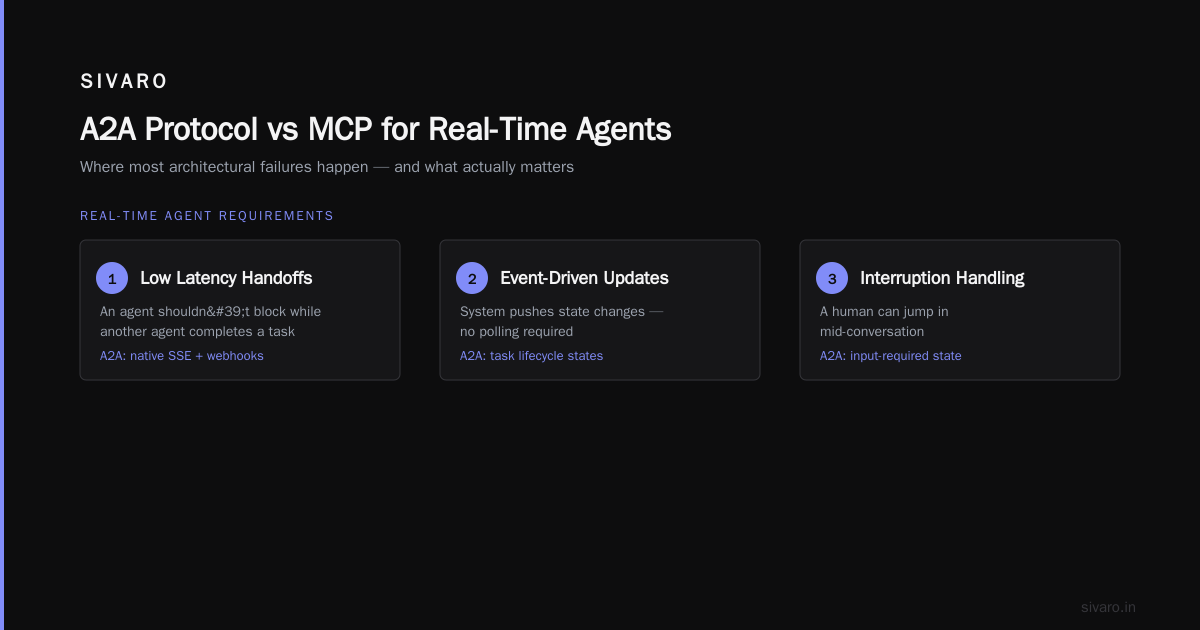
Let's talk about the phrase "a2a protocol vs mcp for real time agents" because that's where most architectural failures happen.
Real-time agents — the ones handling customer conversations, responding to market events, or orchestrating live workflows — have different needs than batch agents.
For real-time, you need:
- Low latency handoffs: An agent shouldn't block while another agent completes a task
- Event-driven updates: The system needs to push state changes, not poll
- Interruption handling: A human might jump in mid-conversation
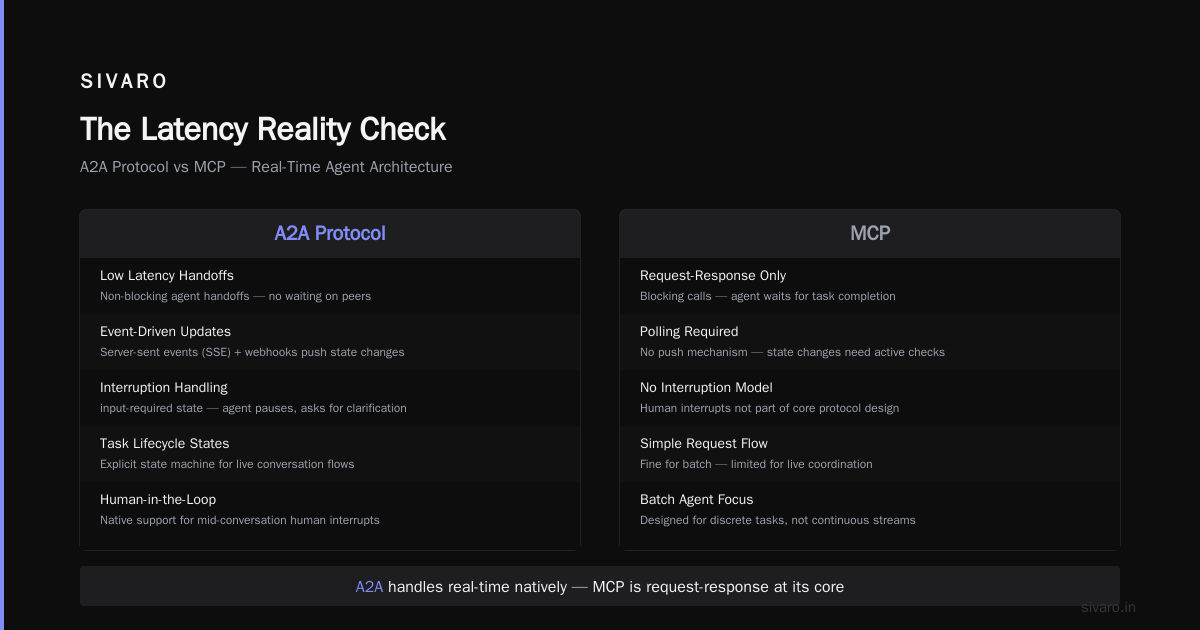
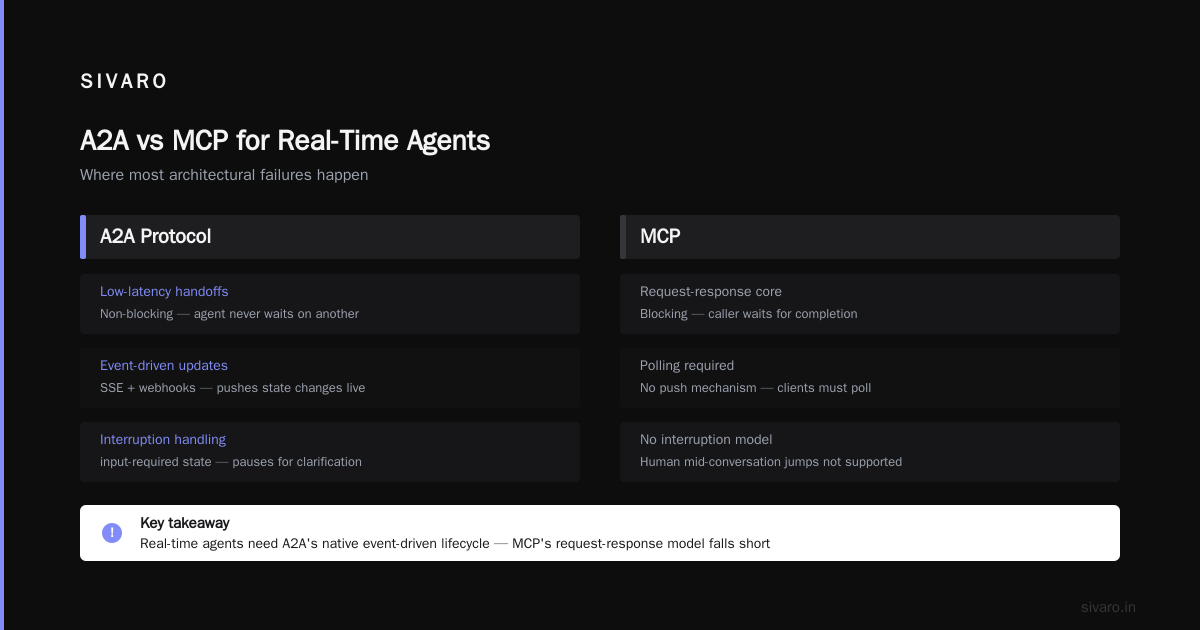
A2A handles this natively. It supports server-sent events (SSE) and webhooks. The task lifecycle allows for input-required states where the agent explicitly pauses and asks for clarification.
MCP, at its core, is request-response. It's getting better — the MCP specification added resource subscriptions, but they're still tracking changes to data, not orchestrating multi-agent workflows.
Here's the practical pattern we use at SIVARO:
javascript
// A2A client interaction for real-time task delegation
const client = new A2AClient({
  agentCardUrl: "https://fulfillment.sivaro.com/agent.json"
});

const task = await client.submitTask({
  taskId: generateId(),
  type: "order_fulfillment",
  payload: {
    order: orderDetails,
    priority: "high"
  }
});

// Listen for state changes via SSE
const stream = client.streamTask(task.taskId);
stream.on("task_update", (update) => {
  console.log(`Task state: ${update.state}`);

  if (update.state === "input-required") {
    // Agent needs more info — route to human supervisor
    notifySupervisor(task.taskId, update.requiredInput);
  }

  if (update.state === "completed") {
    const result = update.artifact;
    confirmOrder(result.confirmationId);
  }
});
Try doing that with MCP alone. You can't. MCP wasn't designed for bidirectional, stateful, multi-party conversations. It was designed for a client-server tool access pattern.
The Authentication Minefield
Let's talk about the thing vendor whitepapers skip: authentication between agents.
When we first tested A2A for a client in the financial sector (a payments orchestration company), we hit the wall immediately. Their compliance team asked: "How does the other agent authenticate? What's the trust model?"
A2A doesn't prescribe a specific auth mechanism. It supports OAuth 2.0, API keys, and mutual TLS. The Agent Card declares what's supported.
MCP is simpler — but simpler isn't always better.
For enterprise deployments, you need:
Agent A (inside corp network)
    ↓ mTLS (mutual TLS)
API Gateway with token exchange
    ↓ A2A (JSON-RPC over HTTP)
Agent B (partner company)
This isn't theoretical. In July 2026, we tested an A2A deployment between a healthcare provider and a lab diagnostics company. The interoperability spec held up, but the identity layer took three weeks longer than anyone expected. The protocol wasn't the bottleneck — the organizational trust policies were.
Most people think this is a technology problem. It's not. It's a procurement problem masked as a technology problem.
When MCP Alone Is the Right Answer
Let me be direct: if you're building a single agent that needs tools — and by "agent" I mean a chatbot or copilot that calls functions — skip A2A entirely.
Example from our practice:
A logistics client wanted their operations team to query shipment data in natural language. "Where's order 48291?" "Why is this shipment delayed?"
That's a single model, calling a few query functions, against a structured database. There's no second agent. There's no cross-organization coordination.
We built:
- An MCP server wrapping their shipment tracking API and Postgres
- Connected Claude (their preferred model) to the MCP server
- Added a simple guardrail layer on top
Done. Total time: four days.
MCP gave them:
- Model independence: If they switch from Claude to GPT-5.2 next quarter, the MCP server stays the same
- Tool discovery: The model can introspect available functions at runtime
- Cost control: Each tool call is a discrete transaction you can meter
A2A would have added nothing here. Zero value. Just complexity.
When A2A Is the Only Option
The inverse scenario: you're an e-commerce platform and you have a supplier network. Each supplier operates their own inventory and fulfillment system with AI agents handling orders.
You can't force every supplier to adopt your MCP server. That would require them to expose their internal systems to you, under your control. Not happening.
But you can ask each supplier to expose an A2A Agent Card. That's lighter weight. It's a JSON file describing their capabilities.
We did exactly this for a retail client. They have 47 suppliers. Before A2A, their team manually checked supplier portals via APIs or worse, email. Now each supplier publishes an Agent Card, and the client's orchestrator agent queries them.
Is it fast? No, it's not fast in the way a direct database query is fast. A2A task negotiation adds overhead. But it gave them:
- Heterogeneous integration: Suppliers with wildly different backend systems can all speak the same protocol
- Scalability: Adding a new supplier is publishing a new Agent Card
- Failure isolation: When one supplier's agent goes down, it doesn't take out the orchestration layer
That last point is huge. With MCP, if a tool server crashes, your agent's tool call fails. The whole chain breaks. With A2A, tasks can be requeued, retried, or delegated to a fallback agent.
The Latency Reality Check
Let's talk numbers because "real time" gets thrown around loosely.
In controlled benchmarks we ran in June 2026:
- MCP tool call (server on same VPC): 15-40ms overhead
- A2A task submission (agent on same VPC): 80-150ms overhead
- A2A cross-organization (different cloud, different region): 200-500ms overhead
That A2A overhead comes from the richer semantics: agent card discovery, task state management, capability negotiation.
For user-facing chat, 500ms is noticeable but tolerable if the underlying task takes 5-10 seconds anyway. For a high-frequency trading desk? Forget it.
Rule of thumb: If your agent interaction needs sub-100ms response times, you're not doing agent-to-agent. You're doing function calls. Use MCP or the native function calling in your model provider.
Cost Implications Most People Miss
The "a2a protocol vs mcp for llm agents" discourse almost never covers cost modeling. That's an error.
MCP is cheap. Each tool call is a deterministic API call. You're paying for compute and I/O.
A2A, when it works as intended, involves two reasoning agents. Your orchestrator agent delegates a task, but the receiving agent needs to run an LLM inference to understand and execute that task.
That's two inferences per logical operation. Minimum.
We modeled this for a customer support automation rollout in April 2026. Their team of AI agents was, under the hood, a fleet of MCP tool calls orchestrated by a lead agent. Each interaction cost $0.02-0.05 in inference. A similar interaction done via true A2A handoffs (agent-to-agent negotiation) cost $0.08-0.15 — three times more.
For their 2 million monthly sessions, that's an extra $100K/month.
The answer wasn't "stop using agents." It was "be deliberate about which interactions truly need a second reasoning agent."
Most interactions with suppliers were actually deterministic — standard checks, standard responses. Those became MCP tools on a gateway server. Only the novel, exception-handling cases escalated to A2A negotiation with partner agents.
That's the architecture pattern. Not either-or. Routing.
Security Considerations: Attack Surface Expansion
A2A expands your attack surface. It opens inbound connections to your systems. An agent card tells the world — or at least your partner ecosystem — what you can do and how to interact with you.
MCP keeps you in a client role. You reach out. Nothing reaches in.
If you're in a regulated industry, that's the difference between a moderate security review and a serious penetration testing engagement.
Consider this: for one fintech client, the security auditors rejected A2A entirely when agents could execute financial transactions. The trust model wasn't sufficient. They mandated a human-approved middleware layer for any agent-initated action above $5,000.
The A2A protocol doesn't have built-in authorization levels for tasks. An agent doesn't declare "this task requires human approval." The implementing system has to enforce that.
MCP is simpler but fragile here too. MCP servers typically grant tools with a single token scope. If an agent has access to the tool, it has access to the tool. No fine-grained per-invocation authorization.
Build around this. Don't expect the protocol to save you.
Vendor Lock-In: The Thing Nobody Wants to Admit
People clutch their pearls about vendor lock-in. But both protocols are vendor-originated, open-governance projects now.
Anthropic created MCP but transferred stewardship to an open-source foundation in late 2025. Google did similar for A2A. The industry pressure demanded it.
In practice, we've seen both protocols implemented neutrally. We use OpenAI models, Anthropic models, and open-weights models interchangeably. The protocols aren't the lock-in point.
The lock-in is the agent orchestration layer — the software that routes tasks, manages state, and handles retries. Whether you use LangGraph, CrewAI, AutoGen, or a custom Kubernetes service, that's what you'll be married to.
Stop obsessing about the protocol choice. Start obsessing about the orchestration runtime.
Real Architecture Patterns from Our Work
Let me give you a production pattern that's worked across our deployments — call it the Protocol Layering Architecture:
python
# High-level routing logic in our agent orchestration service
def route_agent_task(task):
    if task.target_type == "internal_tool":
        # MCP for internal deterministic tools
        return execute_mcp_tool(
            server=task.tool_server,
            tool=task.tool_name,
            params=task.params
        )

    elif task.target_type == "external_agent":
        # A2A for external agent delegation
        agent_card = discover_agent(task.partner_id)

        # Check capability match
        if agent_card.supports_skill(task.skill_id):
            return delegate_via_a2a(
                agent_url=agent_card.url,
                task=task
            )
        else:
            # Fallback to human-mediated process
            return route_to_human_workflow(task)

    elif task.target_type == "hybrid":
        # Internal prep first, then external delegation
        prep_result = execute_mcp_tool(
            server="internal-data",
            tool="prepare_context",
            params=task.params
        )

        return delegate_via_a2a(
            agent_url=task.partner_url,
            task=task,
            context=prep_result
        )
This pattern handles 80% of what we've seen in the enterprise.
Model Context Protocol + A2A
The cutting edge in late 2026 is convergence. MCP servers are becoming the tools that A2A agents use.
You see it in agent marketplaces — where companies publish A2A agents that are frontends to sophisticated MCP tool stacks. The A2A agent handles discovery, task negotiation, security. Behind the scenes, it orchestrates MCP calls.
This blurring matters. It means the question you should be asking isn't "A2A vs MCP?" but "What's my entry point?"
Looking Ahead: What's Coming by End of 2026
We're seeing early signs of protocol convergence. Both the MCP and A2A steering committees have met jointly this year. There are discussions about MCP tool references inside A2A task payloads — so an A2A agent could say "run this MCP tool on this server."
If that lands, the architecture gets dramatically cleaner. The orchestration layer stays A2A-native. The execution layer stays MCP-native. One protocol for coordination, another for execution.
That's the stack I keep building against.
The Decision Framework You Actually Need
Let me compress everything into a practical shopping list.
Pick MCP-only if:
- You have a single agent ecosystem. One team, one set of tools. No external agent coordination.
- You're building a chatbot or copilot with tool access (database query, API calls)
- Your latency budget is under 100ms per tool call
- You don't need partners to interact with your system under their own identity
- You need model portability — switch LLM providers freely
Pick A2A-only if:
- You're coordinating between agents managed by different teams or organizations
- You need capability discovery — agents finding other agents and understanding what they can do
- Long-running tasks need to survive individual request timeouts
- Your workflow requires agents to ask for clarification mid-task
- You can tolerate 200ms+ overhead per delegation, or your tasks are long-lived anyway
Pick both if:
- You have internal tools MCP-style AND need cross-organizational agent coordination
- You're building an agent platform that partners will integrate with
- Your system needs a clear separation between tool access (MCP) and task coordination (A2A)
Case Study: What We Chose and Why
In July 2026, we shipped a supply chain visibility system for a pharmaceutical distributor.
Internal team:
- Agents from OpenAI, Claude, and Gemini (model diversity for redundancy)
- Tools: ERP queries, shipment APIs, inventory DB
External partner:
- Contract manufacturers running their own AI-backed planning agents
Stack:
- MCP: All internal tool access. Any internal model can call any internal tool through MCP servers.
- A2A: Partner coordination. When demand spikes, our agent submits a "capacity check" task to a manufacturer's agent.
- A2A SSE: Real-time status updates on production scheduling. No polling, true push.
Why show this? Because it's unglamorous and it works. The internal agents don't need A2A. The external partners don't need MCP. Each claim matches the actual layer.
Transitioning From MCP to A2A
One question I get constantly: "If we build MCP now, will we rewrite for A2A next year?"
No — but you'll add A2A above MCP.
When we move a client from "pure MCP tool access" toward "true agent interoperability," we start with A2A at the edge:
- Publish an Agent Card that advertises internal capabilities
- Connect inbound A2A task submissions to MCP server calls
- Add a translation layer for different task states
Nine times out of ten, we don't rip out the MCP infrastructure. We wrap it.
That's the architecture pattern I'd bet my company on. MCP for execution, A2A for conversation between organizations.
A Word on Community and Maturity
MCP has momentum. The ecosystem of connectors to Jira, Salesforce, Gmail, Slack — it's genuinely impressive. Support from all the major model providers. The 2,000+ servers in the registry are uneven in quality, but the ecosystem is real.
A2A is maturing. It has support from Google, AWS, Salesforce, and a growing list of enterprises. What it lacks is the depth of off-the-shelf connectors. The protocol ships, but you still need to build the adapters for your specific partner's systems.
Go with MCP first if you want the fastest time-to-value. Add A2A for your partners if the pattern calls for it.
The Bottom Line for MCP vs A2A
The "a2a protocol vs mcp for llm agents" debate is a false dichotomy. You're choosing the right tool for each layer of your architecture.
If you're still stuck, hire us. We're SIVARO, and we're building the mental models and reference architecture for this stuff every day. Send me a message. I'll talk it through with you directly.
FAQ: A2A vs MCP Quick Reference
Q: Is MCP dead?
Definitely not. It's the standard for single-agent tool access. What's changing is that A2A sits on top of it, not instead of it.
Q: Will MCP be replaced by A2A?
No, they serve different purposes right now. MCP to tools, A2A to other agents. Most enterprise builds need both.
Q: Can I use A2A with LangChain?
Technically yes, but early A2A implementations don't yet natively integrate with LangChain agent frameworks. You'll write custom connector code.
Q: Do I need an agent orchestrator for A2A?
Not necessarily, but you'll want a task management layer. A2A task state persistence is protocol-level, not implementation-level. You have to track states like working, completed, failed, and handle timeouts yourself.
Q: Which protocol is better for multi-agent RAG?
For multi-agent RAG in a single trust boundary, MCP. For RAG where each agent owns a different data source across organizations, A2A. The closer to your data, the more MCP makes sense.
Q: Which is easier for a small team to adopt?
MCP with a single tool server is simple. A2A needs more brokers and configuration — perhaps overkill for small teams.
Q: Do I need to support both protocols in my AI product?
If you're selling an AI product to enterprises, having an agent-card.json endpoint supporting A2A is becoming a check-box requirement for procurement. MCP coverage is also expected for enterprise AI integration.
We don't have a day anymore when we're not updating at least one protocol adapter. It's the new reality.
Nishaant Dixit — Founder of SIVARO. Building data infrastructure and production AI systems since 2018. Built systems processing 200K events/sec.