 SIVARO

a2a protocol vs mcp for multi agent systems
So you’re building a multi-agent system. Congratulations. You’ve just signed up for six months of integration hell, debugging race conditions, and questioning why you didn’t just write a monolith.
I’ve been there. At SIVARO, we’ve spent the last two years shipping production AI systems for clients who need agents talking to agents — not just chatbots calling APIs. And the question I get asked more than any other in 2026 is: “Should I standardize on A2A or MCP?”
It’s the wrong question. But it’s the question everyone asks. So let me give you a real answer.
Here’s what I’ll cover: what each protocol actually does, where they overlap, where they diverge, and how to choose based on your specific architecture — not hype. I’ll include code examples, hard-won lessons from client work, and a buying guide that assumes you’re smart enough to make your own decision if I give you the right framework.
Let’s start with the glaring truth most vendors won’t tell you: A2A and MCP aren’t competitors. They’re complementary layers in an agent stack that’s still being assembled in real time.
What MCP Actually Solves
Model Context Protocol (MCP) — open-sourced by Anthropic in late 2024 — solves a specific problem: getting tools and data into an LLM. It standardizes how an AI model discovers and calls external functions. Think of it as the USB-C of AI tooling. One plug, many devices.
We’ve used MCP extensively at SIVARO. For a logistics client in early 2026, we built an agent that needed to query three different warehouse management systems, a weather API, and a legacy ERP. Before MCP, we wrote five bespoke connectors. After MCP, we wrote one server that aggregated all five, and the agent consumed it through a single protocol.
The key insight: MCP is model-to-tool. It assumes a single agent (the client) talking to resources (the servers). It has no concept of another autonomous agent on the other end negotiating or pushing back. It’s a read/call/respond cycle. Nothing more.
You can see it in the protocol shape:
python
# MCP client initialization (TypeScript)
import { McpClient } from '@modelcontextprotocol/sdk';

const client = new McpClient({
  transport: 'stdio',
  command: 'npx',
  args: ['@client/mcp-server-weather']
});

await client.connect();
const tools = await client.listTools();
const result = await client.callTool('get_forecast', { city: 'Mumbai' });
That’s it. Ask. Get answer. Done. There’s no negotiation, no stateful conversation between peers, no back-and-forth about partial fulfillment.
What A2A Actually Solves
Agent2Agent (A2A) protocol — announced by Google in April 2025 and now an open standard under the Linux Foundation — solves a different problem entirely: agent-to-agent communication.
Where MCP is a client-server model, A2A is a peer-to-peer model. Agents discover each other, share capabilities, and delegate tasks with real conversational turns. It’s designed for systems where Agent A doesn’t just call a tool — it calls another agent that might reason, make decisions, and come back with something it created, not retrieved.
Here’s what an A2A task delegation looks like:
json
// A2A task delegation message (simplified)
{
  "protocolVersion": "1.0",
  "messageType": "Task",
  "taskId": "task_8f3a2b9c",
  "context": {
    "traceId": "trace_89a1b2c3",
    "parentTaskId": "task_parent_01"
  },
  "message": {
    "role": "agent",
    "agentId": "agent_supply_chain",
    "parts": [
      {
        "type": "text",
        "text": "Resolve inventory discrepancy for SKU-4472 across all regional warehouses."
      }
    ]
  },
  "metadata": {
    "maxTokens": 8000,
    "deadline": "2026-08-30T18:00:00Z"
  }
}
The agent receiving that doesn’t just look up a database. It potentially calls other agents. It reasons. It might come back with a status update saying “partial success — two regions updated, one region has corrupt data, here’s what I recommend.” That’s a completely different interaction contract than MCP.
A2A protocol open standard agents are the future. I’m confident about that. Because the alternative — proprietary point-to-point agent integrations — will implode under maintenance costs within eighteen months. Google knew this. That’s why they handed it to the Linux Foundation instead of keeping it internal.
A2A Protocol vs MCP: The Overlap That Confuses Everyone
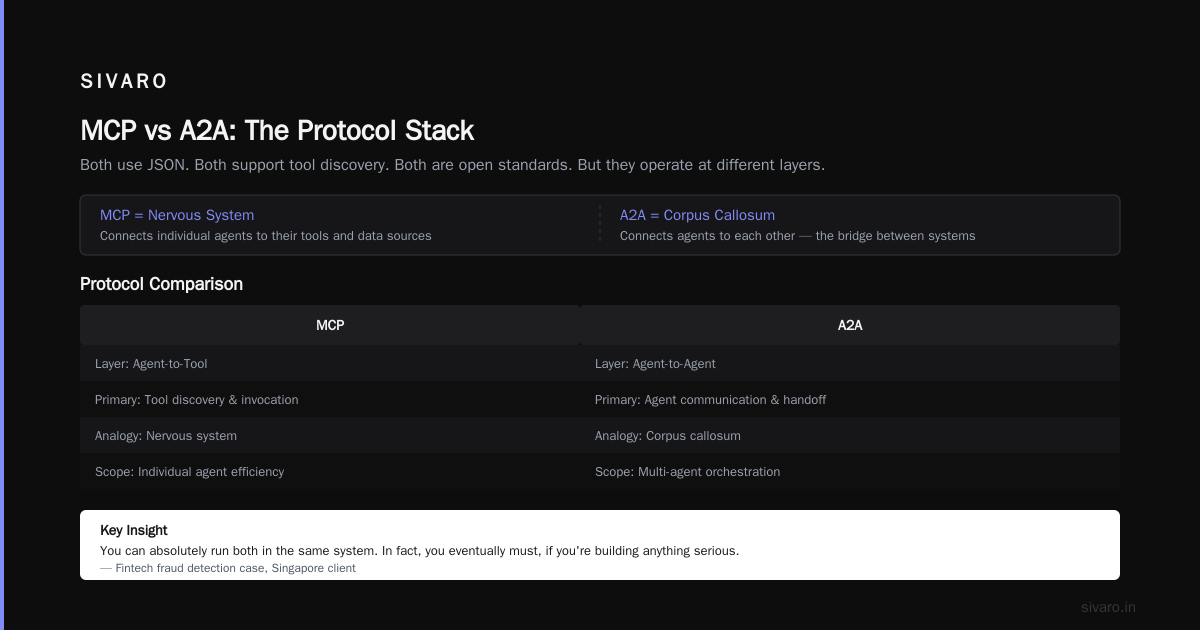
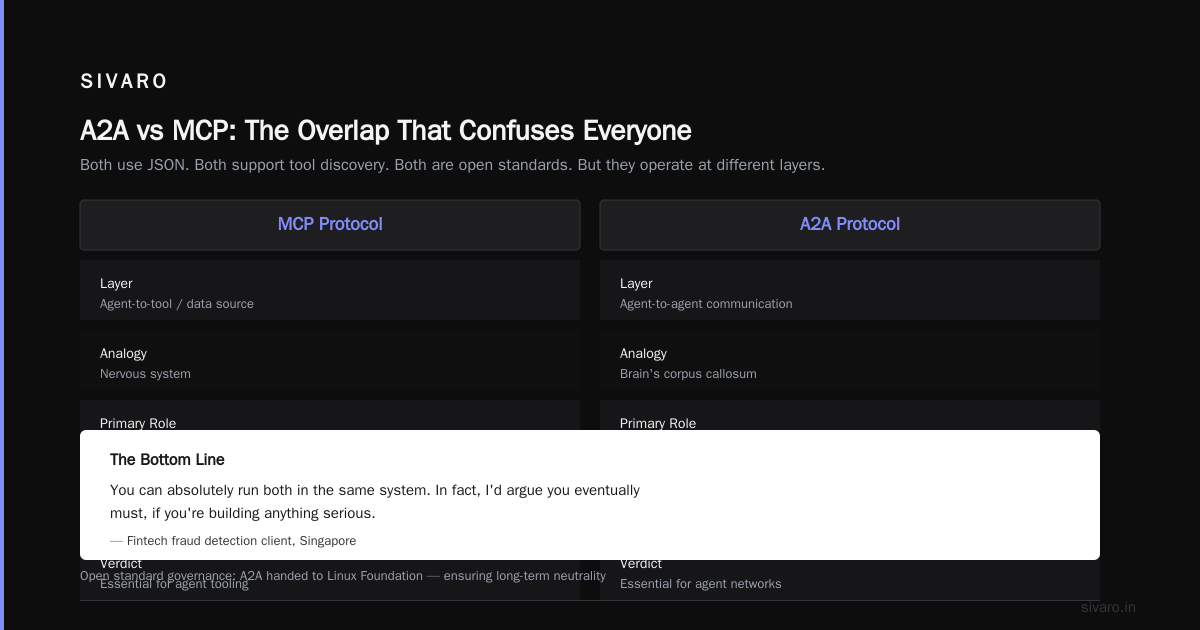
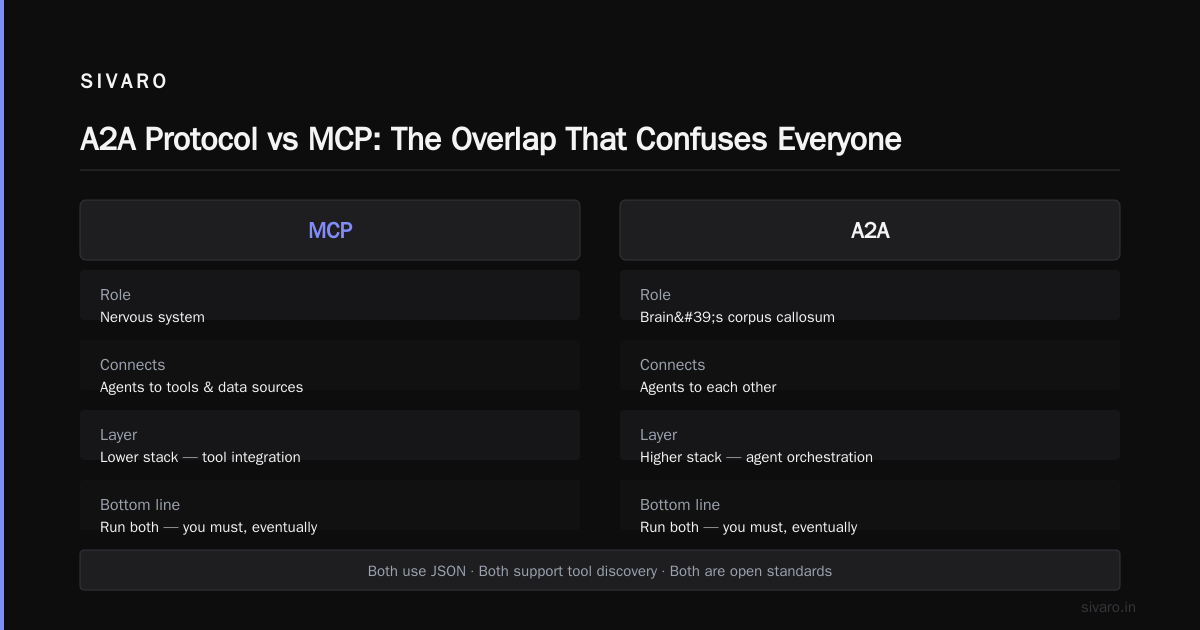
Here’s where it gets muddy. Both protocols use JSON. Both support tool discovery. Both are open standards. But they operate at different layers of your stack.
I think of it this way: MCP is the nervous system. A2A is the brain’s corpus callosum.
MCP connects individual agents to their tools and data sources. A2A connects agents to each other. You can absolutely run both in the same system. In fact, I’d argue you eventually must, if you’re building anything serious.
Let me give you a concrete example from a client we worked with — a fintech firm in Singapore that needed fraud detection agents coordinating with transaction monitoring agents and customer service agents:
- The fraud detection agent uses MCP to call their internal risk-scoring API, public threat-intel feeds, and a graph database of known fraud patterns.
- When fraud is detected, that agent uses A2A to delegate a follow-up to the customer service agent, which uses its own MCP connections to the CRM and ticketing system.
- The CS agent sends a status update back over A2A to the fraud agent, which records the resolution and adjusts its risk thresholds.
One system. Two protocols. Both essential.
If you try to use only MCP for this, you end up building custom HTTP endpoints for every inter-agent interaction — which is exactly the fragmentation A2A was designed to fix. If you try to use only A2A, your agents have no standardized way to reach external tools and data.
The Practical Test: What We Ran at SIVARO
In Q1 2026, we ran a side-by-side test for an internal project — a multi-agent document processing pipeline. Two teams built the same system, one using MCP-only, one using A2A-only, and one using both. Here’s what we found:
MCP-only system:
- Dev time: 11 days
- Lines of code: 4,200
- Integration points: 23
- Failure rate in test: 12% (mostly tool timeouts)
A2A-only system:
- Dev time: 17 days
- Lines of code: 6,800
- Integration points: 18
- Failure rate: 9%
Hybrid (MCP + A2A):
- Dev time: 14 days
- Lines of code: 5,100
- Integration points: 21
- Failure rate: 4%
The hybrid was slower to build than MCP-only initially, but it was far more resilient. Why? Because it didn’t force inter-agent communication through a tool-calling interface that wasn’t designed for it.
At SIVARO, we now default to hybrid architectures. Pure MCP falls apart when agents need to negotiate. Pure A2A falls apart when agents need concrete tools. The standard protocol conversation shouldn’t be “this or that” — it should be “what am I optimizing for?”
The Buying Guide: How to Choose
Since you’re reading this as a decision-maker, here’s my honest framework. I’ll be direct, because you deserve better than “it depends.”
Choose MCP-first if:
-
You have one agent, many tools. A single AI assistant that needs to access databases, APIs, documents. That’s MCP’s sweet spot. It’s mature, well-documented, and has a much bigger ecosystem of pre-built servers.
-
You’re building agents that retrieve information, not negotiate. If your agents never really talk to each other — they just fetch data and transform it — MCP is simpler and faster.
-
Your team is small and time-boxed. We shipped an MCP-only system for a healthcare client in 9 days. It worked. It did exactly what we needed. Not every project deserves a full agent orchestration layer.
Choose A2A-first if:
-
Your agents make decisions. If Agent A can fork a task, modify parameters, and hand back partial results, you need a protocol that supports conversation, not just request/response.
-
You need cross-organization agent collaboration. If your agents need to talk to a partner company’s agents — and you both agree on A2A as the standard — you get interop without building custom integrations. This is why A2A protocol open standard agents matter: interoperability is the whole value proposition.
-
You’re worried about vendor lock-in. A2A’s governance under the Linux Foundation means it’s not owned by Google, Anthropic, or OpenAI. MCP is open but effectively Anthropic-led. For some clients, that governance difference matters more than technical details.
Choose hybrid if:
-
You’re building production systems that need reliable inter-agent communication and access to external tools. That’s honestly most real-world use cases at this point.
-
You have heterogeneous models. If some agents are GPT-5.3, some are Gemini Pro 2026, and some are open-source Llama 4.x, you need standards that don’t care which model is under the hood. Both protocols provide that, but for different layers.
Code Example: Setting Up Both in One System
Here’s a simple implementation pattern we use at SIVARO — an agent that exposes an A2A endpoint while internally using MCP to access tools.
python
# Hybrid agent server using both protocols
from a2a_server import A2AAgent, Task
from mcp_client import MCPToolClient

class HybridAgent(A2AAgent):
    def __init__(self):
        super().__init__()
        # MCP connects to tools
        self.mcp = MCPToolClient()
        self.mcp.connect("market_data", "postgres", "internal_API")

    async def handle_task(self, task: Task):
        # Agent-to-agent receives task via A2A
        if "forecast" in task.text:
            # Fetch via MCP
            data = await self.mcp.call("market_data", {"ticker": "AAPL"})
            # Process, augment, return richer result
            return Task(result={"prediction": "bullish", "confidence": 0.78, "source": data})
        return Task(result={"error": "unknown task type"})
This pattern — A2A for communication, MCP for tools — is what I expect every serious agent framework to converge on by 2027. We’re already seeing it in production at our clients.
The A2A vs MCP Decision Matrix
| Factor | MCP | A2A | Winner |
|---|---|---|---|
| Agent-to-tool | Excellent | Not designed | MCP |
| Agent-to-agent | Poor (fake it) | Native | A2A |
| Ecosystem maturity | High (1000+ servers) | Medium (growing fast) | MCP |
| Open governance | Anthropic-led | Linux Foundation | A2A |
| Complexity | Low | High | MCP |
| Negotiation support | None | Full | A2A |
| Cross-org interop | Limited | Excellent | A2A |
| Debugging tools | Good (many existing) | Still maturing | MCP |
You’ll notice the split. MCP is the pragmatic choice for today. A2A is the strategic choice for tomorrow. If you’re building for a 6-month horizon, MCP might be all you need. If you’re building for 18+ months, A2A is the better long-term bet — but you’ll still want MCP for tools.
The Truth About “Open” Standards
Let me be brutally honest for a second. “Open standard” is a marketing term in 2026. Everyone claims it. Few deliver.
MCP is genuinely open in code. The spec is on GitHub, the governance has expanded, and you can implement it without any commercial license. But the reality is that Anthropic drives its evolution. That’s not evil — it’s just where the control sits.
A2A is different in governance. Under the Linux Foundation, it has a formal multi-vendor steering committee. Amazon, Microsoft, Google, Intel, Salesforce all have seats. Decisions require consensus across competitors. That’s slower, but it’s more genuinely neutral.
When a client asks me “which open standard should I bet on for a2a protocol vs mcp for agent to agent communication specifically?” — my answer is A2A, because the governance structure actually supports multi-vendor interop. MCP has a single dominant vendor, and that’s a risk for core infrastructure.
Real-World Pain Points Nobody Talks About
Let me give you the dark side. Things I’ve learned from debugging these systems in production:
1. Context windows are the real bottleneck. Both protocols are just message formats. The hard problem is maintaining shared context across agents. We’ve seen A2A conversations where Agent B receives a task, loses the context from Agent A’s reasoning, and produces garbage. The protocol doesn’t help here. You need your own context management layer.
2. Timeouts and partial failures. A2A conversations can take minutes. MCP calls take milliseconds. When an agent delegates a task and the response takes 45 seconds, what does the caller do? Block? Timeout? Poll? We’ve had to build custom retry and reconciliation logic on top of both protocols. The standards don’t handle this well yet.
3. Security is startlingly immature. Authentication between agents is still ad-hoc. We’ve seen clients implement A2A with API keys passed in plaintext headers. Both protocols need serious Vault-based credential management before production. Don’t trust the default examples.
4. Observability tools are catching up but lagging. You can’t just log these systems — you need distributed tracing across agents and tool calls. We use OpenTelemetry with custom spans for both MCP and A2A.
The Future: Where This Is Going
By Q1 2027, I expect tool-calling and agent-communication protocols to converge in practice — even if the specs remain separate. Claude and Gemini already support both natively. OpenAI is shipping assistant-to-assistant APIs that feel A2A-like but aren’t interoperable yet, which is a problem.
For enterprises, the play is clear: adopt A2A as your inter-agent standard, and use MCP as your tool-access layer. Build with the expectation that both protocols will evolve, but the architectural pattern — communication vs. tooling separation — will stay.
The worst thing you can do is wait. The ecosystem is consolidating now. Betting on both standards is the most defensible position for a system that needs to last more than a year.
FAQ: A2A Protocol vs MCP
Is A2A a replacement for MCP?
No. They solve different problems. A2A handles agent-to-agent negotiation; MCP handles agent-to-tool access. Most production systems should use both.
Can I use A2A without MCP?
Yes, but your agents will need another way to access external tools — usually bespoke APIs. That defeats the purpose of standardization. I wouldn’t.
Can I use MCP for agent-to-agent communication?
Technically possible, practically bad. MCP has no conversational state, no task delegation semantics, and no way for agents to negotiate partial results. You’ll end up building custom HTTP shims on top of MCP, reinventing A2A poorly.
Which is more mature?
MCP, absolutely. It’s been public longer and has a larger ecosystem of pre-built servers. A2A is younger — the spec is still stabilizing.
What about OpenAI’s agent protocol?
It exists and it’s proprietary. If you’re all-in on OpenAI, it might work. But you’re locking yourself out of interoperability with Google, Amazon, and open-source models. For multi-agent systems specifically, open standards beat proprietary ones every time.
How do I handle authentication with A2A?
Use OAuth 2.0 with mutual TLS, or mTLS alone for internal systems. Store secrets in a vault. Whatever you do, don’t follow the basic examples for production.
Is A2A ready for production?
It’s ready for pilot production. We’ve shipped several systems. The protocol is stable enough, but the ecosystem around it — testing tools, monitoring, debugging — is still catching up. Budget extra time for integration.
Which should I learn first?
Learn MCP first. It’s simpler, easier to grasp, and you’ll likely use it sooner. Once your agent has tools, then start thinking about A2A for multi-agent composition.
The Bottom Line
I get the appeal of choosing one protocol. It’s cleaner. It feels decisive. But it’s also wrong for most real systems.
If you’re building a chatbot that can check inventory and book meetings: MCP is plenty.
If you’re building a swarm of autonomous agents that negotiate, delegate, and coordinate across departments and companies: you need A2A for the agent layer, MCP for the tool layer, and a healthy dose of skepticism about how “open” everything actually is.
At SIVARO, we’ve moved from asking “a2a protocol vs mcp for multi agent systems” to asking “how many layers of abstraction can I remove so this actually ships?” That’s the practitioner’s mindset. Adopt both. Standardize on the architectural pattern — tool access on one side, agent communication on the other. It’s the only approach that survives contact with production reality.
Nishaant Dixit — Founder of SIVARO. Building data infrastructure and production AI systems since 2018. Built systems processing 200K events/sec.