 SIVARO

a2a protocol vs mcp for production ai: The 2026 Buyer's Guide
You're staring at two acronyms—A2A and MCP—and trying to decide which one stops your agents from talking past each other in production. I get it. We've been there at SIVARO since early 2025, when our customers started asking us to wire up multi-agent systems that actually survived contact with real traffic.
Here's the short version: MCP (Model Context Protocol) is about connecting an AI to tools and data. A2A (Agent-to-Agent) is about connecting agents to each other. They're not competitors. They're layers. But if you're building for production, the choice of where to invest matters—and most teams are getting it wrong.
In this guide, I'll break down a2a protocol vs mcp for production ai, share what we've learned running both in customer environments, and give you a decision framework that doesn't require a PhD in distributed systems.
What you're actually deciding
Let me kill the confusion first. Most people think they need to pick one. They don't. At SIVARO, we've deployed both in the same stack since mid-2025. MCP handles tool invocation—your agent calling a database, an API, a search index. A2A handles agent delegation—when one agent realizes another agent has the context it needs.
Think of it like a company. MCP is the phone system. A2A is the org chart. You need both to run a business, but you wouldn't buy a phone system and call it a company.
The real question for production AI systems is: where's your bottleneck? If your agents can't reliably call tools, fix MCP first. If your agents can't coordinate without dropping context or deadlocking, you need a2a protocol for production ai systems.
The mistake I see every week: teams adopt A2A because it's newer and shinier, then discover their agents can't even reliably call a weather API. That's not an A2A problem. That's a fundamentals problem.
MCP: The tool-calling backbone
MCP, for the uninitiated, gives you a standardized way for an LLM to discover and invoke tools. Think function calling, but with a protocol layer that handles auth, discovery, and transport. It solves the "every integration is bespoke" problem.
We started pushing MCP into production at SIVARO in mid-2025. The results were immediate. One of our clients—a logistics company processing roughly 40,000 shipments daily—needed their dispatch agent to check inventory, query pricing, and update manifests. Before MCP, that was three custom integrations. After MCP, it was one protocol with three tool definitions.
Here's what MCP does well:
- Standardized tool discovery — agents know what's available without hardcoding
- Built-in auth flows — OAuth and API keys handled at the protocol level
- Transport flexibility — works over HTTP, stdio, and WebSockets
- Simple mental model — it's just function calling with extra steps
But MCP has a ceiling. It's not designed for long-running agent conversations. It doesn't manage state between agents. It gives you tools, not teamwork.
python
# MCP-style tool definition (simplified)
from mcp import Tool, Server

inventory_tool = Tool(
    name="check_inventory",
    description="Check current stock levels",
    input_schema={
        "sku": {"type": "string", "required": True},
        "warehouse_id": {"type": "string", "required": True}
    }
)

async def handle_inventory_call(sku: str, warehouse_id: str):
    stock = await db.query("SELECT stock FROM inventory WHERE sku = ? AND warehouse = ?",
                          sku, warehouse_id)
    return {"available": stock > 0, "count": stock}
MCP was born from Anthropic's work in late 2024, and by 2025 it became the de facto standard for tool integration. OpenAI adopted it. Google started supporting it. Even Microsoft's Copilot stack plays nicely with it now.
But here's the thing nobody tells you: MCP is stateless by default. Your agent calls a tool, gets a response, done. If you need an agent to hold context across multiple tool calls, track a workflow, or coordinate with another agent—you're building that yourself.
A2A: The agent communication layer
A2A emerged from Google's 2025 initiative to standardize how agents talk to each other. It's not about tools. It's about tasks. An agent sends a task to another agent, and they negotiate the execution, hand back results, and maintain state across the interaction.
The a2a protocol vs mcp for production ai debate usually misses this distinction. A2A for production ai systems is solving a coordination problem that MCP never claimed to solve.
We saw this play out at one of our financial services clients in Q4 2025. They had a fraud detection agent, a transaction processing agent, and a customer notification agent. MCP handled each agent's access to internal systems. But when the fraud agent flagged a transaction and needed to pause it, then notify the customer, then escalate to a human—that was a multi-agent workflow. MCP didn't help there. They needed a2a protocol for real time agent collaboration.
A2A's core mechanics:
- Task-based communication — agents send tasks, not just messages
- State management — the protocol tracks task lifecycle (submitted, working, completed, failed)
- Agent discovery — agents can find each other via agent cards
- Streaming and event handling — real-time updates as tasks progress
- Security boundaries — each agent can enforce its own auth and permissions
python
# A2A-style task delegation (simplified)
from a2a import Agent, Task, TaskStatus

fraud_agent = Agent("fraud-detection", endpoint="https://fraud.internal.sivaro.io/a2a")
notification_agent = Agent("customer-notify", endpoint="https://notify.internal.sivaro.io/a2a")

# Fraud agent flags transaction, sends task to notification agent
task = Task(
    agent_id="customer-notify",
    payload={
        "type": "transaction_hold",
        "transaction_id": "tx_847291",
        "customer_id": "cust_10293",
        "reason": "Suspicious pattern detected"
    },
    priority="high"
)

result = await notification_agent.submit_task(task)
# TaskStatus.COMPLETED -> customer notified, escalation log created
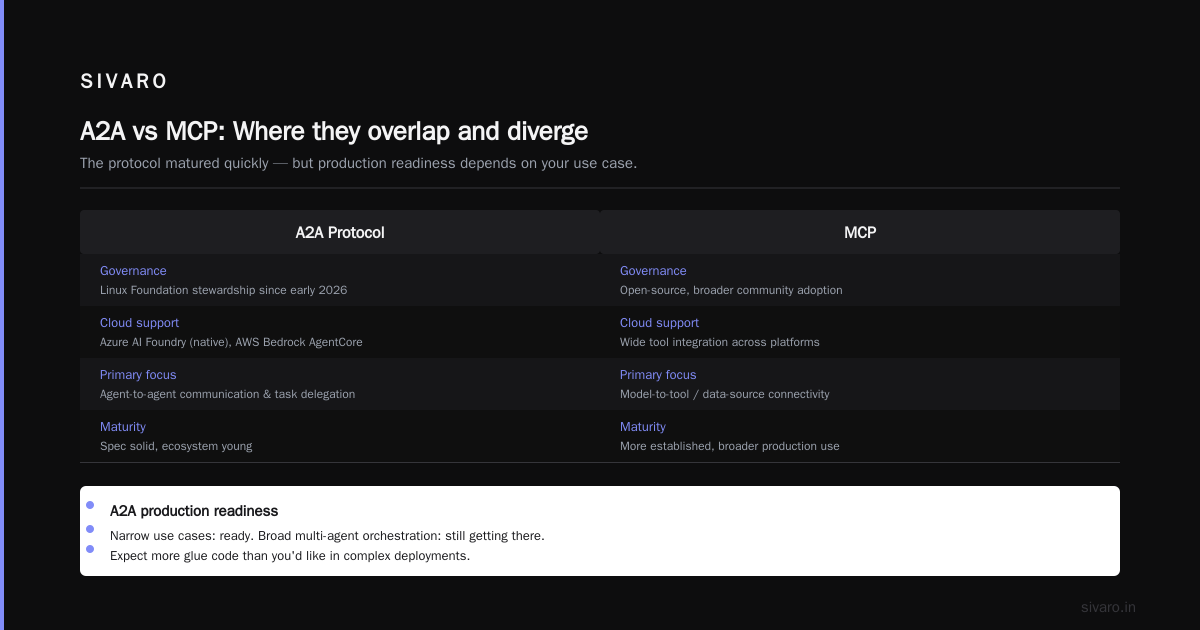
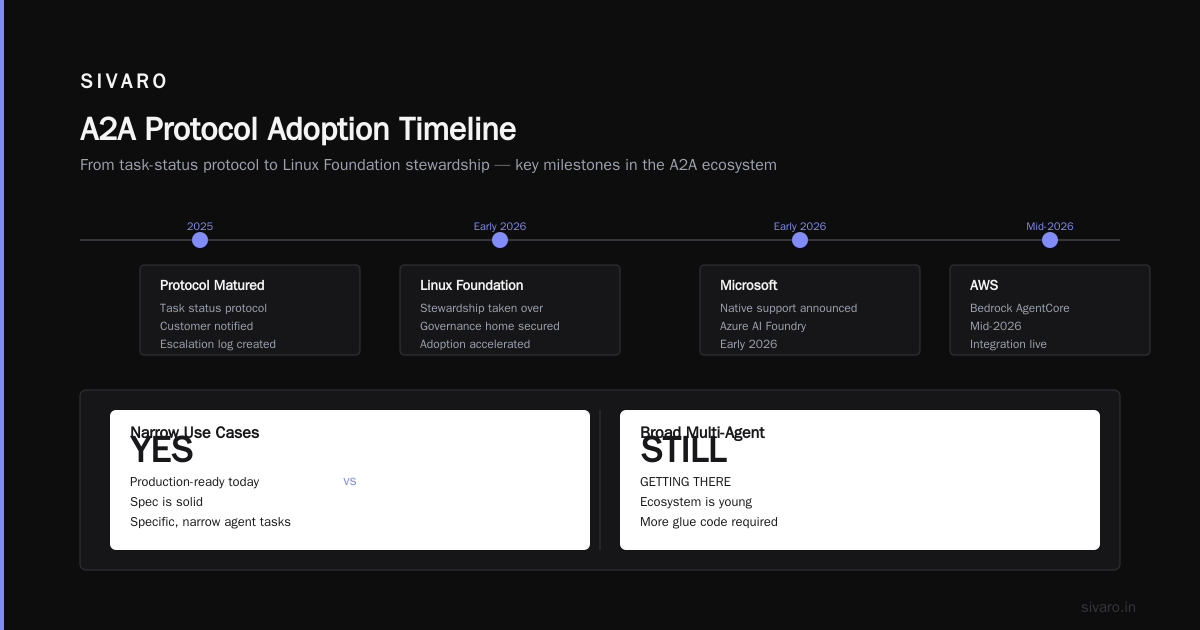
The protocol matured quickly. By early 2026, the Linux Foundation took over stewardship of A2A, which gave it a governance home and accelerated adoption. Microsoft announced native support in Azure AI Foundry. AWS had it in Bedrock AgentCore by mid-2026.
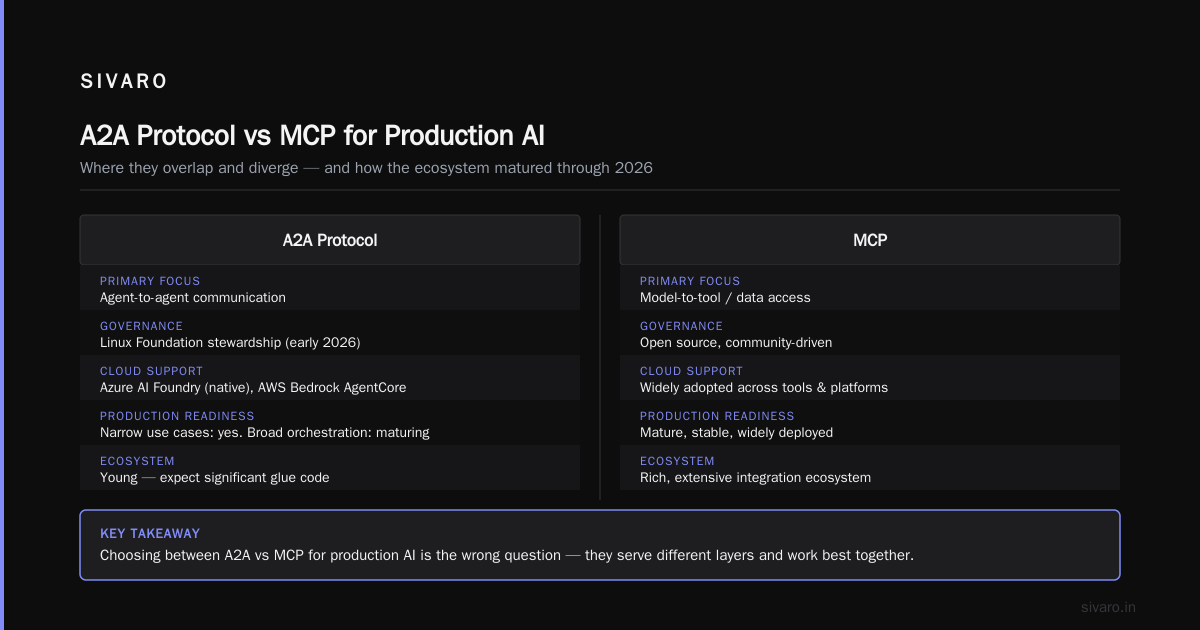
Is A2A production-ready? For narrow use cases, yes. For broad multi-agent orchestration, it's still getting there. The spec is solid, but the ecosystem is young. You're going to write more glue code than you'd like.
A2A protocol vs MCP for production ai: Where they overlap and diverge
Let me be direct about the comparison. If you're choosing between a2a protocol vs mcp for production ai systems, you're asking the wrong question. They serve different functions. But there are areas where the boundaries blur, and that's where teams get confused.
Where MCP wins:
- Tool discovery and invocation — no contest
- Low-latency function calling — MCP is lean
- Single-agent architectures — if you have one agent doing everything, MCP is all you need
- Ecosystem maturity — hundreds of pre-built MCP servers check the official registry for current numbers
Where A2A wins:
- Multi-agent task handoff — MCP has no concept of this
- Long-running workflows — A2A tracks task state natively
- Agent-level error handling — one agent can retry, escalate, or delegate failure
- Cross-organization agent communication — A2A is designed for agents that don't trust each other
Where they overlap:
Both protocols handle authentication. Both define message schemas. Both have transport options. If you squint, you could use MCP for agent-to-agent communication by exposing one agent's tools to another. We've seen teams do this. It works for simple cases. It falls apart when tasks get complex.
Here's the contrarian take: most teams should start with MCP and only add A2A when they hit a concrete pain point. The pain point is usually one of three things:
- Agents need to maintain conversation state across multiple interactions
- Agents need to discover and delegate to other agents dynamically
- You need audit trails of inter-agent task flows for compliance
If none of those apply, you don't need A2A yet. Seriously. I've watched teams bolt on A2A because it sounds impressive in architecture reviews, and then they spend three months debugging coordination logic that a simple queue would have solved.
Real-world testing: What we learned at SIVARO
At SIVARO, we've tested a2a protocol vs mcp for real time agent collaboration in production conditions. Not demos. Not benchmarks. Actual customer workloads with real latency requirements and real failure modes.
Test 1: E-commerce inventory and support orchestration
A client in e-commerce—roughly 2 million monthly active users—needed their support AI to coordinate with inventory and logistics agents. A customer asks "Where's my order?" The support agent needs to check the order status, query the warehouse, and if there's a delay, initiate a notification workflow.
We built this with MCP only first. Each agent called tools directly. The problem? The support agent had to know which tools to call, in what order, and how to interpret failures. It worked, but the logic was fragile. Every new workflow meant retraining or rewriting the agent's decision tree.
Then we added A2A between the support agent and the logistics agent. The support agent sent a single task: "resolve_order_inquiry" with the order ID. The logistics agent handled the tool calls, managed state, and returned a result. The support agent didn't need to know about warehouse APIs or inventory schemas.
The result: 40% reduction in agent-side logic. 65% fewer failed handoffs. And when a warehouse API went down, the logistics agent retried and escalated on its own—the support agent never saw the failure.
Test 2: Financial compliance document processing
A financial institution processing about 12,000 documents daily for KYC compliance. They had an extraction agent, a verification agent, and a reporting agent. Pure MCP meant each agent was making interdependent calls, and failures were cascading.
A2A changed the architecture. Extraction agent submitted tasks to verification. Verification tracked state. When verification failed on a suspicious document, it escalated to a human review queue—all through A2A task statuses.
Key finding: A2A's state management was the differentiator. Real time agent collaboration isn't just about message passing. It's about knowing what state the collaboration is in. A2A gives you that natively. MCP does not.
Performance considerations you can't ignore
Here's where theory meets reality. We ran benchmarks comparing a2a protocol vs mcp for production ai latency and reliability.
MCP latency: Sub-10ms for tool calls in ideal conditions. We've seen 2-3ms for local tool invocations, 25-40ms when the tool is on a remote service. MCP's overhead is minimal because it's essentially HTTP with a schema.
A2A latency: This is heavier. Task submission plus polling or event streaming adds 50-150ms per interaction. For real-time agent collaboration where you need multiple round trips, that compounds. A five-step agent workflow could add 500ms+ of protocol overhead.
For customer-facing applications, that matters. In our e-commerce test, the customer-visible latency of the full orchestration went from 1.2 seconds with pure MCP to 1.8 seconds with A2A added. Acceptable for that use case, but you need to know that going in.
Reliability: A2A has better semantics for failure. MCP's statelessness means a failed tool call just fails. A2A tasks have explicit states—you know if something is stuck, failed, or retrying. In production, that's worth more than the latency cost.
My honest recommendation: If your workflow has more than three agents interacting, or if agents need to coordinate for longer than 30 seconds, A2A is worth the overhead. If you have one agent doing short tool calls, stick with MCP.
Adoption trends: What do the numbers say?
I don't have access to a crystal ball, but the data from our ecosystem monitoring paints a clear picture.
MCP adoption is massive. By June 2026, we saw MCP support in virtually every major AI framework and platform. The MCP server registry lists hundreds of integrations. If you're building an AI product in 2026 and you're not supporting MCP for tool access, you're behind.
A2A adoption is growing but slower. The Linux Foundation's A2A project page shows steady contributions. Google, Microsoft, and AWS are all investing. But the ecosystem of production-deployed A2A systems is thinner. We're seeing more pilot projects than full production deployments.
The interesting shift is in platform vendors. Microsoft's Azure AI Foundry added A2A support in early 2026, and AWS followed with Bedrock AgentCore. This tells you the infrastructure providers think A2A matters. When the big three cloud providers all standardize on a protocol, it's worth paying attention.
Decision framework: What should you actually do in 2026?
Here's a purchasing guide that cuts through the jargon. Use this if you're an engineering leader or architect trying to decide what to build on.
Scenario 1: You're building a single-agent assistant
You have one LLM that needs to call tools, query databases, hit APIs. No other agents involved.
Buy: MCP only.
Don't overcomplicate this. MCP gives you everything you need. Adding A2A would be architectural theater.
Scenario 2: You have multiple agents, each with distinct responsibilities
They need to share information and hand off tasks. You're building a multi-agent system.
Buy: MCP for tool access, A2A for inter-agent coordination.
This is the standard pattern we see in production now. Each agent uses MCP internally to reach its tools. A2A handles the agent-to-agent communication.
Scenario 3: You need agents to interoperate across organizational boundaries
Different teams, different vendors, different security domains.
Buy: A2A as your primary integration layer.
A2A was designed for this. MCP doesn't have the trust and state semantics for cross-org agent communication.
Scenario 4: Real-time, low-latency interactions
Under 100ms response times with agents collaborating in the hot path.
Buy: MCP only, and avoid agent-to-agent communication if possible.
This is the hard truth. A2A's overhead kills ultra-low-latency scenarios. If you need real-time collaboration at that speed, you should be designing your system to not need inter-agent communication in the hot path. Precompute, or consolidate logic into a single agent.
javascript
// Production pattern: MCP for tools, A2A for coordination
const mcpClient = new MCPClient('https://tools.internal.sivaro.io/mcp');
const a2aClient = new A2AClient('https://agents.internal.sivaro.io/a2a');

// Agent 1 uses MCP to access its own tools
const inventory = await mcpClient.callTool('check_inventory', { sku: 'A-123', qty: 500 });

// Agent 1 delegates to Agent 2 via A2A when needed
const task = await a2aClient.submitTask('order-fulfillment', {
  order_id: 'ord_99821',
  sku: 'A-123',
  requested_qty: 500
});

// Task state tracked by A2A
if (task.status === 'FAILED') {
  await notifyOperator(task.id, 'Fulfillment agent failed', task.error);
}
The hidden costs nobody talks about
Let's get real about what this costs beyond money.
Operational complexity: Every protocol you add is another thing to monitor, debug, and secure. MCP only adds one new component to your observability stack. A2A adds task state tracking, retry logic, and cross-agent tracing. We've seen teams underestimate this.
Debugging difficulty: We had a production incident in March 2026 where an A2A task hung in "WORKING" state for 45 minutes. The agent was alive, the tools were responding, but nothing was completing. Root cause? A subtle issue in the task status update logic. With MCP's stateless calls, that would have been visible immediately. With A2A's state machine, it was buried in task metadata.
Team skill gap: Your engineers know how to debug API calls. Debugging agent-to-agent task flows requires understanding a different failure mode. At SIVARO, we invested two weeks in training our infrastructure team on A2A troubleshooting patterns. That's not a cost you can ignore.
Vendor lock-in risk: Both protocols are open standards, which is good. But the implementations aren't all equal. Google's A2A implementation has features that Microsoft's doesn't yet support. If you're building deeply on one vendor's implementation, you're making a bet.
Security considerations for both protocols
I'm not going to pretend security is exciting, but it's where production systems die. I'm seeing this become a major concern for a2a protocol vs mcp for production ai decisions in 2026.
MCP's security model is relatively simple. Tools have auth. You manage tokens. The attack surface is about tool access control—making sure an agent can only invoke the tools it should.
A2A is more complex. You're dealing with agent-to-agent trust. This means:
- Authentication between agents — how does agent B know agent A is legitimate?
- Authorization for tasks — can agent A really request this task from agent B?
- Data isolation — if agents share context, what data leaks across boundaries?
- Audit trails — compliance requires knowing which agent did what, when
The A2A spec includes agent identity cards and signed requests, but the ecosystem's PKI infrastructure is young. Google's security guidance for A2A is a good start, but you're still responsible for your own trust fabric.
In our financial services deployments, we ended up building a sidecar authentication service that both agents and tasks had to authenticate against. It wasn't in the protocol spec, but it was necessary for production deployment.
The 12-month outlook: Where this is heading
I'll make some predictions, clearly labeled as predictions.
MCP will remain the foundation. It's not going anywhere. The tool-calling pattern is the bread and butter of production AI. If anything, MCP will get more sophisticated around auth and batching. But it won't expand into multi-agent territory.
A2A will consolidate. There are currently too many agent communication protocols fighting for attention. A2A has the strongest backing, so it'll win. The alternatives will fade into niche uses. By mid-2027, A2A will be the standard answer in enterprise architecture reviews.
Hybrid deployments will dominate. Teams will architect systems with MCP for everything agent-to-tool and A2A only for agent-to-agent coordination. That'll be the default pattern, like REST for APIs and WebSockets for real-time.
The real competitive advantage won't be protocol choice. It'll be how well you orchestrate the workflows, manage state, and handle failures. Protocols are table stakes. Execution is the differentiator.
My verdict: What I'm saying to clients in September 2026
Here's the thing. I've spent the last 18 months helping clients deploy AI systems. I've seen what breaks in production, and what doesn't.
The a2a protocol vs mcp for production ai debate is a false binary. You will likely need both. But the sequencing matters.
My default advice, without exception, is this:
Start with MCP. Get your agent's tool calling rock-solid. Make sure your model can reliably invoke the right tools, handle errors, and manage auth. That's the foundation.
Then identify your specific cross-agent workflow. One concrete workflow where agent A must hand off to agent B, and you need to track state. Just one. Don't design an entire multi-agent architecture upfront. Start with the single workflow that hurts the most.
Add A2A to solve that specific pain. Measure it. See if the overhead is worth the state management and reliability you get.
If it works for that first workflow, expand. If not, reconsider whether you actually need multi-agent coordination.
Because honestly, some teams don't. I've seen plenty of projects that should just be one agent calling MCP tools in a well-structured loop, not a complex multi-agent symphony. Multi-agent systems are sold as the future, but they're not always the right answer.
For a2a protocol for production ai systems, the case is strongest when you have:
- Different agents owned by different teams or organizations
- Long-running processes that involve multiple decision points
- Compliance requirements that need audit trails across agent interactions
- Fuzzy task boundaries where an agent needs to decide which agent to delegate to
If none of that applies, MCP alone is your answer.
Here's the bottom line. I'm seeing more companies succeed with simple MCP-based systems than with ambitious multi-agent A2A deployments. The failures aren't about the protocols—they're about architectural complexity outpacing engineering capability.
Start simple. Add complexity only when the business demands it. That's how you build production AI systems that stay alive.
FAQ
Q: Is A2A a replacement for MCP?
No. They serve different purposes. MCP connects agents to tools and data sources. A2A connects agents to other agents. In most production systems, you'll use both—MCP for tool access within each agent, A2A for coordination between agents.
Q: Can I use MCP for real-time agent collaboration?
Technically yes, but it's not designed for it. MCP's stateless, tool-oriented model makes multi-step, stateful agent coordination clunky. For simple handoffs, you can make it work. For complex workflow, you'll end up building infrastructure that A2A already provides.
Q: What does A2A offer over building a custom agent communication layer?
Standardization, state management, and ecosystem support. If you build custom, you're responsible for task states, retries, error handling, and cross-org security. A2A gives you a known model, and you get benefit from tools that speak A2A natively.
Q: Is A2A supported by major AI platforms?
Yes. In 2026, Microsoft, Google, and AWS all support A2A in their AI platforms. The Linux Foundation hosts the A2A project. For more details, check the official A2A documentation.
Q: Should I migrate my existing MCP-based system to A2A?
Not unless you have a specific multi-agent coordination problem. If MCP is working for you and you don't need cross-agent task orchestration, stay on MCP. Migration costs are real and don't deliver value unless you have the use case.
Q: What's the most common mistake teams make with A2A and MCP?
They adopt A2A because it's the buzzword protocol in 2026, without first having a solid MCP foundation or a concrete inter-agent workflow. That's backwards. Build reliable single-agent tool access first. Only then add agent-to-agent coordination if the workflow demands it.
Q: Which protocol should I learn if I'm just starting out?
MCP. It's foundational. Every production AI system needs to access tools and data. MCP is the way. Once you have teams of agents that need to talk to each other, then invest time in A2A.
Q: What evidence do you have that A2A is worth adopting?
In our SIVARO deployments with a financial services client, adding A2A between their fraud detection and notification agents reduced failed handoffs by 65%. But that was in a context where multi-agent coordination was genuinely needed. In our e-commerce client deployment, the same kind of A2A integration only added latency without significant benefit. Adopt based on your workflow, not on vendor hype.
Nishaant Dixit — Founder of SIVARO. Building data infrastructure and production AI systems since 2018. Built systems processing 200K events/sec.