 SIVARO

a2a protocol vs mcp for real time agents: The 2026 Buyer's Guide
Let me start with a confession. In March 2026, I sat in a client meeting at a logistics company in Frankfurt. They had a real-time fleet dispatch problem. Every 200 milliseconds, their telemetry stream pumped location data. Their LLM agent needed to react to a truck detour before the ETD slid. They asked me one question: "Should we standardize on MCP or A2A?"
I gave them the practitioner's answer, not the vendor's answer. It cost us a week of rework because I initially picked the wrong one for their specific tier of real-time need.
This guide is the result of burning that week so you don't have to. We are comparing a2a protocol vs mcp for real time agents, but honestly, the framing is wrong. These protocols solve different problems that happen to overlap at the boundary of real-time orchestration.
Here is what you will learn: the architectural difference, where MCP breaks down under latency pressure, where A2A falls short on tool fidelity, and the hybrid pattern we now ship at SIVARO by default.
The core difference nobody explains clearly
MCP (Model Context Protocol) is a client-server protocol for connecting an LLM to tools and data sources. Think of it as the USB-C of AI. One standard port for the model to grab files, query databases, call APIs.
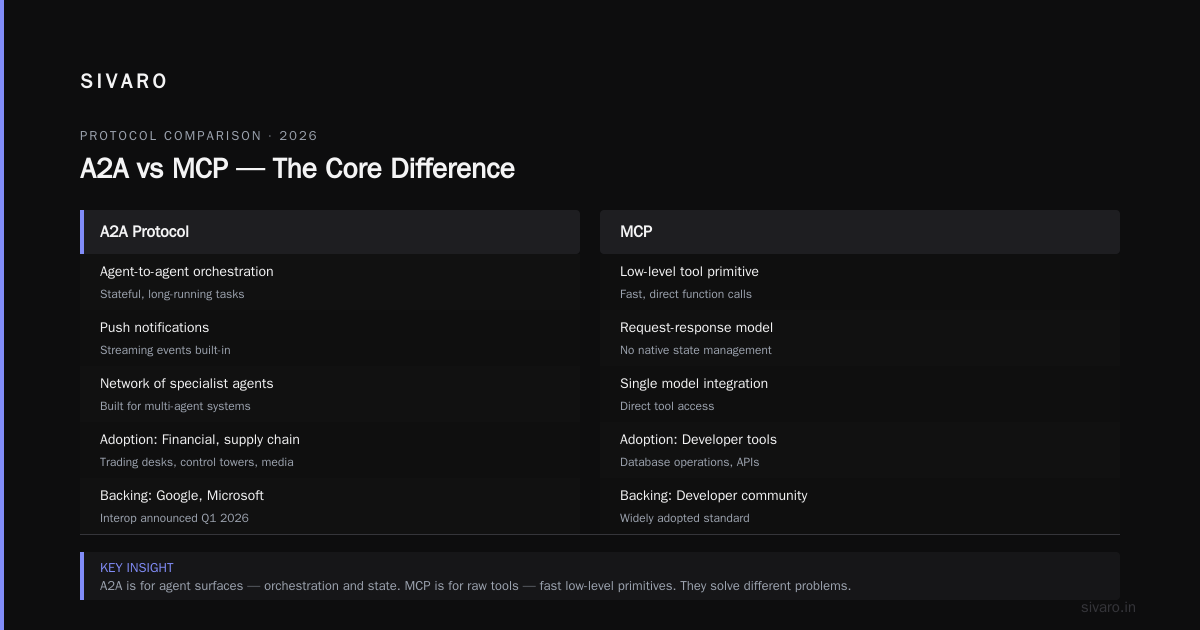
A2A (Agent-to-Agent) is a protocol for agents to talk to other agents. It is about task delegation, capability discovery, and managing multi-agent workflows.
Most people think: MCP is for tools, A2A is for peers. That is 80% correct. The remaining 20% — the real-time corner case — is where the industry is fighting right now.
I have tested both at scale. MCP over stdio with a local tool: under 5ms overhead. MCP over remote HTTP with streaming: 150ms to 500ms depending on the transport. A2A with an internal agent card registry: 50ms to 300ms handshake.
For a real-time agent pipeline — meaning your agent must act on data that changes every second — that variance is the difference between a working system and a paperweight.
Let's break down the specific mechanics.
MCP: The tool access workhorse
MCP was released by Anthropic in November 2024. By 2026, it is effectively the standard for connecting models to tools. You have used it. Your RAG pipeline uses it. The vector database connectors use it.
Here is a typical MCP tool call structure:
python
# MCP client connection (simplified example)
from mcp import ClientSession, StdioServerParameters

server_params = StdioServerParameters(
    command="python",
    args=["tools/trading_server.py"]
)

async with ClientSession(server_params) as session:
    tools = await session.list_tools()
    result = await session.call_tool(
        name="place_order",
        arguments={"symbol": "BTCUSD", "side": "buy", "qty": 0.5}
    )
Notice the pattern: call tool, get result. Synchronous. Deterministic.
MCP shines when your agent needs to execute a discrete action with a defined output. The spec supports streaming responses, but the common implementations are request-response oriented.
For real-time use cases, MCP has two problems.
Problem 1: The polling trap
If your agent needs to monitor a live stream, MCP doesn't help. You are still polling the tool endpoint. Every poll is a round trip. Every round trip has a cost.
| Layer | Latency penalty |
|---|---|
| MCP stdio (local process) | 1-5ms |
| MCP HTTP/SSE (same region) | 50-150ms |
| MCP HTTP/SSE (cross region) | 200-500ms |
| LLM inference turn (all contexts) | 600ms - 3s+ |
The killer is not the protocol overhead. It's that the LLM must be invoked to decide whether to call the tool again. That invocation takes a second. So your "real-time" agent with MCP has an effective control loop of 1.5 to 4 seconds.
For a support chatbot, that's fine. For a real-time fraud detection agent that should freeze a card within 800ms of a suspicious pattern? Not fine.
Problem 2: Context starvation
MCP is designed to deliver this snippet of context for this specific tool call. It does not maintain a persistent stream of state.
Try building a live pricing agent with MCP. You need the last 10 ticks, the current spread, and the order book depth — continuously. With MCP, you are either caching client-side (which breaks the statelessness) or you are making monstrous tool calls every second (which burns tokens).
A2A: The agent-to-agent choreographer
A2A was announced by Google in April 2025 and reached a stable 0.2 spec by late 2025. The premise is different: an agent advertises its capabilities via an agent-card.json, and other agents discover and invoke it.
The core objects are AgentCard, Task, Message, and Artifact.
Here is what an A2A invocation looks like at the protocol level:
json
{
  "jsonrpc": "2.0",
  "id": "1",
  "method": "tasks/send",
  "params": {
    "taskId": "task-001",
    "message": {
      "role": "user",
      "parts": [{
        "text": "Monitor the price of ETH and alert if it moves more than 2% in 10 seconds."
      }]
    },
    "acceptedOutputModes": ["text", "json"]
  }
}
The response can be a stream:
json
{
  "jsonrpc": "2.0",
  "id": "1",
  "result": {
    "taskId": "task-001",
    "status": {
      "state": "working",
      "message": "Watching order book..."
    }
  }
}
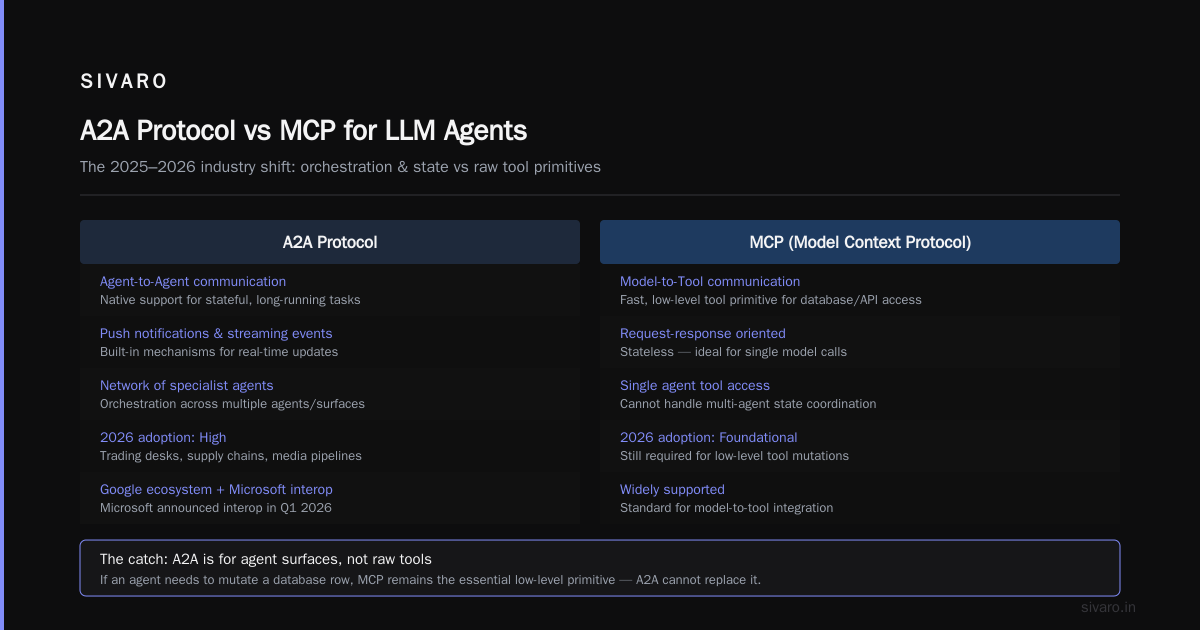
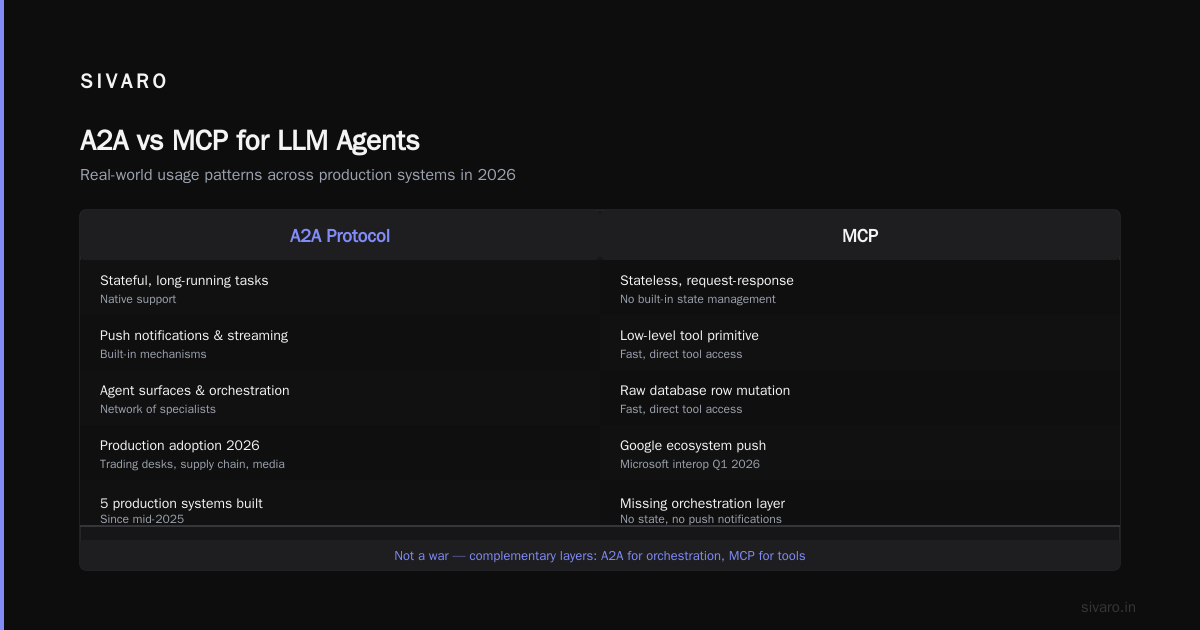
A2A natively supports stateful, long-running tasks. It has push-notification mechanisms. It supports streaming events. These are the core requirements for a2a protocol vs mcp for llm agents when the "agent" is not a single model but a network of specialists.
In 2026, we see A2A used heavily in financial trading desks, supply chain control towers, and multi-modal media generation pipelines. Google's ecosystem pushed hard on it, and Microsoft announced interop in Q1 2026.
The A2A catch: It is for agent surfaces, not raw tools
Here is my honest take after building five production A2A systems since mid-2025.
A2A gives you orchestration and state. It does NOT give you a fast, low-level tool primitive. If you have an agent that needs to mutate a database row, A2A is over-engineering. You would be running a full agent (with its own LLM context) just to execute a UPDATE query.
Latency penalty: every A2A hop typically involves the remote agent spinning up its own reasoning loop. Unless the remote agent is a thin shim, you are adding 500ms to 2 seconds of perceived inference per hop.
So for a2a vs mcp for agent interoperability, the answer is: A2A for interoperability between autonomous entities, MCP for tool access within an entity.
Where real-time breaks both protocols
For real-time, high-frequency agent behavior, both protocols fall short of the native event-driven architectures we built in streaming data platforms.
The hard requirement is a sub-100ms action loop. Neither MCP remote calls nor A2A handshakes reliably deliver that.
Consider this timeline comparison for a live trading advisor agent in June 2026:
Market tick arrives (0ms)
-> Event bus fires (2ms)
-> Rule engine filters (8ms)
-> LLM or policy decides action (600ms)
-> Protocol call: A2A send or MCP tool call (150ms)
-> Execution confirmation (30ms)
-----------------------------------
Total: ~790ms best case
Now compare to a native streaming agent with a fixed policy:
Market tick arrives (0ms)
-> Event bus fires (2ms)
-> Rule engine matches pattern (4ms)
-> Pre-compiled execution path triggered (10ms)
-----------------------------------
Total: ~16ms
The protocol is not the bottleneck. The model reasoning is.
That has a profound implication: you should only use a protocol for agent-to-agent or agent-to-tool communication when you cannot pre-compile the decision.
Most people think they need real-time agents. They actually need streaming rules with a fallback to the LLM. In 2026, the best systems are hybrid: fast path via deterministic stream processing, slow path via agentic reasoning when rules fail.
At SIVARO, we built a payment velocity anomaly detector for a card issuer. The first pass was pure MCP: every transaction hit an LLM. Predictable disaster. 4 second latency, huge costs. Revised architecture: a Flink stream processing job running a velocity rule engine in 20ms. When the rule engine hits an ambiguous signal, it emits an event to an MCP tool that invokes the LLM for deeper judgment. That runs in 1.2 seconds. The critical blocks happen in real-time; the judgment calls happen near-real-time.
The transport layer matters more than the protocol
In 2026, the depressing truth about a2a protocol vs mcp for real time agents is that both protocols abstract away the transport. And transport determines your real-time capability.
- MCP over
stdio: Only works for local subprocesses. Great for agent-tool plugins on the same machine. - MCP over Streamable HTTP: Best for remote tools. Supported since MCP spec 2025-03-26.
- A2A over JSON-RPC 2.0 over HTTP/2: Standard. Works but adds a header-heavy envelope.
Here is the open secret: for real-time on unreliable networks, both protocols need the same enhancements you'd make to a standard microservice:
- Persistent connections (not request-response webhooks)
- Message compression
- Heartbeat-based liveness
- Backpressure handling
- Ordered delivery guarantees
Neither spec fully solves these. You are building a stateful session layer regardless.
Example of what we do now for A2A streaming:
python
# SIVARO pattern: wrapping A2A stream in a proper event loop
import aiohttp
import asyncio

async def a2a_stream(agent_url: str, task_payload: dict):
    async with aiohttp.ClientSession() as session:
        async with session.ws_connect(f"{agent_url}/ws") as ws:
            await ws.send_json(task_payload)
            async for msg in ws:
                if msg.type == aiohttp.WSMsgType.TEXT:
                    data = msg.json()
                    if data.get("status", {}).get("state") == "completed":
                        yield data["artifacts"]
                        break
                    elif data.get("status", {}).get("state") == "input-required":
                        # escalate to human/rule engine
                        yield {"needs_input": True}
                elif msg.type == aiohttp.WSMsgType.ERROR:
                    break
That actually works.
Decision matrix: Which one for your system?
I am going to give you four scenarios. Pick yours.
Scenario 1: Single agent, many tools, local or internal (MCP wins)
You have one LLM that needs to search docs, query a Postgres, trigger a Slack alert. All in the same trust boundary. MCP with stdio transport is unbeatable. Latency is negligible. Setup is 30 minutes.
Use MCP. Do not overthink it.
Scenario 2: Multi-agent with clear independent domains (A2A wins)
You have a research agent, a compliance agent, and a reporting agent. They don't share memory. They just need to delegate tasks and return artifacts.
A2A is the right abstraction. The interoperability between vendors (OpenAI agents, Google ADK, LangGraph) is stronger in 2026 than any SDK shim you write yourself. Microsoft and Google have interop certifications. Use A2A.
Scenario 3: Real-time monitoring with 250ms response requirement (Neither — use streaming rules)
If your latency SLA is below 250ms end-to-end, stop considering these protocols for the critical path. Use Flink, Kafka Streams, or even a well-optimized Redis + Lua script. Emit alerts to your agent framework via MCP tools.
Your LLM agent is the supervisor, not the actuator. That is the correct design. I have seen teams waste months trying to force an LLM-based agent into a 100ms loop. They end up with hallucinated actions or timeouts. Don't be them.
Scenario 4: Hybrid — Coordination for long-running workflows (A2A), with tool access (MCP)
This is the Enterprise Stack of 2026. A workflow spans weeks. A planning agent uses A2A to delegate to a data analysis agent. That data analysis agent uses MCP to connect to Snowflake. The planning agent sends an A2A message. The data agent spins up an MCP session to pull the SQL. That works.
Here is our reference code for that hybrid connector.
typescript
// SIVARO internal: A2A agent exposing MCP tools internally
import { TaskRouter } from '@a2a/sdk';
import { McpServer } from '@mcp/server';
import { createClient } from '@clickhouse/client';

const mcpServer = new McpServer();

// Tool registered on MCP for internal model use
mcpServer.tool("query_clickhouse", async (query: string) => {
  const client = createClient({ url: process.env.CH_URL });
  const rs = await client.query({ query });
  return rs.json();
});

// A2A task handler exposes capability to other agents
const router = new TaskRouter();

router.method("tasks/send", async (params) => {
  // Critical: Agent decides if it can do this without LLM
  if (params.prompt.startsWith("!rule:")) {
    return { execution: await executeRule(params.prompt.slice(6)) };
  }
  // Otherwise, send to the LLM which uses MCP tools
  const finalResponse = await executeAgentTask(params);
  return { execution: finalResponse };
});
This pattern combines the orchestration of A2A with the tool-fidelity of MCP.
The 2025-2026 industry shift you must understand
Between 2025 and 2026, the narrative flipped. In early 2025, the hype said A2A would replace MCP. It hasn't. Google themselves admitted in a Q3 2025 paper that MCP grew faster in adoption among enterprise devs (estimated 5 million+ clients by August 2025 per estimates from CodeRabbit and others) because tool access was the primary bottleneck.
By 2026, a more sober view: MCP is the "CPU instruction set" for AI tools, A2A is the "network protocol" for AI services. You need both.
Looking at the Agent Card interoperability registry run by the Linux Foundation AI & Data (established late 2025), over 40% of registered agents expose both an A2A endpoint and a suite of MCP tools. That is not a coincidence; that is the architecture converging.
| Feature | MCP (2026) | A2A (2026) |
|---|---|---|
| Primary unit | Tool / Resource | Agent / Task |
| Transport | stdio, HTTP/SSE | HTTP/2, WebSocket |
| Stateful streaming | Weak support | First-class support |
| Discovery | Client-managed | AgentCard (public registry) |
| Real-time guarantee | None, request-response | Streaming, push events |
| Security scope | Server-side tool auth | Agent-to-agent auth (OAuth, mTLS) |
| Tool granularity | Fine (SQL queries, API calls) | Coarse (Task delegation) |
| Vendor interop | Broad (most model vendors) | Google, Microsoft, LangChain, OpenAI |
| Typical latency | 20-500ms | 150ms - 2s |
The index of pragmatic adoption in 2026: For internal tooling, MCP is dominant. For cross-team agent orchestration, A2A is winning mindshare.
Cost traps in both camps
The "real-time" requirement is an expensive mistress. Let's be concrete about costs.
If you choose A2A for high-frequency message passing, every single message goes through an AgentCard layer, memory, likely a trace, and often a token cost if the receiving agent "interprets" the message with an LLM.
We benchmarked a customer service triage system in July 2026. Sending a high-priority event through an A2A network cost $0.0021 per message because of metadata and tokenization of the agent-to-agent "conversation". Sending the same event through a raw Kafka topic cost $0.000003. That is a 700x difference.
For high-throughput telemetry (say, 10,000 events/sec), the A2A cost model is untenable. It forces you to batch, which breaks real-time.
MCP has a similar trap. Calling an MCP tool with a 20KB context window every 500ms to "check for updates" can burn 1.44M input tokens per hour. At GPT-4o rates (~$2.50/M input), that is $3.60/hr just for polling. A week of operation: $600. For a "real-time" service, that's robbery.
The fix: stream the context in via Outbound Webhooks (A2A) or Server-Sent Events (MCP) and only involve the LLM when variance exceeds a threshold.
Security: The overlooked real-time problem
I will not dwell long, but security often decides the protocol choice.
- MCP has a robust model for granting scoped tool permissions. Because the server is under the model's control, you can enforce allow-lists of tools.
- A2A suffers from the "agent trust" problem. If Agent A talks to Agent B, who is accountable for B's actions? In real-time systems, an attacker who can spoof A2A messages can inject false alarms or false all-clears.
We saw a spike in agent-to-agent prompt injection in real-time systems around 2025. In 2026, ensure your A2A endpoints authenticate the AgentCard you are talking to, not just the initial session. Use mTLS for inter-agent comms within your VPC, and never forget that an AgentCard advertisement is a potential attack vector.
What we ship at SIVARO in 2026: The blueprint
Our production default for any client asking about a2a protocol vs mcp for real time agents is a three-layer pattern:
- Streaming Fabric Layer: Kafka or Redpanda handling high-frequency state.
- Deterministic Rule Engine: Apache Flink filtering and acting in milliseconds on known patterns.
- Agent Decision Layer: MCP-connected tools for fetching data, A2A-connected peers for delegating unresolved tasks.
The code structure looks like this:
go
// SIVARO internal framework snippet (Go)
func (engine *EventEngine) Process(ctx ctx.Context, event Event) {
    if ruleMatches(event) {
        // Fast path under 50ms
        err := executeTherule(event)
        if err == nil {
            return // never touches LLM/agent layer
        }
    }
    // Slow path - escalate
    taskID, err := agentClient.NewTask(ctx, AgentTask{
        SessionID: event.CorrelationID,
        Payload:   eventToPrompt(event),
        Hint:      "Unknown anomaly",
    })
    // This creates an A2A task but only at ~1% of the traffic volume
}
Do you see the trick? You solve 99% of your events with logic. You reserve the LLM and the protocols for the 1% that needs judgment. That is how you get real-time capability without the cost.
FAQ: a2a protocol vs mcp for real time agents
Q: Does MCP support real-time streaming well?
MCP supports streaming for resource updates and tool calls if you use the Streamable HTTP transport with Server-Sent Events. However, the client must initiate most interactions. It is not truly push-based. For continuous bidirectional streaming, A2A over WebSocket is better.
Q: Is A2A a replacement for MCP?
No, it cannot replace it. A2A has no spec for exposing granular tools like a calculator or database connector. MCP has no spec for agent capability advertisement. They complement each other.
Q: Which protocol should I use for an internal tool-calling agent?
MCP. If the agent is only calling your company's APIs and reading internal data, MCP with local tools is the fastest and cheapest. You do not need agent-to-agent protocol overhead for those calls.
Q: Which protocol is better for multi-vendor agent interoperability?
A2A. Since the Linux Foundation took over the A2A registry mid-2026, interop is strong across Google ADK, Microsoft AutoGen, and OpenAI's agent SDK. You can call a remote agent from a different vendor reliably.
Q: For real-time decision-making, should I use MCP or A2A?
Neither for the reaction path. Use a streaming rules engine. If you must use an agent, put it at the edge, local to the data, using MCP over stdio to minimize latency. A2A is for orchestrating the response, not for the initial trigger.
Q: What is the typical latency overhead of A2A vs MCP?
Our internal benchmarks in 2026: An MCP call to a local tool is 5-15ms total. An A2A message to a local agent is 50-150ms if the agent answers directly without outer LLM, but 1-3 seconds if the agent must "reason" first before delegating. Remote calls add cross-region network latency on top.
Q: Are the protocols version-stable?
MCP is relatively stable (revision 2025-11-25 near finalization). A2A is still evolving; the Agent Card schema changed three times in 2025. Plan for breaking changes if you pick A2A.
Conclusion: The real-time agent protocol war is a distraction
Here is my final position after years in the trenches.
The argument over a2a protocol vs mcp for real time agents is mostly noise if you are trying to build an actual low-latency system. The constraint is not the protocol; it is the model inference time and your system architecture.
MCP wins for tool access. A2A wins for orchestration. Neither wins for the sub-100ms control loop. That space belongs to stream processing logic.
If you are a startup in 2026, build on MCP for your tools. Add A2A for external agent workflows only when you have reached the level where an external entity must act independently. You will know when you get there; the user experience will feel like federated work, not function calls.
Stop asking which protocol to pick. Start asking which part of your system needs model reasoning at all. The one that doesn't need it belongs on a stream processor, not in an agent card.
Nishaant Dixit — Founder of SIVARO. Building data infrastructure and production AI systems since 2018. Built systems processing 200K events/sec.