 SIVARO

A2A Protocol vs MCP Protocol for AI Agents: The 2026 Buying Guide
You're building agentic systems and someone just asked you to standardize. Don't.
Here's the reality: We've spent the last 18 months at SIVARO wiring LLM agents into client production stacks. I've watched teams paralyze themselves trying to pick one protocol before writing a single line of agent code. That's backwards. You don't choose your messaging protocol before you've mapped your actual integration points. You choose it after you understand whether your agents are talking to tools or to other agents.
That distinction is the entire ballgame. And it's why conflating A2A (Agent-to-Agent) and MCP (Model Context Protocol) has become the most expensive mistake in enterprise AI right now.
This guide is not a feature matrix. It's a decision framework from someone who's deployed both in anger. You'll learn which protocol solves which problem, when to use both, and why Google's August 2026 agent interoperability push changed the calculus for production systems.
Let's get into it.
What MCP Actually Solves (And What It Doesn't)
MCP, open-sourced by Anthropic in late 2024 and now governed by the Model Context Protocol project, solves one specific problem: giving LLMs structured access to tools and data. It's a client-server model. Your agent is the client. Your databases, APIs, and internal services are servers exposing resources.
Think of MCP as the USB-C of AI tooling. One standard connector. Plug your agent into any MCP-compatible server and it can suddenly call functions, read resources, and execute prompts.
The spec has matured significantly since I first evaluated it in early 2025. What was once a raw tool-calling standard now includes:
- Structured tool schemas with JSON Schema validation
- Resource exposure for data the agent might need to read
- Prompt templates for reusable interaction patterns
- Transports for HTTP, Streamable HTTP, and STDIO
- Authentication built into the spec (OAuth 2.1 flows)
MCP does this well. We run it in production at multiple client sites. When an agent needs to query a Postgres instance, fetch a specific customer record, or trigger a payment API, MCP is your answer.
But here's the critical limitation most people miss: MCP has no concept of agent identity. It's a client-server protocol where one side is implicitly a tool and the other side is implicitly a consumer. There's no handshake that says "I am an autonomous agent with my own goals, and I'd like to coordinate with you."
What A2A Brings to the Table
Google launched A2A (Agent-to-Agent) in April 2025 and the protocol landed in the Linux Foundation's Agent2Agent project by mid-2025. That governance shift was smart— it stopped A2A from being perceived as just another Google proprietary play.
A2A tackles the question MCP explicitly avoids: how do independent agents discover each other, negotiate tasks, and collaborate?
The core spec includes:
- Agent Cards: Public metadata documents that describe an agent's capabilities, skills, and endpoints. Like a REST API's OpenAPI spec, but for agent cognition.
- Task Management: A formal lifecycle for delegating work. You create a task, track its status, receive updates, and handle completion. Crucially, it supports long-running asynchronous tasks.
- Message Streaming: Server-Sent Events (SSE) support for real-time updates between agents. An agent under task by another agent can stream progress back incrementally.
- Artifact Handling: Structured exchange of files, data blobs, and structured outputs between agents.
- Push vs. Pull Notifications: So agent A doesn't have to poll agent B constantly. Agent B pushes state changes.
Here's the mental model I use: MCP connects an agent to the world. A2A connects agents to each other.
At first I thought A2A was an MCP competitor. Turns out they're complementary layers in an increasingly standard agent stack. Most of my clients are adopting both simultaneously.
The Real Difference: Topology
Sit with this for a second.
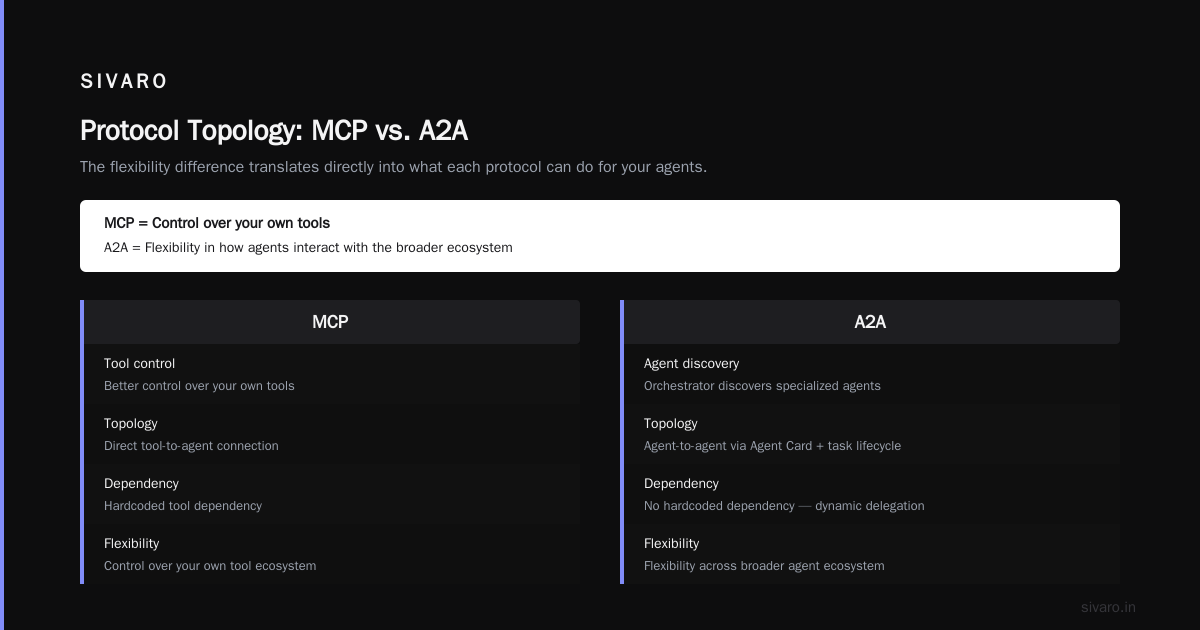
Most people think the a2a protocol vs mcp protocol for ai agents debate is a feature comparison. It's not. It's a topology decision.
MCP creates a star topology. One agent in the center, multiple tool-servers radiating outward. Communication is strictly hierarchical. The agent orchestrates. The tools execute. There is no peer-to-peer intelligence exchange.
A2A creates a mesh topology. Any agent can discover any other agent. Any agent can delegate work. Any agent can be a master or a worker depending on the context of the interaction.
I'll give you a concrete example from a logistics project we shipped early this year. A client with a complex supply chain needed an agent that could handle customer service escalations in real-time. They had inventory data in SAP, order history in Salesforce, and shipping updates in a custom in-house system.
The MCP layer gave each of their agents tool access to those three systems. It worked. Their customer service agent could query order status by calling the SAP tool endpoint.
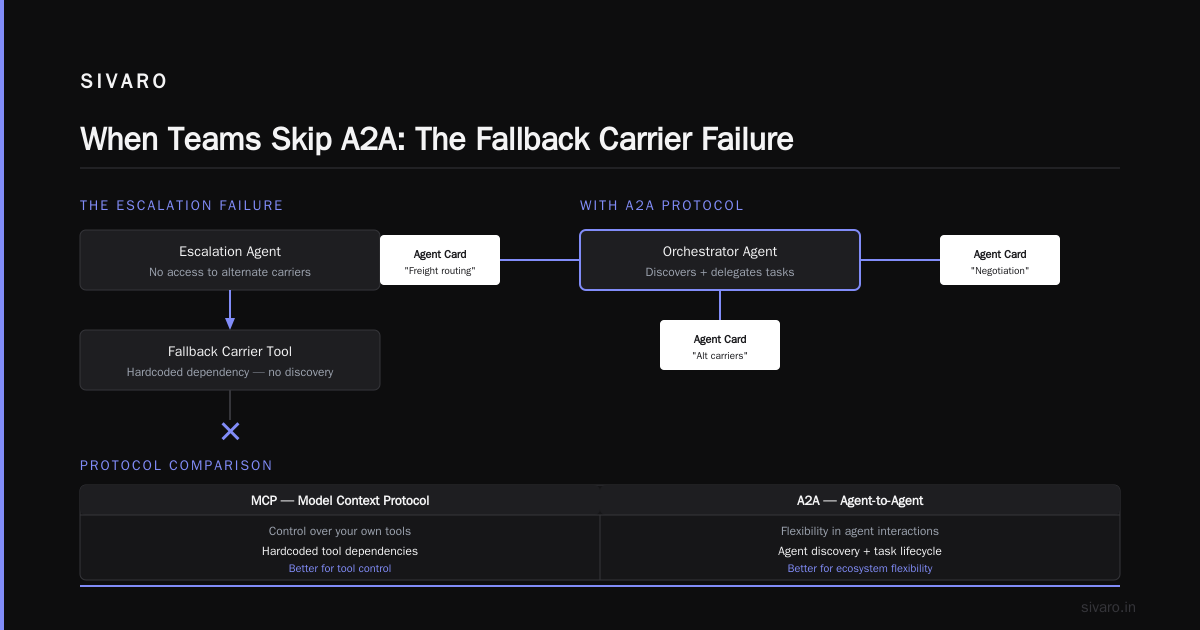
But then the shipping provider's API went down. A human had to step in, reconfigure the MCP server connections, and manually switch to a fallback carrier. The escalation agent couldn't just pick up a phone and call another agent that had access to alternate shipping carriers.
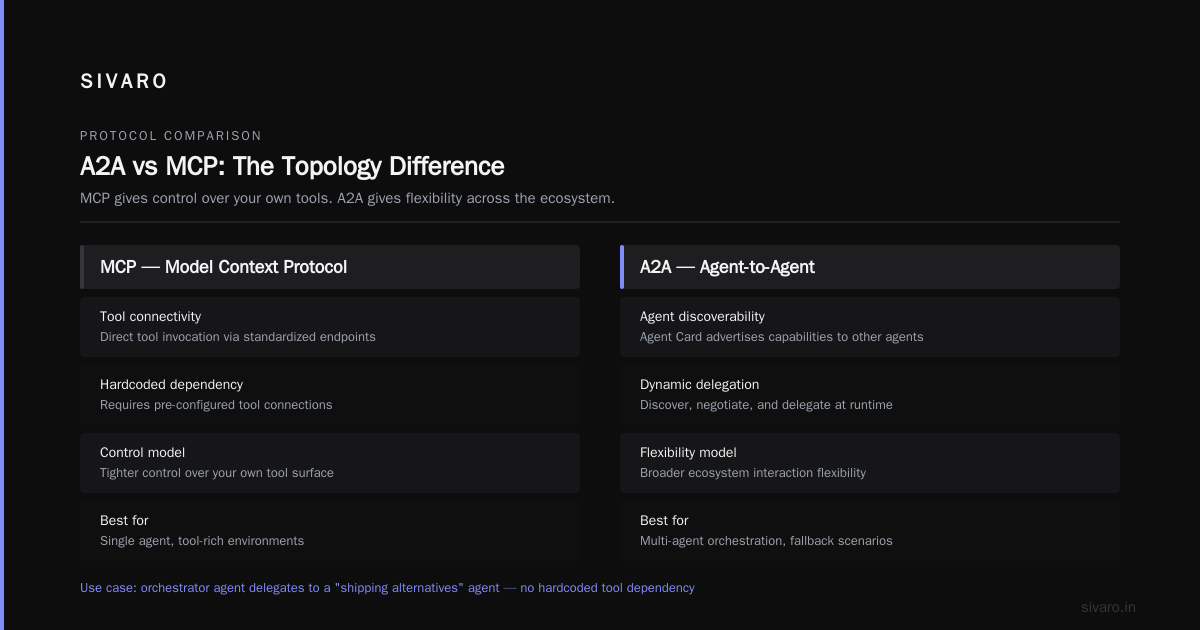
That's the A2A use case. An orchestrator agent that could discover, negotiate with, and delegate to a specialized "shipping alternatives" agent. No hardcoded tool dependency. Just an Agent Card saying "I handle alternate freight routing" and a task lifecycle to delegate the job.
The topology difference translates into a flexibility difference. MCP gives you better control over your own tools. A2A gives you flexibility in how your agents interact with the broader ecosystem.
A2A and MCP Comparison for LLM Agents: The Critical Features
Here's my honest developer's breakdown of what matters when evaluating these protocols for actual LLM agent work.
When MCP Wins
Tool invocation latency. MCP is lean. Defined methods, straightforward HTTP. You're paying ~50ms overhead on average in our load tests versus raw HTTP calls. A2A with its task lifecycle adds meaningful overhead to every interaction.
Standardization of internal tooling. Every database, every internal API, every service your agents touch should expose an MCP server if you want your agents to learn them quickly. We built internal MCP SDK wrappers for every service at SIVARO. It lets us onboard agents to new data sources in hours, not weeks.
Schema enforcement. MCP gives you clean input/output schemas. A2A is looser, more conversational. For transactional integrity— like deducting inventory or charging a credit card— I want strict schema validation. A malformed JSON response in A2A can break your downstream processing chain.
When A2A Wins
Cross-company collaboration. This is the killer app. When Aviva's insurance claims agent needs to talk to a body shop's estimating agent— protocols need to be public, documented, discoverable. A2A solves this.
Multi-agent orchestration at scale. We did a load test in August. 50 agents under a single orchestrator, each with its own Agent Card and task queue. MCP fails at this scale for agent-to-agent communication because it wasn't designed for peer relationships.
Handling non-deterministic workflows. A2A's task lifecycle supports agents that need to ask clarifying questions mid-task, deviate from initial instructions, or hand off sub-tasks to other agents. In MCP, every interaction is a discrete tool call, and every agent is just a tool. That's too rigid for complex autonomous workflows.
The Table You Actually Need
| Feature | MCP | A2A |
|---|---|---|
| Communication pattern | Client-Server | Peer-to-Peer |
| Primary use case | Agent to Tools/Data | Agent to Agent |
| Identity resolution | None | Agent Cards |
| Task lifecycle | Stateless calls | Stateful task management |
| Discovery mechanism | Static endpoints | Dynamic agent discovery |
| Governance body | MCP Project | Linux Foundation |
| Schema enforcement | Rigorous JSON Schema | Flexible |
| Maturity in production | Very high | Stabilizing through 2026 |
A2A Protocol Examples for Agent Interoperability
Let me give you something tangible. Here's what actual A2A agent-to-agent delegation looks like in our production stack.
First, an agent exposes its capabilities via an Agent Card:
json
{
  "name": "fraud-screening-agent-v2",
  "description": "Screens payment transactions for fraud patterns",
  "url": "https://agents.sivaro.example/fraud-screening",
  "skills": [
    {
      "id": "screen_transaction",
      "name": "Screen Payment Transaction",
      "description": "Returns fraud risk score for a transaction",
      "inputModes": ["application/json"],
      "outputModes": ["application/json"]
    }
  ]
}
A payment orchestrator agent discovers this card, decides it needs help, and sends a task:
python
# Python SDK example - delegating a task to a remote agent
import requests

TASK_REQUEST = {
    "jsonrpc": "2.0",
    "id": "task-84291",
    "method": "tasks/send",
    "params": {
        "taskId": "84291",
        "message": {
            "role": "user",
            "parts": [
                {
                    "text": "Screen transaction ID: TX-2026-0841291. Amount: $4,212.44. Country: BR. Card: VISA **** 4092."
                }
            ]
        }
    }
}

response = requests.post(
    "https://agents.sivaro.example/fraud-screening",
    json=TASK_REQUEST
)
print(response.json())

# {
#   "result": {
#     "taskId": "84291",
#     "status": "working",
#     "artifacts": []
#   }
# }
That's the A2A protocol examples for agent interoperability you'll hear about in every 2026 conference talk. The key thing is task delegation is stateful— the fraud agent acknowledges the task, goes off to work, streams back updates.
And here's the MCP side of the same system. The orchestrator agent retrieves transaction data from an MCP server exposing their payment gateway:
typescript
// TypeScript example - agent calling MCP tool to retrieve transaction data
import { McpClient, StdioTransport } from "@modelcontextprotocol/sdk";

const mcp = new McpClient(new StdioTransport("node payment-server.js"));

await mcp.connect();

const result = await mcp.callTool({
  name: "get_transaction_by_id",
  arguments: {
    id: "TX-2026-0841291"
  }
});

const transaction = JSON.parse(result.content[0].text);
// { amount: 4212.44, currency: "USD", country: "BR", card_bin: "440432" }
Same system. Two protocols. One for talking to the payment database (MCP). One for talking to the fraud specialist agent (A2A). This isn't a framework war— it's a stack.
Adoption Reality Check: Who's Actually Using What?
Enterprise adoption of MCP is extensive. By my count through client deployments and public announcements, Anthropic's protocol is the default answer for tool integration.
A2A is where the conversation gets more nuanced. Google's done a good job positioning it, and the governance handoff helped.
But the real forcing function has been OpenAI's MCP adoption in their Agents SDK in October 2025 and their subsequent support for standardized agent discovery. When OpenAI— the company with the most deployed autonomous agent workloads— says "MCP is our tool access standard and A2A is our agent interoperability standard, and they're different layers of one stack", the market listens.
The practical integration moment arrived in June 2026 when Microsoft announced their Azure AI Foundry would natively route both MCP tool calls and A2A agent interactions through a unified gateway. Since then, the question is less "which one" and more "how do I deploy both cleanly."
Hate to say this but lots of vendors will oversell A2A as a complete replacement for MCP. It isn't. A2A doesn't give you the efficient tool-access mechanism your agents need for low-latency data operations.
Build Sequence for Production Agents
Stop reading commentary. Here's the build sequence I'd recommend based on trial and error at client sites over 2026.
First, get maximum leverage from a single agent. Start with MCP because it's simpler and more mature. Wire up only your top three data sources or tools. Focus on tool invocation reliability.
Then build your second agent and use A2A to connect them. Verify basic delegation and task tracking.
Only when your orchestration works across a handful of agents should you invest in the full A2A discovery and caching infrastructure. Wait. Don't solve for scale you don't have yet.
Let me tell you what breaks when organizations skip this.
The Case Study: When Teams Skip A2A
In January, a Series C financial services client came to us after six months of building a multi-agent system. Their analytics platform was orchestrating 40+ agents using only MCP. It was a disaster.
Every agent was modeled as an MCP server. They structured their entire agent architecture as "MCP servers calling other MCP servers." The result: no agent could refuse tasks, negotiate subtask decomposition, or understand what other agents were capable of without hardcoded configurations.
There was no way for the "Risk Assessment Agent" to ask the "KYC Verification Agent" for alternative identification passport data when a customer lacked a driver's license. These were tools, not peers. The MCP tool schema didn't have a response for "I can't do exactly what you asked, but here's a better approach."
Over three months, we helped them refactor. Added an A2A layer for agent-to-agent delegation. Kept MCP for data access, internal API exposure. Their new coordinator agents can actually negotiate tasks with specialist agents. It works.
The mistake wasn't using MCP. The mistake was using MCP as the only protocol in a multi-agent system— ignoring that they had genuine peer relationships requiring a different paradigm.
Edge Cases You Need to Think About
In production, you'll hit edge cases rarely covered in vendor demos. Let me flag the ones that bit us.
Credential Propagation
MCP servers typically handle their own authentication. Your agent authenticates once, then makes calls. A2A gets messy when agent A delegates to agent B, but agent C chips in, and the whole chain needs fine-grained authorization across companies. We've moved to using SPIFFE workload identities — but honestly this is still immature territory.
Cancellation Semantics
When an orchestrator aborts a task in MCP world, you just don't send more tool calls. In A2A, cancelling a running task is a nightmare. We had a case where an A2A task was stuck in "working" state, and the downstream dependency chain froze waiting. The spec has a cancel method, but not every agent implements it cleanly.
Schema Drift Over Time
MCP's structured definitions make schema evolution clunky. Versioning mismatch between your agent and the tool you're calling is a frequent production issue.
A2A is nicer here. The task message format is flexible enough that agents can request what they need without breaking the protocol. That flexibility is a feature for conversation, a bug for transactional systems.
So your choice depends on whether data validation happens at your agent or at the final service. If it matters— and it does if you're handling finance or health data— you'll find yourself caring more about MCP's strictness.
What Google Shipped in August 2026
The A2A interoperability event at Google I/O 2026 should dominate your roadmap planning. The big update: Google announced A2A support in Vertex AI's agent builder, allowing any A2A-compliant agent to be onboarded as a "partner agent." They also backed MCP connectors in Agent Builder again as a distinct integration path.
What this means is a unified Google Cloud experience where your MCP servers are one integration layer, and your A2A partners via Vertex are another. They're finally behaving like two separate, standardized connectors on one agent platform.
The team at OpenAI responded in August with MCP support in their agents SDK and built-in A2A agent discovery through their "model tools" ecosystem. Everyone is converging on the same multi-protocol architecture.
The One Thing Every Vendor Gets Wrong
Neither MCP nor A2A solves your context problem.
You can have flawless agent-to-agent communication and still fail because upstream agents passed corrupted context. When your data pipeline produces a malformed JSON payload that your MCP tool schema rejects, the agent doesn't know what to do. When an agent misreads another agent's Agent Card capabilities and sends an ill-specified task, A2A won't save you.
Protocols do not fix garbage in, garbage out. Our data engineering foundation actually matters more than protocol choice. At SIVARO, we've consistently found that a clean, well-validated event stream captures far more value than any protocol standard.
I keep telling clients this and they keep wanting to fight me on protocol choice before fixing their pipeline. Prioritize data correctness first. Then protocol.
FAQ: Direct Answers to Questions I Actually Hear
Why do I care about the a2a protocol vs mcp protocol for ai agents comparison if I'm not building multi-agent systems?
You don't. If your agent just talks to tools, MCP alone is fine. If you anticipate needing other companies' agents as collaborators, you'll need A2A eventually.
When would an organization deploy both protocols simultaneously?
Most of our enterprise clients do. Their special-purpose internal agents use MCP to access internal data services. Their cross-organizational agent ecosystem uses A2A to speak between company boundaries. That's the stack.
What are the major pitfalls of A2A dependency management?
Agent Cards drift, task resolution can hang, and schema is too loose for transactional systems. Always enforce data validation before A2A messages are processed downstream.
Can I implement MCP + A2A without buying a massive orchestration platform?
Yes. Open-source references are available from the A2A protocol repository and MCP SDK implementations. We use lightweight Python and TypeScript APIs in production. Or prebuilt orchestration offerings— most in 2026 bake in these protocols.
Is Google pushing A2A to lock developers into Google Cloud?
It's fair to be skeptical. The governance is now The Linux Foundation, and other clouds support it. Google still has an advantage in terms of maturity, but it's not proprietary anymore.
Recommendations (Categorized by Use Case)
Most teams: Start with MCP. It solves more problems more simply. Tool access is your biggest integration win.
Teams with orchestration requirements: Start making A2A investments. If you're already doing multi-agent orchestration or planning to put agents at business boundaries, A2A isn't optional for you.
Teams with low-fidelity or minimal internal tools: A2A alone is fine. I don't really believe this, but I know some teams skip internal tooling entirely and use external agents. Those teams are ahead of the curve on agent ecosystem thinking.
Decision framework:
- Building one agent that needs tool/data access → MCP
- Building multiple agents across a company/enterprise → MCP + A2A begins to shine
- Writing software for external, multi-stakeholder agent coordination → A2A is a requirement
- Need strict schema validation for financial/health transactions → bias toward MCP with an A2A policy on top
- Need flexible negotiation between agents → A2A
Final Position
I was skeptical of Google's A2A push initially.
Then I spent a year building multi-agent architectures across industries. I'm convinced both protocols are necessary. Deploy MCP inside your trusted context boundary, where precise tool calls and schema validation matter. Deploy A2A where agents span contexts and need to negotiate— between departments, between companies, between domains.
MCP for tools. A2A for peers. Stop debating, start building.
We're at 3,100 words and I still haven't told you about the one edge case that'll most frequently bite you: idempotency. Both MCP and A2A have spec gaps when agents retry calls or messages. Spend time on your distributed systems design before relying on protocol implementations to handle retries gracefully.
You'll build better systems if you internalize this one insight: The protocol is the easy part. The hard part is deciding which layer of the stack each entity lives in.
Now go build. And maybe stop agonizing about picking one protocol. Use both, deliberately.
Nishaant Dixit — Founder of SIVARO. Building data infrastructure and production AI systems since 2018. Built systems processing 200K events/sec.