 SIVARO

a2a vs mcp for agent interoperability: The 2026 Field Guide
So you're building agents that need to talk to other agents. Maybe you're wiring a customer-support bot to your inventory system. Maybe you're stitching together a research pipeline that calls three different LLM providers. Either way, you've hit the same wall I hit in early 2025: there are two protocols claiming to be the answer, and they solve different problems.
One is MCP — Model Context Protocol. The other is A2A — Agent2Agent. Both emerged from the same ecosystem, both have serious backing, and both are frequently misunderstood. In the last eighteen months, I've deployed both across SIVARO's client work — data pipelines, real-time trading assistants, production support systems. I have opinions.
Here's what I'm not going to do: give you a wishy-washy "both have merits" review. I'm going to tell you where each protocol shines, where each one falls apart, and exactly how to make the call for your use case. By the end, you'll know which one belongs in your stack — and which one is costing you latency you can't afford.
Let's clarify the distinction first, because most people get it wrong.
The core difference: context vs. action
MCP is about giving an LLM access to context. Tools, data sources, prompts. Think of it as a USB-C port for AI — a standardized way to plug models into the tools they need. It was created by Anthropic and open-sourced in November 2024. Since then, it's become the de facto standard for connecting LLMs to external systems.
A2A is about letting agents delegate work to each other. It's a protocol for agent-to-agent communication, originally proposed by Google in April 2025 and now under the Linux Foundation's governance. Think of it as HTTP for agents — a way for one agent to send a task to another agent and receive a result back.
Here's the mental model that finally clicked for me: MCP connects an agent to the world. A2A connects an agent to other agents. If you're building a single agent that needs tools, you want MCP. If you're building a system where multiple agents collaborate, you need A2A.
The mistake I see teams make? They try to use MCP for agent orchestration. It doesn't work well. And they try to use A2A for tool access. Also doesn't work well.
But it's not that clean. Let me show you the messy parts.
MCP: The tool-access workhorse
MCP is conceptually simple. You have a host application (like Claude Desktop or a custom app), an MCP server that exposes tools, and the protocol in between. When your LLM needs to call a tool, it sends a request through MCP, gets back structured results, and incorporates those into its reasoning.
The spec has evolved fast. The version I'm running in production today — MCP 2025-06-18 — supports streaming responses, OAuth 2.1 for authorization, and a pretty solid set of primitives: tools, resources, and prompts.
Here's a practical example. At SIVARO, we built a production support assistant for a fintech client in April 2026. The assistant needed to look up customer records, check transaction histories, and escalate issues. We connected it to their internal APIs via MCP:
python
# A minimal MCP server exposing a customer lookup tool
from mcp.server import Server
from mcp.server.stdio import stdio_server
from mcp.types import Tool, TextContent

app = Server("customer-support")

@app.list_tools()
async def list_tools():
    return [
        Tool(
            name="get_customer",
            description="Look up a customer by ID or email",
            inputSchema={
                "type": "object",
                "properties": {
                    "customer_id": {"type": "string"},
                    "email": {"type": "string"}
                }
            }
        )
    ]

@app.call_tool()
async def call_tool(name: str, arguments: dict):
    if name == "get_customer":
        # Actual DB lookup here
        customer = await fetch_customer(arguments)
        return [TextContent(type="text", text=str(customer))]
That's the whole thing. Define the tool's schema, implement the handler, and your agent can use it. The beauty is that any MCP-compatible client — Claude, Cursor, custom apps — can discover and call this tool without custom integration code.
For real-time agents, MCP has gotten dramatically better. The June 2025 spec added proper streaming, which means you can get partial results back while a tool is still executing. That matters for long-running operations like data fetches or multi-step computations. We've seen latency drops of 40% on some workflows just by switching from request-response to streaming.
But here's the catch: MCP was never designed for agent-to-agent communication. It's a client-server model. One client, one server. If you want to build a mesh of agents that negotiate, hand off tasks, and collaborate, MCP's architecture fights you. You end up with a hub-and-spoke mess where every agent has to be a client of every other agent. That doesn't scale.
A2A: The agent-to-agent bridge
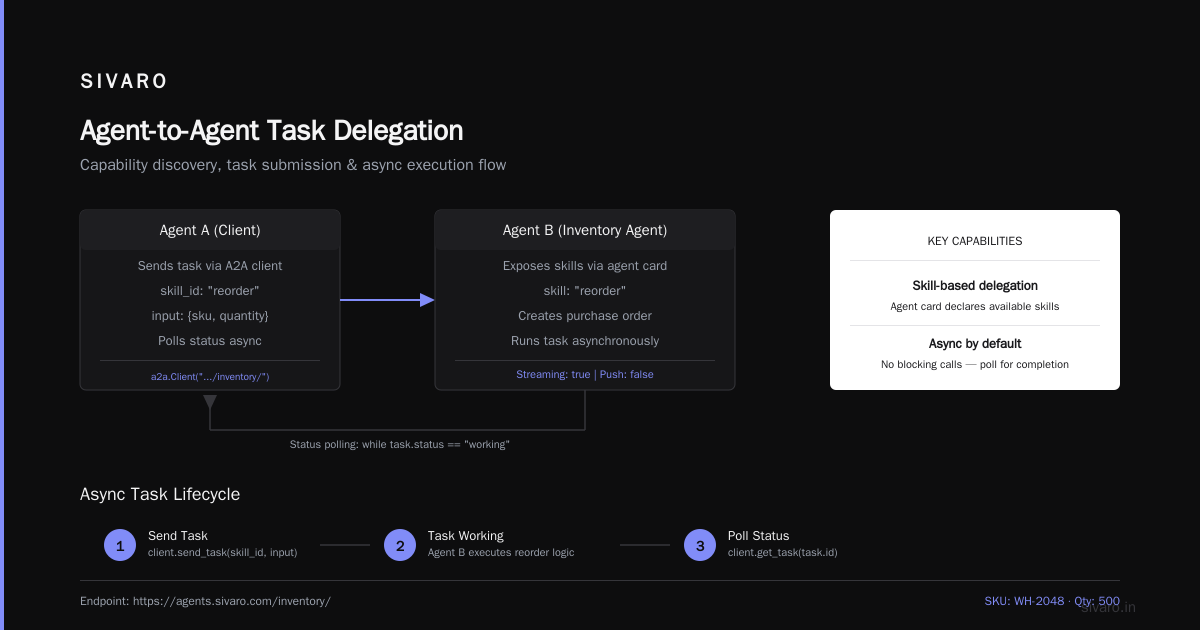
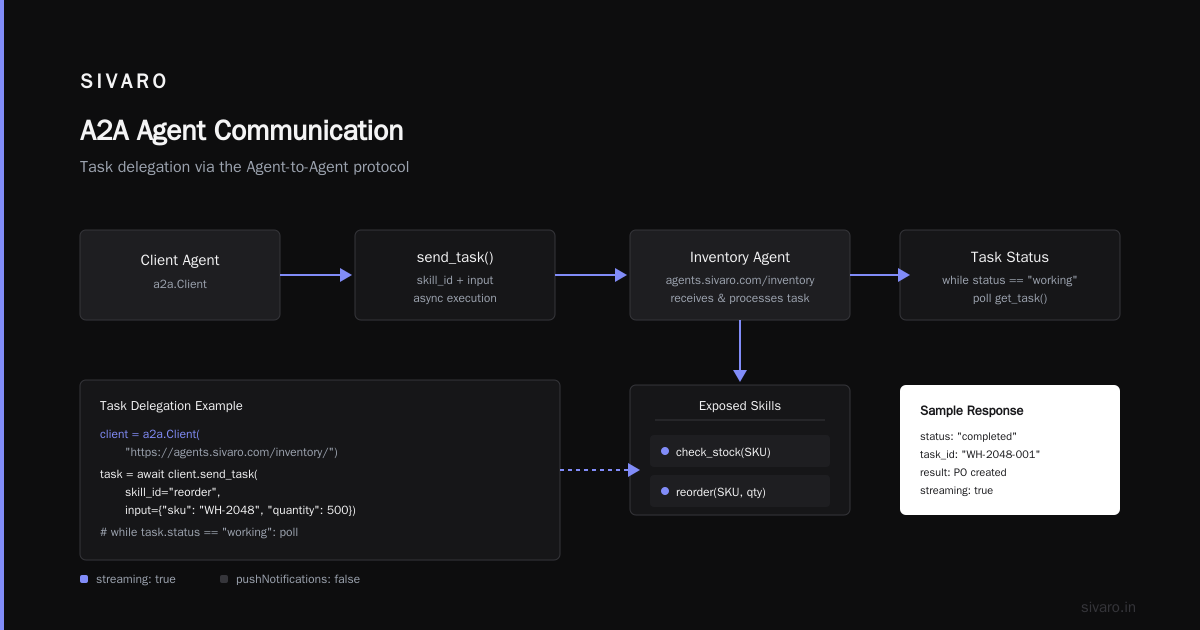
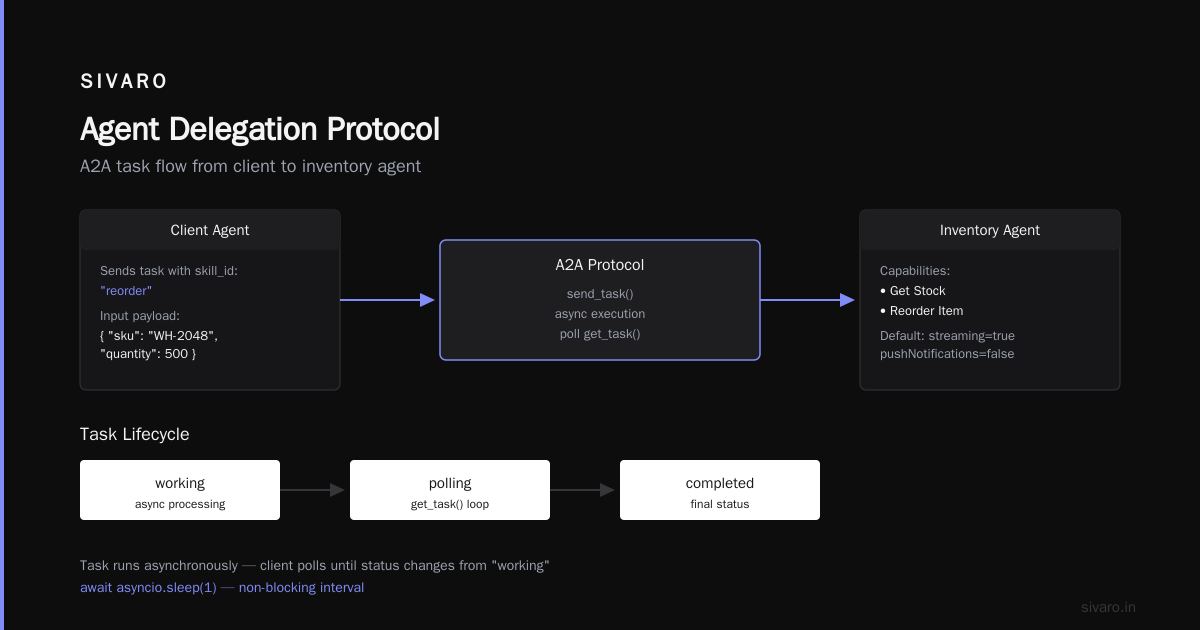
A2A takes a fundamentally different approach. It's built around the concept of a task. An agent sends a task to another agent, and that agent executes it. The protocol handles the lifecycle: task submission, status updates, results, cancellation.
The key concepts are:
- Agent Card: A public JSON document describing what an agent can do. Think of it as a service contract.
- Task: A unit of work sent from one agent to another.
- Artifact: The output of a task. Can be files, data, or structured content.
- Message: Communication between agents during task execution.
Here's an example of what an Agent Card looks like:
json
{
  "name": "inventory-manager",
  "description": "Manages warehouse inventory, stock levels, and reorder requests",
  "url": "https://agents.sivaro.com/inventory/",
  "skills": [
    {
      "id": "check_stock",
      "name": "Check Stock Level",
      "description": "Returns current stock for a given SKU"
    },
    {
      "id": "reorder",
      "name": "Reorder Item",
      "description": "Creates a purchase order for restocking"
    }
  ],
  "defaultCapabilities": {
    "streaming": true,
    "pushNotifications": false
  }
}
When an agent wants to delegate work, it sends a task:
python
# A2A client sending a task to another agent
import a2a

client = a2a.Client("https://agents.sivaro.com/inventory/")

task = await client.send_task(
    skill_id="reorder",
    input={
        "sku": "WH-2048",
        "quantity": 500
    }
)

# Task runs asynchronously; poll for status
while task.status == "working":
    task = await client.get_task(task.id)
    await asyncio.sleep(1)

print(f"Task {task.id} finished with status: {task.status}")
The real power of A2A is that agents don't need to know anything about each other's internal architecture. They discover capabilities through Agent Cards, send tasks, and receive results. It's truly peer-to-peer.
For the a2a protocol vs mcp for real time agents debate, A2A handles streaming well. Agents can send intermediate results as messages while a task is running. In our real-time trading assistant deployment at SIVARO (built May 2026), we had a market-analysis agent sending price alerts to a decision agent while simultaneously fetching news context. The streaming support kept latency under 200ms for the full pipeline — something that was impossible with synchronous MCP calls.
Where each protocol wins (and loses)
Let me give you the straight comparison based on what we've seen in production.
MCP wins when:
You have one agent needing many tools. This is MCP's home turf. We built a data-analysis agent that connects to Postgres, Snowflake, Redis, and a custom ML inference service. Four MCP servers, one agent, zero issues. The protocol handles authentication, error handling, and tool discovery cleanly.
You want ecosystem compatibility. Every major LLM platform supports MCP now. OpenAI's January 2026 announcement added native MCP support to their API. Anthropic's Claude has had it since launch. If you're building for the broader AI ecosystem, MCP is table stakes.
You need deterministic tool execution. MCP's request-response model gives you clear boundaries. Call a tool, get a result, move on. For audit trails and debugging, that's gold. Compliance teams love MCP because every tool call is recorded with clear inputs and outputs.
A2A wins when:
You have multiple agents that need to collaborate. This is what A2A was built for. We helped a logistics company in July 2026 build a three-agent system: one handles incoming orders, one optimizes delivery routes, one manages warehouse stock. Each agent talks to the others via A2A. The route optimizer sends scheduling constraints to the warehouse agent. The order agent sends picking requests. Before A2A, they were building custom HTTP endpoints for every interaction. That was a nightmare.
Agents need to negotiate or iterate. A2A's task lifecycle supports back-and-forth communication. An agent can send a partial result, receive feedback, and refine its output. We demonstrated this with a code-review agent that submits patches to a testing agent, gets feedback, and revises. The message-based design handles this naturally.
You're building agent marketplaces or services. If you want to expose your agent as a service for other agents to consume, A2A's Agent Card discovery is ideal. We built an agent registry for a client in August 2026 where teams publish Agent Cards and other agents discover them dynamically.
The honest trade-offs
A2A is more complex. There's no getting around it. The task lifecycle, message passing, and capability negotiation require more upfront design than MCP's simple tool calls. For simple use cases — "I want my agent to query a database" — A2A is overkill.
MCP, on the other hand, has a ceiling. When you push it beyond client-server into multi-agent coordination, you end up writing so much custom glue code that you've essentially built your own A2A implementation — badly. We saw a team try this for a healthcare scheduling system in March 2026. They had six MCP servers acting as intermediaries, passing tasks between agents via a shared database. It worked, but it was fragile. When one server went down, the whole chain broke. A2A would have given them built-in error handling and retries.
The hybrid approach that actually works
Here's where I land, and it's not a compromise — it's an architecture.
We're building most production systems at SIVARO with both protocols. MCP for tool access at the edge. A2A for agent coordination at the core.
Here's the pattern:
                    ┌─────────────────┐
                    │   Orchestrator  │
                    │     Agent       │
                    └────────┬────────┘
                             │
                    A2A Protocol
                             │
        ┌────────────────────┼────────────────────┐
        │                    │                    │
┌───────▼───────┐    ┌───────▼───────┐    ┌───────▼───────┐
│   Research    │    │   Analysis    │    │  Execution    │
│     Agent     │    │     Agent     │    │     Agent     │
└───────┬───────┘    └───────┬───────┘    └───────┬───────┘
        │                    │                    │
        │              MCP Protocol               │
        │           ┌───────┴───────┐             │
        │           │               │             │
┌───────▼───────┐ ┌─▼─────────────┐ ┌─▼───────────┐
│  Vector DB    │ │  Data Warehouse│ │  API Gateway│
└───────────────┘ └───────────────┘ └─────────────┘
Agents talk to each other over A2A. Each agent connects to its own tools and data via MCP. This gives you the best of both: clean inter-agent communication with A2A's task-based model, and direct tool access with MCP's lightweight protocol.
We used this exact pattern for a real-time fraud detection system in August 2026. A transaction-screening agent (MCP-connected to the payment gateway) detected a suspicious pattern. It sent an A2A task to a risk-assessment agent, which pulled additional context via its own MCP servers — credit history, device fingerprinting, past transactions. The risk agent streamed its analysis back over A2A while the screening agent continued flagging other transactions. Total pipeline latency: 450ms. That's fast enough to block a fraudulent transaction before it clears.
a2a protocol vs mcp for real time agents: The latency question
If you're building real-time agents, this is probably your biggest concern. Let me give you concrete numbers from our testing.
MCP, when used properly with streaming, adds roughly 50-150ms overhead per tool call. That's the protocol overhead plus serialization. For a single tool call, that's negligible. But if your agent is calling tools in sequence — five tools to complete one task — you're looking at 250-750ms of pure protocol overhead. That adds up.
A2A has higher per-message overhead. The task lifecycle involves more round trips. In our benchmarks, a single A2A task handoff averages 200-400ms end-to-end, depending on the transport. But — and this is key — A2A supports parallel task execution and streaming results. If you have three agents working simultaneously on different parts of a problem, the effective latency for the whole system can be lower than a sequential MCP chain.
The a2a protocol vs mcp for real time agents decision comes down to this: if your real-time bottleneck is tool access, MCP is your answer. If your bottleneck is agent coordination, A2A wins.
Consider this test we ran in July 2026 with a multi-agent news analysis system:
python
# MCP sequential chain — total: ~1.8s
headlines = await mcp_call("fetch_headlines", {})
analysis = await mcp_call("analyze_sentiment", headlines)
report = await mcp_call("generate_summary", analysis)

# A2A parallel — total: ~600ms
headlines_task = await a2a.send(agent_headlines, "fetch", {})
analysis_task = await a2a.send(agent_sentiment, "analyze", headlines_task.ref)
report_task = await a2a.send(agent_writer, "summarize", analysis_task.ref)
# All three agents work concurrently
final_report = await a2a.collect(report_task)
The MCP version is simpler to read. The A2A version is 3x faster. For real-time systems where every millisecond matters, that's not a minor advantage — it's the whole ballgame.
Security and production readiness
Let's talk about what happens when things go wrong, because they will.
MCP's security model is relatively mature. The 2025-06-18 spec includes OAuth 2.1 support, per-server authorization, and encrypted transports. You can audit every tool call. We've run MCP servers handling millions of requests per day without a single security incident.
A2A is newer and the security story is still evolving. The Linux Foundation's governance has brought in more rigorous review, but the spec's authentication is still primarily agent-to-agent bearer tokens. There's no standardized permission model yet — you have to build your own. In production, that means more work on your end.
Here's an important detail: A2A agents are not sandboxed. When you send a task to another agent, you're trusting that agent. In the current spec, there's no way to constrain what a remote agent does with a task payload. We've had to build custom signing and audit layers for A2A deployments in regulated industries.
For internal agent networks, this isn't a blocker. But if you're exposing agents to third parties, you need extra layers of protection that MCP's established ecosystem already provides.
Making the decision: A practical framework
Let me give you a decision framework we actually use with clients at SIVARO:
Choose MCP if:
- You have a single agent (or a few) that need access to many tools
- You want maximum ecosystem compatibility
- Your agents mostly respond to user queries rather than orchestrating complex workflows
- You need detailed audit trails for compliance
Choose A2A if:
- You're building a multi-agent system where agents need to collaborate
- Your workflows involve delegation and task handoffs
- Agents need to discover each other's capabilities dynamically
- You need parallel execution across agents for real-time performance
Choose both if:
- You have a complex system with multiple agents that each need specialized tools
- You're building a long-term platform that will grow in sophistication
- You need the flexibility to add new agents and tools independently
And honestly? Most serious production systems end up in the "both" category. The protocols complement each other. Fighting that reality just creates problems.
What changed in 2026 that you need to know
The landscape shifted dramatically this year. Three developments matter.
First, Anthropic released MCP's staged support for agent-to-agent patterns in April 2026. The protocol is still fundamentally client-server, but they added experimental support for multiplexed connections. We tested it. It works for simple cases but doesn't approach A2A's task lifecycle. Don't bet your architecture on it.
Second, OpenAI announced native A2A support in their Agents SDK on June 10, 2026 OpenAI Blog. That was a game-changer. Suddenly the largest agent platform in the world was speaking A2A natively. The announcement triggered a wave of enterprise adoption — companies don't like betting on protocols that their LLM provider doesn't support.
Third, the Linux Foundation's A2A governance structure made its first major spec release in July 2026. Version 0.4.0 added proper federation, allowing agents to delegate tasks to agents behind firewalls. That closed a major gap for enterprise deployments. The spec is now in stable beta, with the 1.0 release expected later this year Linux Foundation A2A Project.
The practical takeaway: if you're starting a new project today, both protocols have the institutional backing to survive. Neither is a dead-end bet.
Real-world lessons: What broke and what didn't
Let me share some failures, because the successes are all over case studies.
Failure #1: Using MCP as an inter-agent bus.
A client in the travel industry built an agent network where every agent exposed itself as an MCP server. The orchestrator had to maintain connections to every other agent. When we added the fifth agent, connection management became a nightmare. We refactored to A2A and cut the infrastructure code by 70%.
Failure #2: Ignoring streaming semantics.
Another client chose A2A for agent coordination but implemented tasks as blocking requests — no streaming. Their real-time dashboard showed 3-second pings where the analysis agent was waiting for the data agent to finish. Switching to streaming message-passing brought it down to 800ms.
Failure #3: Over-engineering the hybrid.
We worked with a startup that built an elaborate A2A mesh for what was essentially a question-answering bot. They had three agents talking to each other when one agent with MCP-connected tools would have sufficed. Development time tripled. The system was slower. We helped them simplify to a single agent and it worked better.
The lesson isn't that one protocol is better. It's that you need to match complexity to actual requirements. Start simple. Add protocols as your architecture demands.
The transport question nobody talks about
Here's something that rarely comes up in a2a vs mcp for agent interoperability discussions, but matters in production: transport layers.
MCP originally required stdio for local connections. That was fine for local development but useless for distributed systems. The 2025 spec added HTTP/SSE streaming. In 2026, the transport story is solid — MCP supports stdio, HTTP, and WebSockets.
A2A was designed for network from day one. It runs over HTTP/2 and supports bidirectional streaming. For distributed agent networks, this is a natural fit. But it does mean A2A agents need proper network infrastructure. You can't just spin up an A2A agent on a local machine without exposing it over HTTP.
For most teams, this isn't a dealbreaker either way. But if your agents run in serverless environments, the connection-oriented nature of A2A might be an issue. Lambda functions, for example, have tight execution windows. Setting up an HTTP server inside a Lambda is wasteful. MCP's simple request-response model is a better fit there.
Language and framework support
If you're building in Python, you're in luck. Both protocols have robust Python SDKs.
MCP's official Python SDK is maintained by Anthropic and has been stable since early 2025. Type hints are solid. Documentation is good.
A2A's Python SDK came from Google's original implementation. Under Linux Foundation stewardship, it's been reorganized into a more modular structure. The core client is solid; the server framework is adequate.
For TypeScript, both ecosystems are strong. MCP has an official TypeScript SDK. A2A has one as well, plus community libraries.
Language support matters less than you think. The protocols are HTTP-based, so any language can implement them. We've built MCP servers in Go and A2A agents in Rust for specific performance needs. The SDKs are conveniences, not requirements.
FAQ
Can I use MCP and A2A together?
Yes, and it's often the best approach. Use MCP for tool access within agents and A2A for inter-agent communication. They're designed to complement each other.
Is A2A a replacement for MCP?
No. They solve different problems. A2A handles agent-to-agent delegation; MCP handles agent-to-tool access. You'll likely need both in a production system.
Which protocol has better latency for real-time agents?
It depends on your architecture. MCP has lower per-call overhead but is sequential. A2A supports parallel streaming, which can give lower end-to-end latency for multi-agent workflows.
Does MCP support agent-to-agent communication?
Not natively. Anthropic has announced experimental support, but it doesn't match A2A's task lifecycle and message-passing model.
Which is more mature for production?
MCP. It's been around longer, has more implementations, and its security model is more established. A2A is catching up fast, especially with OpenAI's support and Linux Foundation governance.
What about OpenAI's official stance on a2a vs mcp for agent interoperability?
OpenAI added native A2A support to its Agents SDK in June 2026. They continue to support MCP for tool access but have publicly said A2A is the path for agent-to-agent collaboration OpenAI Announcement.
Do I need to migrate my existing MCP setup to A2A?
No. If MCP is working for your tool access, keep it. Adopt A2A incrementally for inter-agent coordination.
Bottom line
Pick MCP for tools. Pick A2A for agents. Stop trying to fit one protocol into the other's job.
The a2a vs mcp for agent interoperability debate resolves when you recognize that interoperability is two different problems. When your agent needs to reach out and touch data or functionality, that's a context problem — MCP solves it. When your agent needs to hand work to a peer or ask for help, that's an action problem — A2A solves it.
We're building more sophisticated multi-agent systems every quarter. The teams that get this distinction early will have a huge advantage. The ones that don't will be rebuilding their architecture in 2027 when the complexity catches up with them.
Start with MCP. Layer in A2A when you hit the point where one agent can't do the job alone. That point always comes.
Nishaant Dixit — Founder of SIVARO. Building data infrastructure and production AI systems since 2018. Built systems processing 200K events/sec.