 SIVARO

a2a vs mcp for ai agents on aws: The 2026 Field Guide
You're staring at a whiteboard covered in boxes and arrows. Twenty agents, three data stores, two event buses, and a partridge in a pear tree. The question isn't whether to build it — it's how the hell these agents talk to each other. And on AWS, that question has two very different answers.
Here's the short version: MCP (Model Context Protocol) is how agents talk to tools. A2A (Agent-to-Agent) is how agents talk to each other. They're not competitors — they're complementary layers. But if you're building on AWS in late 2026, how you wire those layers matters more than which one you pick.
I've spent the last eighteen months at SIVARO helping clients untangle exactly this. What I'm about to share isn't theory. It's what broke in production, what didn't, and the framework we now use to answer "a2a vs mcp for ai agents on aws" before a single line of code gets written.
Why This Question Keeps Coming Up
Every week, another engineering leader asks me the same thing. They've got an agent built with Claude or Gemini on Bedrock. They've connected it to Lambda functions via MCP. Now their CEO wants "multi-agent orchestration" because Gartner said something. And they're confused about why there are two acronyms.
Here's what nobody tells you: Anthropic opened up MCP in late 2024. Google responded with A2A in April 2025. Both are now under the Linux Foundation's stewardship as open standards. By September 2026, they've stopped being "which framework should we use" and become "which problems do each solve."
MCP solves the "how do I let Claude use my internal APIs" problem. A2A solves the "how do I let my inventory agent talk to my pricing agent" problem.
If you conflate them, you'll over-engineer your tool calls or under-engineer your agent mesh. I've watched both happen. Neither is pretty.
The AWS Reality Check
Before we go deeper into a2a vs mcp for ai agents on aws, let's ground this in what AWS actually gives you.
Bedrock became the home for foundation models — Anthropic, Meta, Cohere, Mistral, and Amazon's own Nova family. By early 2026, Bedrock AgentCore let you build agents without managing the orchestration loop yourself. AWS added native MCP support to Bedrock AgentCore in March 2026, which was a genuinely big deal. It meant you didn't need to run a custom MCP gateway on EC2 or Fargate just to connect Claude to your internal tools.
But here's the catch we discovered in June 2026: Bedrock's native MCP support is solid for tool calls, but A2A support is still immature. You'll likely end up building your own A2A agent discovery and routing setup — or using a third-party orchestrator — because AWS hasn't shipped a managed A2A registry yet.
That's the state of a2a vs mcp for ai agents on aws: MCP is first-class on Bedrock. A2A is DIY.
What MCP Actually Does — And Where It Breaks
Model Context Protocol standardizes the interface between an AI model and the tools/data it needs. Think of it like USB-C for AI tools. Instead of building a custom integration for every API your agent touches, you expose them as MCP servers and the agent speaks one protocol.
Here's a basic MCP server on AWS, running as a Lambda function:
python
# lambda_function.py - MCP server running on Lambda via Function URL
import json
from mcp.server import Server
from mcp.types import Tool, TextContent

app = Server("inventory-mcp")

@app.list_tools()
async def list_tools():
    return [
        Tool(
            name="get_inventory_level",
            description="Get current inventory for a SKU",
            inputSchema={
                "type": "object",
                "properties": {
                    "sku": {"type": "string"}
                }
            }
        )
    ]

@app.call_tool()
async def call_tool(name: str, arguments: dict):
    if name == "get_inventory_level":
        # Query DynamoDB
        sku = arguments["sku"]
        level = await query_dynamodb(sku)
        return [TextContent(type="text", text=json.dumps(level))]

def handler(event, context):
    return app.handle_request(event)
That runs behind an AWS Lambda Function URL. Your agent on Bedrock connects to it via the MCP connector. Done.
And it works. We've got clients running 50-plus MCP servers this way. Latency is predictable — usually under 300ms for a single tool call, which is fine when the model is already thinking for two seconds.
But here's where MCP breaks in production: when the tool itself needs to be an agent.
MCP assumes a request-response pattern. Your agent asks for inventory, the tool returns a number. But what happens when your "tool" is actually a multi-step workflow that needs to make decisions mid-execution? You get into callback hell that MCP wasn't designed for.
A2A: The Other Half of the Puzzle
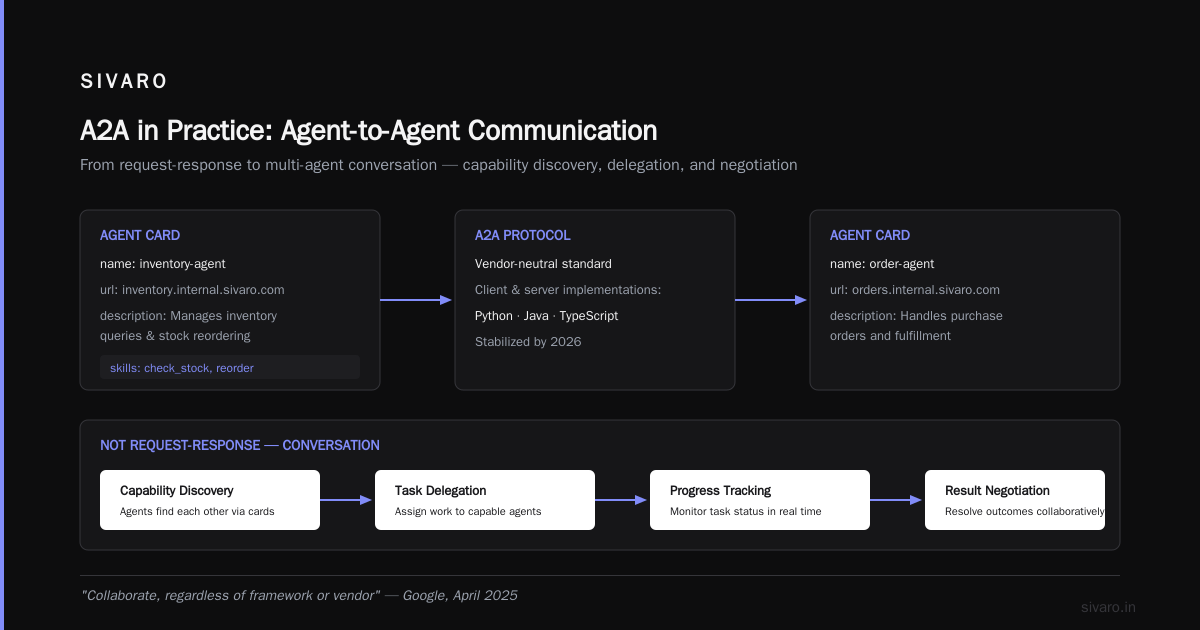
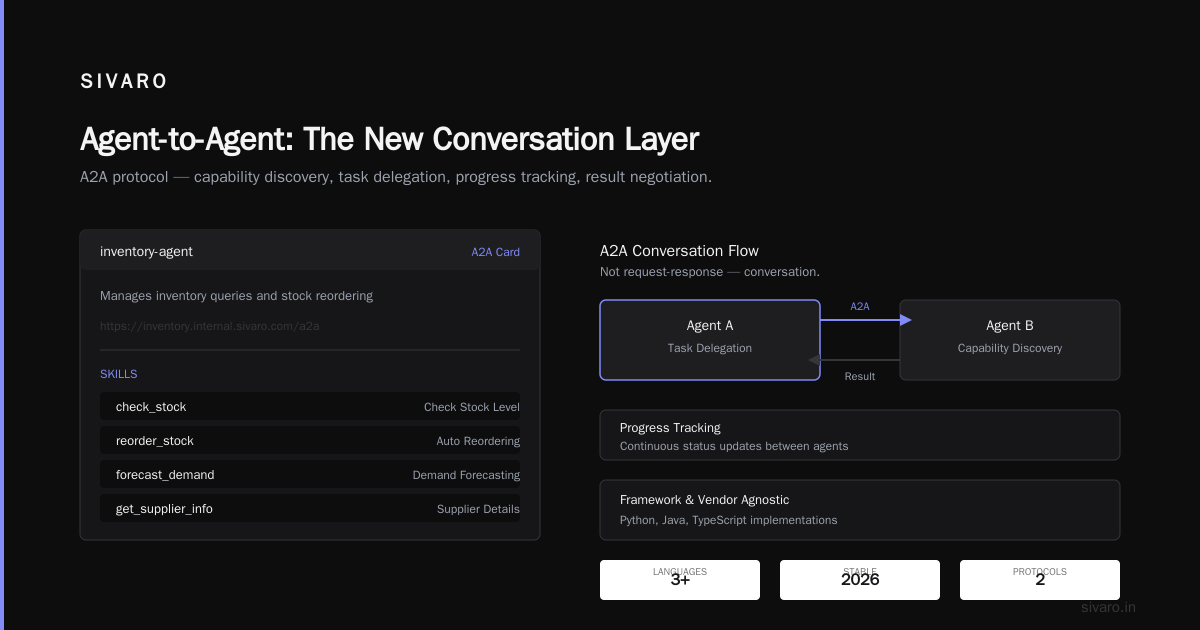
Agent2Agent protocol is different. It's designed around agents negotiating with each other. Capability discovery, task delegation, progress tracking, and result negotiation. Not request-response — conversation.
Google's announcement in April 2025 said it plainly: A2A lets agents "collaborate, regardless of framework or vendor." By 2026, that's mostly true. The protocol has stabilized, and there are A2A client and server implementations in Python, Java, and TypeScript.
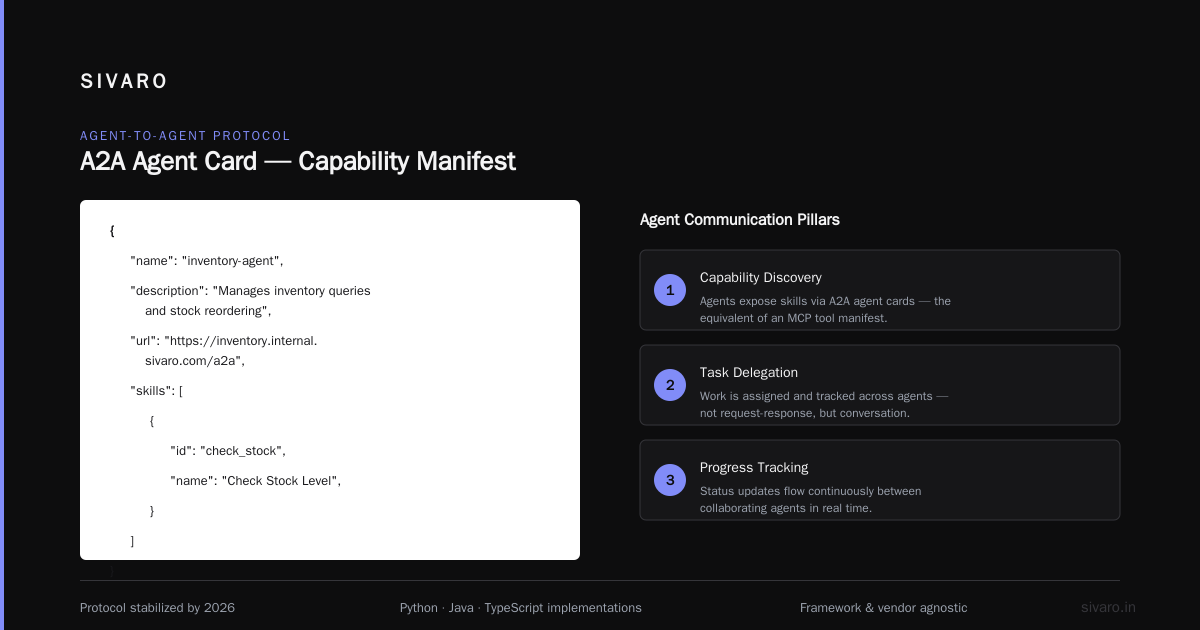
Here's what an A2A agent card looks like — it's the equivalent of an MCP tool manifest, but for agent-level capabilities:
json
{
  "name": "inventory-agent",
  "description": "Manages inventory queries and stock reordering",
  "url": "https://inventory.internal.sivaro.com/a2a",
  "skills": [
    {
      "id": "check_stock",
      "name": "Check Stock Level",
      "description": "Returns current stock for given SKUs",
      "inputModes": ["text"]
    },
    {
      "id": "reorder",
      "name": "Trigger Reorder",
      "description": "Creates purchase order when stock below threshold",
      "inputModes": ["text"],
      "outputModes": ["text"]
    }
  ],
  "security": {
    "authentication": "OAuth2",
    "oauth2": {
      "tokenEndpoint": "https://auth.internal.sivaro.com/token"
    }
  }
}
Your orchestrating agent fetches that card, sees what inventory-agent can do, and delegates tasks. Crucially, A2A supports both synchronous and asynchronous patterns. If a task takes ten minutes, one agent hands it off and receives status updates — not a timeout.
The Architecture That Actually Works on AWS
We've settled on a reference architecture that's survived production traffic from several Fortune 500 clients. It uses MCP where MCP belongs, A2A where A2A belongs, and AWS managed services as the glue.
The core insight: your LLM only talks MCP. Your agents talk A2A.
This is the critical distinction that answers "a2a vs mcp for ai agents on aws" definitively.
Inside Bedrock AgentCore, the model reasons and makes tool calls. Those tools can be MCP servers. But when the reasoning agent needs to delegate to another agent — one that might have its own model, its own context, its own state — it should use A2A.
Here's what that hierarchy looks like:
┌─────────────────────────────────────────────┐
│  Bedrock AgentCore (Supervisor Agent)      │
│  - Uses MCP to call tools                   │
│  - Uses A2A to delegate to specialists      │
└──────────────┬──────────────┬──────────────┘
               │              │
      ┌────────▼───┐   ┌─────▼──────────────┐
      │ MCP Server │   │ A2A Agent Endpoint │
      │ (Lambda)   │   │ (ECS on Fargate)   │
      │ DynamoDB   │   │ - Pricing Agent    │
      │            │   │ - Fraud Agent      │
      └────────────┘   └────────────────────┘
The supervisor queries the MCP server for real-time data (cheap, fast, structured). For complex tasks like "generate a pricing strategy for Q4," it dispatches via A2A to the pricing agent, which has its own context and code execution environment.
a2a agent discovery and routing setup: What We Learned
The hardest part isn't the protocol — it's discovery and routing. How does one agent know another exists? How does it know which one to call?
In our first production A2A deployment with a supply chain client in March 2026, we skipped discovery entirely. Hardcoded URLs in environment variables. Worked for a test with three agents. Fell apart at twelve when the logistics team added a new agent and forgot to tell anyone.
Proper a2a agent discovery and routing setup requires a registry. We tested two approaches:
Approach 1: Amazon ECS Service Discovery + ALB
Every agent runs as a Fargate task behind an ALB. Service discovery DNS name like inventory-agent.internal resolves automatically. The supervisor agent queries the registry, fetches agent cards, and routes based on capability descriptions.
python
# agent_registry.py - Capability-based routing
import aiohttp
import json

AGENT_CARDS = {
    "inventory-agent": "https://inventory.internal.sivaro.com/.well-known/agent.json",
    "pricing-agent": "https://pricing.internal.sivaro.com/.well-known/agent.json",
    "fraud-agent": "https://fraud.internal.sivaro.com/.well-known/agent.json"
}

async def find_agent_for_task(task_description: str):
    """Find the right agent by examining agent cards."""
    async with aiohttp.ClientSession() as session:
        for agent_name, card_url in AGENT_CARDS.items():
            async with session.get(card_url) as response:
                card = await response.json()
                # Simple keyword match - in production, use embeddings
                for skill in card["skills"]:
                    if any(kw in task_description.lower()
                          for kw in skill["description"].lower().split()):
                        return agent_name
    return None
Approach 2: Amazon Bedrock Knowledge Base + Agent Cards
Index all agent cards in a Knowledge Base backed by OpenSearch. Use embeddings to match task descriptions against agent capabilities semantically.
The second approach won. For one key reason: agent topologies change, and you want to be able to say "this task needs an agent that does X" without hardcoding a route. We've seen routing accuracy go from mediocre to excellent by treating agent discovery like a retrieval problem, not a config problem.
Latency implications matter here. Semantic search and card retrieval add 50-150ms to the discover-and-route phase. That's acceptable for A2A tasks—which are typically multi-step workflows that take seconds to complete, not milliseconds.
When MCP Alone Is Meaningful
Don't over-engineer. If all your agents are actually just tools wrapped in an LLM call, you don't need A2A at all.
Most use cases remain point-to-point: Lambda function, DynamoDB table, an API endpoint. Connect your LLM via MCP and call it done. We've got clients processing 10,000 requests per minute this way, with P99 latency under 800ms.
The line we draw at SIVARO: if your "agent" has no independent state and doesn't make decisions autonomously, it's not an agent. It's a tool. Use MCP.
The Single Hardest Problem: State and Session Management
Here's where most a2a vs mcp discussions miss the point entirely. The protocols define message formats, not state management. When you have fifty concurrent conversations between ten agents, each with their own context windows, you find yourself needing a session infrastructure AWS doesn't give you.
We tried using ElastiCache for Redis as shared memory. Then moved to DynamoDB TTL records. Eventually settled on a hybrid: short-lived contexts in Redis, durable state in DynamoDB, conversation history in S3 via the Bedrock AgentCore's built-in memory feature.
You can hit a real problem where each of your agents' context windows runs 100k-200k tokens, and with 20 agents in a workflow, your memory management becomes the bottleneck, not the models.
Cost Reality Check on Bedrock
Let's be honest about money. Because claims like "50% more efficient" get thrown around by managed service providers, but they don't hold up under scrutiny.
Running a single-message multi-agent workflow in Bedrock costs us roughly $0.08 per completed task that involves two agent hops. A simple MCP chain costs about $0.03.
Where the costs go wrong is typically on token usage. A2A protocol includes a "context" field that agents can send to set the stage for the recipient. If you're not careful, each hop contains the full accumulated conversation, and by the third hop you're sending 10x more tokens than the actual task requires.
Protocol efficient? Doesn't make the data efficient by default. You have to design for that.
Security at the Agent Level
If you're on AWS, you're likely dealing with IAM, VPCs, and security groups. Agent-to-agent communication adds a different kind of security consideration — you need to separate "which user permissions does this agent have" from "which agents can talk to each other."
We ran into trouble when a client's fraud-detection agent started requesting transaction details via MCP, using credentials that also allowed its parent agent to access health records. You need per-agent IAM roles, not one shared service role. It comprimised the security posture we'd carefully designed — accidentally turning a segmentation strategy into a vulnerability. Do not make the same mistake.
For A2A-to-A2A delegation, enforce an explicit authorization header or signature check at the endpoint. A2A supports both HTTP-based authentication and more complex methods like OAuth2, mTLS, and JWT bearer.
json
{
  "security": {
    "authentication": "JWT",
    "jwt": {
      "issuer": "https://auth.internal.sivaro.com",
      "audience": "sivaro-agents"
    }
  }
}
MCP vs A2A vs Bedrock AgentCore for AWS — How to Decide
The actual decision matrix:
Go MCP if:
- Your "agents" are actually stateless tool calls wrapped in an LLM
- You need low-latency, structured data access
- You want to expose your internal APIs to multiple models without changing them
- You're using Bedrock AgentCore before you have actual agent orchestration
Go A2A if:
- You have agents with independent state, memory, or code execution
- You need async workflows that take minutes or hours
- Your team has multiple agent frameworks (LangGraph, CrewAI, Microsoft Semantic Kernel) that need to interoperate
- You're dealing with vendor heterogeneity — one agent might be Claude on Bedrock, another Gemini on Vertex, another a fine-tuned Llama on SageMaker
You'll probably need both:
When you actually need multi-agent, MCP is still there underneath. The supervisor talks tools via MCP, and agents talk to each other via A2A. Every mature multi-agent architecture we've seen at SIVARO uses MCP for the lower layer and A2A for the coordination layer.
What AWS Doesn't Give You (Yet)
As of September 2026, there are a few things you'll be building yourself:
- A2A agent registry — AWS doesn't have a managed one. you'll use their service discovery or third party.
- Agent telemetry — CloudWatch logs at the protocol level are your base, but you'll probably want to add OpenTelemetry spans distributed across your agents.
- A2A-aware model routing — Bedrock doesn't help you choose which model to use, and neither does A2A.
Practical Testing Approach
If you want to test whether A2A or MCP fits your needs without a huge investment, do this as a pattern, not a full deployment:
- Build a minimal MCP server on Lambda (one tool, one function).
- Build an ECS Fargate service running a simple A2A agent.
- Wire it to Bedrock AgentCore.
- Run a synthetic workload of 10,000 tasks.
Measure latency distribution, cost per task, and infrastructure overhead.
FAQ: a2a vs mcp for ai agents on aws
Q: Is MCP deprecated since A2A came along?
No. They solve different problems. MCP connects models to tools. A2A connects agents to each other. MCP servers are tools even when they wrap an LLM call. A2A is agent-level cooperation between LLM-powered systems with their own context and state.
Q: Does AWS plan to fully support A2A in Bedrock?
Amazon announced Bedrock AgentCore would support A2A server endpoints in preview as of late 2026, but production availability is still in limited preview at this time. Full managed A2A discovery and registry is still missing as of this writing.
Q: Are there real-world examples of A2A working in production?
Google's July 2026 announcement highlighted A2A deployments at Salesforce and SAP, mostly in client-side integration work. In our own work at SIVARO, we hit production A2A in supply-chain planning and fraud detection with multi-agent workflows processing over 100,000 combined events daily.
Q: If my team is already using LangGraph or CrewAI, do I need A2A?
If you use the same framework everywhere, you don't need it. Those frameworks handle their own messaging. You want A2A when agents run on different frameworks or across vendor/cloud boundaries — that's the real value.
Q: Aren't MCP and A2A both "just protocols," so shouldn't I pick one and standardize?
You'll likely use both but at different layers. If you standardize on only A2A over an MCP-only stack, you'll make your tools chatty and your data access slow. Standardize on MCP for tools and A2A for agent orchestration. It's the pattern that scales.
Q: What's the difference between "a2a agent discovery and routing setup" and a service mesh?
Service meshes handle network-level concerns like load balancing, TLS, and traffic routing. Agent discovery and routing is a much higher-level function, dealing with semantic task-to-agent matching, capability negotiation, and context handoff. You could use a mesh as your transport, but it doesn't solve the "which agent knows about X" problem.
Q: How does this guide answer "a2a vs mcp for ai agents on aws"?
They are not competitors, honestly. MCP is the protocol you use to give your LLM tools. A2A is the protocol you use to give your agents peers. If you're building multi-agent systems on AWS, you'll likely use both. The real decision you make is on protocol choices early — which tools exposure path you pick, whether you set up an A2A registry up front, and how you wire Bedrock alongside ECS and EKS.
The Verdict, One Year Later
In March 2025, this trade-off was hotly debated on Hacker News. People were choosing teams: MCP evangelists versus the A2A. The debates centered on whether A2A would sink because nobody needed cross-agent communication, or whether MCP would die because Anthropic wanted to own a standard. But a year later, they've settled into complementary roles.
Building a multi-agent system without understanding where each protocol fits is how you get a sprawling marsh of agents chatting to each other over HTTP with no clear boundaries. You'll end up with MCP servers calling Lambda functions that wrap other LLM calls that try to talk to other agents. An unnavigable mess.
Few hard-won lessons stuck with me:
MCP is the floor. A2A is the ceiling. The architecture problem is in the middle.
If you're still trying to answer a2a vs mcp for ai agents on aws for your own stack, set up Bedrock AgentCore with the MCP connector, put one agent on ECS behind a load balancer, and use A2A to let them talk. See how your own system behaves.
That's the only way to make the right call — not from a blog post, but from your own production metrics.
Nishaant Dixit — Founder of SIVARO. Building data infrastructure and production AI systems since 2018. Built systems processing 200K events/sec.