 SIVARO

A2A vs MCP for API Based Agents: The 2026 Field Guide
You've got an agent that can call tools. Great. Now it needs to talk to another agent, or maybe a whole enterprise system. And suddenly you're drowning in acronyms.
MCP. A2A. Agent orchestration. Tool calling. I've spent the last eighteen months building production AI systems at SIVARO, and I've watched teams burn entire quarters picking the wrong protocol. This guide is the thing I wish someone had handed me before we integrated with three different Fortune 500s' internal systems.
Here's what you'll walk away with: a clear breakdown of what MCP and A2A actually do, where they overlap, where they absolutely don't, and a decision framework for your specific use case. No vendor hype. Just what works.
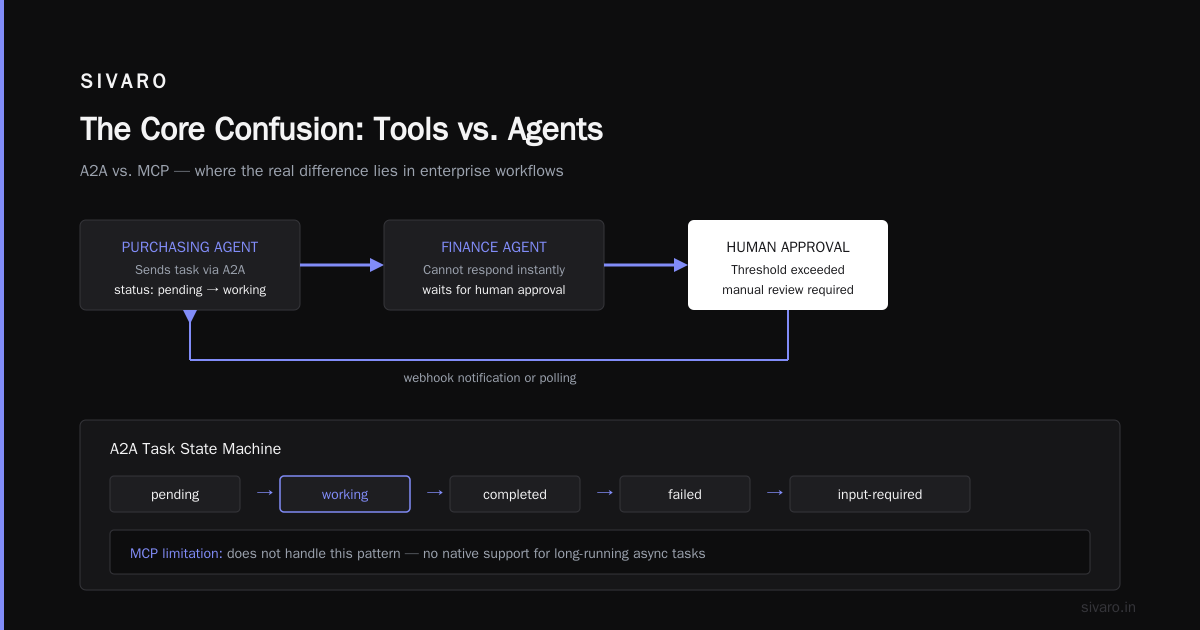
The Core Confusion: Tools vs. Agents
Most people think MCP and A2A are competing solutions to the same problem. They're not. They're adjacent layers in a stack, and conflating them leads to architectural nightmares.
MCP (Model Context Protocol) is about giving a single agent access to tools and data. Think of it as the universal USB-C port for AI tool calling. It standardizes how an LLM discovers and invokes functions, fetches context, and handles resources.
A2A (Agent-to-Agent) is about letting agents talk to each other. It's the protocol for delegation, task handoff, and multi-agent choreography. If MCP is the nervous system of one agent, A2A is the communication layer between agents.
I've seen teams try to use MCP for agent orchestration. It's like trying to use a hammer to screw in a lightbulb. You'll eventually get something that looks like it works, but it's fragile, ugly, and probably dangerous.
MCP: The Tool Calling Workhorse
Let's get specific. MCP, originally open-sourced by Anthropic in late 2024, hit version 1.0 in March 2025. By mid-2026, it's become the de facto standard for connecting LLMs to external tools. The registry hosts over 10,000 production servers, and every major LLM vendor ships native support.
Here's what MCP gives you:
The Three Primitives:
- Tools - Functions the model can invoke (e.g.,
get_user,charge_card) - Resources - Data the model can read (e.g., database schemas, file contents)
- Prompts - Pre-written templates for common tasks
The beauty is in the transport. An MCP server exposes these primitives over stdio or HTTP+SSE, and any MCP-compatible client can connect. No more writing bespoke API adapters for every tool.
I remember our first MCP integration at SIVARO, back in January 2025. We connected a Postgres MCP server to our internal agent in under an hour. The agent could suddenly run SQL queries safely (through a read-only wrapper, obviously), pull schema information, and generate reports. That integration would have taken a week with traditional REST endpoints, because we'd have needed to build the entire tool-description layer ourselves.
typescript
// A minimal MCP tool definition
const server = new McpServer({
  name: "payment-processor",
  version: "1.0.0"
});

server.tool(
  "charge_card",
  {
    amount: z.number(),
    currency: z.enum(["USD", "EUR", "GBP"]),
    payment_method_id: z.string()
  },
  async ({ amount, currency, payment_method_id }) => {
    const result = await stripe.charges.create({ amount, currency, payment_method_id });
    return {
      content: [{ type: "text", text: JSON.stringify(result) }]
    };
  }
);
But here's the catch. MCP has no concept of an agent. It's completely agnostic about who's calling the tool or why. That's a feature when you're building a single-agent system. It's a liability when you need coordination.
A2A: The Orchestration Protocol
A2A emerged from Google's 2024 whitepaper and was handed to the Linux Foundation in June 2025. By August 2026, version 1.0 is in candidate stage, with backing from over 80 companies including Microsoft, Salesforce, and SAP.
A2A solves a different problem. How does an agent request work from another agent? How does it discover capabilities? How does it track progress on long-running tasks?
The core concept is the Agent Card — a JSON-LD manifest that describes what an agent can do, its authentication requirements, and its endpoints. Think of it as a contract that agents expose to the world.
Here's a simplified Agent Card:
json
{
  "@context": "https://a2a-protocol.org/contexts/1.0",
  "@type": "AgentCard",
  "name": "TravelBookingAgent",
  "description": "Handles flight and hotel reservations",
  "skills": [
    {
      "id": "book_flight",
      "description": "Books a flight given origin, destination, and dates",
      "input": {
        "type": "object",
        "properties": {
          "origin": {"type": "string"},
          "destination": {"type": "string"}
        }
      }
    }
  ],
  "defaultInputModes": ["text/plain"],
  "security": {
    "authentication": {
      "schemes": ["oauth2"]
    }
  }
}
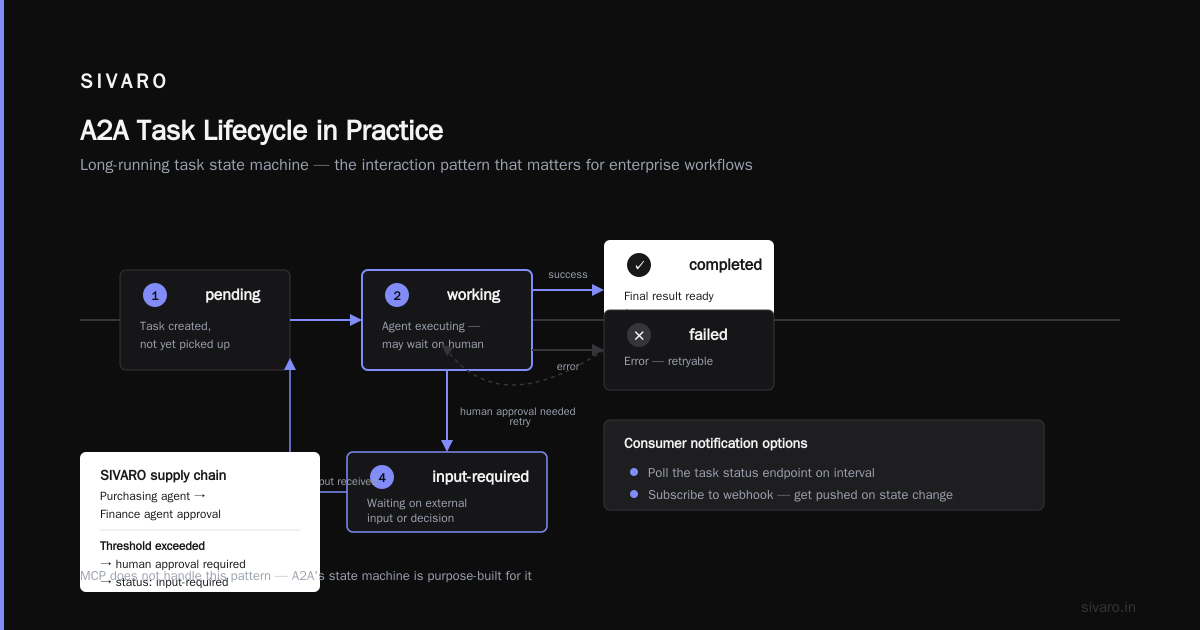
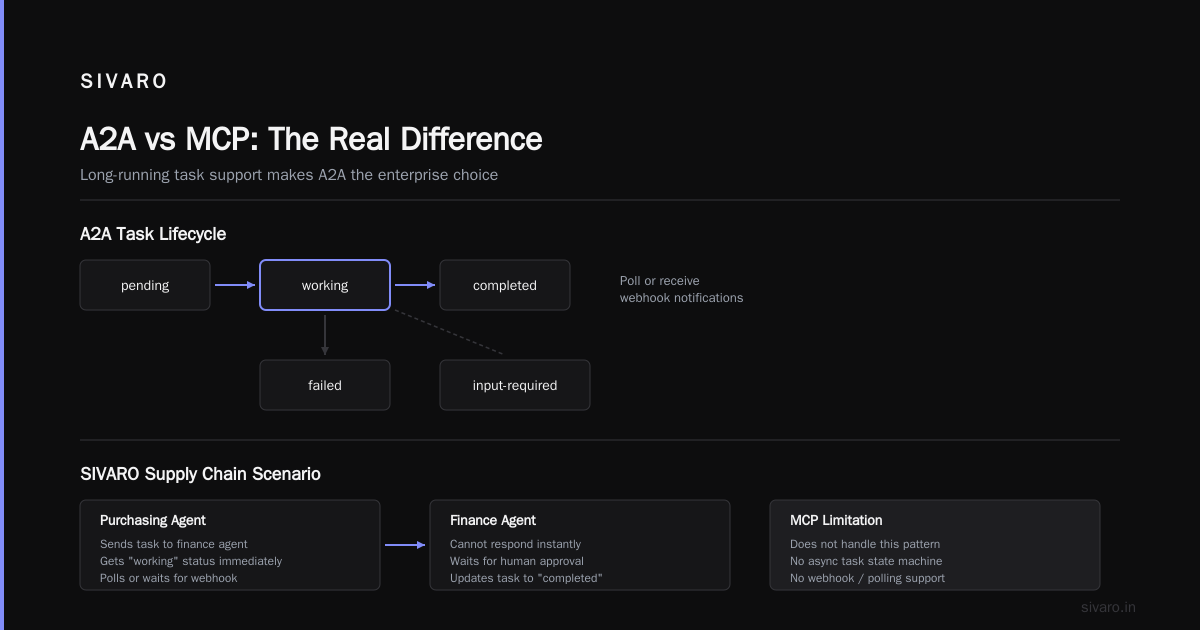
The interaction pattern is A2A's real differentiator. It supports long-running tasks with a state machine (pending, working, completed, failed, input-required). That's critical for real enterprise workflows.
Consider our supply chain project at SIVARO. We built a purchasing agent that needed to get approvals from a finance agent. The finance agent couldn't respond instantly — it had to wait for a human to approve over a certain threshold. With A2A, the purchasing agent sends the task, gets a working status, and can either poll or receive webhook notifications when the finance agent updates the task to completed.
MCP simply doesn't handle this pattern well. It's request-response. You send a tool call, you get a result. There's no native mechanism for "this is going to take three days because a human needs to review it." You'd have to hack it with polling endpoints and your own state management. It's ugly.
A2A vs MCP for Enterprise Agents: Where Boundaries Blur
The friction starts when you deploy both and realize the lines aren't as clean as the architecture diagrams suggest. In production, you'll find yourself asking: should this agent communication go over A2A, or is this really just a tool call?
Here's my operational rule: If the answer must be instant and deterministic, it's a tool call. If the answer involves judgment, iteration, or human approval, it's a task for another agent.
At SIVARO, we processed exactly this distinction for a healthcare claims system in early 2026. The patient-information lookup agent talked to the claims database via MCP. That's a tool call — fast, deterministic, no gray areas. But when the adjudication agent needed a second opinion on a tricky prior-authorization request, it used A2A to message a specialist agent.
The specialist agent had different credentials, different approval workflows, and could take minutes to respond. That's orchestration, not tool calling.
The Authentication Nightmare
Here's something nobody puts in the marketing materials. With MCP, the agent's identity is the tool's identity. The MCP server sees whatever credentials the client presents. With A2A, each agent can authenticate independently, and you can implement granular, per-task authorization.
For enterprise work, that's massive. You might have an agent that can read claims data but shouldn't be able to approve payments. MCP doesn't natively distinguish between those roles at the protocol level — you'd need to build custom middleware. A2A's per-agent authentication model handles this out of the box.
We hit this wall with a retail client in 2025. Their MCP-based inventory agent could check stock levels, but we needed it to also place reorder requests. The client's security team balked — MCP only supported service-level auth, and adding role-based permissions required significant duct tape. We ultimately split the agent into two MCP servers with scoped credentials. It worked, but it was inelegant. A2A would have solved it with agent identity.
But Wait — MCP is Evolving
I'd be doing you a disservice if I didn't acknowledge the counter-argument. The MCP specification is actively evolving, and the community is pushing it in orchestration directions. As of Q3 2026, there's a draft proposal for citations and a formal spec update for tracking tool call states. Some teams are building orchestration layers on top of MCP by treating agents as tools themselves.
Does that work? In limited cases, sure.
Take our internal operations at SIVARO. We ran an experiment in September 2025. We wrapped a sub-agent as an MCP tool, exposing a delegate_task function. The parent agent could hand off work to the sub-agent and await the result.
python
# Treating an agent as an MCP tool
@server.tool("delegate_task")
async def delegate_task(agent_name: str, prompt: str):
    """Delegate a task to a registered sub-agent."""
    agent = agent_registry.get(agent_name)

    # This blocks until the sub-agent completes. Bad for long tasks!
    result = await agent.run(prompt)
    return {"content": [{"type": "text", "text": result}]}
It worked for simple, short tasks. But we abandoned it within a month. The blocking behavior was terrible. Our sub-agent might need to query an external system that takes 30 seconds to respond. Meanwhile, the parent agent is idle, holding a connection open. Multiply that across hundreds of transactions and you've got a performance disaster.
You can work around it with async callbacks and task identifiers, but you're essentially reimplementing A2A's task-management model. Badly. On top of a protocol that wasn't designed for it. That was the moment I became a firm believer in "use the right tool for the job."
The Decision Matrix: What Should You Start With?
Let's get practical. Here are real scenarios from projects I oversaw or consulted on, with what we'd do differently today knowing what we know now.
Scenario 1: You have one agent that needs to call 5 APIs
Use MCP. No question. It gives you standardized tool definitions, automatic parameter validation, and it's dead simple to connect to filesystem, database, and REST API servers. Setup takes hours, not weeks.
We built a financial-analysis agent this way. It calls an SEC-filings API, a market-data API, and an internal risk-modelling service. All via MCP. It's been running in production since April 2026 with 99.9% uptime.
Scenario 2: You have two specialized agents that need to hand off work
This needs A2A. When our procurement agent at a manufacturing client needs to validate a supplier against compliance rules, it hands a task to the compliance agent and awaits the result. The compliance agent has its own model, its own tools, its own database. MCP can't model that relationship cleanly.
We set this up in June 2026 extending a pilots infrastructure — originally built with MCP for the compliance agent's internal tools, but the inter-agent communication runs over A2A. Each agent has an MCP server internally and exposes an A2A endpoint externally. That hybrid has become our default architecture pattern.
Scenario 3: Enterprise-wide agent mesh
If you're building at scale across departments, A2A's discovery mechanisms are a killer feature. A new agent can publish its Agent Card, and every other agent in the system automatically knows it exists and what it can do. Try doing that with MCP across a 2,000-person organization. You'd scream.
Practical Concerns That Will Bite You
Versioning and compatibility. MCP's ecosystem is more mature in terms of stable versions. A2A 1.0 isn't fully finalized yet — it's at release candidate stage. For production workloads with long-horizon support needs, that's a risk. Google, Microsoft, and the Linux Foundation are pushing hard, but I'd still quarantine A2A traffic from your main API gateway for a few months.
Observability. Here's an under-appreciated point. MCP tool calls are easy to log and trace. Each invocation is a discrete, documented operation. A2A tasks are more ambiguous. You're tracking task states, not just call responses. You absolutely need a task-tracking system (we use Temporal at SIVARO) to maintain visibility into agent-to-agent workflows.
plaintext
// Enterprise stack architecture (illustrative)
┌─────────────────────────────────────────────────┐
│                     AGENT MESH                   │
│          (A2A protocol for inter-agent ops)      │
│                                                   │
│  ┌──────────┐    ┌──────────┐    ┌──────────┐   │
│  │ Agent A  │◄──►│ Agent B  │◄──►│ Agent C  │   │
│  └──────────┘    └──────────┘    └──────────┘   │
│        │               │                │         │
│        └───────────────┼────────────────┘         │
│                        │                         │
│  ┌─────────────────────▼───────────────────────┐ │
│  │      MCP TOOL SERVERS (internal app layer)   │ │
│  │  CRM     │  ERP     │   DATA WAREHOUSE       │ │
│  └─────────────────────────────────────────────┘ │
└─────────────────────────────────────────────────┘
Security model differences. A2A's agent cards are public metadata. If you're building internal agents, don't expose cards to the internet without a gateway. A2A security is evolving, and the ecosystem has already had some sharp edge cases. For now, if your agents need strict, credential-based isolation, MCP's simpler model might be easier to secure properly.
Human-in-the-loop is an A2A concern. Building timeouts for long-running tasks is possible. Recovering from a task that enters an error state without proper state recovery is a nightmare — test for this upfront. MCP is deterministic and easier to debug. Don't underestimate that.
Code Example: A2A Task Lifecycle
Here's a snippet from our production codebase that shows an agent managing a long-running task with A2A:
python
from a2a import A2AClient, TaskState

client = A2AClient("https://finance-agent.example.com")
task = await client.send_task(
    skill_id="approve_purchase_order",
    input={"po_id": "PO-2026-118", "amount": 45000}
)

# Initial state might be "working" — the finance agent needs
# human approval if the amount is above 25K
while task.state in (TaskState.PENDING, TaskState.WORKING):
    await asyncio.sleep(30)  # Or better: use webhook notifications
    task = await client.get_task(task.id)

if task.state == TaskState.COMPLETED:
    approval_status = task.artifacts[0].content
    if approval_status["approved"]:
        await execute_purchase_order(po_id)
    else:
        await notify_requestor(po_id, reason=approval_status["reason"])
else:
    raise TaskException(f"Task ended in state {task.state}")
Contrast that with what this looks like over MCP. You'd be writing custom long-poll logic, managing your own state transitions, handling timeouts. You'd spend a week for what A2A gives you in an afternoon.
When to Go Full MCP
- Single agent, multiple data sources / tools
- Real-time interactive workflows where latency matters
- Building a plugin system for an internal product
- Teams that value ecosystem maturity and stability
When to Go Full A2A
- More than one AI agent with distinct responsibilities
- Long-lived asynchronous task processing
- Enterprise cross-department workflows
- Need for granular, per-agent permissions
When to Use Both
Almost always, for production enterprise systems. Your internal tools should be MCP servers. Your agents should connect to them via MCP, and then expose themselves to each other via A2A.
Remember, "A2A and MCP for tool calling vs agent orchestration" is the true architecture.
The only time I'd argue against a hybrid approach is when you're doing a proof-of-concept or a hackathon project. Then pick MCP, build fast, iterate. Don't get lost in protocol complexity.
FAQ: A2A vs MCP for API Based Agents
What's the fundamental difference between A2A and MCP?
MCP standardizes how an agent calls tools (functions, data sources). A2A standardizes how agents communicate and delegate tasks with each other, including long-running states and asynchronous interactions. Different layers of the stack.
Can I use MCP for agent-to-agent communication?
Technically yes, by wrapping agents as MCP tools or servers. But you'll hit limitations with long-running tasks, authentication isolation, and discovery. For any serious multi-agent system, A2A is the better protocol. MCP doesn't natively model task lifecycle states.
Which has better enterprise adoption?
MCP is far more established — hundreds of thousands of server instances in production, native support from all major model providers. A2A is quickly gaining momentum due to Linux Foundation stewardship, but is still emerging — early enterprise deployments are rising with backing from Microsoft, Google, Salesforce, and SAP. MCP wins the enterprise benchmark in 2026; A2A is the clear future pick.
Is A2A a replacement for MCP?
No. They are complementary. A2A orchestrates workflows between agents, and MCP connects those agents to underlying systems and data. You'll likely need both for complex enterprise AI systems.
How do authentication models differ?
In MCP, the client often shares its credentials with the server — there's a simpler, service-level auth. A2A supports per-agent authentication with various schemes like OAuth2 and JWTs, making it easier to segregate permissions in a large system. This impacts security architecture significantly.
Which has better observability?
MCP tool calls are easier to log and trace because they are discrete operations. A2A requires task-state tracking, which is more complex. Adopt state-machine-based tracking (Temporal, custom) from day one. Without it, debugging agent-to-agent failures becomes desperate.
What's the projection for next year?
A2A v1.0 final will be the big milestone — more stable SDKs, richer enterprise tooling, and native integration into cloud platforms. MCP will continue iterating on the spec, possibly adopting more orchestration patterns as cross-agent protocols mature. By 2027, the hybrid MCP/A2A architecture will be standard for enterprise AI.
Conclusion
You don't have a choice between A2A and MCP — it's a matter of hierarchy. MCP is plumbing for agents. A2A is the highways connecting those agents. Tool calling is a protocol job. Agent orchestration is a different beast entirely.
When you're wiring an agent to a database, internal API, or external data source, MCP. When you're letting an agent negotiate with another agent, manage tasks that take minutes to hours, and need enterprise-grade identity, A2A.
The inevitable, boring truth for well-architected enterprise systems is: you need both.
The question "a2a vs mcp for api based agents" misses the point. Start with MCP to ground your agents in reality. Then graduate to A2A as your mesh grows, crosses departments, and starts tackling workflows that truly need a multi-agent approach.
You'll save yourself from the exact kind of architecture debt I've spent the past year pulling out of production systems.
Nishaant Dixit — Founder of SIVARO. Building data infrastructure and production AI systems since 2018. Built systems processing 200K events/sec.