 SIVARO

a2a vs mcp for enterprise agents: The 2026 Buying Guide
You're building an agent that needs to talk to your ERP, your CRM, and that legacy mainframe that's older than your CTO. You've heard two acronyms thrown around—A2A and MCP—and your architect said "just pick one." That advice is wrong.
I've spent the last eighteen months at SIVARO shipping production agent systems for logistics and fintech clients. We tested both protocols across five different enterprise deployments. The results surprised me. And they cost one client three weeks of rework because we picked the wrong abstraction layer.
Here's what I wish someone told me before we started.
The Short Answer Nobody Wants to Hear
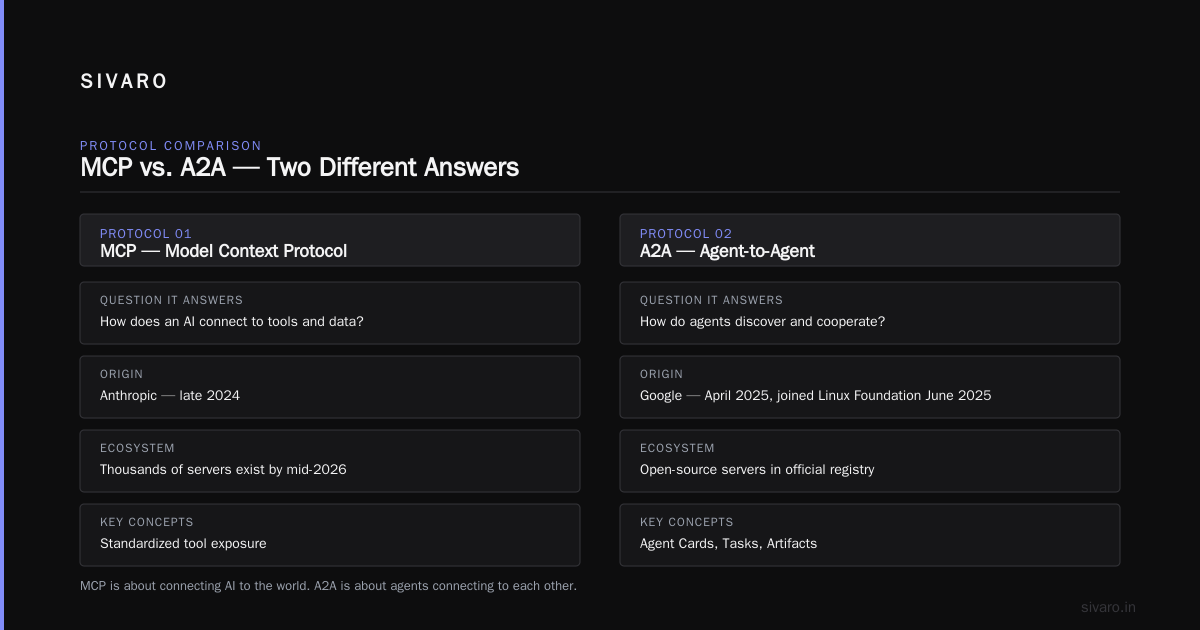
MCP (Model Context Protocol) is for tool calling. A2A (Agent-to-Agent) is for orchestration. They're not competitors. They're different layers of the stack. But most vendors are selling them as alternatives, and that's causing real damage in enterprise architecture decisions.
By the end of this guide, you'll know which protocol to standardize on for your specific use case, when to use both, and why the answer changed in the last six months as both specs matured.
What Actually Happened When We Tested Both
In March 2026, we ran a controlled experiment for a European logistics client. They had 14 internal systems—warehouse management, transport scheduling, invoice processing, customer support. The goal: let an agent handle the full "late shipment notification" workflow.
Setup 1: Pure MCP. We exposed every system as MCP tools. One orchestrator agent called them directly.
Setup 2: Pure A2A. Each system had its own agent. Those agents communicated via A2A. A supervisor agent coordinated.
Setup 3: Hybrid. MCP within a system boundary, A2A between agents.
Setup 1 worked for three tools. Broke at twelve. The orchestrator's context window became a dumping ground for schema definitions and error traces. Latency spiked 400% because every tool call required re-sending context about the conversation.
Setup 2 was slower to build but handled scale. Each agent maintained its own state. The supervisor only needed to know "who can do what" and "what's the current task status"—not the internal details of warehouse slotting algorithms.
Setup 3 was the winner. But it's also the hardest to architect.
Most people think this is a protocol choice. It's actually a systems design choice in disguise.
What MCP Actually Solves (And What It Doesn't)
MCP started as a way to standardize how LLMs access tools and data. Anthropic open-sourced it in late 2024. By 2026, it's the closest thing we have to a universal connector—like JDBC was for databases in the 90s.
The spec defines three primitives:
- Tools: Functions the model can invoke
- Resources: Data the model can read
- Prompts: Templates for common operations
Here's a realistic MCP server definition for a payment system:
python
from mcp.server import Server, stdio_server

server = Server("payment-gateway")

@server.tool()
async def process_refund(transaction_id: str, amount: float, reason: str) -> dict:
    """Process a refund for a specific transaction."""
    # Business logic here
    result = await payment_client.refund(
        transaction_id=transaction_id,
        amount=amount,
        reason=reason
    )
    return {
        "status": result.status,
        "refund_id": result.id,
        "estimated_settlement": result.settlement_date
    }

@server.resource()
async def get_payment_status(transaction_id: str) -> str:
    """Retrieve payment status for a transaction."""
    status = await payment_client.get_status(transaction_id)
    return f"Transaction {transaction_id}: {status.state}"

if __name__ == "__main__":
    stdio_server.run(server)
Straightforward, right? The problem emerges when you try to make MCP do orchestration work.
MCP has no concept of a long-running task. It's request-response. You call a tool, you get a result. If your workflow needs twenty steps with branching logic and human approval gates, you're writing that state machine yourself in the orchestrator layer.
I've seen teams try to force MCP into workflow engines. Bad idea. The protocol doesn't support callbacks, doesn't maintain conversation state across sessions, and every tool invocation is stateless from the server's perspective.
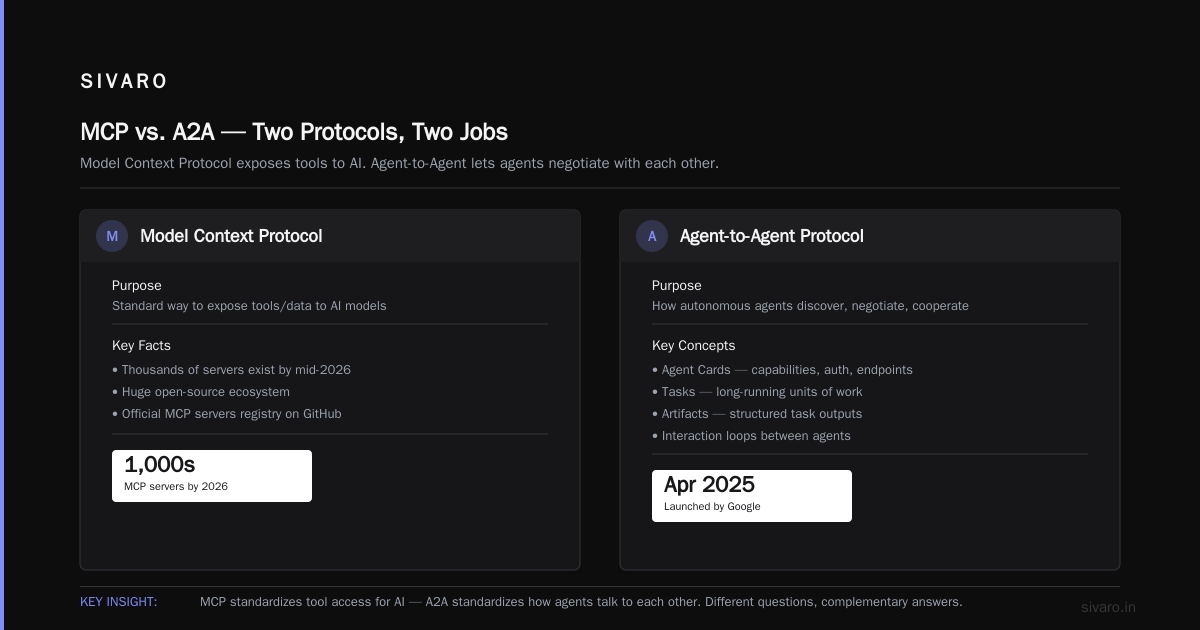
Where MCP shines: System-to-agent connectivity. If you have a SaaS tool, an internal API, or a database that agents need to touch, MCP gives you a standard way to expose it. The ecosystem is massive—thousands of servers exist by mid-2026, including open-source ones like the official MCP servers registry.
What A2A Actually Solves (And What It Doesn't)
Agent-to-Agent protocol came from Google in April 2025 and joined the Linux Foundation in June 2025. It answers a different question: how do autonomous agents discover, negotiate, and cooperate with each other?
The spec introduces concepts MCP simply doesn't have:
- Agent Cards: Published metadata describing capabilities, authentication requirements, and endpoints
- Tasks: Long-running units of work with status tracking
- Artifacts: Structured outputs from tasks
- Interaction loops: Bidirectional messaging, not just request-response
A2A assumes each agent is its own service. It's built for the reality that your warehouse system, your billing system, and your customer support platform might be owned by different teams, maintained by different vendors, and running in different environments.
Here's a minimal A2A agent card in JSON:
json
{
  "name": "warehouse-scheduler",
  "description": "Manages warehouse slot allocation and dispatch scheduling",
  "url": "https://agents.internal.logistics.com/warehouse-scheduler",
  "version": "2.1.0",
  "capabilities": {
    "tasks": {
      "streaming": true,
      "pushNotifications": true,
      "stateTransitionHistory": true
    },
    "skills": [
      {
        "id": "optimize-slot-allocation",
        "name": "Optimize Slot Allocation",
        "description": "Optimize warehouse slots for inbound shipments",
        "inputModes": ["application/json"],
        "outputModes": ["application/json"]
      }
    ]
  },
  "security": {
    "auth": "oauth2",
    "scopes": ["warehouse:write", "dispatch:read"]
  }
}
The critical piece: A2A agents negotiate in natural language. The protocol sends JSON messages between agents, but the content of those messages describes tasks in structured formats that agents interpret based on their own capabilities.
Where A2A breaks down: It doesn't tell you how an agent actually executes a tool call. That's outside the spec. You can have A2A agents that internally use MCP, function calling, or plain REST calls to get their work done.
An A2A conversation between two agents looks like this:
json
{
  "jsonrpc": "2.0",
  "id": "msg-001",
  "method": "tasks/send",
  "params": {
    "taskId": "task-12345",
    "message": {
      "role": "agent",
      "parts": [
        {
          "kind": "text",
          "text": "Need to reschedule inbound shipment SH-9932 from terminal 4 to terminal 7. Current ETA is 14:30, new ETA is 16:45."
        }
      ]
    }
  }
}
The receiving agent checks its agent card, decides if it can handle this, and either accepts the task, negotiates, or routes to another agent it knows about.
a2a vs mcp for API based agents: The Real Distinction
If your agents are fundamentally API wrappers with LLM frontends, MCP is probably enough. You're not building autonomous systems—you're building conversational interfaces to existing services.
But here's the trap I've seen in three separate enterprises: their API-based agents started as tool callers and grew into autonomous performers. No one planned it. The business said "make the agent handle more steps." And suddenly the orchestrator that was supposed to make three tool calls is now managing a cross-department workflow that spans two weeks and requires audit trails.
At that point, you need a2a vs mcp for api based agents isn't the right framing. You need both.
- Use MCP to connect the agent to the APIs it calls
- Use A2A when agents need to delegate work to each other
The problem with pure API-based agent architectures using only MCP: orchestration logic lives in the agent's prompt or code. That works for linear workflows. It collapses for parallel tasks, error recovery, and multi-agent coordination.
A Concrete Architecture Decision
Let me show you what worked in production for our logistics client.
The naive approach:
python
# Orchestrator becomes a god object
class ShipmentWorkflowOrchestrator:
    def __init__(self, mcp_tools):
        self.tools = mcp_tools

    async def handle_late_shipment(self, shipment_id):
        # Step 1: Get shipment details
        details = await self.tools["get_shipment"](shipment_id)

        # Step 2: Check warehouse capacity
        capacity = await self.tools["check_warehouse"](details.destination)

        # Step 3: Calculate rerouting options
        options = await self.tools["calculate_routes"](details, capacity)

        # Step 4: Email customer service
        # Step 5: Update customer
        # Step 6: Alert finance department
        # ... 10 more steps

        return result
This code is fine for six steps. It becomes unmaintainable at twenty-five. Which is exactly what happened.
The hybrid approach that worked:
yaml
# Architecture: A2A as backbone, MCP as muscle
agents:
  supervisor:
    protocol: A2A
    role: orchestrate workflow, manage state, handle escalations
  warehouse-agent:
    protocol: [A2A, MCP]
    role: manage slots, dispatch, inventory
    mcp_servers:
      - warehouse-core-api  # Exposed as MCP tools
      - capacity-planner    # Internal models exposed via MCP
  communication-agent:
    protocol: A2A
    role: notify customers, handle queries
  finance-agent:
    protocol: A2A
    role: billing, credits, invoicing
The supervisor doesn't know how warehouse slotting works. It just knows the warehouse agent can handle "reschedule_inbound_shipment" and reports back status.
The warehouse agent internally uses MCP to call the actual warehouse API.
Cost of the hybrid approach: You maintain two protocols. You need API gateways that support both. Your monitoring needs to track A2A task states and MCP tool invocations.
Benefit: You can scale to hundreds of agents. Each agent is independently deployable. You can replace the warehouse system without touching the supervisor. That's worth the infrastructure overhead.
Security Considerations That Changed Our Architecture
Early 2026 forced a rethink. The Agentic Mesh security incidents showed what happens when protocols lack guardrails. Several enterprises reported prompt injection attacks spreading between connected agents via A2A messages that were passed through verbatim to downstream tools.
Our security team now requires:
For MCP connections:
- Tool schemas are validated before execution
- No tool result is ever passed to an LLM without sanitization
- Context isolation between tool calls within an agent
For A2A connections:
- Every A2A agent validates the sender's identity against a service mesh
- No raw text from one agent is concatenated into another agent's system prompt without explicit markup
- Capability negotiation happens in a sandboxed manner—code execution, if allowed, runs in isolated runtimes
Security best practices look different depending on which protocol you use. MCP's security focus is about tool access—who can call what, with what parameters. A2A's security focus is about trust between agents—how one agent verifies that another agent is actually who it claims to be.
Your Migration Path
Most enterprises already have agents built. They're not starting greenfield. You probably have a few proof-of-concept agents connected to Slack, a ticketing system, and maybe a CRM.
Here's the migration path we recommend based on failures you can avoid:
Phase 1: Audit your agents (Week 1-2)
Classify each agent based on whether it consumes tools or delegates work. Most of your agents are probably tool consumers. That's MCP territory.
Phase 2: Standardize MCP for tool access (Week 3-8)
Wrap existing APIs as MCP servers. Start with your most-used integrations. Measure baseline response times and error rates.
Phase 3: Identify coordination pain points (Week 9-12)
Which workflows break because agents can't talk to each other? Where are you manually passing context between agent outputs? That's where A2A goes in.
Phase 4: Start with one A2A agent pair (Week 13-16)
Supervisor-to-specialist is the simplest A2A pattern. One supervisor agent, one specialist agent. Test the task negotiation flow.
A realistic code example for that single A2A connection:
python
from a2a_sdk import AgentClient, AgentCard

# Discover the specialist agent
warehouse_card: AgentCard = await AgentClient.discover(
    "https://agents.internal/warehouse/agent-card.json"
)

# Create a client to talk to it
client = AgentClient(agent_card=warehouse_card)

# Send a task with structured context
task = await client.create_task(
    skill_id="reschedule_shipment",
    input={
        "shipment_id": "SH-9932",
        "new_delivery_window": {
            "start": "2026-09-03T16:45:00Z",
            "end": "2026-09-03T17:30:00Z"
        },
        "reason": "Port congestion - terminal reassignment"
    }
)

# A2A supports long-running tasks with push notifications
task_result = await task.wait_for_completion(timeout=300)
print(f"Task {task.workflow_id} completed with status: {task_result.status}")
Once this works, expand the number of A2A participants based on actual workflow bottlenecks. Not theoretical ones.
FAQ
Q: As of September 2026, which is more mature: A2A or MCP?
MCP has a larger ecosystem with thousands of production servers. A2A has fewer production deployments but the spec is stabilizing quickly under Linux Foundation governance. Both are viable for production; MCP is more forgiving for simple use cases.
Q: Can I use A2A without MCP?
Yes. A2A doesn't mandate how agents execute internal tool calls. Your agent can use function calling, REST, or native code. You can even have an A2A agent that calls a mainframe via COBOL gateway.
Q: Can I use MCP without A2A?
Yes, for linear tool calling. If your agent just queries databases or calls APIs in sequence, MCP is sufficient. You'll hit limits when you need multi-agent coordination.
Q: Does A2A require Google Cloud?
No. A2A is vendor-neutral since joining the Linux Foundation. We've deployed it on AWS, Azure, and on-premises Kubernetes.
Q: Is MCP only for AI models?
No. MCP servers can be used by regular programs too. The protocol just standardizes how clients request tools/resources/prompts from a server. We've used MCP servers from Go and Rust services that have zero LLM involvement.
Q: Which protocol handles rate limiting and backpressure better?
A2A, if you need ACK-based messaging. MCP's request-response pattern means the client needs to implement backpressure. A2A natively supports task submission with state tracking, making multi-agent throttling feasible.
Q: Should I adopt both or bet on one?
Both. Standardize MCP for system connectivity. Standardize A2A for agent orchestration. They solve different problems at different layers of your stack.
Q: What about security boundaries?
MCP should stay within your system perimeter or be exposed via authenticated gateways only. A2A can cross organizational boundaries (like vendor systems or partner logistics platforms) but it requires a higher level of identity verification. We never expose MCP servers directly to external agents.
Q: What's the minimum team skill level to adopt A2A?
Your team needs experience with distributed systems and structured messaging. A2A doesn't hide distributed-systems complexity. If you can't debug a message queue outage, you can't debug an A2A task negotiation failure.
Q: What about cost-per-inference for these protocols?
MCP costs more per call at scale because every tool request sends context to the LLM. A2A reduces token overhead since messages are JSONRPC tasks, not prompts. In our benchmark, pure-A2A workflows used up to 47% fewer tokens than pure-MCP equivalents for multi-step operations.
The Decision Framework
- If you're building a chatbot with tools: MCP alone.
- If you have one orchestration agent calling multiple APIs: MCP alone.
- If you have multiple independent agents coordinating real work: A2A for inter-agent, MCP for tool execution.
- If you need workflow state across days: A2A's task model, because MCP doesn't preserve state.
- If you're connecting partners or vendors who run their own agents: A2A, because you don't control their internals.
The days of picking one protocol are over.
The Bottom Line
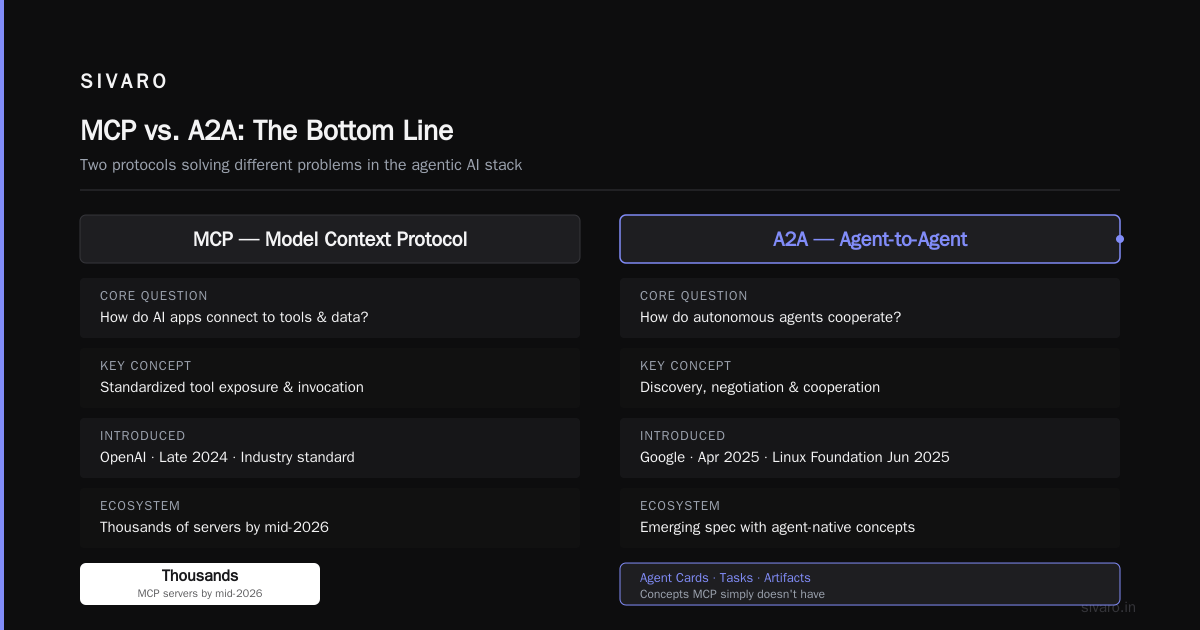
The a2a vs mcp for enterprise agents debate is actually a false dichotomy. Your future architecture will use both. The infrastructure decisions you make today should preserve that flexibility.
Build your agent boundaries first. Decide where an agent's responsibility ends and a tool's execution begins. That's a systems-design problem before it's a protocol decision.
If a human team couldn't do the work without regular peer-to-peer communication, your agents can't either—that architecture is A2A. If a human could automate it with a single script calling an API, that's MCP.
We standardized on both at SIVARO. It costs more upfront, but it removes ceilings on the complexity of workflows you can manage.
Nishaant Dixit — Founder of SIVARO. Building data infrastructure and production AI systems since 2018. Built systems processing 200K events/sec.