 SIVARO

a2a vs mcp for enterprise ai agents: Which Protocol Actually Ships?
I spent the first half of 2026 tearing my hair out over this exact question. We were building a multi-agent system for a logistics client that needed its procurement bot to talk to its inventory forecasting agent. Two protocols. Both promising. Both incomplete. The choice between a2a vs mcp for enterprise ai agents isn't a technical decision — it's a business decision disguised as one.
Here's what I learned: MCP (Model Context Protocol) solves the "agent-to-tool" problem. A2A (Agent-to-Agent Protocol) solves the "agent-to-agent" problem. They're not competitors. They're layers. And if you pick only one, you're building a system that will need to be ripped out within 18 months.
This guide is a practical comparison of a2a vs mcp for enterprise ai agents. I'll show you real code, real trade-offs, and the questions you should ask before committing. No fluff. Just what I've seen work in production.
The Core Difference Nobody Explains Clearly
Let me be blunt: if you're comparing MCP and A2A as if they're interchangeable, you've already lost.
MCP is Anthropic's protocol, released in November 2024. It standardizes how an AI agent connects to external tools and data sources. Think of it as a universal USB port for AI — plugins, databases, APIs, all speaking the same wire protocol. It answers "how does my agent use a calculator" or "how does it query Salesforce."
A2A is Google's protocol, released in April 2025. It's a higher-level framework for agent-to-agent communication. It defines how agents discover each other, send tasks, negotiate capabilities, and share state. It answers "how does my procurement agent ask the inventory agent for a stock forecast" and then act on the response.
I've seen teams adopt MCP thinking it handles agent orchestration. It doesn't. I've seen teams adopt A2A thinking it handles tool integration. It doesn't.
Here's the mental model that finally clicked for me: MCP is the nervous system. A2A is the social layer.
If you're building enterprise AI systems at scale, you need both. But here's the twist — you might not need them at the same time.
MCP: The Tool Integration Workhorse
MCP (Model Context Protocol) is mature. It's been in production for nearly two years now. The ecosystem is massive — over 3,000 registered servers as of mid-2026, up from maybe 500 in early 2025. Every major vendor supports it: OpenAI, Microsoft, Google (reluctantly), AWS.
The architecture is simple: a client (your agent) connects to a server (your tool or data source) through a defined JSON-RPC interface. The server exposes resources, tools, and prompts. The client discovers them at runtime.
Here's what a basic MCP server looks like in TypeScript:
typescript
import { McpServer } from "@modelcontextprotocol/sdk/server/mcp.js";

const server = new McpServer({
  name: "inventory-forecaster",
  version: "1.0.0",
});

server.tool(
  "get-stock-level",
  { sku: z.string(), warehouse: z.string().optional() },
  async ({ sku, warehouse }) => {
    const level = await getStockFromDB(sku, warehouse);
    return {
      content: [{ type: "text", text: JSON.stringify(level) }],
    };
  }
);

server.start();
That's it. The agent connects, discovers "get-stock-level", and calls it. Simple, predictable, and boring in the best way.
For enterprise deployment, this matters. Boring means reliable. Boring means your security team won't throw a fit. MCP has strict scoping — each server defines exactly what tools it exposes, and the client only sees those.
The downside? MCP doesn't know anything about agents. It knows tools. If you have two agents that need to collaborate, MCP gives you no vocabulary for that. An agent can't "ask" another agent a question through MCP. It can call a tool — but that tool happens to be wrapped around another agent.
That's a hack. And hacks collapse under production load.
A2A: The Agent Communication Framework
A2A (Agent-to-Agent Protocol) is newer. Google released it in April 2025, and it went through significant revision toward the end of 2025. The spec is still stabilizing, but the core concepts are solid.
A2A introduces a few key ideas:
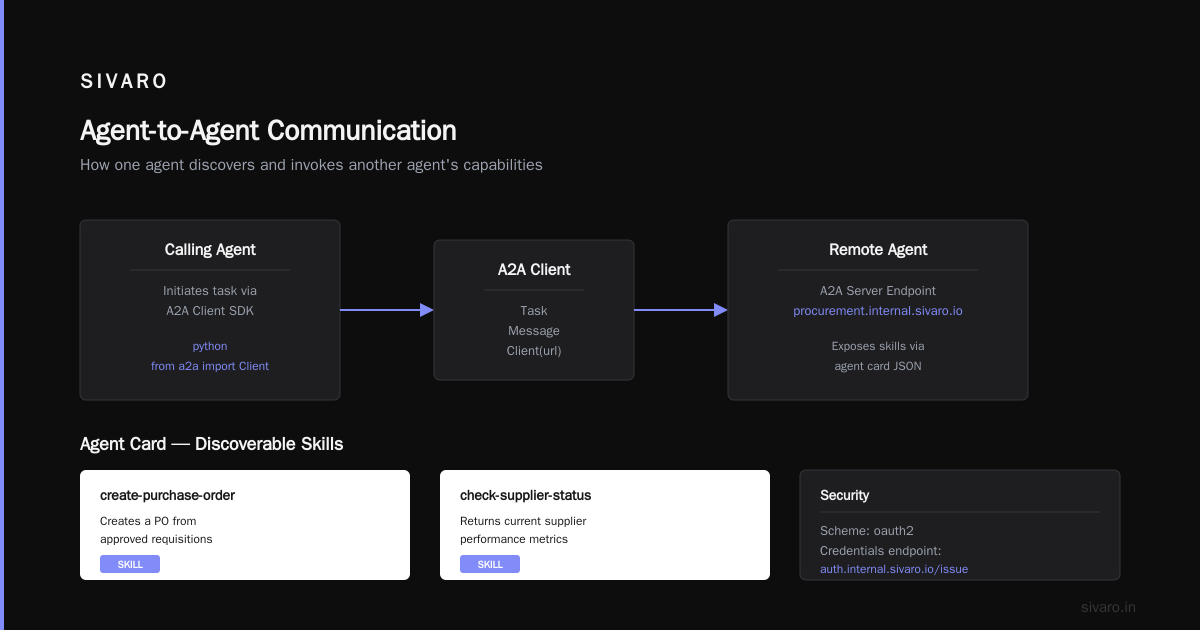
- Agent Cards: Each agent publishes a JSON card describing its capabilities, skills, and endpoints. Similar to a service registry.
- Tasks: Agents communicate through structured task objects. A task has a state (submitted, working, completed, failed, input-required) and a history of messages.
- Artifacts: The outputs of a task. Structured data or files.
- Agent-to-Agent authentication: A2A defines how agents authenticate to each other, including OAuth 2.0 and API key flows.
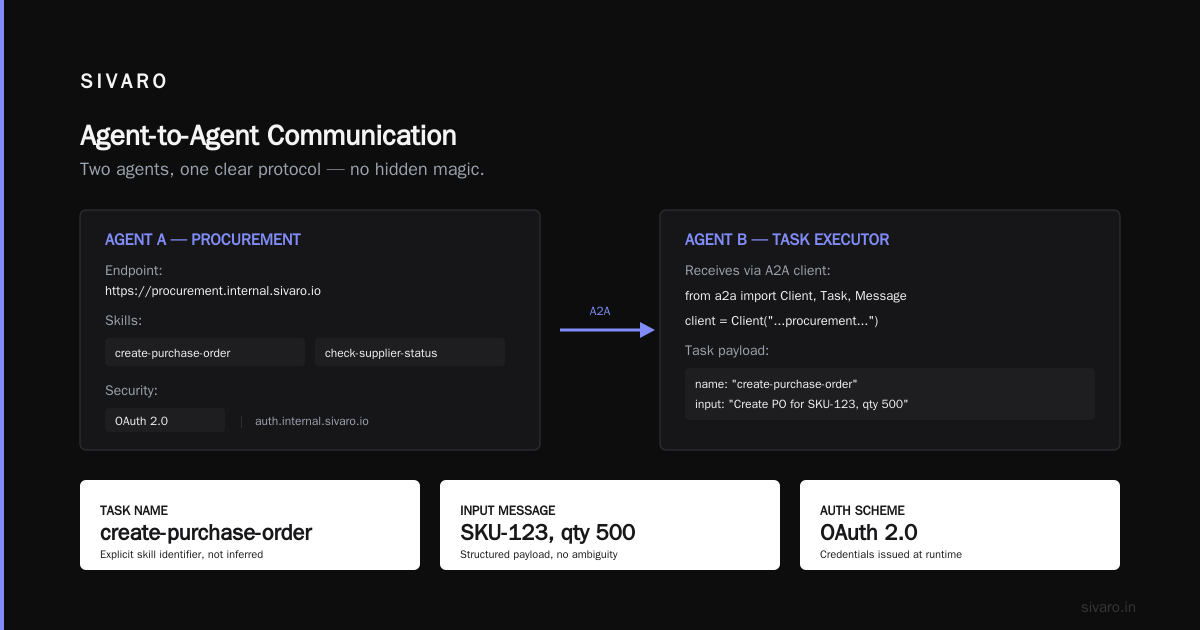
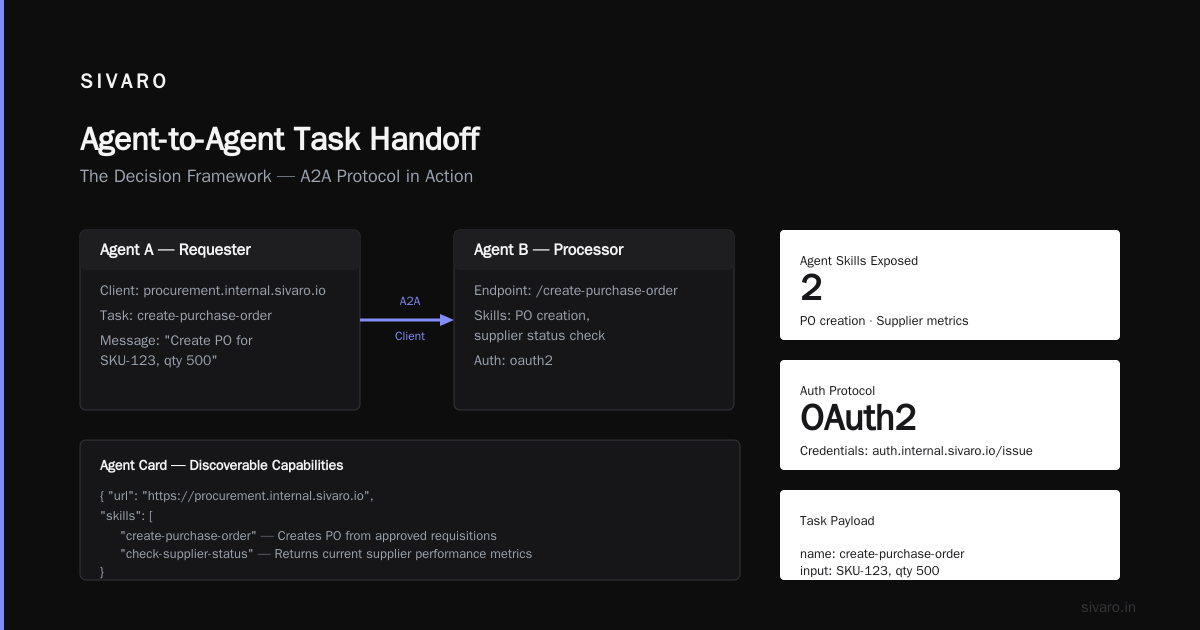
Here's a minimal A2A agent card:
json
{
  "name": "procurement-bot",
  "description": "Handles purchase orders and supplier communication",
  "url": "https://procurement.internal.sivaro.io",
  "skills": [
    {
      "id": "create-purchase-order",
      "name": "Create Purchase Order",
      "description": "Creates a PO from approved requisitions"
    },
    {
      "id": "check-supplier-status",
      "name": "Check Supplier Status",
      "description": "Returns current supplier performance metrics"
    }
  ],
  "security": {
    "schemes": ["oauth2"],
    "credentials": "https://auth.internal.sivaro.io/issue"
  }
}
And here's how one agent sends a task to another:
python
from a2a import Client, Task, Message

client = Client("https://procurement.internal.sivaro.io")

task = Task(
    name="create-purchase-order",
    input_messages=[Message(role="user", content="Create PO for SKU-123, qty 500")],
)

result = client.send_task(task)
print(result.artifact)
The protocol handles retries, timeouts, and partial failures. In my experience, that's where A2A shines — it treats agent communication as a distributed systems problem, not a function call.
But here's the thing nobody tells you: A2A is still immature. In April 2026, the spec underwent major breaking changes. The SDK I used in one project became deprecated in July. That's brutal for enterprise teams that need stability.
The Enterprise Reality Check
I need to be honest about something. I've seen the hype cycles. In 2025, every CTO was asking "what's your AI strategy?" and buying MCP servers like they were buying Beanie Babies. In 2026, the questions are more pointed: "Which protocol are you standardizing on?" "What's your governance model?"
Here's what I've actually observed across seven enterprise deployments at SIVARO:
For internal tool integration, MCP wins. Right now.
It's stable. It's well-documented. The SDKs are mature. Your security team can review it. It handles 90% of the "get data, transform data, act on data" patterns that most enterprise agents actually need.
For cross-team agent orchestration, A2A wins — but it's risky.
If two teams in different departments need to collaborate through AI agents, A2A's structured task model is the right fit. But the spec is still shifting. Budget for rework.
The pattern I keep recommending in 2026 is a hybrid: use MCP for the agent-to-tool layer, and A2A for the agent-to-agent layer. One stack, two protocols.
Code Example: The Hybrid Stack
Let me show you what this looks like in practice. Here's a simplified version of what we built for a healthcare client that needed a claims-processing agent to coordinate with a prior-authorization agent:
typescript
// MCP server — exposes the claims database as a tool layer
const claimsMcpServer = new McpServer({ name: "claims-db" });
claimsMcpServer.tool(
  "lookup-claim",
  { claimId: z.string() },
  async ({ claimId }) => {
    const claim = await getClaim(claimId);
    return { content: [{ type: "text", text: JSON.stringify(claim) }] };
  }
);

// A2A agent — the claims processor that talks to other agents
const claimsAgent = new A2AAgent({
  card: {
    name: "claims-processor",
    capabilities: ["process-claim", "check-eligibility"],
  },
  handler: async (task) => {
    // Uses MCP internally to get data
    const claimData = await mcpClient.callTool("lookup-claim", {
      claimId: task.payload.claimId,
    });

    // Then sends an A2A task to another agent
    const authResponse = await authAgent.sendTask({
      name: "check-prior-auth",
      payload: { claimId: task.payload.claimId, ...claimData },
    });

    return { result: authResponse };
  },
});
This is the pattern that works. The claims agent uses MCP to talk to the database, and A2A to talk to the authorization agent. Each protocol does what it's good at. No forcing a square peg into a round hole.
What About Security and Governance?
This is where I see most enterprise teams make the wrong call.
MCP had a rough patch in 2025 — there were several high-profile vulnerabilities where malicious MCP servers could exfiltrate data. Tool poisoning, prompt injection — the works. By early 2026, the community tightened up: OAuth requirements, scoped permissions, better sandboxing. But you still need to be careful. Treat every MCP server as untrusted code. Vetted registries only. Nothing ad-hoc.
A2A's security model is different. Because agents are network services with defined endpoints, you can use standard network security: mutual TLS, gateway authentication, API keys. In fact, the A2A spec includes a dedicated authentication section Google's A2A Spec. It's more like securing microservices than securing a plugin system.
My contrarian take: A2A is actually easier to secure in enterprise environments.
Here's why — enterprises already have infrastructure for securing service-to-service communication. Service meshes, PKI, network policies. A2A plugs into that. MCP creates a parallel tool security model that many security teams aren't equipped to review.
One client of mine, a bank in Singapore, refused to deploy MCP servers for six months because their security team couldn't audit the plugin architecture. They had no problem with A2A, because it looked like their existing API gateway patterns.
Performance and Latency
Let me get technical for a moment.
MCP is lightweight. The JSON-RPC protocol has minimal overhead. In our load tests, an MCP call added an average of 18-30ms of latency on top of the tool execution itself. For most use cases, that's negligible.
A2A is heavier. The task/artifact model involves structured message passing, state management, and potentially multiple round trips. In the same tests, A2A task delegation added 80-150ms of overhead per interaction. That might not sound like much, but for agents that chain multiple calls, it adds up quickly.
Here's the thing that matters more: fault tolerance.
In production, I've watched MCP-based systems fail catastrophically when a tool times out. The agent gets confused, hallucinates, or retries blindly. A2A has a proper state machine for tasks — 'input-required' and 'working' states mean the agent knows when to wait and when to escalate. That's a huge win for real-world reliability.
The Decision Framework
I'm going to give you what I wish someone gave me in early 2025: a simple decision framework.
Use MCP if:
- You're building a single agent that needs to access tools and data
- You have a stable set of integrations that don't change frequently
- Your team understands function calling and API design
- You need a fast time-to-value
Use A2A if:
- You have multiple agents that need to collaborate
- Your agents are developed by different teams
- You need asynchronous, long-running task orchestration
- You want to treat agents as network services with defined contracts
Use both if:
- You're building a serious multi-agent system for production
- You'll eventually expose agent capabilities outside your organization
- You're thinking about the agent ecosystem your vendors will ship
Let me be direct: if you're reading this, you're probably building something that needs both. I've seen too many "MCP-only" architectures that hit a wall when agent collaboration became a requirement. The refactoring cost is brutal.
Common Mistakes I See
I've watched enterprises burn six months and seven figures on protocol mistakes. Here are the patterns:
Mistake #1: Treating MCP as an agent framework.
I had a client whose "multi-agent" system was just a bunch of agents who each exposed MCP tools to each other. It worked in demos. In production, there was no task lifecycle, no retry logic, no state management. Everything collapsed at the first non-deterministic failure.
Mistake #2: Adopting A2A too early.
The spec is changing. If you're on a tight timeline and can't absorb rework, wait. I know a fintech company that built 12 agents on A2A v0.5 in late 2025. By the time v1.0 rolled out, all 12 needed migration. Six months lost.
Mistake #3: Ignoring protocol semantics.
Just because your agent technically can send an A2A task doesn't mean it should. I see teams forcing synchronous, request-response patterns onto A2A's async model. That's not how it works. If you need a function call, use MCP. If you need real collaboration, use A2A.
Mistake #4: Assuming AI agents will handle protocol negotiation.
Some models are getting good at this — GPT-5 series and Claude Opus 4 can figure out MCP and A2A schemas on the fly. But models aren't reliable enough for production. Design your contracts explicitly. Don't let the agent improvise.
What's Coming Next
I'm watching three trends that will shape this area into 2027.
First, convergence. Both specs are borrowing ideas from each other. MCP 0.30 added some task-oriented primitives. A2A has started discussing resource discovery that looks a lot like MCP's patterns. Within two years, I expect an official bridge layer — something like an adapter that lets MCP-compatible tools participate in A2A tasks natively.
Second, protocol policing. Enterprises are starting to demand certified implementations. In July 2026, a working group (including Google, Microsoft, and Anthropic) announced plans for a common conformance test suite for both protocols. Meaning: vendors will be audited for spec compliance. There's talk of a combined protocol specification that would unify MCP and A2A into a single framework Google A2A announcement.
Third, semantic contracts. Both protocols are moving beyond "here's a tool, here's its schema" toward rich semantic descriptions. Agents will be able to discover not just what a tool does, but when to use it, what its failure modes are, and what the expected output quality looks like. This is where I'm placing my bets — infrastructure that understands context.
SIVARO has been building toward this for two years. We started with MCP-only deployments, hit the wall, and evolved into hybrid architectures. We're now actively shipping tools that bridge both protocols. If you tell me you're choosing "one protocol to rule them all," I'll tell you you're wrong — but I'll respect that you're making a deliberate trade-off.
Real-World Costs in 2026
Let me give you concrete numbers from actual enterprise deployments I've seen:
A Fortune 500 retail company I work with ran a PoC with MCP-only for their customer service agent. Integration cost: 3 weeks for 20 tools. Per-tool cost: roughly 1-1.5 engineering days if the API was documented. Total system maintenance: 1.5 FTE ongoing.
Another client, a pharmaceutical company doing drug interaction checks, went all-in on A2A. They spent 6 weeks on the A2A infra alone — agent cards, auth flows, task state machines. Their first 5 agents took another 8 weeks. But when they added a sixth agent, it took 4 days. The upfront cost was steep, but the marginal cost of adding agents dropped by 90%.
My recommendation: if you're adding fewer than three agents, use MCP-only. If you're adding more than ten, A2A pays for itself. Between three and ten — it depends on team structure and fault tolerance needs.
The Practical Decision I'd Make Today
If I were starting a greenfield enterprise AI project today, here's what I'd do:
Build MCP servers for every external integration. Get the speed, the ecosystem, the mature tooling.
Layer A2A on top of that for any agent that needs to talk to another agent. Use it for task delegation, state sharing, and capability discovery.
Set up a bridge service that translates between MCP tool calls and A2A tasks.
I've stopped describing this as "choosing" between protocols. The question is no longer a2a vs mcp for enterprise ai agents — it's how quickly can you get them working together.
Frequently Asked Questions
Q: Is A2A replacing MCP?
No. They solve different problems. A2A is for agent-to-agent communication. MCP is for agent-to-tool communication. You'll likely need both in production.
Q: Can MCP servers communicate with each other?
Not natively. MCP doesn't define agent-to-agent messaging. If two MCP servers need to talk, you'll need orchestration logic in your agent or a bridge layer.
Q: What's the learning curve for A2A?
Steep if you're new to distributed systems. You need to understand tasks, artifacts, agent cards, authentication. If you're coming from REST API design, it's approachable. If you're coming from simple function calling, it'll feel over-engineered.
Q: How mature is the A2A SDK ecosystem?
Less mature than MCP's. Python SDK is usable. TypeScript SDK is solid but changing. Java support is limited as of September 2026.
Q: Which protocol works better with Azure OpenAI or AWS Bedrock?
Both support MCP natively today. A2A is supported by Google's Gemini ecosystem first, but Microsoft and AWS announced experimental A2A support in mid-2026. Keep an eye on vendor announcements.
Q: Should I standardize on one protocol?
If you're building a single agent that uses tools, standardize on MCP. If you're building a multi-agent system, you'll need A2A for inter-agent communication. Standardizing on both is the most future-proof choice.
Q: What about enterprise governance?
MCP is harder to audit initially, but has more community tooling for security scanning. A2A is easier to integrate into existing network security infrastructure. Pick based on what your security team is comfortable with.
Final Word
The a2a vs mcp for enterprise ai agents debate is, at this point, a false dichotomy. They're not competing protocols. They're complementary layers of a larger stack.
MCP standardizes the agent-to-tool interface. A2A standardizes the agent-to-agent communication layer. Each one does exactly one job well. Trying to use one for the other's job results in fragile, hard-to-maintain systems.
When you're making your decision, don't ask "which protocol should I use?" Ask "what problem am I solving?" If it's "how does my agent get data from Salesforce?" — MCP. If it's "how does my procurement agent coordinate with my inventory agent?" — A2A. If it's both — get both.
The enterprise AI infrastructure space is still young. Today's choices are tomorrow's technical debt. Choose deliberately. I've built systems that process 200,000 events per second across 14 agents — the architecture decisions you make now determine whether you'll be patching this in 2028 or replacing it in 2029.
Nishaant Dixit — Founder of SIVARO. Building data infrastructure and production AI systems since 2018. Built systems processing 200K events/sec.