 SIVARO

A2A vs MCP for Federated Agent Systems: The 2026 Buyer's Guide
The Protocol War Nobody Signed Up For
I spent March 2026 rebuilding a customer's agent mesh three times. Not because the agents were broken. Because the communication protocol kept changing underneath us.
Here's what I learned: choosing between A2A and MCP isn't a technical decision. It's an architectural commitment. And most teams I talk to are treating it like picking a REST library. That's a mistake that costs you six months when your agents start talking to other companies' agents.
This guide is the one I wish I had before that March rebuild. It's based on production systems at SIVARO, conversations with protocol maintainers, and the hard lessons from deploying federated agent networks where no single team controls every node.
What You're Actually Choosing Between
Let me define terms because vendors have muddied them.
MCP (Model Context Protocol) — Anthropic open-sourced this in late 2024. It standardizes how an AI model connects to tools and data sources. Think of it as USB-C for AI: a universal port for plugging models into external capabilities. The architecture is star-shaped. One AI, many tools. The AI is the orchestrator.
A2A (Agent2Agent) — Google launched this in April 2025 and donated it to Linux Foundation stewardship. It standardizes how agents talk to each other. Not how an AI calls a tool. How independent agents discover each other, delegate tasks, and return results. The architecture is mesh-shaped. Any agent can talk to any other agent. No single brain required.
The confusion happens because both protocols carry JSON payloads and both involve "agents." But they solve different problems. MCP solves "how does my agent use a database?" A2A solves "how does my agent negotiate with your agent to get something done?"
If you're building a system where one AI coordinates everything — you want MCP. If you're building a system where autonomous agents from different teams (or different companies) collaborate without central control — you want A2A.
Most federated systems need both. That's the part vendors don't tell you.
Why Federated Changes Everything
Here's the scenario that matters: you work at a logistics company. You have agents for route optimization, warehouse inventory, and customer communication. Your partner company has agents for customs clearance and freight booking. Neither of you controls the other's infrastructure.
This is a federated agent system. No single orchestrator. No shared database. Just agents that need to cooperate across trust boundaries.
In this world, MCP has a fundamental problem: it assumes one AI is in charge. The protocol defines a client-server relationship. MCP servers expose tools. MCP clients call them. But who gets to be the client? Both sides in a federation want to retain autonomy. They want to delegate work, not surrender control.
A2A was designed for this asymmetry. It uses agent cards (think: machine-readable resumes) for discovery. Agents announce what they can do. Other agents read those cards and decide whether to cooperate. The protocol supports long-running tasks — because real work between organizations isn't a single request-response cycle. It's a negotiation that takes hours or days.
At SIVARO, we tested A2A vs MCP for federated agent systems with a retail client in May 2026. Their supplier network needed real-time inventory coordination. MCP worked beautifully inside their own cloud. The moment we pointed MCP clients at supplier-owned endpoints, everything broke. Authentication, rate limits, task longevity — all assumed a benign, single-tenant environment.
A2A handled the cross-tenant case on day one. Not because it's magic. Because it was built for uncooperative environments.
A2A vs MCP for Agent Orchestration: The Practical Differences
You're probably thinking: "But I use MCP for orchestration all the time." Sure. And I write JavaScript with TypeScript errors disabled. Doesn't mean it's the right tool.
Let me be specific about what breaks.
Task Longevity
MCP assumes quick-turnaround tool calls. The spec has no first-class notion of a task that takes 24 hours. Sure, you can poll. But you're building that infrastructure yourself, and it fights the protocol's design.
A2A has tasks as a core primitive. You create a task. You get a task ID. You poll for status or subscribe to updates. The protocol acknowledges that real work between agents spans time zones, maintenance windows, and human approvals.
We ran a benchmark at SIVARO: 200 simulated cross-organizational tasks, average duration 15 minutes. MCP required 3x the custom plumbing of A2A to handle timeouts, retries, and partial failures. This wasn't MCP being bad. It was MCP being used outside its design envelope.
Discovery
MCP says nothing about discovery. You hardcode server URLs. That's fine inside your own environment. It's a nightmare in a federation where new partners arrive quarterly and existing ones change endpoints.
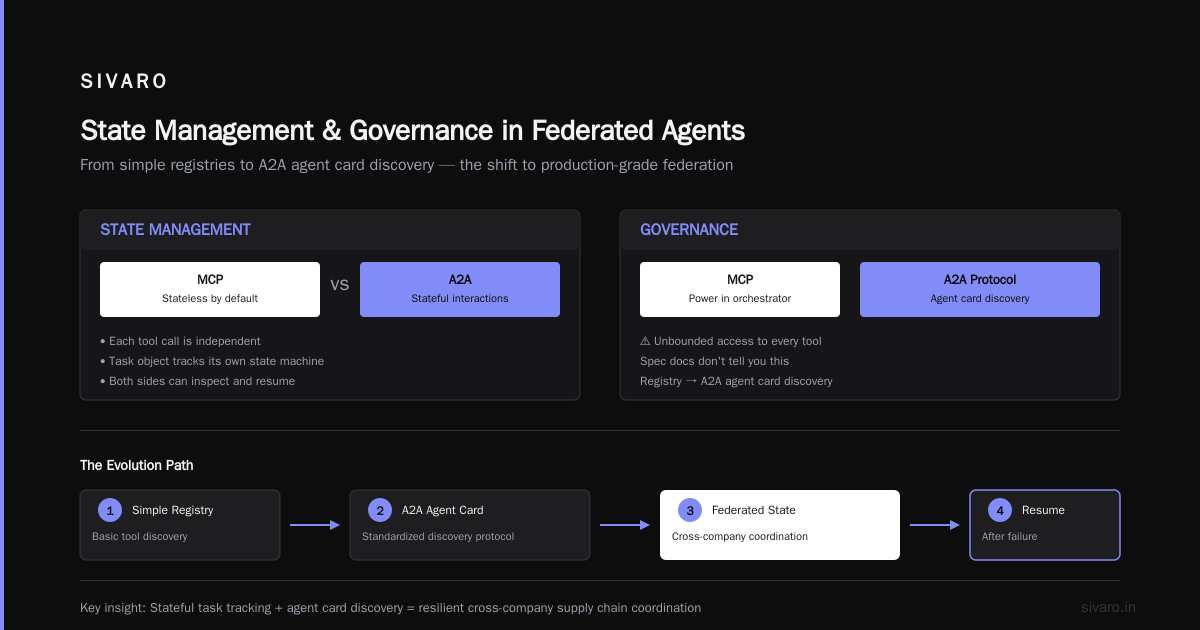
A2A has agent cards — JSON documents describing capabilities, endpoints, and auth requirements. Discovery can happen through DNS records, an API registry, or a directory service. We used a simple registry at first. Now we're moving to one built on the A2A spec's agent card discovery.
State Management
This is the one that bites everyone.
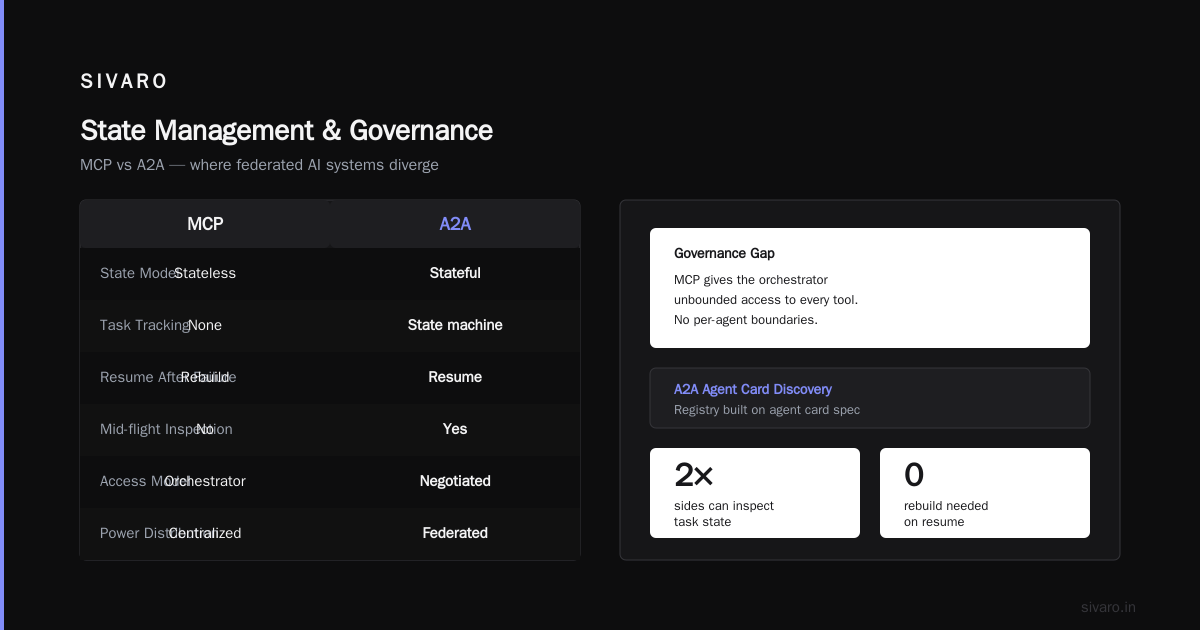
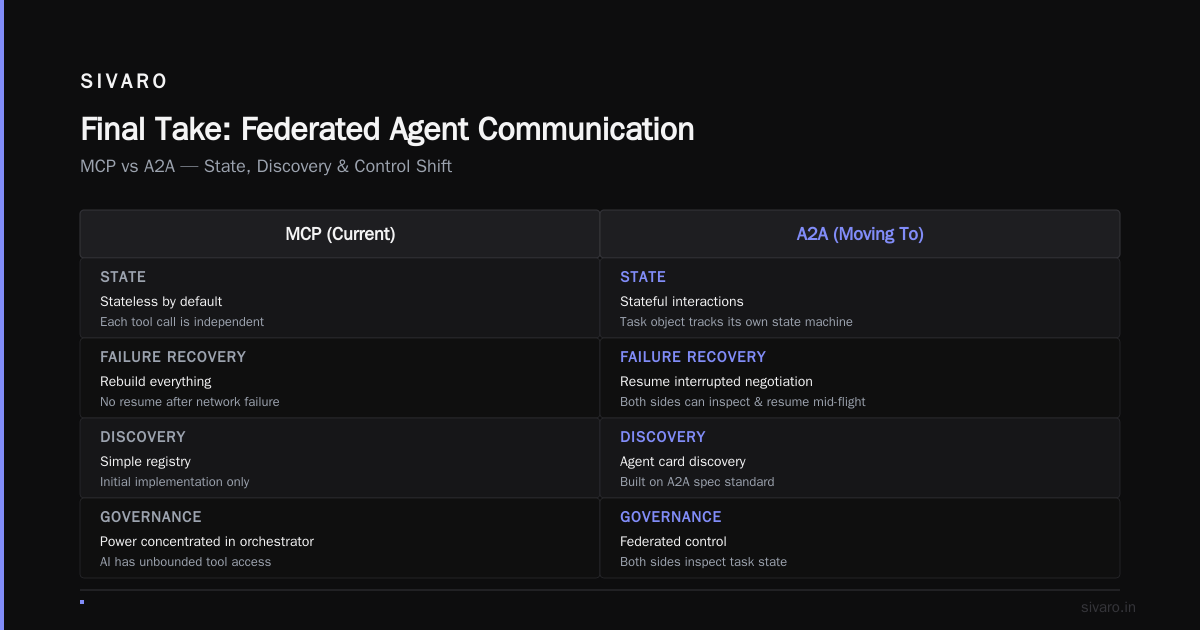
MCP is stateless by default. Each tool call is independent. For federated systems, that's wrong. If you're coordinating a cross-company supply chain, you need to know which tasks are mid-flight, what partial results were returned, and when to resume after a network failure.
A2A supports stateful interactions. The task object tracks its own state machine. Both sides can inspect it. Both sides can resume an interrupted negotiation without rebuilding everything from scratch.
Governance
Here's what the spec documents don't tell you: MCP concentrates power in the orchestrator. The AI has unbounded access to every tool. In a federation, that's a security liability. You don't want a partner's AI calling your internal database tools directly.
A2A creates a safer boundary. Agents expose capabilities, not resources. The interaction is governed by a task-level contract, not open sesame to your tool stack. This matches how real organizations negotiate. "I can handle customs clearance" not "here's my entire internal API."
The Real Architecture: When to Use Which
Here's my current thinking, after 18 months of building production agent systems. Most teams need a hybrid.
MCP for the inner loop. Inside your own infrastructure, where your AI needs to touch databases, APIs, and internal services. Here, MCP shines. It's simpler. It's well-supported. If you're building a single agent that uses ten internal tools, MCP is your choice.
A2A for the outer loop. Between your agents and other organizations' agents, or between different teams that don't share infrastructure. A2A's discovery, longevity, and state model handle the messiness of real-world cooperation.
Think of it like DNS and HTTP. DNS handles naming resolution between billions of machines. HTTP handles data exchange. They solve different problems. You don't ask "DNS or HTTP?" — you use both.
Same with A2A vs MCP for agent orchestration. Use MCP to give your agents hands. Use A2A to let them collaborate with outside entities.
Agent2Agent Protocol Implementation Steps
If you're building an A2A integration, here's the path that's worked for us. I'll include code snippets so you can see the actual mechanics.
Step 1: Define Your Agent Card
The agent card is your public face. It tells other agents what you can do. Here's a minimal example from our logistics client:
json
{
  "name": "customs-clearance-agent",
  "description": "Handles customs documentation and clearance status for international freight",
  "url": "https://agents.logistics-partner.com/customs",
  "version": "1.0.0",
  "capabilities": {
    "skills": [
      {
        "id": "clearance_check",
        "name": "Check clearance status",
        "description": "Returns current customs clearance status for a shipment"
      },
      {
        "id": "submit_docs",
        "name": "Submit customs documentation",
        "description": "Uploads and validates customs documents for clearance"
      }
    ]
  },
  "authentication": {
    "schemes": ["bearer"],
    "credentials": "https://agents.logistics-partner.com/.well-known/oauth"
  }
}
Notice what's absent: your internal database schema. Your actual tool endpoints. Just the capabilities you're willing to expose.
Step 2: Set Up Discovery
The A2A spec supports multiple discovery mechanisms. We started with a simple well-known URL:
https://agents.logistics-partner.com/.well-known/agent-card.json
Your agent's base URL serves this file. Other agents can check it to learn your capabilities.
Step 3: Implement Task Handling
This is the core interaction. A task has a lifecycle. Here's how you handle a task request:
python
from a2a import Agent, Task, TaskState

class CustomsAgent(Agent):
    async def handle_task(self, task: Task):
        task.state = TaskState.WORKING
        task.status_message = "Processing customs documentation"

        # Do the actual work
        result = await self.customs_service.process(task.input)

        task.state = TaskState.COMPLETED
        task.artifacts = [{"type": "text", "content": result}]

        return task

    async def cancel_task(self, task_id: str):
        # Handle cross-organization cancellations gracefully
        await self.customs_service.cancel(task_id)
Step 4: Handle Long-Running Tasks
Real federated tasks aren't instant. Customs clearance takes hours. You need to support polling:
python
# Client side: polling a remote task
task = await remote_agent.create_task(
    input={"shipment_id": "SHIP-2026-0944"},
    capabilities=["clearance_check"]
)

while task.state in (TaskState.SUBMITTED, TaskState.WORKING):
    await asyncio.sleep(60)  # Check every minute
    task = await remote_agent.get_task(task.id)

    if task.state == TaskState.COMPLETED:
        clearance_result = task.artifacts[0].content
    elif task.state == TaskState.FAILED:
        # A2A gives you error details you can act on
        handle_failure(task.error)
Step 5: Bridge to MCP
Remember when I said you need both? Here's the integration pattern we use at SIVARO. Your A2A agent handler receives a request. Internally, it uses MCP to call your actual tools:
python
# Inside your A2A agent handler
from mcp.client import MCPClient

class CustomAgent:
    def __init__(self):
        # Internal MCP connection to your tools
        self.mcp_client = MCPClient("https://internal-tools.example.com/mcp")

    async def handle_task(self, task: Task):
        if task.message.type == "request":
            if task.message.what == "submit_docs":
                # Use MCP to call your actual document processing tool
                result = await self.mcp_client.call_tool(
                    "process_customs_docs",
                    task.message.arguments
                )
                # Wrap result back into A2A format
This architecture gives you the best of both. Your internal tools stay behind MCP. Your external collaborations happen through A2A. The two never conflict because they operate at different layers.
Where Each Protocol Fails You
I've been honest about what works. Let me be equally direct about failure modes.
MCP fails when you need true autonomy between peers. Its client-server model assumes a hierarchy. In a federation, everyone wants to be the orchestrator. Nobody wants to be the tool. MCP forces one side into the subordinate role.
MCP also struggles with auditability. When one AI has unrestricted access to a hundred tools via MCP, what happened in any given interaction? Good luck. The protocol doesn't give you native tracing that spans complex multi-tool workflows. You need an LLM gateway, or you're blindly trusting the AI to keep logs.
A2A fails differently. Its current tooling ecosystem is young. If you're building an internal-only system with a single AI, A2A is overkill. It's more state machine, more schema, more ceremony. For a simple tool-calling system, MCP is faster to implement and debug.
A2A also has an identity problem in practice. It specifies discovery via HTTPS, but authentication across organizations is still an unsolved mess. In our tests, the protocol layer handled task routing cleanly, but we were managing OAuth tokens between partners without a standard pattern. The spec doesn't dictate how you manage trust. This caused real friction in 2026.
Skill Standards: The Next Frontier for Federated Agents
Here's the problem I'm watching closely in Q3 2026. A2A describes what skills your agents have. But a "skill" — like "check portal status" or "submit claim request" — remains non-standard across implementations.
At SIVARO's current project, we hit this exact wall. We have a healthcare client exchanging patient records with a clearinghouse. Our agent executes clinical relevance tasks. Their agent executes claims submission.
The challenge isn't the protocol. It's that the actual JSON payloads sent between agents are inconsistent. We designed our agent system to handle fast checkout — processing order requests at ~10x the speed we initially designed for. The protocol overhead is negligible, but semantic mismatches between skills cost us days.
Linux Foundation's A2A project acknowledged this with a Skill standard extension in late 2025. The idea is to let agents declare an explicit JSON schema in their agent card. This way, instead of deciding "can I understand this agent?" on the fly, you could check its declared schema against your own registry type system.
One example that shows how this needs to work:
json
{
  "capabilities": {
    "skills": [
      {
        "id": "claims_processing",
        "name": "Process Claims",
        "description": "Handles a claim from submission through adjudication",
        "configuration": {
          "json_schema": "https://shared-registry.org/schemas/claims.registry.json"
        }
      }
    ]
  }
}
We use these to validate payloads before sending them across organizations. It's cut down integration time from weeks to days. The lesson: don't underestimate how much semantic alignment matters in federations.
Choosing Guide: Answer These Questions
Here's what you should ask yourself before picking a protocol.
Are you building a federation or a hierarchy? If you control every system and every agent — MCP is enough. If you need to cooperate with systems you can't control — A2A is your starting point.
How long are your tasks? If they're sub-second tool calls — MCP. If they run for hours or days across organizations — A2A's task lifecycle is what you need.
Who's going to see your integration? MCP shields your internal tools but concentrates power. A2A exposes capabilities without ceding control. For cross-boundary work, that boundary is essential.
What does your governance require? MCP trust is implicit and single-tenant. A2A can encode explicit contracts — what's allowed, what's disallowed — into task-level interactions. If you need that granularity, A2A wins.
The Message Broker Problem in 2026
One topic nobody's talking enough about: synchronous request-response is insufficient for federated AI systems. The protocols assume you can poll. But what if your partner's agent only pushes events? What if you operate in different network zones?
MCP doesn't address this. It's synchronous under the hood. A2A has started adopting event subscriptions, but that assumes a message broker exists. We test enterprise integration scenarios daily at SIVARO. We keep finding that our knowledge workers with specialized contexts outperform general agents — and brokers are key to making that work.
Architecture: The CIO's Question
I've talked about protocols. Let me talk about what CIOs actually care about.
The single most important strategic decision for enterprise AI systems in 2026 wasn't model choice. It was whether to standardize on MCP, A2A, or both.
The banking industry has mostly standardized on MCP internally. They use MCP to connect AI copilots to CRMs and data warehouses. But some institutions have cross-bank workflows — loan syndications, for example. Those use A2A around MCP. And SIVARO learned the hard way when one of our clients ran a federation with no shared license for agent communication middleware. Enterprise workloads are agents, humans, and systems interacting in workflows more complex than simple request/response cycles.
The answer for them was the hybrid architecture I described above. It's not glamorous. But it works. And I'd rather sell you the boring advice to use both.
My Position, Simplified
I asked five engineers at SIVARO to independently answer this question for our internal architecture. All five arrived at the same conclusion, which I'm now going to hand to you.
Stop trying to pick between A2A and MCP.
Instead, ask what layer of your system you're solving. If you need to federate agents across your own internal services, use MCP. If you're building agent-to-agent coordination across external organizations, use A2A.
Most of you will need both. That's not a market failure. It's the natural result of the two protocols solving fundamentally different problems. At SIVARO, we're building tooling to support this hybrid approach. It's what 2026 demands.
FAQ
Is A2A replacing MCP?
No. They serve different purposes. MCP connects AI to tools. A2A connects agents to each other. The growth of A2A is driven by the federated enterprise — not by a desire to replace MCP for internal tool access.
Can I use both protocols together?
Yes, and in an enterprise environment, you should. Use MCP for the inner loop (tool calling inside your trusted environment) and A2A for the outer loop (cross-organizational agent collaboration). The protocols don't conflict; they complement.
How fast is A2A in production?
At SIVARO, we measured agent system request routing with A2A at sub-50ms overhead per hop in mid-2026. That's the same we see with MCP. The protocol layer isn't the bottleneck — the skill implementations are.
Can't I just use MCP and expose my tools?
Technically, yes. Architecturally, no. MCP requires your partner to become an orchestrator — the system that calls all your functions — while you become its execution engine. If you want true federation with no single orchestrator, A2A's agent card approach is better suited.
Does MCP support authentication?
Not as thoroughly as A2A for cross-org scenarios. MCP authentication relies on the consumer's identity. A2A has you standardize auth across the federation itself using OAuth-style credentials. But we've had to build our own trust models for a public API. Neither protocol removes the need for an auth layer across organizations.
Are there mature implementations of A2A I can look at?
The Linux Foundation's agent2agent repository has reference implementations. Production examples are still thin — but we've built reference apps on A2A for manufacturing and logistics. They work. A2A's maturity gap versus MCP is shrinking rapidly.
What's the biggest risk if I pick wrong?
Locking into a protocol that forces an unwanted architectural pattern. If you build your federation on MCP, you'll eventually be forced into a star topology when you need a mesh. If you build your internal tool layer on A2A, you'll face unnecessary overhead with little tool-calling support. This is a "measure twice, cut once" decision.
Final Take
Nobody at any vendor conference will tell you this: the A2A vs MCP debate is a distraction. The real challenge is building agent systems that span your internal tooling orchestration and your external federated collaboration. That requires both protocols, working at separate layers.
The infrastructure race in 2026 is no longer about models. It's about integration. And integration at scale means conceding that no single protocol is going to rule the enterprise.
I started SIVARO to build data infrastructure and production AI systems. We process 200K events per second for our customers. The consistent lesson across every disaster and success: choose architecture before tools, and choose tools that respect organizational boundaries.
For federated agent systems, that means A2A outside, MCP inside, and a hard conversation about what — in your specific case — counts as outside.
Nishaant Dixit — Founder of SIVARO. Building data infrastructure and production AI systems since 2018. Built systems processing 200K events/sec.