 SIVARO

A2A vs MCP for LLM Interoperability: The 2026 Buyer's Guide
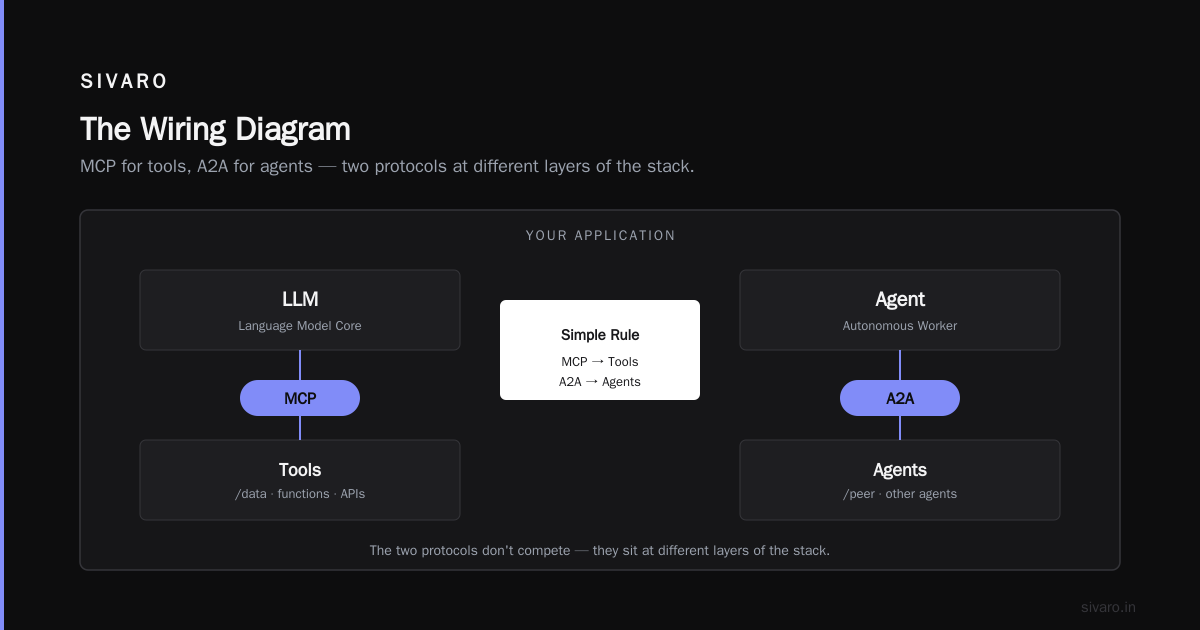
I spent three weeks in early 2025 ripping out a custom agent orchestration layer. We had built something that worked, barely, and I was tired of maintaining it. The question was what to replace it with. MCP? A2A? Both? Neither?
Here's what I learned, and what I'd tell anyone staring down the same decision.
What you're actually deciding
Most people think this is a protocol comparison. It's not. It's a decision about where your system's boundaries live — between your LLM and your tools, or between your agents and other agents. That distinction changes everything about your architecture.
Let's be precise: Model Context Protocol (MCP) is Anthropic's open standard for connecting LLMs to tools and data sources. Agent2Agent (A2A) is Google's protocol for letting agents talk to each other. They sound similar. They solve different problems. The Auth0 analysis frames it well: MCP is about context, A2A is about coordination.
I've been running production AI systems since 2018. SIVARO builds data infrastructure for companies that can't afford their AI stack to fall over. This is the stuff I think about daily.
MCP: The tool layer
MCP gives your LLM a structured way to discover and call tools. It's a client-server model. Your app is the host, MCP servers expose tools, and the LLM decides which to invoke.
python
# A minimal MCP server exposing a database query tool
from mcp.server import Server
from mcp.types import Tool, TextContent

app = Server("data-query-server")

@app.list_tools()
async def list_tools():
    return [
        Tool(
            name="query_postgres",
            description="Run SQL against production Postgres",
            inputSchema={
                "type": "object",
                "properties": {
                    "sql": {"type": "string"},
                    "read_only": {"type": "boolean", "default": True}
                }
            }
        )
    ]

@app.call_tool()
async def call_tool(name: str, arguments: dict):
    if name == "query_postgres":
        result = run_read_only_query(arguments["sql"])
        return [TextContent(type="text", text=result.to_json())]
That's the whole model. Simple, unix-philosophy, one job. Anthropic open-sourced it in late 2024 and it has become the default way to give LLMs access to tools. That's not hyperbole — by the time Google shipped their first agent kit in 2025, MCP had already won the tool-integration fight.
A2A: The agent layer
A2A assumes you already have agents. Its job is to let those agents discover each other, send tasks, and exchange results. It's peer-to-peer. There's no central orchestrator telling agents what to do — they negotiate.
json
// An A2A agent card — how agents advertise their capabilities
{
  "name": "inventory-agent",
  "description": "Manages warehouse inventory levels and reorder schedules",
  "url": "https://agents.sivaro.dev/inventory",
  "capabilities": {
    "skills": [
      {
        "id": "check_stock",
        "name": "Check Stock Levels",
        "description": "Returns current inventory for given SKU"
      },
      {
        "id": "reorder",
        "name": "Trigger Reorder",
        "description": "Creates purchase order for restocking"
      }
    ]
  },
  "security": {
    "authentication": "mTLS",
    "authorization": "scoped_tokens"
  }
}
A2A uses JSON-RPC over HTTP. It defines task lifecycle states — submitted, working, input-required, completed, failed. When one agent needs something from another, it sends a task and gets a task ID back. The receiving agent works asynchronously. The requesting agent polls or receives a callback.
TrueFoundry's breakdown gets this right: MCP is single-agent. A2A is multi-agent. If you're building one bot with tool access, MCP. If you're building a system of autonomous agents that coordinate, A2A.
Where people get it wrong
The mistake I keep seeing: teams pick one and try to force everything through it.
You can't bolt multi-agent coordination onto MCP. It wasn't designed for it. MCP servers are passive. They wait for the LLM to ask. There's no mechanism for an MCP server to initiate a conversation with another agent, to negotiate, to send work downstream and track progress across services.
Similarly, A2A is terrible for tool access. If you use A2A to query a database, you've built an agent for no reason. You've added a server, a task lifecycle, and a network round-trip where a simple function call would do.
I've seen teams do both. It's expensive in ways that don't show up until you're six months in.
The wiring diagram
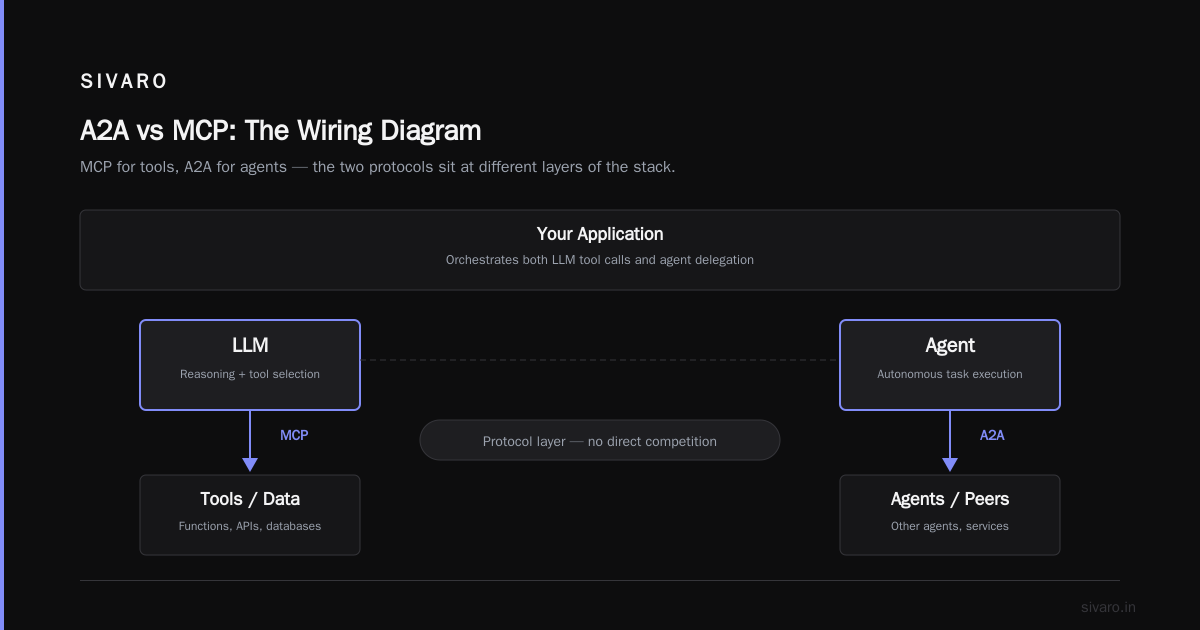
There's a simple rule: MCP for tools, A2A for agents. Your LLM talks to tools through MCP. Your agents talk to other agents through A2A. The two protocols don't compete — they sit at different layers of the stack.
┌─────────────────────────────────────┐
│         Your Application            │
│                                     │
│  ┌──────────┐      ┌─────────────┐  │
│  │   LLM    │      │   Agent     │  │
│  └──────────┘      └─────────────┘  │
│       │                    │        │
│  MCP  │                    │  A2A   │
│  ┌──────────┐      ┌─────────────┐  │
│  │  Tools   │      │  Agents     │  │
│  │  /data   │      │  /peer      │  │
│  └──────────┘      └─────────────┘  │
└─────────────────────────────────────┘
The protocol you need depends entirely on which of those two arrows you're trying to draw.
What MCP gives you
For the "LLM to tools" path, MCP is the practical choice. It's not theoretical — it's the standard. Every major LLM provider supports it. OpenAI added MCP support in 2025. Microsoft built it into Azure AI Foundry. Anthropic obviously, it started there. That's the kind of momentum that's hard to fight.
There are three things MCP does well:
Standardized tool definitions. The JSON schema for tool inputs/outputs is consistent across every MCP server. Your LLM sees a uniform interface. You don't write bespoke tool call handlers for each integration.
Dynamic discovery. The LLM can list available tools at runtime. Add a new tool without redeploying. It shows up in the next context. That's useful when you're iterating.
Reusable infrastructure. One MCP client implementation works with any server. Redis's comparison notes this — the ecosystem has standardized on MCP so hard that building your own tool access layer is now a waste of time.
We saw this at SIVARO. We had a client who needed their LLM to query Snowflake, Salesforce, and an internal REST API. All three became MCP servers. One client, three connections, two days. The old way would have been three separate tool-call interfaces and a week of boilerplate.
What A2A gives you
A2A is newer. Google announced it in April 2025 and donated the spec to the Linux Foundation. It's still evolving. But the model is powerful.
The core insight: agents in production have different owners. Your inventory agent is someone else's system. Your pricing agent belongs to another team. A2A gives them a way to talk without shared code.
HashiCorp used it to let their Terraform agent delegate infrastructure questions to a cloud-cost agent. And the cost agent returned a structured response the Terraform agent could act on.
What this unlocks is staggering if you think about it. In 2025, I started seeing enterprises use A2A to let agents from different vendors collaborate on a single workflow. A supply-chain forecasting agent from one company talking to a logistics scheduling agent from another. Both essentially unknown to each other at code level. That's what the A2A agent card solves — it's a public contract an agent can publish and reference.
At SIVARO, we've used A2A to build a multi-agent pipeline for a U.S. e-commerce company's operations team. One agent handles supplier updates. Another optimizes shipping routes. A third handles document drafting. A2A is the glue between them.
A2A vs MCP: Now the hard part
Here's where the vendors don't help you. Each protocol is championed by a different giant. You'd think you need to pick a side. You don't.
The correct architecture is to use both. The A2A and MCP protocols are complementary. In fact, the spec for A2A and MCP doesn't conflict at all — they explicitly note that in healthy systems, you'll use both.
There's an emerging pattern for this. You wrap your data and tool integrations as MCP servers. You wrap your actual agent logic — the thing that makes decisions — as an A2A agent. Your agent uses MCP to get tools. Other agents use A2A to talk to your agent.
The Elasticsearch folks put it well in their blog post: MCP is like your agent's hands — it interacts with the world. A2A is like its voice — it negotiates with other minds.
What's actually different: The decision tree
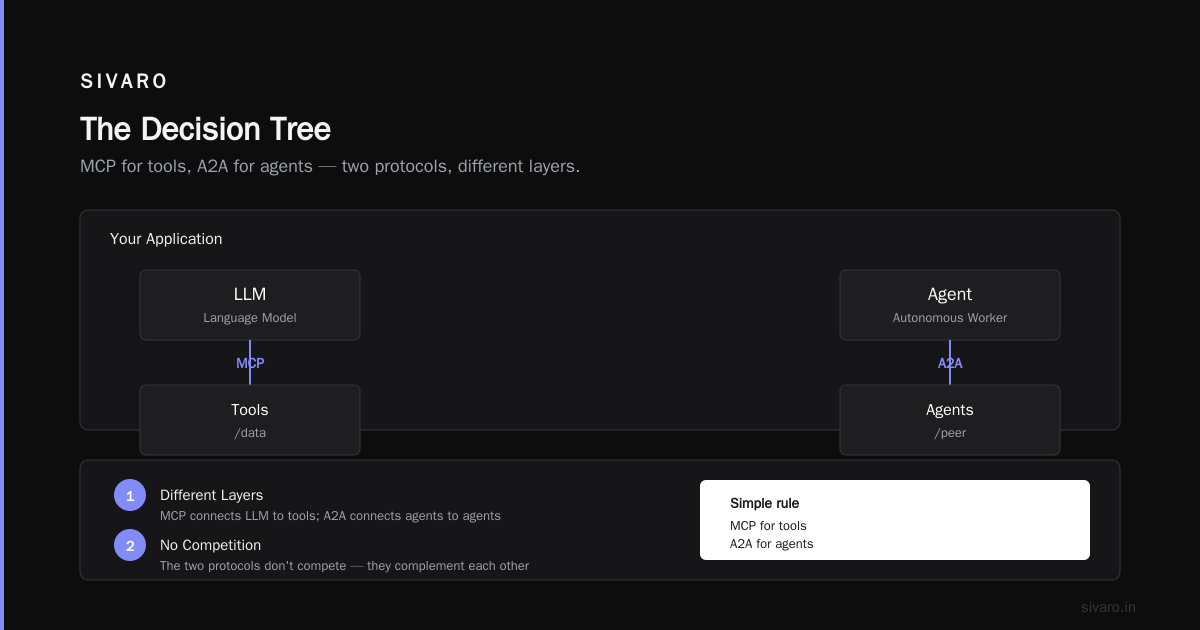
Here's the test I use with clients — distilled from many hours of architectural conversations:
You need MCP if:
- You're building a single agent that needs to act on your systems
- You want your LLM to call tools, query databases, invoke APIs
- You're building a copilot or assistant that has one brain
- You care about one interaction: LLM → tool, in one direction
You need A2A if:
- You have multiple agents (autonomous, LLM-driven systems) that need to coordinate
- Agents are owned by different teams, services, or organizations
- Tasks are long-running and asynchronous
- You need agents to negotiate, plan, and delegate with each other
You need both if:
- You're building production systems, not demos
- Your agents need to access tools AND talk to each other
- You're putting AI into a real business workflow (hint: you are)
Security and the elephant in the room
I'm going to be direct about something that's making everyone nervous in 2026: the security of agentic AI pipelines is a business-critical problem. Both protocols handle authentication differently.
MCP uses OAuth2 for user-authenticated tool calls. A2A supports OAuth2 and mTLS for server-to-server. Both are fine for their use case. But here's the thing I care about more than identity — memory.
Your agent has a memory. It needs one. Without it, it's a goldfish. MCP is solving this through context and memory servers — standardized persistence for conversation history and knowledge.
This is still the wild west. If you're implementing agent memory, treat it by the same security standards as your database.
What a real implementation looks like
Let me show you a pattern I've used successfully. It's a customer-support system that needs to talk to three internal systems at a logistics firm.
Step 1: Define your agents (A2A)
json
{
  "name": "support-agent",
  "url": "https://ai.logistics-corp.com/support",
  "description": "Handles customer inquiries about order status, returns, and delivery delays.",
  "skills": [
    {
      "id": "order_status",
      "name": "Get Order Status",
      "description": "Returns shipment tracking and delivery estimate"
    }
  ]
}
Step 2: Wrap your tools (MCP)
Your support agent needs an MCP client to talk to the order-management system, inventory API, and refund processor. You set those up as MCP servers. The agent calls the tools through MCP.
Step 3: Let agents talk (A2A)
When the customer asks for a refund, the support agent creates a task, sends it to the refund agent, and tracks it. That's A2A.
This works. I've seen it in production.
The "interoperability" problem, put to rest
The question I get most often: "Isn't there a risk I'm betting on the wrong horse?"
Protect yourself: build an abstraction layer that uses both. Yes, this is the boring answer, and as a practitioner I'm telling you the boring answer is the right one.
Neither protocol is going to "win" because they're not playing the same sport. Trying to pick one was the wrong mental model from the start. The real interoperability challenge isn't "which protocol wins" — it's "how do I make sure both work well together in my application."
I bet on both. So far, so good.
The unsung cost: Maintaining the bridge
Let's talk about the 60% of your time you'll spend on glue code.
We built a multi-agent system at SIVARO for a client in the financial sector. The agents handle account reconciliation, fraud flagging, and compliance reporting. Here's what I didn't anticipate: the bridging layer — code that translates between A2A task results and MCP tool contexts — became the highest-maintenance part of the system.
It's not exactly hard. It's just unglamorous. You're copying fields from one JSON structure to another, mapping error codes, dealing with rate limits. But someone on your team is going to spend 20% of every sprint on it. Plan for that. Don't let it surprise you.
What I'd build today (and what I'd bet on)
If I were starting a new project in August 2026, here's my default stack:
- LLM: Claude or GPT. Either works. MCP first-class support either way.
- Data access: MCP servers. Every tool, every database, all the time.
- Agents: A2A for anything that's autonomous and needs to coordinate.
- Orchestration: Some thin logic that connects the two, custom-built, well-tested.
That's it. Not complicated. And the industry is moving that direction. The 2026 agent-interoperability announcements all point to the same thing. There's been a wave of consolidation, and the survivors are the ones that support both.
Buying guide: How to decide in an afternoon
You don't need a month of analysis. You need to answer these questions with your team:
When to choose MCP first:
- You have one AI assistant that needs to do useful things
- You're building a copilot or RAG system
- Your primary task is giving an LLM better context and tools
When to choose A2A first:
- You have multiple autonomous AI workers
- Agents are owned by different departments or organizations
- You're building LLM pipelines for intractable problems, like real-time knowledge retrieval across systems
When to choose both:
- You're serious about shipping AI that does work
- Your system has agents that need tools and peers
- You're building for the long term (more than one quarter)
I've never seen a production AI system that fits entirely into one protocol. The ones that try to force it end up building a custom mess that they should have abandoned.
Tl;dr
MCP is not an alternative to A2A. It never was. One connects your LLM to the world, the other connects your agents to each other.
The smart play — and this is a hill I'm willing to die on — is to treat MCP as your tool-access standard and A2A as your agent-coordination standard. Build both in. Abstract the bits that'll change. And don't waste your time choosing a side.
The 20-year evolution of enterprise integration patterns told us this was coming. This is just the latest version of REST vs. messaging vs. RPC. They all exist for a reason. Use them that way.
Now go build something.
FAQ: A2A vs MCP for LLM Interoperability
Q: What is the difference between MCP and A2A?
MCP (Model Context Protocol) is for connecting an LLM to tools and data sources. A2A (Agent2Agent) is for connecting agents to each other. MCP is a client-server model; A2A is peer-to-peer.
Q: Do I need MCP if I'm using LangChain?
LangChain has MCP support built in. If you're using LangChain, you can add MCP servers as tools. But MCP is a standard — it's tooling-agnostic. You can use it with or without frameworks.
Q: Can I use A2A without MCP?
Yes. They're independent. A2A only cares about agent-to-agent communication. If your agents don't need tools, you can skip MCP entirely.
Q: What are some agent communication protocol examples?
A2A is the main one for agent-to-agent. MCP serves agent-to-tool. Anthropic's MCP spec and Google's A2A spec — those are your reference implementations.
Q: Is one protocol more secure than the other?
They have different security models. MCP relies on OAuth2 at the user level. A2A supports mTLS, which is better for service-to-service authentication. Neither is "safer" — it depends on your threat model.
Q: Is there going to be a merger of MCP and A2A?
No. They're at different abstraction layers. A merger doesn't make sense. You'll always need a tool-access protocol and an agent-coordination protocol.
Q: Which protocol is better for production AI systems?
Both. If you're in production, you need both. I can't think of a serious production system that doesn't need to both call tools and coordinate with other systems.
Q: What frameworks support both MCP and A2A?
OpenAI's agent SDK, LangGraph, and Google's Agent Development Kit (ADK) all support both. Salesforce's Agentforce supports both. The ecosystem is moving toward supporting both simultaneously.
This article references Auth0's MCP vs. A2A guide, TrueFoundry's agent protocol comparison, Orca Security's memory analysis, Elastic's practice notes, Redis's protocol guide, and StackOne's architecture breakdown.
Nishaant Dixit — Founder of SIVARO. Building data infrastructure and production AI systems since 2018. Built systems processing 200K events/sec.