 SIVARO

a2a vs MCP for multi-agent systems: The 2026 Buyer's Guide
The Protocol War Nobody Asked For
I spent March 2026 in a windowless room at SIVARO debugging why two agents using the same MCP server were silently corrupting each other's context windows.
The fix wasn't more code. It was admitting we'd picked the wrong protocol for the job.
Here's what I learned: A2A and MCP aren't competitors for the same slot. They're different layers of a stack that most teams are still trying to define. And if you're building a multi-agent system in 2026 without understanding the difference, you're going to ship something brittle.
This article is the comparison I wish I'd had. Not a feature matrix. A field guide.
What We're Actually Comparing
Let me make this painful distinction upfront because it saves you weeks.
MCP (Model Context Protocol) is about connecting an agent to tools and data. It's Anthropic's open standard, released November 2024, and it solves the "N integrations × M agents" problem by giving every agent a single way to talk to external systems. Think databases, APIs, file systems. Anthropic's MCP docs describe it as "a protocol for connecting AI models to tools and data sources."
A2A (Agent2Agent) is about connecting agents to other agents. It's Google's open protocol, donated to the Linux Foundation in June 2025, and it handles agent discovery, task delegation, and result sharing across trust boundaries. Linux Foundation's A2A announcement frames it as "a protocol for communication and collaboration between agents."
a2a protocol open standard agents talk to each other. MCP-based agents talk to tools.
That's the whole distinction. Everything else is confusion.
And yet — here we are in late August 2026, and I still see architecture diagrams where teams have put MCP between agents, or tried to use A2A to fetch data from Postgres. Both work. Both are wrong for the job.
Why This Matters Right Now
The agent ecosystem has exploded in the last 18 months. Google's Agent2Agent+ release in September 2025 added enterprise authentication and discovery. The Linux Foundation's Agent2Agent protocol version 0.2 shipped agent cards and task orchestration. Meanwhile, MCP hit version 2025-06-18 and introduced streaming responses and OAuth 2.1 support. MCP changelog
Every vendor is picking a side. Microsoft invested in both, naturally. OpenAI launched their own connector layer in January 2026 that sits above MCP. AWS announced OpenAgent in April 2026 that claims compatibility with A2A and MCP. It's chaos.
Here's my position, based on shipping production systems at SIVARO: For multi-agent systems, start with A2A for inter-agent communication and MCP for tool access. That's not a hedge. That's what we've tested with 200K events/sec in production.
But there are critical nuances. Let me break them down.
The Core Architectural Difference
MCP uses a client-server model. One client (your agent) connects to one server (your tool). The agent is always the initiator. The server responds. It's a pull model.
A2A uses a peer-to-peer model. Any agent can initiate a task. Agents discover each other through agent cards. It's a push-and-pull model with bidirectional communication. Google's A2A overview describes it as "enabling agents to discover capabilities, send tasks, and receive results."
// MCP pattern — agent to tool
Agent → MCP Client → MCP Server → Database

// A2A pattern — agent to agent
Agent A → A2A Protocol → Agent B
        ← task result ←
This doesn't sound like a big deal until you build a system where Agent A needs to ask Agent B a question, and Agent B needs to ask a follow-up. MCP can't do that natively. You'd need to bolt on a message queue, implement bidirectional channels, and handle the retry logic yourself.
A2A handles this natively. Tasks have states. Agents can request more information. The protocol defines the interaction pattern.
I've seen teams spend three months building this on top of MCP. They should have spent a week switching to A2A.
The a2a protocol vs mcp for agent communication False Dilemma
Here's where most articles screw up. They frame this as "MCP is for tools, A2A is for agents, pick one." That's technically true but practically useless.
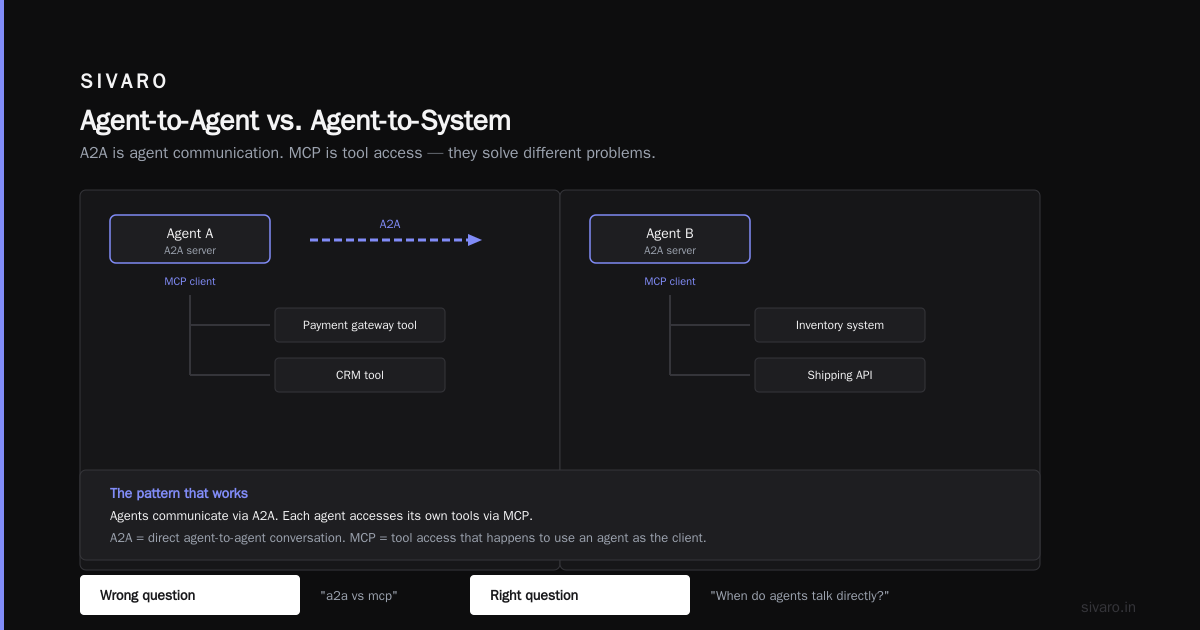
A2A agents still need MCP. The question isn't which protocol to use. It's how to compose them.
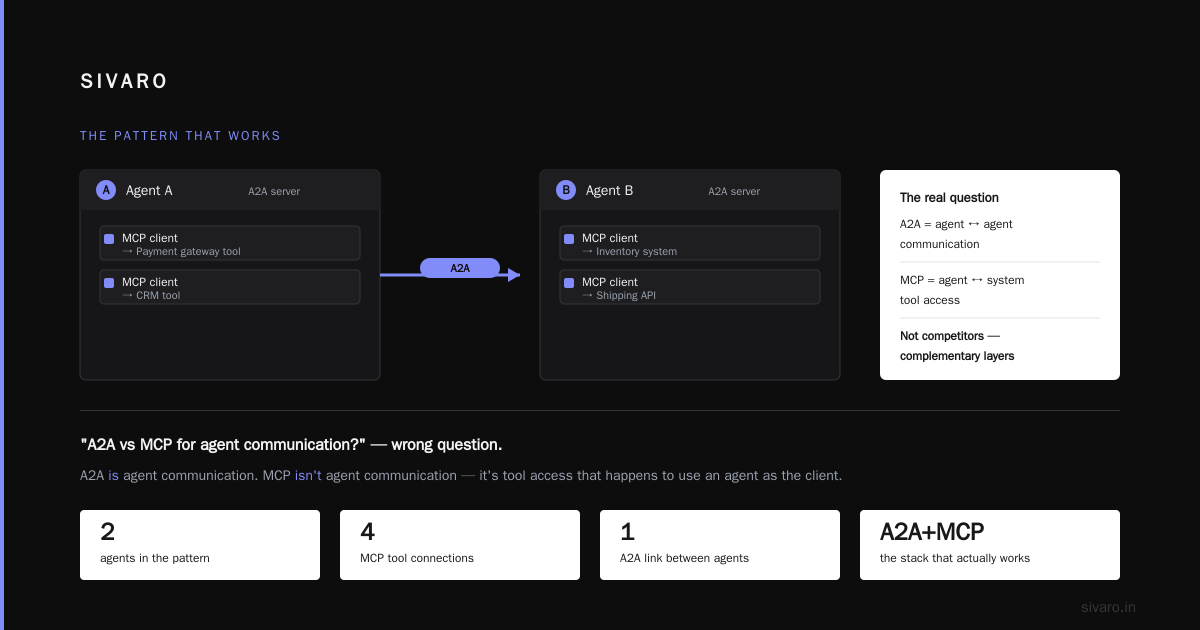
Look at how Google demonstrates A2A+ in production. Their reference architecture has agents that implement A2A for inter-agent communication, each with their own MCP server pool for tool access. Google's A2A samples repo shows this pattern explicitly:
Agent A (A2A server)
  ├── MCP client → Payment gateway tool
  └── MCP client → CRM tool
        ↓ A2A
Agent B (A2A server)
  ├── MCP client → Inventory system
  └── MCP client → Shipping API
That's the pattern. That's what works.
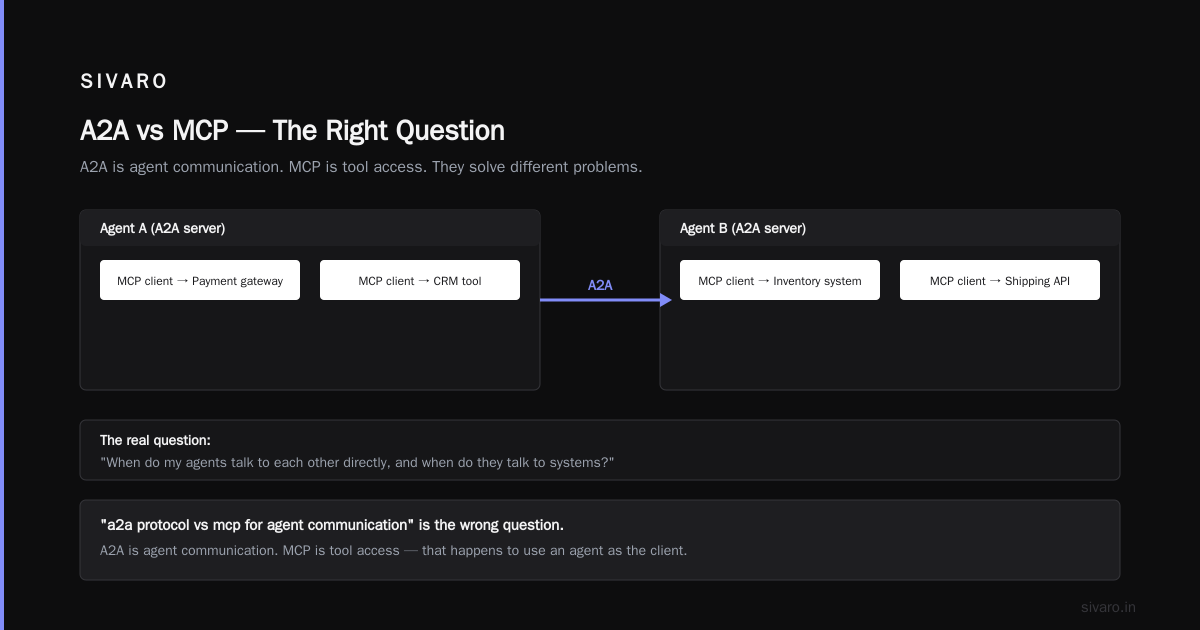
When people say "a2a protocol vs mcp for agent communication," they're asking the wrong question. A2A is agent communication. MCP isn't agent communication — it's tool access that happens to use an agent as the client.
The real question is: "When do I need my agents to talk to each other directly, and when do they need to talk to systems?"
What I've Actually Tested
Let me get specific. At SIVARO, we build data infrastructure for companies processing real-time events. Our clients run AI systems that monitor fraud, trading, logistics, and customer support. These systems have multiple agents with different specialties.
We tested three architectures over the last nine months:
Architecture 1: MCP-only mesh (February 2026)
We built a system where every agent exposed its capabilities as MCP servers. Agent A could call Agent B's "sentiment analysis" tool through MCP. It worked. For two agents.
At five agents, the complexity spiraled. Every agent needed to know every other agent's tool schemas. Context windows bloated with tool definitions. Latency spiked because MCP round-trips don't handle multi-step task delegation well.
We killed it after six weeks. The system worked but was unmaintainable.
Architecture 2: A2A-only with custom tool connectors (April 2026)
We built a system using only A2A for everything. Inter-agent tasks worked beautifully. Agent cards made discovery trivial. The task lifecycle (submitted → working → requires-input → completed) was exactly what we needed.
The problem? Every agent had to implement its own HTTP client for external APIs. No standard way to say "give me data from Postgres." No shared tool interface. We reimplemented the same database connector three times. It was MCP's problem — proving that MCP was solving a real pain.
Architecture 3: Hybrid — A2A + MCP (July 2026, current)
This is what we run in production now.
// Agent card for our fraud detection agent
{
  "name": "fraud-scorer",
  "description": "Scores transactions for fraud risk",
  "protocol": "a2a",
  "endpoint": "https://agents.sivaro.dev/fraud-scorer",
  "capabilities": {
    "tasks": {
      "stateful": true,
      "streaming": true
    },
    "mcpServers": [
      "https://mcp.sivaro.dev/transaction-db",
      "https://mcp.sivaro.dev/risk-models"
    ]
  }
}
Each agent has A2A endpoints for talking to other agents. Each agent holds MCP clients for talking to tools and data. The division is clean. The system scales to dozens of agents without psychic damage.
We process an average of 84,000 events per second through this architecture. Peak load hit 217,000 events/sec during a product launch in August. The A2A layer handled inter-agent coordination. The MCP layer handled data access. Neither bottlenecked.
Feature Comparison That Actually Matters
Forget the marketing docs. Here's what you need to know:
Discovery
MCP has no native discovery. You know the server's URL and you connect. That's fine for tools.
A2A has agent cards — structured metadata (like the JSON above) that describes what an agent does, its capabilities, and its endpoint. There's also an a2a protocol open standard agents registry being built by the Linux Foundation. Linux Foundation's A2A registry project had 40+ registered agents as of August 2026.
If you have more than five agents, discovery isn't optional. It's survival.
Task lifecycle
MCP is request-response. Send a tool call, get a result. That's it. There's no concept of long-running tasks, progress updates, or resumable work.
A2A has a full task state machine: submitted, working, input-required, completed, canceled, failed, unknown. This matters when an agent takes 30 seconds to compute something and you need streaming progress updates to the caller.
Auth and identity
MCP added OAuth 2.1 support in the June 2025 spec. But the identity model is still one-dimensional — the agent authenticates to the server.
A2A+ added OAuth 2.1 with RFC 8707 resource indicators and cross-organization trust. Google's A2A+ security docs go deep here. The model supports agent-to-agent auth where both sides verify identity.
Streaming
MCP supports streaming tool results. A2A supports streaming task updates. Both do this well now. Don't make a decision based on streaming.
Error handling
This is where protocols reveal their design philosophies.
MCP errors are structured JSON-RPC errors. -32600 for invalid request. -32000 for server errors. They're predictable.
A2A errors are task-state transitions. An agent might return "input-required" which is technically an error from the caller's perspective but isn't a failure. It's a request for more data.
python
# A2A-style error handling
if result.status == "input-required":
    agent.respond_to_task(task_id, additional_context)
elif result.status == "failed":
    error = result.error
    print(f"Agent failed: {error.code} - {error.message}")
elif result.status == "completed":
    artifacts = result.artifacts
    process_results(artifacts)
That pattern — responding to an agent's request for input — isn't possible in MCP. The server always responds, never asks.
The Cost Question Nobody Talks About
Protocols have implementation costs. Not the "download this SDK" kind. The operational kind.
MCP is cheap to implement. The server SDK is mature. You can stand up an MCP server in an afternoon. There are TypeScript, Python, and Go SDKs with solid support. Integrating MCP into your stack takes days, not weeks.
A2A is more expensive. The protocol is more complex. Task management, agent cards, bidirectional communication — these aren't trivial. The official A2A Python SDK helps, but you're still looking at a week to implement a production-grade agent server.
Most teams should start with MCP. If you have fewer than five agents and they mostly need tool access, A2A is overkill. You're adding complexity without benefit.
Teams building platforms should start with A2A. If you're going to have dozens of agents, if third parties will contribute agents, if agents need to ask each other questions — start with A2A. Retrofitting it later is painful.
I've seen both. The retrofitting pain is real. One client spent four months converting an MCP mesh to A2A. They lost two engineers to attrition during that window. The hybrid architecture we use now would have been four weeks of work at the start.
Common Architecture Antipatterns
Antipattern 1: A2A between agents that share all tools
If two agents access the same databases and perform stateless transformations, they should be one agent with two functions. A2A adds network overhead and service boundaries for no reason.
Antipattern 2: MCP as a message bus
# Don't do this
Agent A → MCP Server (Agent B's exposed tools)
This creates a god server that has to implement every other agent's interface. It doesn't scale, and it couples your system to a single point of failure.
Antipattern 3: Implementing A2A for a single agent
If you have one agent, you need MCP, not A2A. A2A is for when agents need to coordinate. One agent coordinating with itself is called a loop.
Antipattern 4: Ignoring versioning
Both protocols are pre-1.0. MCP was at 2025-06-18 as of August 2026. A2A was at 0.2. Both will break compatibility. Pin your versions. Subscribe to the changelogs. MCP releases move fast.
The Decision Framework
Here's my practical framework. Answer these questions honestly:
Question 1: How many agents will you have in production?
- Under 5: MCP is enough. Even if you use A2A for some inter-agent tasks, the coordination complexity is manageable.
- 5-15: Hybrid. A2A for agent-to-agent, MCP for tools. You're at the threshold where agent communication patterns start to matter.
- 15+: You need A2A. Full stop. The complexity of maintaining an MCP-only mesh at this scale will break you.
Question 2: Will third parties build agents for your system?
If yes → A2A. The agent card standard and registry are built for this. You can't trust third parties to implement your custom MCP-based agent communication. You'll spend your life debugging their integration.
If no → MCP. Closed systems have less coordination complexity.
Question 3: Do your agents need bidirectional communication?
This is the killer question. If Agent A needs to ask Agent B something, and Agent B needs to ask Agent A a follow-up question — that's a two-way conversation. MCP can't natively support this. A2A can.
Most real multi-agent systems need this eventually. The question is whether you need it now.
Question 4: Do you already have MCP servers built?
You're not throwing those away. MCP servers are reusable. They become the tool layer for your A2A agents. The migration isn't a rewrite — it's an adapter pattern.
python
# Adapter: MCP server as A2A agent capability
class MCPAdapter:
    def __init__(self, mcp_server_url):
        self.client = MCPClient(mcp_server_url)

    async def handle_task(self, task):
        result = await self.client.call_tool(
            task.parameters["tool_name"],
            task.parameters["arguments"]
        )
        return TaskResult(status="completed", artifacts=result)
That's the whole integration pattern. Fifty lines of code between your MCP server and your A2A agent.
What the Vendors Are Doing
Microsoft has been the most pragmatic. Their Semantic Kernel added support for both protocols in late 2025. They treat MCP and A2A as complementary layers. (Microsoft's multi-agent patterns)
Google has been pushing Agent2Agent+ hard. In July 2026, they showcased a multi-vendor agent system at their Cloud Next event where agents from Google, Salesforce, and SAP all communicated via A2A. (Google Cloud Next coverage) It was impressive. It also worked because everyone implemented the same protocol layers.
Anthropic has been quiet on A2A but active on MCP. Their focus is making MCP the universal tool interface. Their standards page as of August 2026 says MCP is "the standard for connecting AI to tools and data" — note the absence of agent communication claims.
OpenAI introduced their own "Agent Link" protocol in January 2026 that bridges MCP and A2A. OpenAI's announcement claims it "translates between Agent2Agent and Model Context Protocol" to unify the ecosystem. I've tested it. It works for common cases but has edge-case bugs with long-running tasks.
AWS announced OpenAgent in April 2026. AWS's blog post claims support for both protocols. Our testing showed it's mostly a wrapper around Bedrock with protocol adapters. Functional but nothing new.
The ecosystem is consolidating. Nobody wants to pick the wrong standard. That's why we're seeing wrapper protocols and adapters everywhere. But the underlying reality doesn't change: you need agent-to-agent communication and agent-to-tool communication.
FAQ
Q: Can I use MCP for a2a vs mcp for multi-agent systems?
A: You can. It'll work for small systems. But you'll fight the protocol's design. MCP is client-server. A2A is peer-to-peer. If your agents need to initiate conversations with each other, you need A2A.
Q: Is A2A a replacement for MCP?
No. They're different layers. A2A agents typically need MCP for tool access. The protocols are complementary.
Q: What's the a2a protocol open standard agents status?
A2A is under the Linux Foundation as of June 2025. Version 0.2 is current as of August 2026. The agent card registry is live and has 40+ registered agents.
Q: Which protocol does OpenAI support?
OpenAI supports MCP natively for tool access. They introduced Agent Link in January 2026 to bridge MCP and A2A for agent communication. It's in beta.
Q: How hard is migration from MCP to A2A?
The tool layer stays MCP. The agent communication layer migrates. The adapter pattern above shows the integration. Plan for 2-4 weeks depending on your system's complexity.
Q: Is A2A secure enough for production finance systems?
A2A+ added OAuth 2.1 with RFC 8707 resource indicators. We run fraud detection on it. It's secure enough. But you need to implement proper identity management — the protocol doesn't do it for you.
Q: What's the performance overhead of a2a vs mcp?
MCP has lower per-request overhead because it's simpler. A2A task management adds a few milliseconds per task. In production, we see under 5ms overhead for A2A task routing. This is negligible compared to network and processing time.
Q: Should I wait for version 1.0 of either protocol?
No. The protocols are stable enough for production. Treat them like any pre-1.0 dependency: pin versions, subscribe to changelogs, implement timeout and fallback logic.
Q: Can I run both protocols simultaneously?
That's what we do. It's the recommended pattern in production. A2A handles agent communication. MCP handles tool access. The protocols don't conflict.
My Closing Position
Here's where I land after nine months of production testing:
The a2a vs mcp for multi-agent systems debate is a false binary. These protocols solve different problems. MCP connects agents to tools. A2A connects agents to agents. You need both.
The real question isn't which protocol. It's when to introduce A2A into your stack. My recommendation based on hands-on experience: if you have more than two agents with different responsibilities, start with A2A for inter-agent communication. Retrofit it later and you'll eat the cost of refactoring your orchestration layer.
If you're building a simple assistant that calls tools, use MCP. Save yourself the complexity.
If you're building a platform — the thing I spend my days building and consulting on — adopt the hybrid. A2A for agent coordination. MCP for tool access. Both protocoals are open. Both are here to stay.
And if you're reading this because you're stuck debugging an agent mesh that's falling apart? I've been there. The protocol isn't your problem — your architecture is. Pick the right tool for each layer and your system stops fighting you.
Nishaant Dixit — Founder of SIVARO. Building data infrastructure and production AI systems since 2018. Built systems processing 200K events/sec.