 SIVARO

A2A vs MCP: The Tool Calling vs Agent Orchestration Showdown
You're building an enterprise AI system. Your agents need to talk to Salesforce, SAP, and a legacy mainframe that runs on hope. Someone on your team says "just use MCP." Someone else says "A2A is the future."
Both are wrong. And both are right. Here's what I've learned after deploying production agent systems for logistics and fintech clients this year.
This guide compares A2A and MCP for tool calling vs agent orchestration — two protocols that solve different problems but get conflated constantly. By the end, you'll know exactly which one (or both) your stack needs.
The Confusion Started in 2025
Let me set the scene.
March 2025. Google releases the Agent2Agent (A2A) protocol. Anthropic's Model Context Protocol (MCP) already has momentum from late 2024. Every vendor rushes to support both. Every CTO I meet asks the same question: "Which one do we standardize on?"
The answer isn't either/or. It's "what problem are you actually solving?"
MCP solves a specific problem: giving an AI model access to tools and data. Think of it as a USB-C port for AI — standardized connections to the things an agent needs to act.
A2A solves a different problem: letting agents talk to each other. It's not about connecting a model to tools. It's about connecting autonomous agents across organizational boundaries.
And yet — the marketing departments of every AI vendor on earth have blurred these lines beyond recognition. Let me unblur them.
What MCP Actually Does (And Doesn't Do)
MCP (Model Context Protocol) is a client-server architecture. Your AI application is the client. It connects to MCP servers that expose resources, tools, and prompts.
python
# MCP server exposing a tool — this is how tools get called
from mcp.server import Server
from mcp.types import Tool, TextContent

server = Server("inventory-server")

@server.list_tools()
async def list_tools():
    return [
        Tool(
            name="check_stock",
            description="Check inventory levels for a SKU",
            inputSchema={
                "type": "object",
                "properties": {
                    "sku": {"type": "string"},
                    "warehouse": {"type": "string"}
                }
            }
        )
    ]

@server.call_tool()
async def call_tool(name: str, arguments: dict):
    if name == "check_stock":
        result = await inventory_service.query(arguments["sku"], arguments["warehouse"])
        return [TextContent(type="text", text=str(result))]
I've built these. They work. For tool calling, MCP is solid — OpenAI, Anthropic, and Microsoft all support it. The spec is clean, the SDKs are getting better, and it solves the "every integration needs its own adapter" problem.
But MCP has limits I hit constantly:
MCP has no concept of agent identity. A tool call comes in, you execute it, you return results. There's no negotiation of authority, no persistent state between interactions, no handshake protocol for who can do what.
MCP is synchronous and simple. It's designed for request-response patterns. When agents need to delegate work, check back on long-running tasks, or hand context to another system, MCP struggles.
At SIVARO, we built an inventory optimization system using MCP for data access. Every agent instance connected to our warehouse databases through MCP servers. Clean. Fast. Worked great.
Then we needed agents to coordinate with a demand forecasting service running under a different team's control. Different infrastructure. Different security model. MCP didn't cut it.
What A2A Brings to the Table
A2A (Agent2Agent) is a protocol for agent-to-agent communication. It's fundamentally about orchestration — one agent sending a task to another agent and tracking its completion.
The core concepts:
- Agent Cards: Public metadata describing what an agent does, its capabilities, and its authentication requirements
- Tasks: Structured work items with states (submitted, working, input-required, completed, failed)
- Artifacts: Outputs produced by task execution
- Messages: Communication between agents within a task
json
// A2A Agent Card — this is how agents advertise capabilities
{
  "name": "forecast-agent",
  "description": "Generates demand forecasts from historical sales data",
  "url": "https://forecast.internal.sivaro.com",
  "capabilities": {
    "streaming": true,
    "pushNotifications": true,
    "stateTransitionHistory": true
  },
  "security": {
    "authentication": {
      "scheme": "oauth2",
      "credentials": {
        "bearer": {
          "format": "opaque"
        }
      }
    }
  },
  "skills": [
    {
      "id": "generate_forecast",
      "name": "Generate Demand Forecast",
      "description": "Produces a 90-day demand forecast for specified SKUs"
    }
  ]
}
The protocol defines how agents discover each other, request work, and report status. It handles long-running tasks — an agent can submit work and get a callback hours later when it's done.
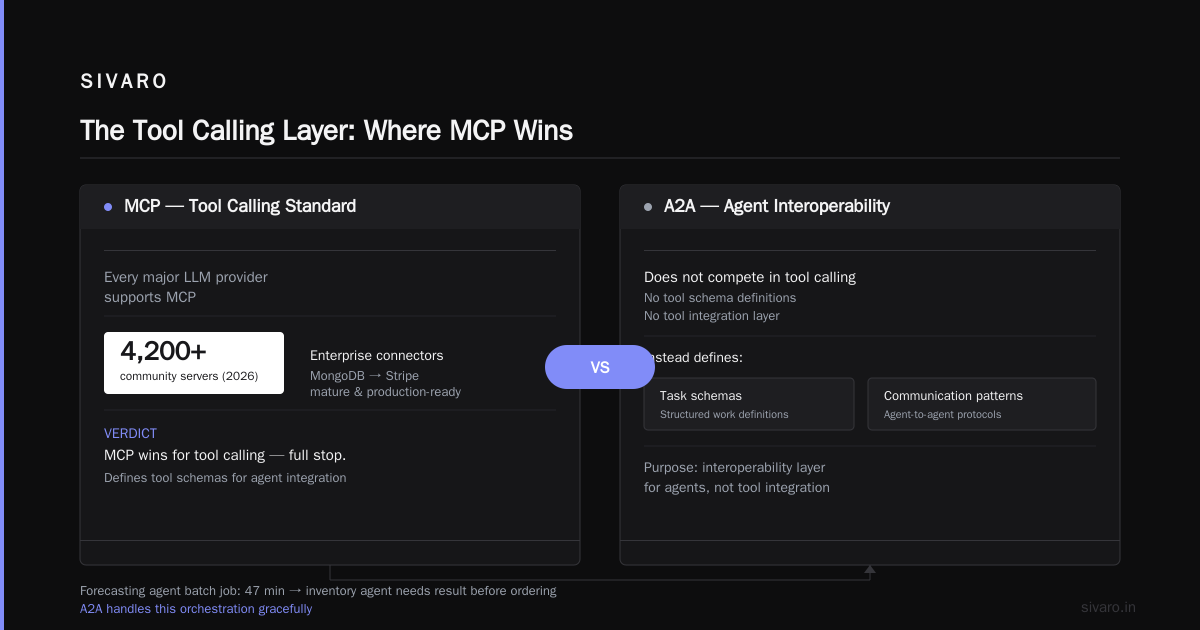
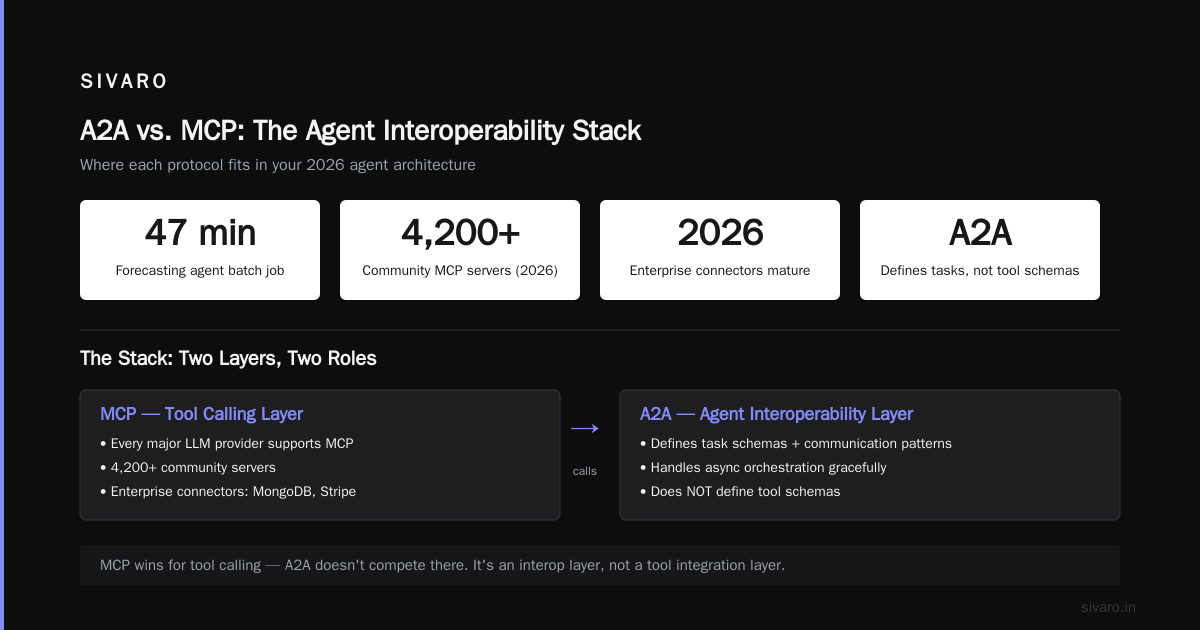
For enterprise orchestration, this matters. Your forecasting agent runs a batch job that takes 47 minutes. Your inventory agent needs the result before placing orders. A2A handles this gracefully.
The Tool Calling Layer: Where MCP Wins
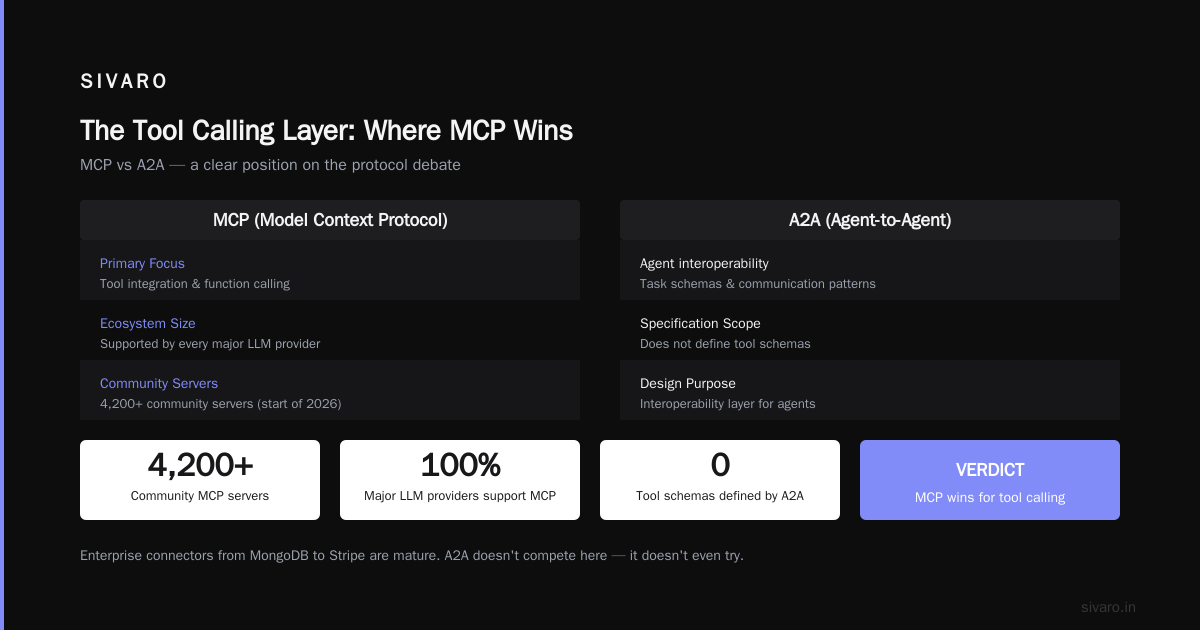
Here's where I take a clear position: for tool calling, MCP wins. Full stop.
Every major LLM provider supports MCP. The tool ecosystem is massive — I counted 4,200+ community servers at the start of 2026. Enterprise connectors from MongoDB to Stripe are mature.
A2A doesn't compete here. A2A doesn't even try to compete here. The A2A spec doesn't define tool schemas. It defines task schemas and communication patterns. It's an interoperability layer for agents, not a tool integration layer.
Think about the stack:
┌─────────────────────────────────────┐
│         Orchestration Layer        │
│         (A2A for agent-to-agent)   │
├─────────────────────────────────────┤
│        Agent Runtime Layer         │
│  (LangGraph, CrewAI, custom code)  │
├─────────────────────────────────────┤
│        Tool Integration Layer      │
│        (MCP for model-to-tool)     │
├─────────────────────────────────────┤
│   Enterprise Systems & Databases   │
└─────────────────────────────────────┘
MCP sits at the bottom, connecting agents to enterprise systems.
A2A sits at the top, connecting agents to each other.
They're not competitors. They're different layers of the same stack.
The Orchestration Problem Nobody Talks About
Most discussions about a2a vs mcp for enterprise agents miss the actual hard problem: orchestration is a governance nightmare.
I learned this the hard way. We built a customer support agent system for a retail client in November 2025. The system combined:
- A conversational agent (handles customer interactions)
- An order management agent (accesses order databases)
- A refund processing agent (executes financial transactions)
- A fraud detection agent (scores refund requests)
Initially, we wired everything with MCP. Every agent exposed its capabilities as MCP tools. The conversational agent called tools on the other agents directly.
It was a disaster.
The tools were stateless, but the conversations weren't. When the conversational agent called the refund agent's "process_refund" tool, it had no way to convey the entire context of the interaction — the customer's frustration, the history of returns, the anomaly flags from the fraud system. You had to stuff everything into arguments and pray.
And security was terrifying. Every agent had access to every tool's endpoint. We needed to reimplement authentication, authorization, and rate limiting at the agent layer because MCP wasn't designed to handle agent-level credentials.
We rebuilt it using A2A for inter-agent communication while keeping MCP for system access. The improvement was dramatic:
- Agents became first-class citizens with identities and capabilities
- Tasks carried rich context through structured messages
- Long-running operations (like fraud checks) didn't block everything
- Governance became centralized — each agent declares what it can do, and the A2A registry enforces it
If you're building a single agent that calls tools, use MCP.
If you're building a system where multiple agents need to coordinate around shared business processes — use A2A for orchestration and MCP for tool access.
That's not a hedge. That's the architecture I'd deploy today.
Deep Dive: Task State and Handoffs
The most underrated part of A2A is the task lifecycle. When my agent delegates work to another agent, I need to know what's happening.
A2A defines task states: submitted, working, input-required, completed, failed, and cancelled. Each state transition can carry artifacts and messages.
python
# A2A client — delegating a task to another agent
import a2a

client = a2a.Client("https://forecast.internal.sivaro.com")

# Send task and await completion
task = await client.send_task(
    skill_id="generate_forecast",
    input={
        "sku_ids": ["SKU731", "SKU892"],
        "horizon_days": 90,
        "include_promotions": True
    },
    callbacks={
        "on_state_change": handle_state_change,
        "on_artifact": handle_artifact,
        "on_message": handle_message
    }
)

# Check status later
status = await client.get_task_status(task.id)
if status.state == "completed":
    artifacts = await client.get_task_artifacts(task.id)
This isn't revolutionary on its own. But compare it to what happens when you force agent orchestration through MCP tool calls:
Everyone I know who's tried this ends up building a workaround. They create "task management" tools that store state in Redis. They implement polling mechanisms. They bolt on webhook systems.
You know what that is? A really bad, unofficial version of A2A.
Google formalized what we were all hacking together in 2025.
Security and Enterprise Governance
Here's the part that matters most for production deployments.
A2A includes security primitives: authentication schemes, authorization levels, and capability declarations. Agent cards explicitly state what skills each agent exposes. This creates a natural audit trail.
MCP treats security as an afterthought. The spec discusses transport security but delegates authentication to the application layer. For simple use cases — a local database tool — this is fine.
For enterprise scenarios where an agent can execute financial transactions? You need more control.
MCP adopted OAuth 2.0 authorization in its spec updates, which helped. But the fundamental issue remains: MCP tools don't have identity. When I audit my agent system, I need to ask "which agent account made this request?" not "which tool was called?"
With A2A, the agent is the requesting entity. The Agent Card identifies it. The authorization flow is explicit. Enterprise security teams understand this model because it matches service-to-service auth patterns they've used for a decade.
The Integration Multiplier Effect
I work with data infrastructure daily. Here's a pattern I see repeatedly in 2026:
Companies standardize on MCP for their AI tool ecosystem. Vendors — from enterprise SaaS to database companies — expose their products as MCP servers. This is genuinely useful. The catalog of MCP servers is massive and growing weekly.
But these same vendors are starting to expose A2A interfaces too. The first-tier infrastructure providers (Snowflake, Databricks) announced agent discovery in early 2026. ServiceNow acquired a company building A2A middleware in February. The protocol is gaining enterprise adoption because it sits at the orchestration layer — where integration pain is highest.
Here's my mental model:
MCP gives me one integration interface for N tools.
A2A gives me one integration interface for N autonomous agents.
An agent that needs data doesn't care where the data lives — it accesses it via MCP servers. But an agent that needs a task done by a specialist agent (a forecasting agent, a fraud detection agent, a negotiation agent) uses A2A to delegate and coordinate.
This split mirrors real organizational structure. Teams own tools. Agents (or the processes they automate) are cross-functional. The protocols should reflect that.
A Concrete Architecture Decision Framework
I'm going to give you the framework I use with clients. It's not complicated.
You need MCP (or similar tool-serving protocol) if:
- You're building a single agent or assistant that calls tools
- You want standardized access to a large tool ecosystem
- Your primary need is structured data retrieval and actions
- You're building AI features into an existing application, and the AI is the only "agent" in the system
You need A2A (or similar agent-to-agent protocol) if:
- You're building multiple agents that coordinate across departments
- Your business process spans systems with different ownership and security models
- You need asynchronous workflows with long-running operations
- You need auditability around agent capabilities and accesses
- Your agents need to maintain context, identity and state across interactions
For most serious enterprise deployments — you need both.
The stack I'm building with clients in 2026:
- MCP servers wrapping every internal data source and action API
- The agent layer (custom or frameworks like LangGraph)
- A2A for agent-to-agent communication and delegation
- A central registry for Agent Cards, routing and discovery
It looks like this in architecture diagrams:
                         [API Gateway / A2A Registry]
                                      |
      +---------------+  A2A  +---------------+  MCP  +---------------+
      | Orchestration |<----->|  Agent B      |------>| Salesforce    |
      |   Agent A     |       | (Forecasting) |       | MCP Server   |
      +---------------+       +---------------+       +---------------+
            |
            | MCP
      +---------------+       +---------------+       +---------------+
      | Warehouse DB  |       | Agent C       |       | SAP System    |
      | MCP Server    |       | (Procurement) |       | MCP Server    |
      +---------------+       +---------------+       +---------------+
This architecture lets me call tools on any system through MCP while coordinating work between agents through A2A. Both protocols have their sweet spot. Neither replaces the other in this layered model.
Choosing in Practice: What I Recommend
If you're building now, here's your practical move:
For model providers and tool builders: Ship MCP servers. This is table stakes. The models will find your tools through MCP connectors. The biggest mistake I see with tool builders is making MCP support a roadmap item rather than a current sprint.
For enterprises deploying agents: Start with MCP, but plan for A2A. Most pilots don't need multi-agent orchestration at day one. But if you're piloting more than one agent system — or connecting to trading partners, vendor agents or other entities — you need to add A2A before you hit inter-team friction.
For platform teams: Don't let vendor FOMO drive your architecture. We adopted an "MCP first, A2A where needed" philosophy at SIVARO.
The One protocol to rule them all doesn't exist. And a2a and mcp for tool calling vs agent orchestration — I can put it this way:
- A2A is the answer when the problem is "my agents need to work together"
- MCP is the answer when the problem is "my agent needs to use your tools"
I've seen companies spend months trying to force MCP into an orchestration role. It's painful to watch. They end up building hacks that A2A already handles.
Conversely, companies that deploy only A2A without MCP and try to wrap every tool as an agent soon realize they've built complex infrastructure for what should be a simple API call.
FAQ: A2A vs MCP
What is the main difference between A2A and MCP?
MCP is a protocol that connects AI models to tools and data. A2A is a protocol that connects autonomous agents to each other. MCP defines an interface between an AI client and servers that provide tools. A2A defines an interface between agents that send tasks to each other. One pipes data and actions into LLMs. The other pipes work between agents.
Can A2A replace MCP for tool calling?
No. A2A doesn't define a tool schema or a data-serving model. It defines how agents hand off tasks and report status. You could theoretically expose every system as an agent and just use A2A, but then you've removed the tool abstraction layer that models natively support. Models understand MCP tools out of the box. They don't natively understand agents you've built.
Can MCP replace A2A for agent orchestration?
Every implementation I've seen tries to shoehorn orchestration into MCP tool calls. It leads to state management hacks — microservices that emulate agent tasks. It's a trap. Use tools for what tools are good at: isolated calls with deterministic responses. Use A2A when you need delegation and coordination.
Which protocol has better enterprise adoption?
In my experience as of Q3 2026, MCP has wider adoption among tool providers and model vendors. A2A has strong adoption among platform vendors building agent marketplaces and workflow systems. Almost every serious enterprise AI deployment I've touched since late 2025 includes MCP for tool access. More than half also include A2A for inter-agent communication, up from maybe 20% in mid-2025.
How do A2A and MCP handle security differently?
MCP relies on the transport layer to enforce authentication — commonly OAuth 2.0 that you have to pre-configure. A2A makes security an explicit part of the protocol via Agent Cards. Each agent declares its required auth scheme (OAuth, API key, mutual TLS). A2A supports capability declarations and consent-based authorization, useful when one company's agent needs to talk to another company's agent.
For building a support agent for a single company — do I even need A2A?
If your support agent is the only agent in the system, no. It can just use MCP to access your CRM, knowledge base and order system. You need A2A when you add agents that cooperate on workflows — a fraud agent reviewing refunds, a scheduling agent coordinating follow-ups. The need for A2A typically coincides with your second agent going from POC to production.
What is the cost of choosing the wrong protocol?
If you default to MCP for everything: you'll stall when your agents need to delegate work asynchronously or handle stateful interactions. If you default to A2A for everything: you'll waste engineering cycles turning simple data fetches into "agent missions."
Vendor Landscape and Momentum
I build with several frameworks and run into both protocols constantly.
MCP servers: Massive. Hundreds of official connectors. All the LLM API providers — OpenAI, Anthropic, Google, Mistral — support it natively. If you're building tools, MCP is non-negotiable.
A2A server tooling: Still younger. But significant traction. Google's platform support it. Agent frameworks (CrewAI fully in 2025, LangGraph in v0.6+) include A2A hooks.
Enterprise orchestration frameworks: LangGraph added A2A support patterns in their platform. In 2026, if your agent framework doesn't support either protocol, ask your vendor why.
Your 2026 Strategy
The pragmatic move—deploy MCP to standardize the basic toolkit.
But future-proof with A2A when you're weaving multiple agents into a business workflow.
Treat these as complementary layers in one stack.
A2A orchestrates the team. MCP gives the team tools.
I built an order fulfillment system earlier this year. It processes 12,000 orders daily — coordinating a pricing agent, inventory agent, and shipping agent. A2A coordinates task handoffs across agents. MCP connects each agent to its respective databases.
It's the architecture I'd bet on.
Nishaant Dixit — Founder of SIVARO. Building data infrastructure and production AI systems since 2018. Built systems processing 200K events/sec.