 SIVARO

Admission Control vs Backpressure in GPU Serving: The 2026 Buyer's Guide
You've got a GPU cluster burning money while your inference endpoint melts down under load. I've been there. In 2024, we watched a customer's Llama-3 deployment at 2,000 RPS turn into a pile of 429s and OOM kills because nobody had answered a basic question: what happens when demand exceeds capacity?
Most teams treat "admission control vs backpressure in GPU serving" as an either/or decision. It's not. They're two different tools for two different failure modes, and picking wrong means either dropping requests you could have served or queueing requests until your latency SLO is a joke.
This guide is based on what we've actually shipped at SIVARO across dozens of production GPU deployments since 2023. I'll cover what each mechanism does, where they break, and how to combine them for real workloads. By the end, you'll know exactly what to buy, build, or configure for your specific serving stack.
What I'm Actually Comparing Here
Let me define terms before we get into the weeds.
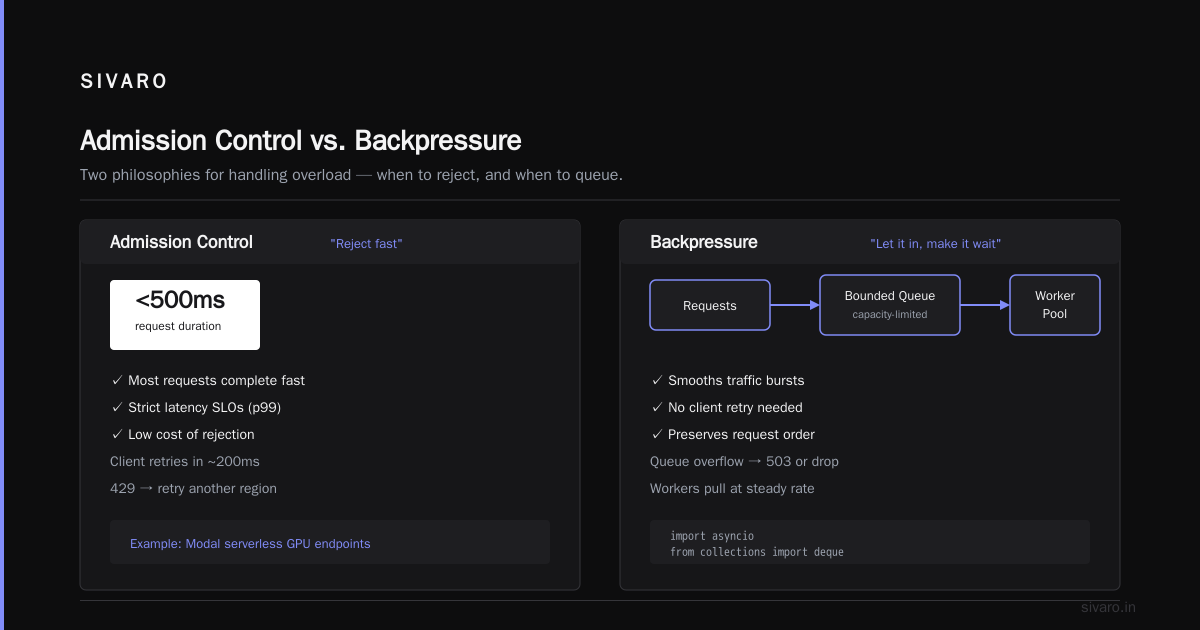
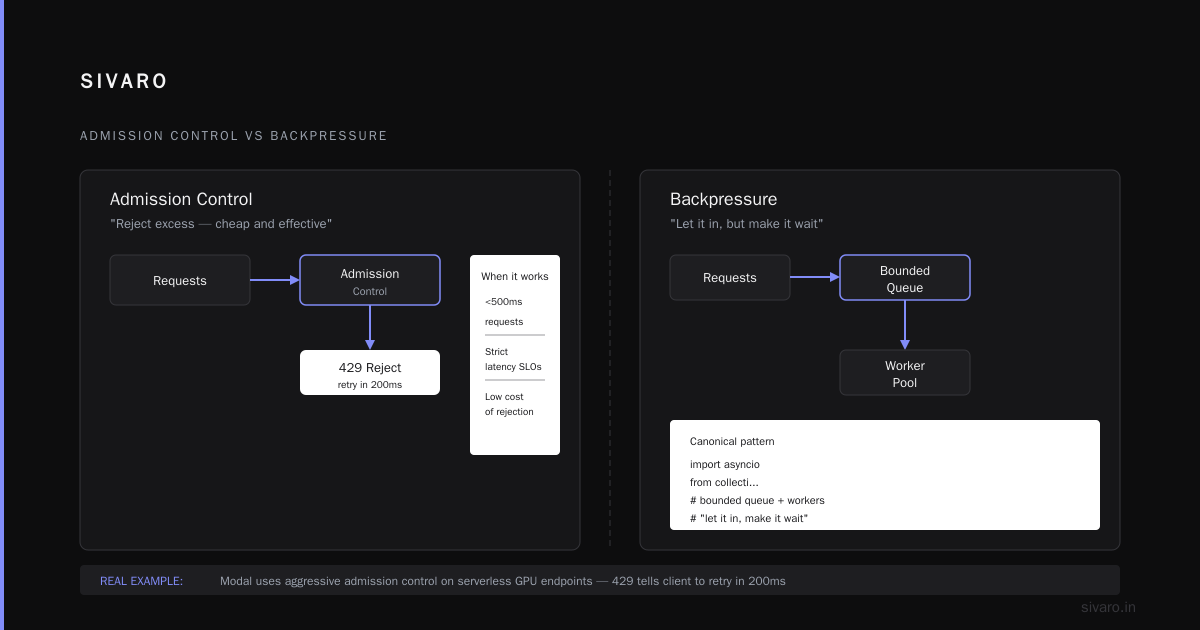
Admission control is the bouncer at the club. It decides whether a request gets in at all, based on current system state. If the GPU is saturated, new requests get rejected—politely, with a proper status code—before they consume a single millisecond of compute.
Backpressure is the traffic jam. It lets requests in but slows down the pipeline when downstream components can't keep up. Think TCP flow control, bounded queues, and retry-with-backoff logic.
The confusion happens because both mechanisms protect the same resource: GPU compute. But they operate at different layers, with different costs and different failure signatures.
Here's the mental model I use with every client:
- Admission control protects latency for the requests you accept
- Backpressure protects throughput by smoothing out bursts
You need both. The question is how much of each, and where to put them. That's a systems design decision, not a checkbox.
Why "Just Add More GPUs" Fails (Or: The Autoscaling Trap)
Before we dive into admission control vs autoscaling for GPU clusters, let me kill the most common misconception.
Most people think Kubernetes autoscaling solves this. Add a HorizontalPodAutoscaler, set target GPU utilization to 70%, and you're done.
That's wrong for three reasons:
-
GPU nodes take 3-10 minutes to provision. Not even Spot instances spin up faster than that. Your burst window is measured in seconds.
-
Kubernetes doesn't natively understand GPU memory fragmentation. Two Pods might each fit on a 24GB card, but a single request needing 20GB can't squeeze in. Autoscaling based on node count doesn't see this.
-
Scaling down is destructive. When demand drops, the HPA kills Pods. Any in-flight requests on those Pods die. For long-running inference like LLM generation, that's catastrophic.
Don't get me wrong—autoscaling has a role. Kubernetes Event-driven Autoscaling with GPU metrics helps you right-size your baseline. But it's the slow control loop. You need a fast control loop that operates in milliseconds, not minutes.
That fast loop is either admission control or backpressure. Let's talk about how they actually behave in production.
Admission Control in Practice: Rejecting Early, Rejecting Clearly
At its core, admission control answers one question: "Should I even try to serve this?"
The simplest version is a counter. Track in-flight requests, compare against a threshold, reject if you're over.
python
# Python pseudocode for a simple token-bucket admission controller
class GPUSemaphore:
    def __init__(self, max_concurrency):
        self.semaphore = asyncio.Semaphore(max_concurrency)

    async def acquire(self):
        if self.semaphore.locked():
            raise HTTPException(status_code=429,
                                detail="Server at capacity")
        async with self.semaphore:
            return await self.process_request()
But that's too crude for GPU serving. Here's why: GPUs have two bottlenecks—compute (FLOPs) and memory (VRAM). A token bucket on request count doesn't distinguish between a 128-token completion and a 2048-token completion.
Better admission control accounts for estimated resource consumption.
I've seen teams at companies like Together AI and Fireworks build sophisticated estimators that predict runtime from prompt length and model architecture. We built something similar at SIVARO for a fintech client running fraud detection models.
The principle: estimate cost before you commit GPU resources.
yaml
# Kubernetes ValidatingAdmissionPolicy example for GPU Pods
apiVersion: admissionregistration.k8s.io/v1
kind: ValidatingAdmissionPolicy
metadata:
  name: "gpu-concurrency-limit"
spec:
  matchConstraints:
    resourceRules:
    - apiGroups: [""]
      apiResources: ["pods"]
      operations: ["CREATE"]
  validations:
  - expression: "object.spec.containers.all(c, c.resources.limits['nvidia.com/gpu'] <= 1)"
    message: "Each container may request at most 1 GPU"
  - expression: "object.spec.containers.sum(c, c.resources.limits['nvidia.com/gpu']) <= 8"
    message: "Total GPUs per namespace limited to 8"
Notice I mentioned Kubernetes admission control inference GPU Kubernetes patterns. That's the infrastructure layer—deciding which Pods get GPU access in the first place. The runtime layer—deciding which requests get served—is where most of your latency protection happens.
When Admission Control Wins
Admission control shines when:
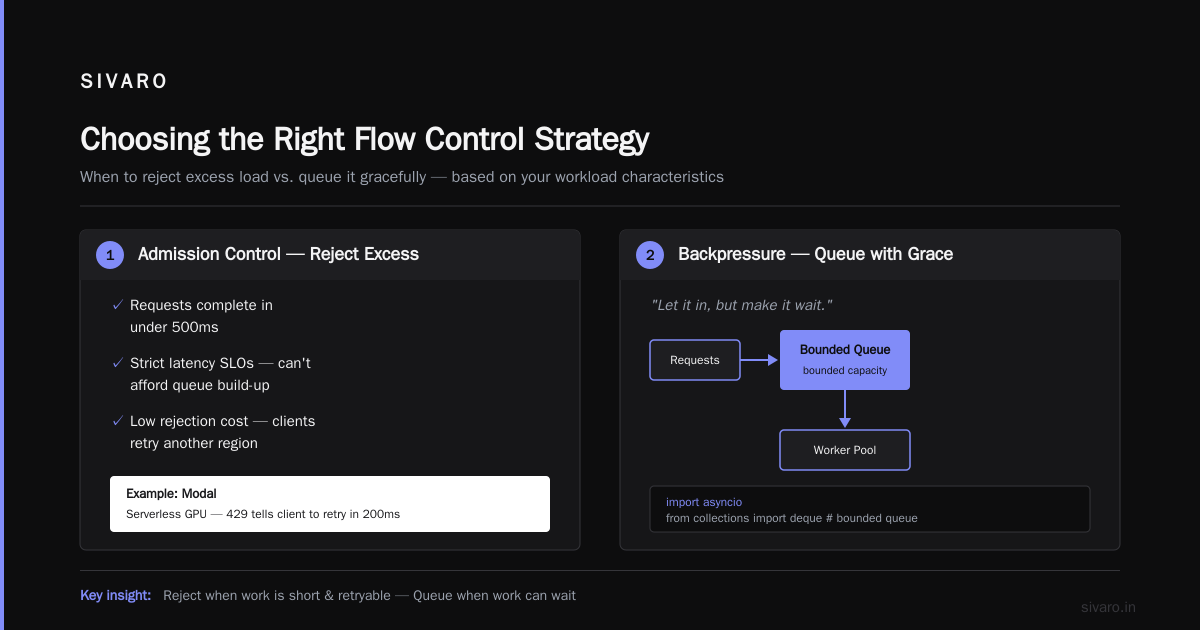
- Requests are short and homogeneous. If most requests complete in under 500ms, rejecting excess is cheap and effective.
- You have strict latency SLOs. A 99th-percentile latency guarantee means you can't afford a queue build-up.
- The cost of rejection is low. Clients can retry against another region, or the request isn't critical.
I'll give you a real example. Modal uses aggressive admission control for their serverless GPU endpoints. Because functions are short-lived, a 429 tells the client to retry in 200ms—which usually works because the burst has subsided.
Backpressure in Practice: Queuing with Grace
Backpressure is the opposite philosophy: "Let it in, but make it wait."
The canonical pattern is a bounded queue with a worker pool.
python
import asyncio
from collections import deque

class BoundedPriorityQueue:
    def __init__(self, max_size=100):
        self.queue = deque()
        self.max_size = max_size
        self.workers = [
            asyncio.create_task(self.worker(i))
            for i in range(4)  # 4 concurrent GPU workers
        ]

    async def submit(self, request, priority=0):
        if len(self.queue) >= self.max_size:
            # Apply backpressure: reject or block
            raise RuntimeError("Queue full - backpressure applied")
        self.queue.append((priority, request))

    async def worker(self, id):
        while True:
            if self.queue:
                _, request = self.queue.popleft()
                await self.process_on_gpu(request)
            else:
                await asyncio.sleep(0.01)
Why bother? Because GPU requests aren't like HTTP requests. If you're running a multi-turn chatbot, rejecting a request means the user's entire conversation is lost. Backpressure lets you buffer those requests until a GPU frees up.
The catch: unbounded queues are how you get the thundering herd of timeouts — a queue that grows faster than it drains, so every request waits longer than the client's patience.
The Hybrid: Producer-Consumer with Dynamic Window
What actually works in production is a sliding window that adjusts based on observed latency. This is essentially a closed-loop control system.
Target: p99 latency = 800ms
Measure: current p99 latency every 5 seconds
If p99 > 800ms: reduce max_in_flight by 10%
If p99 < 400ms: increase max_in_flight by 5%
This is admission control that learns. It's not static. It adapts to traffic patterns.
I first saw this pattern in Google's BDP (Bandwidth Delay Product) flow control — TCP itself is a giant admission control + backpressure system. The AI serving world rediscovered this in 2024-2025 as continuous batching made GPU utilization more dynamic.
Admission Control vs Autoscaling for GPU Clusters: Where Each Fits
Let me settle this specifically for GPU clusters.
Admission control operates at the request and Pod level. It makes decisions in microseconds. It prevents overloading the GPUs you already have.
Autoscaling operates at the node and cluster level. It makes decisions in minutes. It ensures you have enough GPUs for the predicted demand.
These are complementary, not competing. Here's the architectural pattern I recommend:
- Autoscaling handles the baseline. Scale up when sustained utilization exceeds 60% for 5+ minutes.
- Admission control handles the spikes. Reject or queue requests when instantaneous utilization exceeds 90%.
- Backpressure handles the burst buffer. A small queue (10-20 requests) smooths out sub-second jitter.
We built exactly this at SIVARO for a media company running real-time video analysis. Their traffic had diurnal patterns plus unpredictable news-driven spikes. Autoscaling handled the diurnal pattern; admission control handled the spikes; and without backpressure, we'd have lost 15% of requests during flash surges.
The Failure Modes Nobody Tells You About
Let me tell you what actually breaks when you deploy these systems.
Failure 1: Admission Control Rejecting Healthy Requests
Your admission controller uses GPU utilization as the signal. GPU sits at 95%. You reject all new requests.
But you're rejecting short requests that would have completed in 50ms. The GPU is 95% utilized because one long-running generation is chewing through compute.
The fix: track request-level concurrency, not just GPU utilization. Set a limit based on (max_concurrent_requests * expected_duration) / expected_throughput. We call this the "Little's Law guard" after the queueing theory formula.
Failure 2: Backpressure Causing Cascading Timeouts
Your queue is depth-limited, which is good. But your clients have timeouts that are shorter than your queue wait time. So requests sit in the queue, the client times out and retries, and the retry lands behind the original request in the queue.
Result: the GPU burns cycles on requests nobody is waiting for, while new requests pile up behind them.
The fix: enforce a maximum queue time. If a request has waited longer than client_timeout * 0.7, drop it and return 503 immediately.
python
class TimedQueueEntry:
    def __init__(self, request, enqueue_time):
        self.request = request
        self.enqueue_time = enqueue_time

    def is_expired(self, max_wait_ms=500):
        return (time.time() - self.enqueue_time) * 1000 > max_wait_ms
Failure 3: Ignoring GPU Memory Fragmentation
This one got us at SIVARO in mid-2025. We were running a vLLM-based deployment for a code generation service. GPU utilization looked fine—65%. Memory utilization looked fine—70%. But requests were failing with OOM errors.
Turns out, vLLM's paged attention has a sweet spot for GPU memory allocation. If you set gpu_memory_utilization too low, you get excessive swapping. If you set it too high, you risk OOM spikes under load.
Admission control based on memory headroom saved us. We set a floor of 4GB free VRAM per GPU, and rejected requests that estimated needing more than that.
How to Choose: A Decision Framework
Here's the practical guide. Answer these questions honestly:
Choose admission control first if:
- Your requests are idempotent or safely retryable
- You have strict p99 latency goals (under 500ms)
- Your clients are capable of handling 429s (microservices, not end-users)
- GPU memory isn't the bottleneck—compute is
Choose backpressure first if:
- Your requests are stateful or user-facing (multi-turn chat)
- Requests have varying durations (some 20ms, some 20 seconds)
- Client timeouts are generous (2+ seconds)
- You can't afford to drop any request—even slow ones
Choose both (the right answer for most) if:
- You have heterogeneous workloads
- Your traffic has bursty patterns
- You're serving at scale (100+ RPS sustained)
What the Major Frameworks Actually Do
Let me give you a quick rundown of what you'll get out of the box, as of September 2026.
vLLM has built-in request admission control via max_num_seqs — it will queue requests beyond that limit. But the queue is bounded by max_num_batched_tokens. You can also set --max-parallel-loading-workers. No native backpressure mechanism beyond the standard queue.
NVIDIA Triton is the most configurable. It has explicit --max-queue-delay and rate limiters via its model configuration. The dynamic batching feature is a form of backpressure—it holds requests to form larger batches.
KServe on Kubernetes gives you queue-based autoscaling via KEDA, but the actual admission control happens at the HTTP layer. Use Knative's concurrency limits — set containerConcurrency to your GPU's safe concurrency level.
Ray Serve has built-in request queuing and backpressure. Set max_queued_requests per replica. I've found its behavior predictable as long as you tune max_concurrency carefully.
My recommendation: start with Triton if you need fine-grained control. Start with vLLM if you're serving LLMs and want built-in continuous batching.
The Numbers You Should Actually Track
I'm going to give you five metrics. If you track nothing else, track these:
- GPU utilization — but the distribution, not the average. P95 above 90% means you're saturating.
- Queue depth — if it stays above zero for more than 2 seconds, your admission threshold is too loose.
- Rejection rate — target under 1% for admission control. Above 5%, your capacity planning is broken.
- p99 vs p50 latency gap — if p99 is 5x p50, you have a queueing problem. Backpressure is misconfigured.
- Inference cost per request — dollar per 1K tokens or per prediction. This is your CPQ (cost per quality), and it lands in a report nobody else sees until they're telling your CFO that GPU spend is off the rails.
FAQ
Is admission control just rate limiting with a fancy name?
No. Rate limiting is typically static—X requests per second. Admission control is stateful—it looks at current system utilization, remaining queue capacity, and model characteristics before deciding. A good admission controller makes different decisions at the same request rate depending on GPU state.
Should I put admission control at the API gateway or the inference server?
Both, for different reasons. At the gateway, you protect the entire pipeline (including pre/post-processing). At the inference server, you protect the GPU itself. We typically set gateway limits 20-30% above server limits, so the server becomes the real bottleneck decision-maker.
How do I avoid thundering herd when many clients retry after getting rejected?
Use exponential backoff with jitter. Standard retry: start at 100ms, double each time, cap at 5 seconds. Add ±20% random jitter so retries don't synchronize. Kubernetes clients can use the client-go rate limiter as a model.
Can admission control help with multi-tenant GPU isolation?
Yes, and that's become a hot topic. Companies like Baseten and Replicate use per-tenant admission controls to prevent noisy neighbors. Set a per-tenant concurrency limit that's a fraction of the GPU's total capacity. This is the Kubernetes admission control inference GPU Kubernetes pattern taken to the tenant level—you're doing admission checks on requests, not just Pods.
What about backpressure for GPU memory, not just compute?
vLLM's KV cache management is a form of memory backpressure—it evicts least-recently-used KV blocks when memory runs low. PagedAttention explicitly treats KV cache like virtual memory. For non-LLM workloads, you'll want to watch memory bandwidth—that's often the real bottleneck on modern GPUs like H100s.
When should I reject instead of queue?
Rule of thumb I use: if the queue time would exceed half the client's timeout, reject. Otherwise queue. A 200ms queue for a 2-second request is fine. A 2-second queue for a 500ms request is a false economy—you're just delaying the inevitable timeout.
Does continuous batching change how I approach this?
Yes, significantly. With continuous batching (what vLLM and TensorRT-LLM do), requests are not processed in discrete batches—they fill freed slots as generation completes tokens. This means queue time is less predictable. Admission control based on available sequence slots is more accurate than a simple request count. Track num_seqs on vLLM and set admission thresholds accordingly.
What We Actually Deploy at SIVARO
Here's our current reference architecture for a typical LLM serving workload:
Client → API Gateway (rate limit: 2x peak demand)
       → Admission Controller (token-based, based on GPU seq slots)
       → Bounded Queue (max depth: 50, max wait: 300ms)
       → GPU Serving (vLLM or Triton)
We use Redis for shared admission control across replicas. Each replica reports its current seq slot availability every 100ms. The controller's decision logic is:
if available_slots > request_estimate:
    pass through
elif queue_depth < 50:
    queue with estimated wait time
else:
    reject with 429
The key is the estimate comes from the model's token distribution — prompt length is a poor predictor of completion length for chat. We use a 3-gram model of the last 50 tokens to predict remaining tokens. It's not perfect, but it's better than assuming a fixed completion length.
The Hard Truth About Buying Decisions
Here's my contrarian take: if you're asking whether to buy admission control or backpressure tooling, you're asking the wrong question. You already have both in your serving stack. What you need is someone to configure them correctly for your workload.
The vendor landscape is confusing. You've got Portkey, LiteLLM, Helicone, and a dozen others offering "intelligent routing" that's really just rate limiting with dashboards. The big three cloud providers all have their own serving stacks with conflicting terminology.
The only "buy" decision that matters: managed serving (like Together AI or Fireworks) versus self-hosted with your own control plane.
Managed serving costs 2-3x per token but gives you 100 engineers of operational experience bundled in. Self-hosted costs less but demands you actually understand admission control vs backpressure in GPU serving, because no one else will fix it when things break at 2 AM.
Given that we're in September 2026, with GPU prices where they are and inference becoming a commodity utility, I lean self-hosted for anything above 100K tokens/day. Below that, just pay for managed and spend your engineering time on features, not infrastructure.
If you do self-host, budget at least 2 dedicated engineering weeks for proper admission control and backpressure tuning. Anything less and you'll ship something that works until the first real traffic spike, then dies with a pager storm.
The Sequence That Actually Matters
Let me say this one more time because it's the insight that took me three production meltdowns to learn:
Apply backpressure downstream and admission control upstream.
The GPU server should apply backpressure—it's the slowest component, and it should tell the rest of the system how much it can handle. Admission control belongs at the edge, near the client, where you can reject early and cheaply.
A GPU server using admission control by rejecting requests directly is a design smell. If the GPU is saturated, you want it focused on the work it has, not making HTTP-level decisions about which requests to accept.
This is why the Kubernetes native admission controllers (ValidatingAdmissionPolicy, etc.) matter so much. They let you enforce GPU allocation policies before a Pod ever schedules. That's the far-upstream admission control for admission control.
Conclusion
Stop treating admission control and backpressure as competitors. They're the two hands of a control system: one catches what's coming in, the other holds what's already inside.
I've watched too many teams fall into the trap of implementing one and declaring victory. It doesn't work. You need both, tuned to each other, and measured against your latency and throughput goals.
And if you're getting ready to build this for the first time, don't over-engineer it. Start with a simple concurrency counter. Then add a bounded queue. Then add the dynamic feedback loop. Then, and only then, worry about the Kubernetes admission controller policies.
Yes, admission control vs autoscaling for GPU clusters will keep getting attention — the KubeCon talks will keep coming, the blog posts will keep being written. But the fundamentals haven't changed since I first built queueing systems in 2018:
Know your limits. Respect them. And let the system tell you when you're at the edge.
Nishaant Dixit — Founder of SIVARO. Building data infrastructure and production AI systems since 2018. Built systems processing 200K events/sec.