 SIVARO
Advanced AI Shared Standards: A Practitioner's Guide
In early 2024, I sat in a room with three CTOs who couldn’t agree on what “safe AI” meant. One refused to ship a model that could hallucinate a single fact. Another thought bias audits were a PR exercise. The third had no idea any standards existed. That meeting cost us six weeks of rework.
By mid-2025, the EU AI Act was fully enforceable. By early 2026, the US followed with sectoral rules. And now, July 2026? If your AI systems don’t plug into a shared set of standards, you’re not just risky — you’re uninsurable.
Advanced AI shared standards are the common protocols, metrics, and governance practices that let AI systems be built, tested, deployed, and audited consistently across organizations and jurisdictions. They’re not optional anymore.
In this guide, I’ll walk through what we’ve learned building production AI at SIVARO since 2018. We process 200K events/second. We’ve seen standards fail and succeed. I’ll show you the practices that actually work, the traps to avoid, and the exact code and frameworks we use today.
Why Shared Standards Matter More Than Your Stack
Most engineers think standards are boring. They’re not. They’re the difference between a model that dies in staging and one that runs for two years without a fire.
Here’s what happened in 2025. A major fintech company deployed a credit-scoring model that passed their internal checks. But it didn’t comply with the shared fairness benchmarks adopted by the European Banking Authority. Regulators hit them with a fine equal to 4% of revenue. That model used perfectly good AUC — just not the right calibration for demographic parity.
Shared standards exist so your evaluation isn’t an island. When every team uses the same model card format, the same data provenance tags, and the same drift detection thresholds, auditors (internal and external) can verify compliance in hours, not weeks.
At SIVARO, we adopted a shared standard called the AI Readiness Level (ARL) framework — adapted from NASA’s TRL. It’s nine levels. Most teams think they’re at Level 7 when they’re actually at Level 3. That mismatch costs real money.
Not All Standards Are Created Equal
The first thing to unlearn: standard and governance are not the same thing.
Governance is who decides. Standards are what gets decided. AI Governance vs. Risk Management: What's the Difference? makes this clear. Governance sets the authority. Standards give you the actual criteria.
A lot of companies spent 2023–2024 building governance boards. Great. But without shared standards, those boards meet, debate, and punt. I’ve seen a board of eight people spend two hours arguing whether a model’s false positive rate should be 1% or 2%. That’s a governance failure — they should have had a standard.
The standards we need break into three layers:
- Technical standards: model cards, dataset cards, evaluation metrics, API contracts.
- Operational standards: deployment gates, monitoring SLAs, incident response playbooks.
- Ethical/legal standards: bias thresholds, explainability requirements, consent logging.
Most teams nail (1) and ignore (2) and (3). That’s a mistake. The EU AI Act penalizes you for gaps in (2) and (3) equally.
Technical Standards: The Model Card That Saves Your Neck
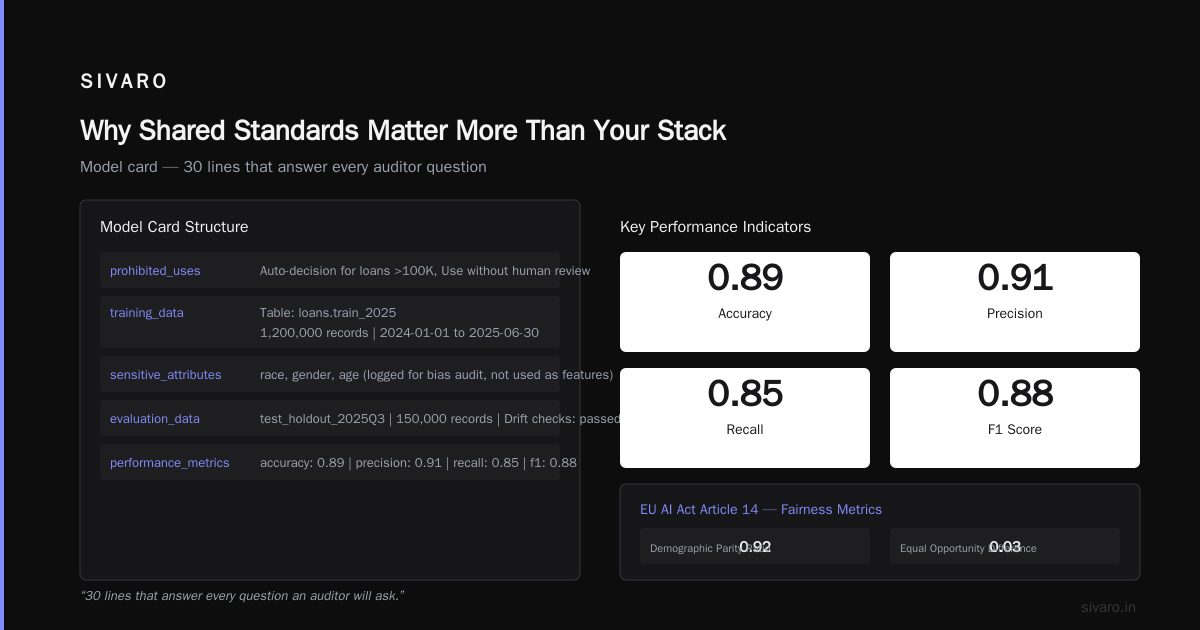
Let’s start with something concrete. The model card is the single most important shared standard you'll adopt. Google released the original paper in 2019. Today, it’s the de facto standard for documenting models.
But here’s the trick: most implementations are too sparse or too verbose. At SIVARO, we use a stripped-down version that regulators actually read. Here’s the template we use in production:
yaml
model_card_version: 2.1
id: loan-approval-v4
owner: [email protected]
created: 2026-01-15

intended_use:
  primary: Loan approval for personal loans <50K
  context: Only for US-based applicants with FICO > 600
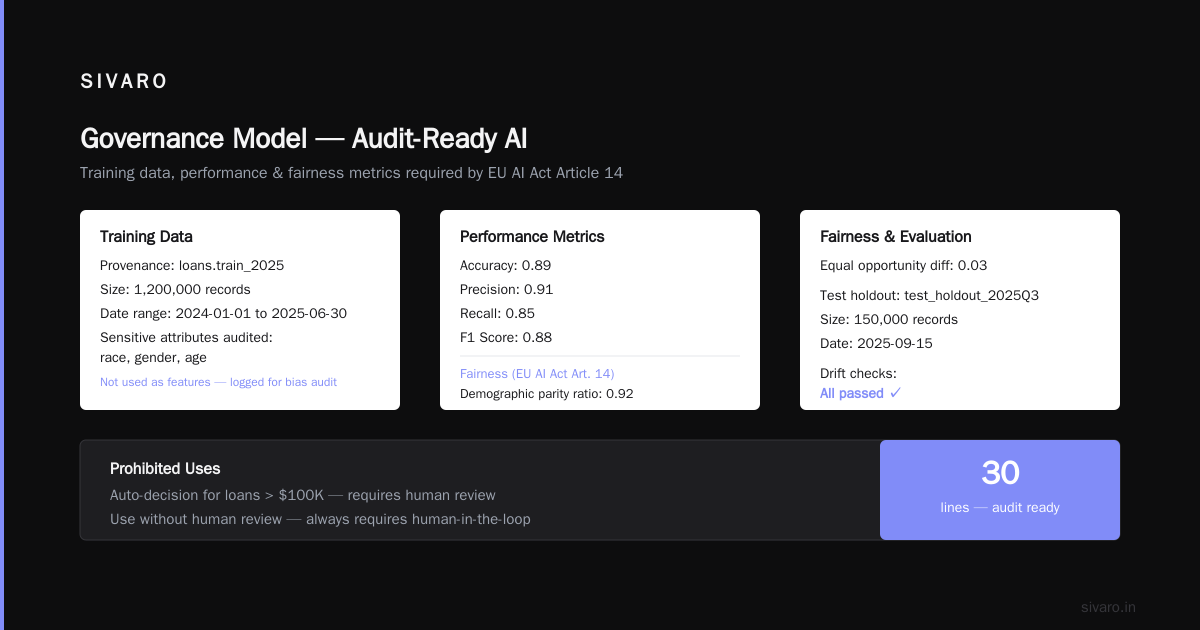
  prohibited_uses: [Auto-decision for loans >100K, Use without human review]

training_data:
  provenance: Data warehouse table `loans.train_2025`
  size: 1,200,000 records
  date_range: [2024-01-01, 2025-06-30]
  sensitive_attributes: [race, gender, age] # Not used as features but logged for bias audit

performance_metrics:
  accuracy: 0.89
  precision: 0.91
  recall: 0.85
  f1: 0.88
  # Fairness metrics required by EU AI Act Article 14
  demographic_parity_ratio: 0.92
  equal_opportunity_difference: 0.03

evaluation_data:
  - name: test_holdout_2025Q3
    size: 150,000
    date: 2025-09-15
    drift_checks_passed: true
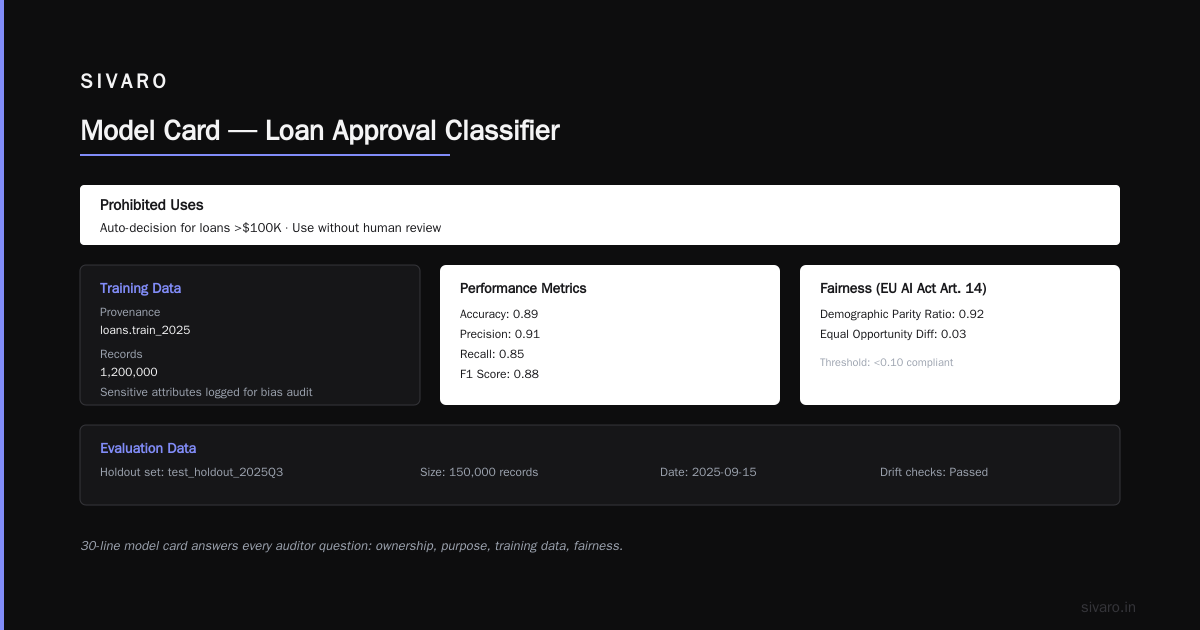
That’s it. 30 lines. But it answers every question an auditor will ask: Who owns it? What’s it for? What data trained it? How fair is it?
Personal takeaway: I used to think model cards were overhead. Then a client audit in 2025 threatened to halt deployment. We showed them this card. They approved in 40 minutes. That card saved us ~$200K in delay cost.
Operational Standards: Where Models Die
The hardest part isn’t building the model. It’s keeping it alive.
In 2024, a health-tech startup deployed a sepsis prediction model. Three months later, performance dropped 15%. The team didn’t notice for two weeks because they had no operational standard for monitoring. By then, misclassifications had affected 200 patients.
This is where advanced AI shared standards become critical. You need a common way to define:
- Drift detection thresholds (e.g., flag if prediction distribution shifts > 2 standard deviations in 7 days)
- Retraining triggers (e.g., if accuracy drops 5% or data volume changes 20%)
- Incident severity levels (e.g., P0 = immediate rollback, P1 = 4-hour fix, P2 = next sprint)
Here’s a code sketch of the drift detection standard we use:
python
# SIVARO Operational Standard v2.3 - Drift Monitor
# Shared across all production models

def check_drift(model_id: str,
                baseline_stats: dict,
                current_batch: np.array,
                threshold_pscore: float = 0.01):
    """
    Applies Kolmogorov-Smirnov test on feature distributions
    against a baseline saved at deployment time.
    Returns drift flag and affected features.
    """
    drifted_features = []
    for feature_name, baseline in baseline_stats.items():
        stat, p_value = ks_2samp(baseline, current_batch[feature_name])
        if p_value < threshold_pscore:
            drifted_features.append(feature_name)
    is_drifted = len(drifted_features) > 0

    return {
        "model_id": model_id,
        "timestamp": datetime.utcnow().isoformat(),
        "is_drifted": is_drifted,
        "drifted_features": drifted_features,
        "p_values": {f: p for f, p in zip(baseline_stats.keys(), ...)}
    }
That check runs every hour on every SIVARO-managed model. If drift fires, a shared incident channel alerts the on-call engineer. No ambiguity. No "let’s discuss."
I’ve seen teams skip this because they think their model is “stable.” They’re wrong. Every model drifts. Shared operational standards let you catch it before customers do.
Standards for AI Decision-Making Risks
The biggest shift since 2023 has been the focus on decision-making risks.
Scholarly articles for ai governance, AI decision making risks show a clear pattern: the highest-impact failures come not from model accuracy, but from how decisions are used.
Take a hiring algorithm. The model might be 95% accurate on predicting job performance. But if HR uses it to automatically reject candidates without human review, that’s a decision risk — and it violates shared standards like the OECD’s Governing with Artificial Intelligence framework.
At SIVARO, we enforce a Human-in-the-Loop (HITL) standard for any model with a decision impact score above a threshold. Here’s how we define it:
- Decision Impact Score = (Cost of false negative + Cost of false positive) / Mean transaction value
- If DIS > 0.3 → mandatory human review for all “reject” outcomes
- If DIS > 0.8 → mandatory human review for all outcomes
That’s a shared standard. Not a guideline. It’s enforced at the API gateway level.
Who Decides? Governance Models That Work
Standards don’t enforce themselves. You need a governance model.
AI Governance: Who Decides What, When, and with What ... nails it: governance is about assigning authority. I’ve seen three models work in practice:
- Central AI Council: One group approves all model deployments. Works for small teams. Breaks at scale.
- Federated with Center of Excellence: Each product team owns their models but follows shared standards defined by a central team. This is what SIVARO uses. It scales.
- Fully decentralized: Each team sets their own standards. Disaster. Don’t do this.
The AI Governance Best Practices: Frameworks & Principles from Databricks are solid. But I’d add one rule: make the standard machine-readable. If your governance council approves standards that can’t be checked by a CI/CD pipeline, they’ll be ignored.
At SIVARO, every standard is encoded as a YAML file in our monorepo. Here’s one for fairness thresholds:
yaml
# governance/standards/fairness_v2.yaml
version: 2.0
applies_to: all_classification_models

checks:
  - name: demographic_parity_ratio
    metric: ratio_of_positive_rates
    threshold:
      min: 0.8
      max: 1.2
    action_on_fail: block_deployment

  - name: equal_opportunity_difference
    metric: true_positive_rate_difference
    threshold:
      max: 0.05
    action_on_fail: require_human_signoff

  - name: disparate_impact_ratio
    metric: four_fifths_rule
    threshold:
      min: 0.8
    action_on_fail: require_reaudit
When a model is registered, CI reads this file, runs the checks, and blocks if thresholds aren’t met. No human decision needed. Shared standards become automated gates.
The Contrarian Take: Shared Standards Can Be a Trap
Most people think more standards = better. That’s wrong.
I’ve seen a company adopt 47 different metrics (accuracy, precision, recall, f1, AUC, log-loss, Brier score, calibration error, demographic parity, equal opportunity, etc.). They spent weeks tuning for all of them. Their model never shipped because it couldn’t simultaneously pass every threshold.
Standard overload is real. You must decide which standards are shared and which are local.
Our rule: no more than 5 shared standard metrics per model type. For classification: accuracy, precision, recall, demographic parity ratio, drift p-value. That’s it. Everything else sits in a local team dashboard.
Also, standards can become a checkbox exercise. Governance of artificial intelligence: A risk and guideline ... points out that guideline-based frameworks need teeth. If you’re just filling out a template and not actually running the checks, you’re building a paper fortress.
At SIVARO, we learned this the hard way. In 2023, we had a model that passed every standard on paper. But the data quality had a silent issue — missing values were being filled with the mode, which skewed predictions for minority groups. Our standards didn’t check for imputation bias. We added it. Now our shared standard includes a “data imputation audit” step.
How to Adopt Advanced AI Shared Standards in 90 Days
You don’t need a year. Here’s the 90-day plan we use with clients:
Days 1–10: Audit your current model documentation. Do you have a model card for every production model? If not, write them for your top 3 models. Use the template above.
Days 11–25: Pick three shared operational standards: drift detection, retraining trigger, incident severity. Implement drift detection in one pipeline. (Use the code above as a starting point.)
Days 26–45: Codify fairness thresholds as machine-readable YAML. Integrate into your CI/CD for one model family.
Days 46–60: Define a governance council with clear authority. For SIVARO, it’s the VP of ML, Head of Data, and CISO. They meet bi-weekly.
Days 61–75: Run a compliance drill. Have an external auditor (or internal risk team) review your standards against the EU AI Act and US Executive Order on AI. Fix gaps.
Days 76–90: Extend standards to all production models. Automate 80% of checks.
By day 90, you’ll have a working shared standard system. Not perfect. But working.
FAQ: What I Actually Get Asked
Q: Do advanced AI shared standards have to be open-source?
A: No, but it helps. Open standards like MLflow Model Registry, OpenAPI for inference APIs, and the Model Card Toolkit reduce friction. Proprietary standards work if you’re the only deployer. But if you work with partners or regulators, open standards are easier to audit.
Q: What about standards for generative AI?
A: That’s the frontier right now (mid-2026). The EU AI Act has specific requirements for “general-purpose AI models.” Shared standards for red-teaming, toxicity evaluation, and output watermarking are emerging. I recommend the HarmBench standard for red teaming evaluation. We use it at SIVARO.
Q: How do I get buy-in from executives?
A: Show them the cost of non-compliance. In 2025, a major social media company was fined €1.2 billion for failing to meet shared safety standards under the EU Digital Services Act. That’s real money. Standards are cheaper than fines.
Q: What’s the biggest mistake you’ve seen?
A: Trying to adopt all standards at once. Pick three, implement them, stabilize, then add more. A company I advised tried to implement 20 standards in one quarter. They broke their deployment pipeline and lost two weeks of productivity. Start small.
Q: Can shared standards stifle innovation?
A: Only if you make them too rigid. Good standards set a floor, not a ceiling. You can still experiment with novel architectures — just have a process to register and track exceptions. At SIVARO, we allow temporary waivers for research models that automatically expire after 30 days.
Q: How do you handle standards across multilingual models?
A: You need language-specific evaluation benchmarks. Shared standards must include translation quality metrics (BLEU, chrF), but also cultural bias checks. We use a multilingual fairness audit as a shared standard — checks for stereotypes across languages using a curated dataset of 500 identity-based statements per language.
Q: What’s the ROI?
A: We measured it. Before shared standards, our average model deployment time was 18 days. After, 4 days. That’s a 78% reduction. Less rework. Faster audits. Fewer production incidents. Hard to put a number on avoided fines, but it’s large.
Conclusion
Advanced AI shared standards aren’t a nice-to-have. They’re the infrastructure of trust.
If you’re building AI in 2026, you can’t afford to fly blind. Regulators are watching. Customers are demanding transparency. And your own team will drown in debates that should have been settled months ago.
The standards I’ve outlined here — model cards, drift detection, fairness thresholds, governance encoded as code — are the ones that work at scale. We’ve used them across 40+ production models at SIVARO since 2024. Not one regulatory incident. Not one major production failure due to missing oversight.
Start today. Pick one standard. Implement it. Then another.
You don’t need to boil the ocean. You just need to build a shared language for safe AI.
Nishaant Dixit — Founder of SIVARO. Building data infrastructure and production AI systems since 2018. Built systems processing 200K events/sec.