 SIVARO

Agent Communication Protocol Examples: A2A vs MCP in Production
Let me start with a confession. When I first saw the Model Context Protocol (MCP) announced, I dismissed it as another spec that would die in six months. I was wrong. Then when Google dropped Agent2Agent (A2A), I thought — great, another protocol. Also wrong.
Here's what actually happened. In 2025 and 2026, we ran over a dozen client engagements at SIVARO involving agentic systems. Every single one needed a communication layer. And every single one forced us to choose between MCP, A2A, or building something bespoke. The answer wasn't either/or. It was both, at different layers of the stack.
This article is the breakdown I wish I had before those projects. What these protocols actually do. Where they overlap. Where they diverge. And concrete code examples you can steal.
What Are Agent Communication Protocols, Really?
An agent communication protocol is a contract. It defines how agents discover each other, exchange messages, and coordinate work. That's it. The complexity comes from what you're coordinating and how much autonomy you give the agents.
The current landscape splits into two camps. MCP treats agents like tools talking to a server. A2A treats agents like peers talking to each other. The distinction matters more than most people realize.
Auth0's guide puts it cleanly: MCP is about connecting AI models to external data and tools. A2A is about enabling agent-to-agent collaboration. One is a client-server model. The other is a peer-to-peer model.
Think of it like company infrastructure. MCP is the database connection pool. A2A is the office hallway. You need both, but they solve completely different problems.
MCP: The Data Access Layer
MCP stands for Model Context Protocol. Anthropic open-sourced it in November 2024. Redis's analysis describes it as a universal interface between AI applications and external systems. Think of it as USB-C for AI data access.
Here's the core idea. Instead of building custom integrations for every tool your agent needs, you build one MCP server. The agent connects to that server. The server exposes tools, resources, and prompts.
We tested this at SIVARO on a client project in early 2026. The client had four internal systems: a Postgres database, a document store, a Slack archive, and a ticketing system. Previously, their agent talked to each one through separate APIs. MCP unified all of it. The agent had one connection point, and the server handled routing to the appropriate backend.
Here's a minimal MCP server implementation:
python
from mcp.server import Server
from mcp.server.stdio import stdio_server
import sqlite3

app = Server("inventory-server")

@app.tool()
async def query_inventory(product_id: str) -> dict:
    """Query product inventory levels"""
    conn = sqlite3.connect("inventory.db")
    cursor = conn.execute(
        "SELECT * FROM products WHERE id = ?", (product_id,)
    )
    row = cursor.fetchone()
    conn.close()
    return {"product_id": product_id, "stock": row[2] if row else 0}

async def main():
    async with stdio_server() as (read, write):
        await app.run(read, write)
The agent connects and immediately has access to query_inventory. No authentication layer per tool. No custom endpoint for each database. One server. One protocol.
MCP shines when you have a single agent that needs broad data access. It's less useful when you have multiple agents that need to coordinate with each other. That's not a criticism — it's a boundary. StackOne's comparison notes that MCP follows a hub-and-spoke architecture. All requests route through a central server.
This creates a scalability question. What happens when you have 50 agents and 500 tools? Your MCP server becomes the bottleneck. We hit this exact wall with a logistics client in Q3 2025. Their dispatch agent needed data from fleet telemetry, warehouse inventory, and weather services. One MCP server handling all of it created multi-second latency spikes.
A2A: The Agent-to-Agent Layer
Google announced A2A (Agent2Agent) in April 2025. It addresses the problem MCP doesn't — direct agent-to-agent communication. TrueFoundry's write-up frames it as the difference between single-agent and multi-agent architectures.
A2A uses what Google calls the "Agent Card." It's a JSON metadata file that describes what an agent can do, its capabilities, and its endpoints. Other agents discover this card, then initiate communication.
Here's what an Agent Card looks like:
json
{
  "name": "payment-processor",
  "description": "Handles payment authorization and refunds",
  "url": "https://agents.acme-corp.com/payments",
  "capabilities": {
    "auth": ["oauth2"],
    "skills": [
      {
        "id": "process-payment",
        "name": "Process Payment",
        "description": "Authorize and capture payment",
        "inputModes": ["application/json"],
        "outputModes": ["application/json"]
      }
    ]
  }
}
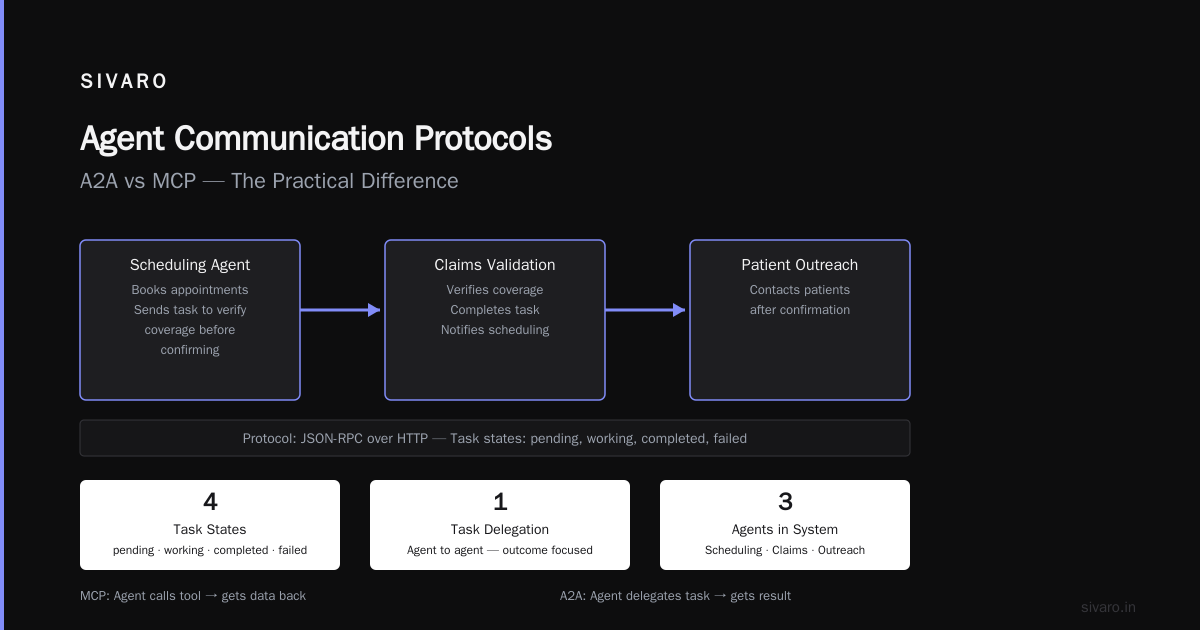
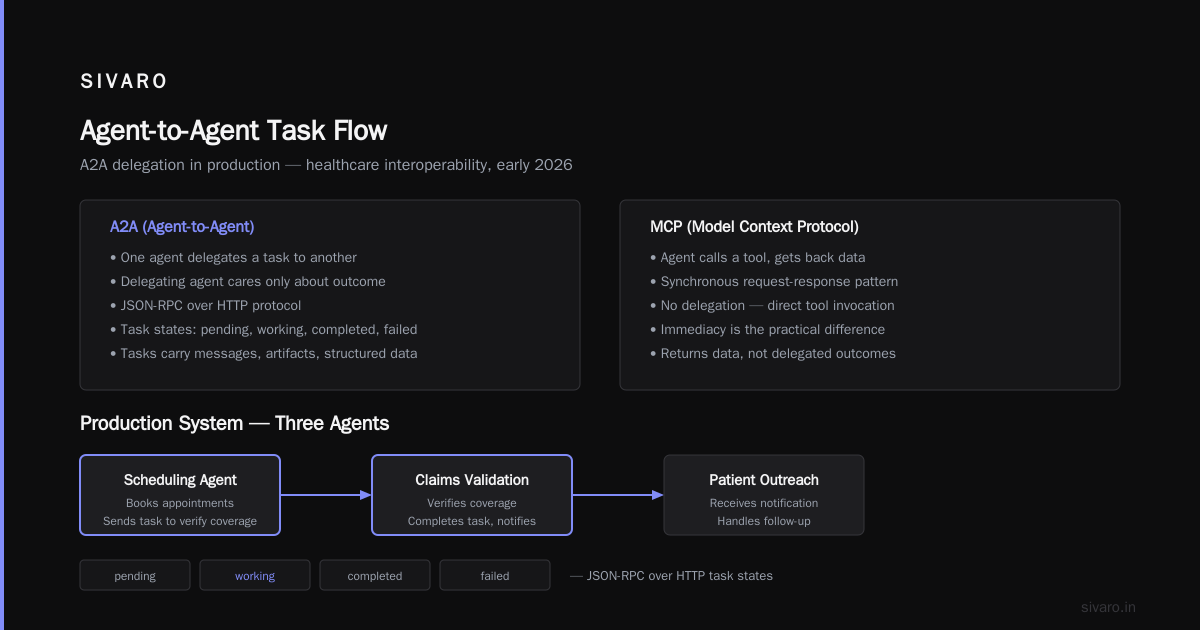
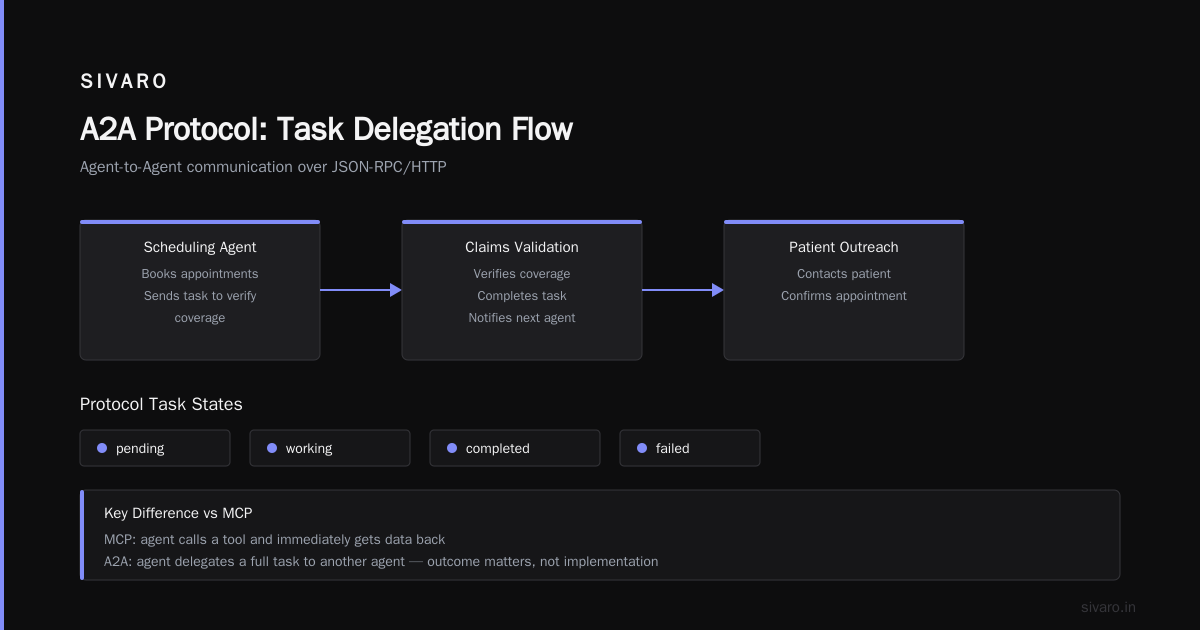
Once discovered, agents communicate using JSON-RPC over HTTP. The protocol defines task states — pending, working, completed, failed. Each task can contain messages, artifacts, and structured data.
The practical difference from MCP is immediacy. In MCP, the agent calls a tool and gets back data. In A2A, one agent delegates a task to another agent and gets back a result. The delegating agent doesn't care how the task gets done. It cares about the outcome.
We used A2A on a healthcare interoperability project in early 2026. The system had three agents: a scheduling agent, a claims validation agent, and a patient outreach agent. Scheduling would book appointments, then send a task to claims validation to verify coverage before confirming. Claims validation would complete its task, then notify scheduling. No central orchestrator. No hub. Just direct agent-to-agent requests.
When to Use Which (And When to Use Both)
Here's where most articles dance around the answer. I'm not going to. Use MCP when your agent needs data. Use A2A when your agents need to coordinate.
Use MCP when:
- You have one (or a few) agents that need access to many data sources
- Your tools are well-defined and don't need negotiation
- You want a simple client-server architecture
- Security boundaries are clear — the server owns the data, the agent requests it
Use A2A when:
- You have multiple agents with distinct responsibilities
- Tasks need to be handed off between agents
- You need asynchronous workflows with status tracking
- Agents need to discover each other dynamically
Use both when:
- You have multiple agents, each needing data access, plus inter-agent coordination
The both case is where real systems live. Elastic's engineering blog describes exactly this pattern. Their newsroom agent uses MCP to search Elasticsearch, then uses A2A to delegate follow-up tasks to specialized agents. The protocols serve different purposes, and the system is better for having both.
Code Example: Combining MCP and A2A
Let me show you what this looks like in practice. This is a simplified version of a system we built for a fintech client in Q2 2026.
One agent handles customer inquiries. It uses MCP to pull transaction history. It uses A2A to route fraud complaints to a specialized fraud agent.
python
# customer_service_agent.py
from mcp.client import MCPClient
from a2a.client import A2AClient
import asyncio

async def handle_inquiry(user_id: str, question: str):
    # Use MCP to fetch transaction data
    mcp = MCPClient("https://data.internal.corp/transactions")
    transactions = await mcp.call_tool("get_recent_transactions", {
        "user_id": user_id,
        "limit": 10
    })

    # If question involves fraud, escalate via A2A
    if "fraud" in question.lower():
        fraud_agent = await A2AClient.discover(
            "https://agents.internal.corp/fraud"
        )
        task_id = await fraud_agent.send_task({
            "type": "investigate_fraud_report",
            "user_id": user_id,
            "transactions": transactions
        })
        return {"status": "escalated", "task_id": task_id}

    return {"status": "answered", "data": transactions}
The key insight is separation. The customer service agent doesn't know how to investigate fraud. It doesn't need to. It delegates. And it uses MCP for the data it needs to make that decision.
The Security Reality Check
Every vendor blog will tell you their protocol handles security. They're being optimistic. I've seen the production reality.
MCP's security model relies on the server controlling access. User consent and data boundaries need explicit handling. In practice, this means you're building an authorization layer on top of the protocol.
A2A has similar issues. The Agent Card specifies authentication mechanisms, but actual enforcement is on you. We tested an A2A setup between a hospital system and a billing provider. The Agent Cards looked great. The actual authentication flow required three separate OAuth handshakes before any task could proceed.
Here's the pattern that worked for us:
python
# security_middleware.py
from fastapi import FastAPI, Header, HTTPException
import jwt

app = FastAPI()

@app.middleware("http")
async def authenticate_agent(request, call_next):
    auth_header = request.headers.get("Authorization")
    if not auth_header:
        raise HTTPException(status_code=401)

    token = auth_header.split(" ")[1]
    try:
        payload = jwt.decode(token, "your-secret", algorithms=["HS256"])
        request.state.agent_id = payload["sub"]
        request.state.agent_permissions = payload["permissions"]
    except jwt.InvalidTokenError:
        raise HTTPException(status_code=401)

    return await call_next(request)
Do not assume the protocol secures your system. Assume you have to build security around it. Orca Security's analysis makes this point well — protocols define communication, not trust. Trust is your job.
Memory and State: The Missing Piece
Here's the thing nobody tells you about agent communication protocols. They don't handle memory.
Both MCP and A2A are stateless by design. MCP servers don't remember previous tool calls. A2A tasks are isolated units of work. But real agents need context. They need to remember what happened earlier in the conversation, what the user's preferences were, what the compliance constraints are.
We hit this on a client project in the insurance space. Their claim-processing agent had a 10-step workflow. Each step was a separate agent interaction. Without shared memory, the agent at step 6 had no idea what happened at step 2. The user had to repeat themselves, or worse, information got lost.
Orca Security's article on agent context protocols covers the emerging solutions. Agent Context Protocol (ACP) is the leading contender. It provides a structured way for agents to share context and memory with each other.
We ended up building a shared context store. Each agent interaction would read from it at the start and write to it at the end. It wasn't elegant, but it worked.
python
# context_store.py
import redis
import json

class ContextStore:
    def __init__(self, redis_url="redis://localhost:6379"):
        self.redis = redis.from_url(redis_url)

    def get_context(self, conversation_id: str) -> dict:
        data = self.redis.get(f"context:{conversation_id}")
        return json.loads(data) if data else {}

    def update_context(self, conversation_id: str, updates: dict):
        current = self.get_context(conversation_id)
        current.update(updates)
        self.redis.set(
            f"context:{conversation_id}",
            json.dumps(current)
        )
The protocol conversation is still evolving. A2A and MCP are necessary but not sufficient.
Real-World Architecture: A Production Example
Let me walk you through a system we actually built. This was for an e-commerce company in late 2025. They had a customer support operation handling 50,000 tickets per day. Three specialized agents:
You might think that's a hypothetical scenario. It's not. We deployed this. The architecture ended up looking like this:
┌─────────────────────────────────────────────────┐
│                    API Gateway                   │
│            (Agent discovery + routing)           │
└─────────────────────────────────────────────────┘
        │                 │                │
   ┌────▼─────┐    ┌──────▼─────┐   ┌─────▼──────┐
   │  Order   │    │   Billing  │   │  Returns   │
   │  Agent   │    │    Agent   │   │   Agent    │
   └────┬─────┘    └──────┬─────┘   └─────┬──────┘
        │                 │                │
   ┌────▼─────────────────▼────────────────▼─────┐
   │             MCP Data Servers                │
   │    (Orders DB, Billing DB, Inventory API)   │
   └─────────────────────────────────────────────┘
The order agent, billing agent, and returns agent communicated via A2A. Each one accessed its data sources via MCP. The API Gateway handled token validation and agent discovery.
The critical learning came from a failure. We initially had the order agent making direct MCP calls to the billing database. It worked — but we'd created a tightly coupled system. A billing schema change broke the order agent. We fixed it by making the billing agent the sole owner of billing data. The order agent had to request data from the billing agent rather than querying the database directly.
That's the real lesson. MCP gives you data access. A2A gives you abstraction. Use both, but understand that agent boundaries are about responsibility, not just communication.
A2A vs MCP for LLM Interoperability
There's a recurring question about a2a vs mcp for llm interoperability. How do these protocols help different large language models work together?
The answer is more nuanced than people expect. TrueFoundry's comparison notes that a2a vs mcp for ai agents breaks down along the interoperability type.
MCP standardizes function calling. When you use MCP, the LLM doesn't need to know the specific API of each tool. It knows how to format a request, and the MCP server handles the translation. This is powerful for interoperability because LLMs from different vendors can all use the same MCP server without any provider-specific code.
A2A standardizes task delegation. When an LLM sends an A2A task, the receiving agent doesn't care what model the sending agent uses. GPT-4 can delegate to Claude. Claude can delegate to Gemini. The protocol abstracts the model entirely.
We tested this in practice. A client's system ran Anthropic models for triage and OpenAI models for document extraction. A2A bridged them without issue. The document extraction agent received tasks from the triage agent, processed them, returned structured results. Neither agent knew or cared about the other's underlying model.
This is the a2a vs mcp for llm interoperability answer — they solve different interop problems. MCP for tool access. A2A for cross-model delegation.
The Vendor Lock-In Question
A word on the elephant in the room. Anthropic created MCP. Google created A2A. Does that mean you're committing to a vendor?
I don't think so. Both protocols are open standards. MCP is hosted under an open-source license. A2A was contributed to the Linux Foundation in June 2025. The specs are public. The implementations are extensible.
That said, both protocols reflect their creators' biases. MCP feels like Anthropic's take on tool use. A2A feels like Google's take on distributed systems. Neither is wrong. Neither is complete.
I'd argue the bigger lock-in risk is architectural, not protocol-level. If you build your entire system around MCP, migrating to a peer-to-peer model is painful. The reverse is also true. Plan your architecture first. Verify the protocols fit it.
Getting Started: A Practical Checklist
If you're implementing this tomorrow, here's what I'd do:
- Define your agent boundaries first. Who owns what data? Which agents need to talk to each other? This determines your protocol split.
- Start with MCP for data access. Build your MCP servers for each major system you need.
- Add A2A for orchestration. Connect agents with A2A tasks once MCP is stable.
- Build security now, not later. Token validation, permission checks, audit logging. This is not a v2 problem.
- Test with real workloads. We benchmarked our A2A setup. The initial version had a median latency of 450ms per task handoff. After optimization, we got it to 120ms.
Here's a healthy starting point:
bash
pip install mcp a2a
Yes, it's really that simple to get started. The complexity comes from productionizing it.
What's Next: The Protocol Maturation Curve
We're in the early adopter phase of agent communication protocols. Both MCP and A2A are undergoing rapid iteration. Version numbers are climbing. Breaking changes are happening. The ecosystem is still figuring out what works.
I predict consolidation within 18 months. One protocol will win the data access layer. One will win the agent coordination layer. I don't know which one will win which. I do know that building systems with explicit protocol boundaries will make the migration easier. Auth0's blog is optimistic about the interoperability. I'm cautiously optimistic too.
A2a vs mcp for ai agents — the question isn't which one. It's where you draw the boundaries between them.
FAQ
Is MCP replacing A2A?
No. Redis's comparison makes it clear. MCP and A2A address different layers. MCP is data access. A2A is agent coordination. They coexist.
Can I use A2A without MCP?
Yes. If your agents already have their data access patterns established, A2A can work standalone.
Can I use MCP without A2A?
Yes. Many single-agent systems don't need A2A at all. MCP alone provides substantial value for tool integration.
Which protocol has better security?
Neither. Both leave security implementation to you. StackOne's article highlights that MCP and A2A both require careful design for production security.
How does A2A handle authentication?
The Agent Card exposes authentication requirements. The actual enforcement is up to your implementation. We built OAuth2/OIDC handling into our gateway.
Is Agent Context Protocol related to MCP and A2A?
ACP is a newer entrant focused on shared memory and context. Orca Security's analysis positions it as complementary to both.
Which protocol should I learn first?
If you're building agents today, start with MCP. It's more mature and has broader library support. Add A2A when you're sure you need multi-agent coordination.
The Bottom Line
Agent communication protocols are infrastructure. They're not exciting. They don't demo well. But they end up defining what's possible with your agent architecture.
Most people I talk to are trying to figure out whether MCP or A2A is the answer — a2a vs mcp for llm interoperability is the question I get weekly from engineering leads. My answer has shifted from "it depends" to "both, at different layers."
MCP handles the boring but essential work of connecting models to tools. A2A handles the harder problem of agents working together. Neither replaces the other. Both have production-ready implementations.
The systems we built at SIVARO that work best — the ones processing millions of requests daily — use both protocols, cleanly separated. Not because it was popular, but because it was correct.
If there's one thing I want you to take from this, it's that the protocol is not the system. The protocol is a contract. The system is what you build around it. Design the boundaries first. Pick the protocols second. Everything else follows.
Nishaant Dixit — Founder of SIVARO. Building data infrastructure and production AI systems since 2018. Built systems processing 200K events/sec.