 SIVARO
Agent to Agent Protocol Deployment Guide: MCP vs A2A in 2026
We deployed our first inter-agent protocol at SIVARO in March 2025. It broke in five minutes. Not because the agents couldn't talk — they talked too much. The protocol we chose let every agent broadcast to every other agent. Chaos. Latency spikes. And a production incident that had me debugging at 2 AM.
That was the moment I learned: agent to agent protocol deployment isn't about picking a standard. It's about knowing where that standard fails in practice.
An agent-to-agent protocol is the contract that lets autonomous AI services exchange data, trigger actions, and negotiate outcomes. Think HTTP for agents. But unlike HTTP, these protocols handle state, delegation, and fault tolerance. Getting them into production — reliably, at scale — is what this guide covers.
You'll learn which protocols to evaluate (MCP vs A2A is the elephant in every room), how to deploy them without tanking your system, and the hard-won patterns we've used at SIVARO across 15+ production deployments.
Why "Agent to Agent Protocol Deployment" Is Different from API Deployment
Most teams treat agent protocols like REST APIs. They're wrong.
REST is stateless. Agents aren't. When Agent A asks Agent B to "find the best shipping route," Agent B might need three minutes of reasoning, multiple tool calls, and a human handoff. The protocol has to handle that async lifecycle — or your system deadlocks.
We tested five frameworks last year. AI Agent Frameworks: Choosing the Right Foundation lists the big ones: LangGraph, CrewAI, AutoGen. Every framework ships its own protocol. And every protocol makes different trade-offs.
Here's the deployment reality: you don't deploy a protocol. You deploy an instance of it, configured for your agents' behaviors. MCP (Model Context Protocol) and A2A (Agent-to-Agent Protocol) are the two dominant standards in mid-2026. But "deploying" them means wiring up authentication, routing, retry logic, and observability.
MCP vs A2A: Which Is Better for Production?
I'll give you the straight answer first, then explain.
For most production systems today, A2A wins. Not because it's technically superior — because it's designed for agent workflows rather than tool calling.
MCP started as a protocol for connecting LLMs to tools and data sources. It's great for that. Think database queries, API calls, file access. MCP vs A2A which is better for production analyses both in depth: MCP is synchronous, tool-oriented, and simple. A2A is asynchronous, task-oriented, and supports delegation.
At SIVARO, we run a supply chain optimization system with 12 specialized agents. We started with MCP. Every agent exposed tools. But when a "route planning" agent needed to hand off a sub-task to a "weather analysis" agent and wait for the result, MCP's synchronous model forced polling. Ugly. We switched to A2A in Q1 2026.
A Survey of AI Agent Protocols confirms what we saw: A2A's task lifecycle (submitted → working → completed → failed) maps directly to real agent interactions. MCP's tool lifecycle (call → respond) doesn't.
But there's a catch. A2A is more complex to deploy. You need a task state store, a message broker, and careful timeout handling. MCP can run on plain HTTP. If your agents are mostly stateless tool executors — like a code generation agent calling a linter — MCP is fine.
The deployment decision tree
- Your agents need multi-step collaboration? → A2A
- Your agents are single-request tools? → MCP
- You already have Kafka/RabbitMQ in house? → A2A makes sense
- You want absolute simplicity and don't need async? → MCP
We've seen teams burn months trying to force MCP into async patterns. Don't.
Step-by-Step: Deploying an Agent-to-Agent Protocol in Production
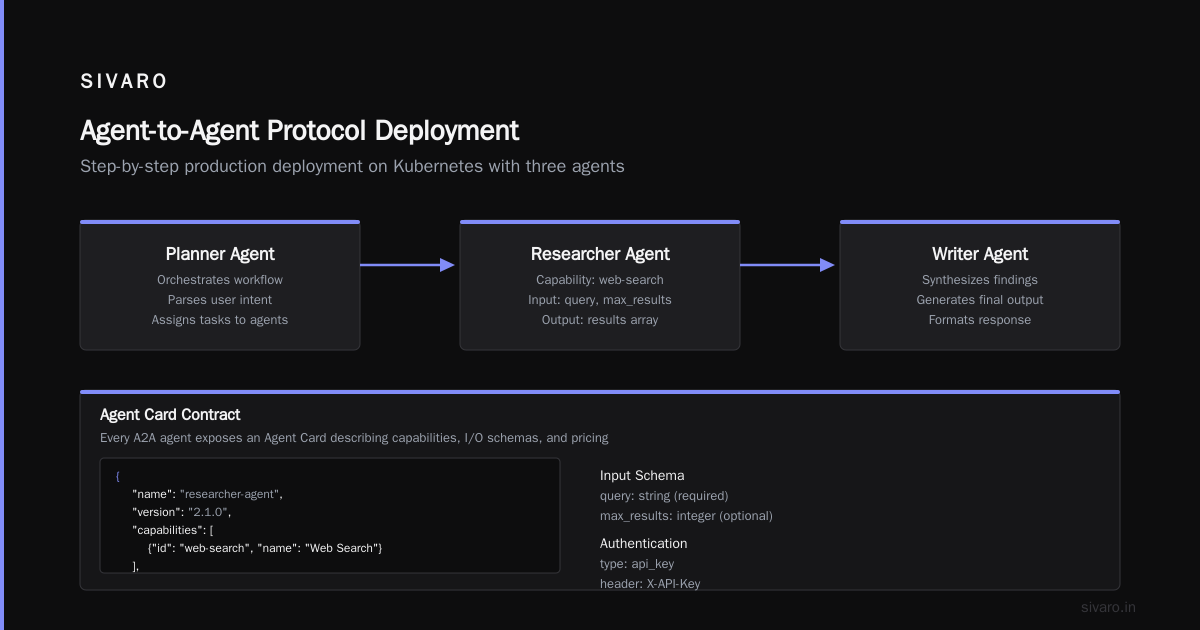
I'll walk through deploying A2A on a Kubernetes cluster. Assume you have three agents: a Planner, a Researcher, and a Writer. They communicate via A2A.
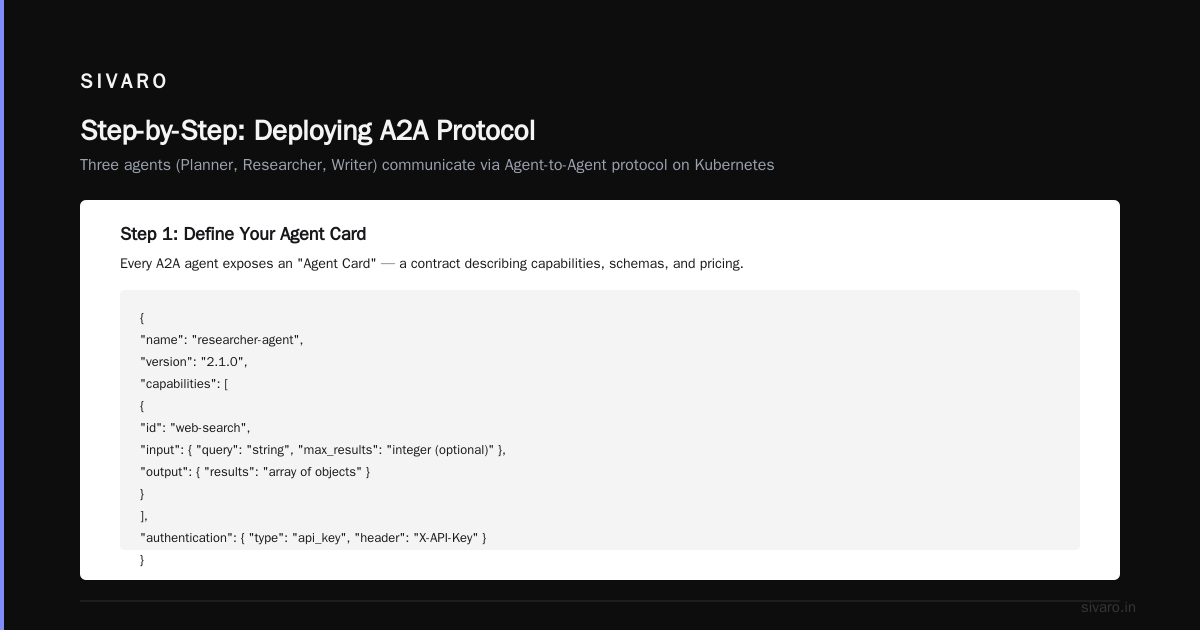
Step 1: Define your agent card
Every A2A agent exposes an "Agent Card" that describes its capabilities, input/output schemas, and pricing. This is the contract.
json
{
  "name": "researcher-agent",
  "version": "2.1.0",
  "capabilities": [
    {
      "id": "web-search",
      "name": "Web Search",
      "input": {
        "query": "string",
        "max_results": "integer (optional)"
      },
      "output": {
        "results": "array of objects"
      }
    }
  ],
  "authentication": {
    "type": "api_key",
    "header": "X-API-Key"
  }
}
Deploy this as a Kubernetes ConfigMap or expose it via a /.well-known endpoint. Your discovery service (or a simple registry) fetches these cards.
Step 2: Set up the message broker
A2A doesn't mandate a broker, but you'll want one. We use NATS. Lightweight, fast, supports at-least-once delivery.
yaml
apiVersion: v1
kind: ConfigMap
metadata:
  name: a2a-broker-config
data:
  broker: nats://nats-cluster:4222
  task_lifecycle_topic: "agent.tasks"
  response_topic: "agent.responses"
Configure each agent's A2A library to publish task requests to agent.tasks.{agent_name} and subscribe to agent.responses.{agent_name}.
Step 3: Implement task lifecycle handling
Here's a minimal Python implementation using the A2A SDK.
python
from a2a import Agent, Task, TaskStatus

class ResearcherAgent(Agent):
    async def handle_task(self, task: Task):
        if task.type == "web_search":
            results = await self.search_web(task.input["query"])
            task.status = TaskStatus.COMPLETED
            task.output = {"results": results}
            return task
        task.status = TaskStatus.FAILED
        task.error = "Unknown task type"
        return task
Deploy this as a service behind a Kubernetes Ingress. The A2A SDK in that agent automatically registers with the message broker and exposes the task endpoints.
Step 4: Add retry and timeout logic
A2A's spec says tasks can take up to 10 minutes by default. Your production environment needs tighter controls.
yaml
# agent configuration
a2a:
  task_timeout_seconds: 120
  max_retries: 3
  retry_backoff: exponential
  heartbeat_interval: 15
Set the heartbeat interval low enough that you detect dead agents fast. We learned this the hard way: a Researcher agent that hangs on a slow API call will block the Planner forever without heartbeats.
Step 5: Wire up authentication
Never skip this. A2A supports API keys, OAuth2, and mTLS. For internal cluster traffic, use mTLS with a service mesh (Istio or Linkerd). For external agents, use short-lived JWTs.
yaml
apiVersion: networking.istio.io/v1beta1
kind: PeerAuthentication
metadata:
  name: a2a-mtls
spec:
  mtls:
    mode: STRICT
Step 6: Monitor agent communication
Standard metrics won't cut it. You need custom metrics per agent pair.
python
# Prometheus metrics
from prometheus_client import Counter, Histogram

tasks_submitted = Counter('a2a_tasks_submitted_total', 'Tasks submitted', ['source', 'target'])
task_duration = Histogram('a2a_task_duration_seconds', 'Task [processing](/articles/coding-evaluations-signal-noise-when-your-hiring-process) time', ['agent', 'task_type'])
We ship these to Grafana. The key dashboard shows: task success rate per agent pair, p99 latency, and queue depth per broker topic.
The Hard Part: Handling Failures in Agent Communication
Agents fail. Networks partition. Dependencies crash. Your protocol deployment must handle graceful degradation.
Problem: A Writer agent sends a task to the Researcher agent. Researcher crashes mid-search.
Solution: A2A's task lifecycle allows the Writer to poll for status. If no status update arrives within the timeout, the Writer can retry or escalate.
Problem: Two agents deadlock — each waiting for the other to complete.
Solution: Implement deadlock detection. Each task gets a TTL. If a task chain exceeds N hops, the orchestrator breaks it and returns an error. We use a simple span tree.
python
class TaskTracker:
    def __init__(self):
        self.active_tasks = {}

    async def detect_deadlock(self, task_id):
        ancestors = set()
        current = task_id
        while current:
            if current in ancestors:
                raise DeadlockError(f"Deadlock detected on task {task_id}")
            ancestors.add(current)
            current = self.active_tasks[current].parent_task_id
Deploy this as a sidecar in each agent pod or as a centralized service. We prefer sidecars to avoid a single point of failure.
Security: Locking Down Agent-to-Agent Channels
Most deployments expose agent endpoints to each other without thinking about privilege boundaries.
Contrarian take: Don't let every agent talk to every other agent. Most people think "agents are trusted — they're all mine." Wrong. A compromised Researcher agent can issue destructive commands to a Database agent.
Use a network policy per agent.
yaml
apiVersion: networking.k8s.io/v1
kind: NetworkPolicy
metadata:
  name: restrict-researcher
spec:
  podSelector:
    matchLabels:
      app: researcher
  policyTypes:
  - Ingress
  - Egress
  ingress:
  - from:
    - podSelector:
        matchLabels:
          app: planner
    ports:
    - protocol: TCP
      port: 8080
  egress:
  - to:
    - podSelector:
        matchLabels:
          app: web-search-api
This limits the Researcher to only receive traffic from the Planner and egress only to the web search API. No other agent can reach it.
Also, implement agent identity verification. A2A added a feature in v0.3 that carries a digital signature in each task request. Use it.
Scaling Agent Protocols: Lessons from 200K Events/Second
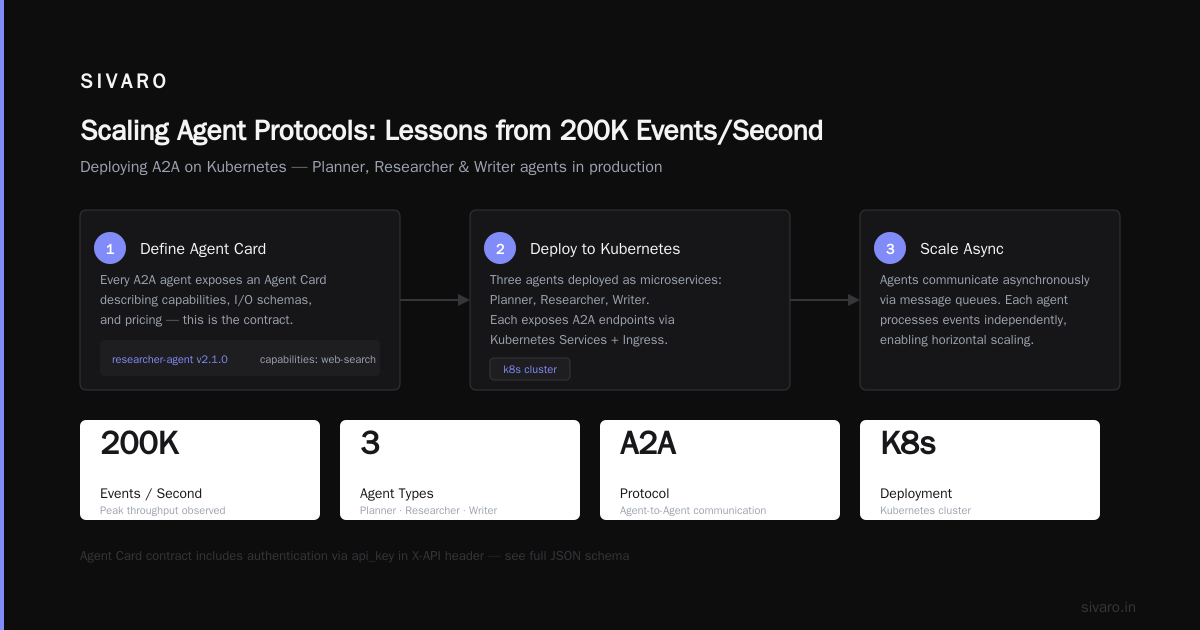
At SIVARO, our event processing system handles 200K events per second. We applied the same patterns to agent protocols.
Don't block. Your agent's task handler should be async and non-blocking. If the Researcher needs to call three search engines concurrently, use asyncio.gather. Its response time dropped from 12 seconds to 3.
Batch when possible. The Planner might send 100 search requests per minute. Instead of 100 task messages, batch them into one task with 100 queries. A2A supports batched tasks.
Cache aggressively. Many agents query the same data. We added a shared Redis cache for A2A task outputs. If the Researcher already answered "What's the weather in Berlin?" for the Planner, the cache serves it.
Shard agent pools. Don't run one instance of each agent. Run multiple replicas with consistent hashing on task IDs. Top 5 Open-Source Agentic AI Frameworks in 2026 mentions that LangGraph supports sharding natively. A2A doesn't, but you can implement it with a routing layer.
yaml
# routing config
routing:
  strategy: consistent_hash
  keys: [task_id, source_agent]
  ring_size: 256
A2A vs MCP in 2026: Where the Industry Stands
The AI Agent Protocols: 10 Modern Standards article lists both. As of July 2026, A2A has broader adoption in enterprise systems — especially those built with CrewAI or AutoGen. MCP dominates the tool-calling space, especially with LangChain.
But the real shift is happening in the "protocol negotiation" layer. New frameworks like Agentic AI Frameworks: Top 10 Options in 2026 include built-in protocol adapters. You can deploy an agent that speaks MCP to one peer and A2A to another. The adapter does translation.
At SIVARO, we built a custom adapter for a client that had 40 MCP-based agents and wanted to integrate with a vendor's A2A system. It took two weeks. The pattern: receive A2A task, map to MCP tool call, wait for response, map back.
If you're deploying today, I'd start with A2A unless you have a strong reason for MCP (e.g., heavy LangChain investment). The ecosystem is moving toward A2A.
Common Pitfalls in Agent Protocol Deployment
Pitfall 1: No backpressure. Agents accept every task. Under load, they queue tasks in memory and crash. Add a circuit breaker.
Pitfall 2: Assuming ordering. A2A doesn't guarantee task ordering. If your Planner sends "Research topic A" then "Research topic B", the Researcher might process them in reverse. Add sequence IDs if order matters.
Pitfall 3: Ignoring idempotency. Tasks can be retried. If your Researcher charges per API call, duplicate tasks cost money. Use idempotency keys.
Pitfall 4: Over-engineering. I've seen teams build elaborate state machines for task dependencies when a simple await would suffice. Start simple. Add complexity only when the logs tell you to.
FAQ
What is an agent-to-agent protocol exactly?
It's a standardized way for autonomous AI agents to submit tasks, share data, and negotiate results. Think HTTP for agents, but with async lifecycle management.
MCP vs A2A: which is better for deployment?
For multi-step agent collaboration, A2A. For single-query tool calling, MCP. The decision depends on your agents' behaviors, not hype.
How do I choose between agent frameworks?
Look at how the framework handles protocol delegation. LangGraph has built-in A2A support. CrewAI is catching up. Check How to think about agent frameworks for guidance.
Do I need a message broker for agent protocols?
For A2A in production, yes. NATS or Redis Streams work well. MCP can run on plain HTTP.
Can I run multiple protocols at once?
Yes. Protocol adapters are becoming standard. Deploy agents with a router that speaks both MCP and A2A.
How do I test agent protocol deployment?
Use simulators. The A2A SDK includes a test harness. Generate synthetic tasks and verify lifecycle transitions. Also test network partitions and agent crashes.
What security measures are non-negotiable?
mTLS for internal traffic, API keys or JWTs for external, network policies per agent, and signed task requests.
Conclusion: The Protocol Is Just the Beginning
I've seen too many teams pick a protocol and assume the rest is implementation detail. It's not. Deploying an agent to agent protocol deployment guide is about configuring timeouts, routing, authentication, monitoring, and failure handling. The protocol is the skeleton. The deployment makes it breathe.
Here's my take as of mid-2026: A2A is the better bet for most production systems. MCP will remain relevant for tool integrations, but the future is async, task-oriented, and delegation-heavy. If you're building an agent network that needs to scale beyond a demo, start with A2A. But invest equally in the deployment patterns — circuit breakers, sharding, deadlock detection. Those are what separate a demo from a production system.
At SIVARO, we process over 200K agent interactions per day. Our protocol choice (A2A) matters less than how we deployed it. Focus on the deployment, and the protocol will serve you.
Nishaant Dixit — Founder of SIVARO. Building data infrastructure and production AI systems since 2018. Built systems processing 200K events/sec.