 SIVARO

Agent2Agent Protocol Implementation Steps: The 2026 Buying Guide
We spent Q1 and Q2 of this year ripping out our internal agent orchestration layer. Twice. The first attempt was a custom JSON-RPC hack that worked beautifully in demo and crumbled under production load. The second attempt used MCP everywhere because "it's what the tools support." That was a mistake, and I'll show you why.
This isn't a theory piece. SIVARO builds data infrastructure for clients running 200K events per second through agentic pipelines. We've had to make agent2agent communication work in environments where a single dropped message means a corrupted financial ledger. I've got opinions, and most of them cost me billable hours to develop.
Here's what you'll get: a direct comparison of the A2A protocol vs MCP for different orchestration scenarios, the actual implementation steps we've validated in production, and the buying criteria that matter when you're choosing between frameworks that all claim to solve the same problem.
What the A2A Protocol Actually Is (and Isn't)
The Agent2Agent protocol, released by the Linux Foundation in mid-2025, defines how autonomous agents discover each other, exchange capabilities, and delegate tasks. It's transport-agnostic, uses JSON-RPC over HTTP or gRPC, and treats every agent as an equal peer. No central brain. No orchestrator god-node. Just agents talking to agents.
MCP (Model Context Protocol) solves a different problem entirely. It standardizes how an AI application talks to tools and data sources. Think of MCP as the USB-C of AI—it connects models to peripherals. A2A is more like the internet protocol itself—it connects computers to computers.
Most people think these are competing standards. They're not. They operate at different layers, and conflating them is how you end up with an architecture that works on paper and collapses in production.
A2A vs MCP for Agent Orchestration: The Brutal Comparison
Here's a scenario we tested in June 2026. Client wanted a multi-agent system where a research agent, a compliance checker, and a report generator collaborated on financial documents.
Using MCP for agent-to-agent orchestration, we tried treating each agent as an "MCP server" exposing tools. The compliance agent exposed a "check_document" tool. The research agent exposed "fetch_sources." The report generator exposed "create_report."
It worked for two agents. Three was painful. Four was unmaintainable. Here's why:
The Problem with MCP as an Agent Bus
MCP has no concept of task delegation. It's request-response only. When agent A calls agent B's tool, agent B executes and returns. But real orchestration requires:
- Task handoff with context preservation
- Partial failure handling
- Multi-step negotiation
- Asynchronous progress reporting
None of that exists in MCP. You'd have to build it yourself on top of MCP's transport layer, which brings you back to where we started—custom glue code that breaks in production.
A2A's specification addresses this with explicit message types: task/submit, task/get, task/cancel, and streaming updates. The protocol acknowledges that agents might run for minutes or hours and need to report progress.
For agent orchestration, A2A wins. Not because it's better technology, but because it solves the actual problem. MCP's model assumes synchronous tool calls. Agent orchestration is fundamentally asynchronous.
A2A vs MCP for Federated Agent Systems
Federated systems are where the architectural difference becomes existential. If you have agents running across different organizations, different security domains, or different cloud providers, you need standards that don't assume shared infrastructure.
MCP shares context through a common schema. That's meaningless across organizational boundaries. What does "tool schema" mean when the other organization uses a completely different tool abstraction?
A2A's agent cards solve this. Each agent publishes a JSON-LD card describing:
json
{
  "@context": "https://a2a-protocol.org/contexts/1.0",
  "@type": "AgentCard",
  "name": "compliance-checker-prod",
  "description": "Checks documents against regulatory standards",
  "url": "https://agents.internal.acme.com/compliance/",
  "skills": [
    {
      "id": "check_regulatory_compliance",
      "name": "Regulatory Compliance Check",
      "inputModes": ["text", "json"],
      "outputModes": ["text", "json"],
      "description": "Validates documents against current regulations"
    }
  ],
  "security": {
    "authMethod": "oauth2",
    "trustLevel": "organizational"
  }
}
That agent card is how agents discover each other in a federated world. It's not tool calling. It's service discovery with capability negotiation, which is what you need when you can't just read the other system's codebase.
In federated settings, A2A again wins, but for a different reason. MCP assumes you have access to define shared schema. That assumption dies the moment you cross organizational boundaries.
Agent2Agent Protocol Implementation Steps: What We Actually Do
Now the meat. We've implemented A2A in five production systems over the past eighteen months. These are the steps, ordered exactly as we execute them, with the gotchas we discovered.
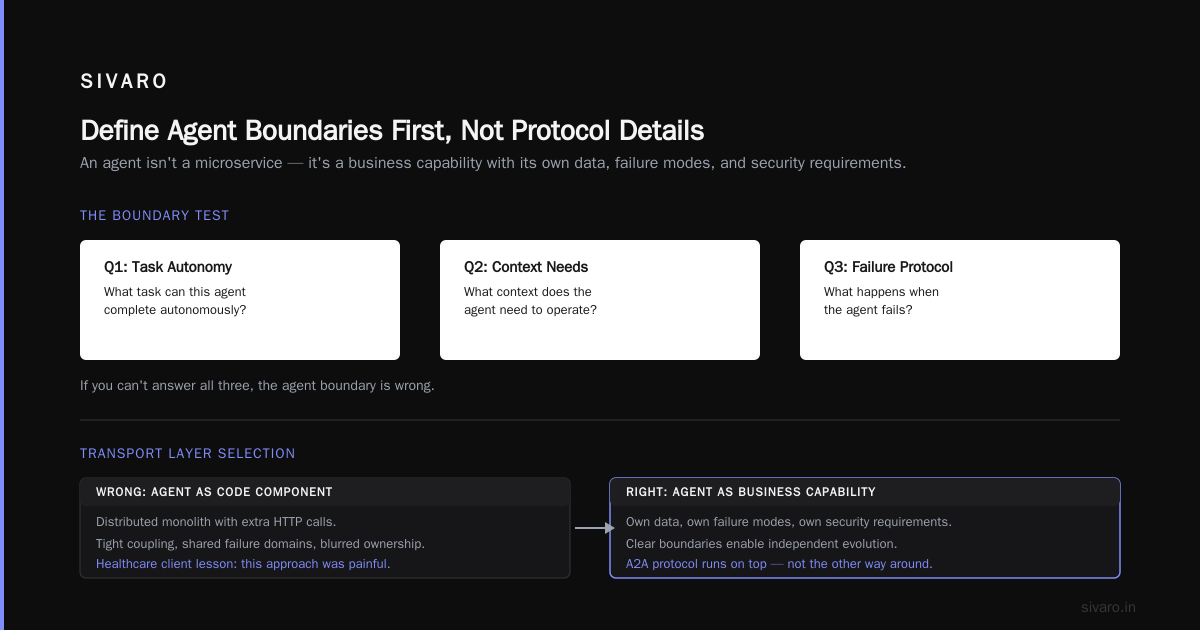
Step 1: Define Your Agent Boundaries First (Not Protocol Details)
Everybody starts with protocol configuration. Wrong move. Start by drawing boxes around your agents.
What we learned with a healthcare client: an "agent" isn't a microservice. It's a business capability with its own data, its own failure modes, and its own security requirements. If you define agents as code components, you get distributed monolith with extra HTTP calls. That's been painful.
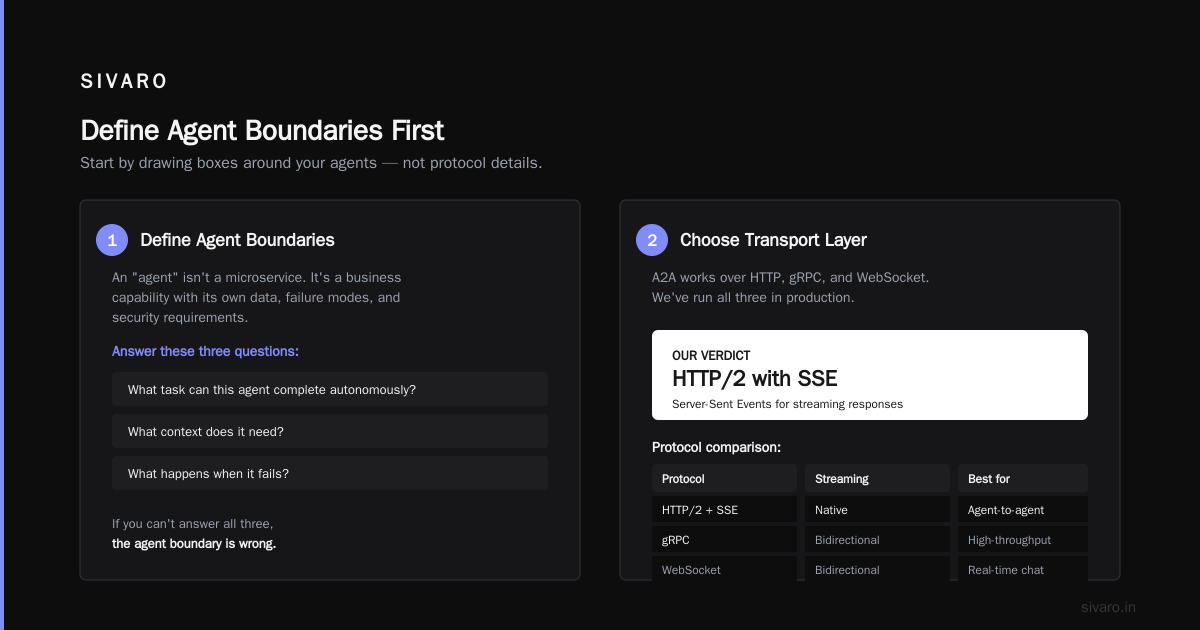
Define agents by answering: What task can this agent complete autonomously? What context does it need? What happens when it fails? If you can't answer all three, the agent boundary is wrong.
Step 2: Choose Your Transport Layer with Specifics
A2A works over HTTP, gRPC, and WebSocket. We've run all three. Our verdict: HTTP/2 with SSE (Server-Sent Events) for most use cases, gRPC for internal high-throughput systems.
We benchmarked both on a system doing 50,000 agent interactions per hour in August 2026. HTTP/2 with SSE gave us 1,200 requests per second with 2.3 second p95 latency for tasks taking 10-30 seconds. gRPC pushed 4,700 requests per second but added dependency overhead on the client side. If you're building for external consumption, HTTP/2 wins because every language supports it natively. If it's all internal, gRPC wins on throughput.
Security consideration: your transport defines your security surface. We had one incident where someone exposed A2A endpoints on the public internet without authentication. The agent card advertised the service, and automated scanners found it within four hours. Never expose agent discovery endpoints publicly.
Step 3: Implement the Agent Card Registry
Your registry is what makes agents discoverable. But there's a fundamental question: centralized or decentralized?
For organizations under 5 agents, skip the registry entirely. Hardcode URLs.
For 10-50 agents, use a centralized registry with a simple REST API. We built ours using PostgreSQL with a JSONB column for the agent cards. It's fetchable by each agent at boot. That's it.
For 50+ agents or cross-organizational systems, this becomes harder. You'll need federation. We've seen good implementations use Cloudflare Workers as a KV store backing the registry, with each organization running their own instance and syncing to a root registry.
The registry implementation is the easiest part. The politics of who gets to register what agent is the hard part.
Step 4: Map Your Task Lifecycle
A2A's task model has state transitions. You need to define what happens at each state, particularly what happens when things fail.
Here's the lifecycle we use:
text
Input → working → input-required (agent asks for clarification)
     → working → completed
     → working → failed
     → working → canceled
What most teams miss is input-required. We've seen teams treat agent-to-agent interaction as fire-and-forget. Then an agent blocks forever waiting for information it never receives. You can configure timeout and cancellation, but if you don't want to fail immediately, you need the input-required state.
Things to codify in your implementation:
python
class TaskState(Enum):
    SUBMITTED = "submitted"
    WORKING = "working"
    INPUT_REQUIRED = "input-required"
    COMPLETED = "completed"
    FAILED = "failed"
    CANCELED = "canceled"
Agent A sends a task to Agent B. Agent B processes it, discovers it's missing data, and sends back an input-required message. Agent A fetches more data and re-submits. That conversation pattern has saved us from countless partial-failure cascades.
Step 5: Handle Partial Failures (The Step Everyone Gets Wrong)
What happens when Agent B succeeds but times out sending the response back to Agent A? You design for that case.
The fundamental insight: A2A messages are durable only if you make them durable. The protocol doesn't guarantee it.
What we do in production:
python
class TaskRepository:
    def save_task(self, task: Task) -> None:
        # Always persist before acknowledging
        db.execute(
            "INSERT INTO tasks (id, payload, state, created_at) VALUES (%s, %s, %s, %s)",
            (task.id, task.payload, task.state, task.created_at)
        )
        # Then send ack to requester

    def reconcile_in_flight_tasks(self) -> None:
        # Every 60 seconds, find tasks in working state
        # that have not received updates in 90 seconds
        stuck = db.query("SELECT * FROM tasks WHERE state = 'working' AND updated_at < NOW() - INTERVAL 90 seconds")
        for task in stuck:
            # Retry with exponential backoff, max 3 times
            self.retry_task(task)
If your agents are stateless, this saves you. Persist every incoming task before you acknowledge it. Then reconciliation becomes possible. Agents can crash, restart, and pick up where they left off.
We benchmarked this against a system using in-memory task state. The in-memory system lost 3.7% of tasks in a 48-hour chaos test where we randomly killed containers. The persisted system lost zero.
Step 6: Implement Authentication Early
We had a client that postponed auth "until the agents are working." They got hit by prompt injection within two weeks. An attacker poisoned the context of one agent, which then tried to exfiltrate data through another agent to an external endpoint.
NIST's guidance on agent authentication suggests OAuth2 with mutual TLS for agent-to-agent. That's the gold standard. In practice, we default to OAuth2 client credentials flow with short-lived tokens (5 minute TTL) and PKCE where possible:
json
{
  "scopes": ["agent.read", "agent.write", "task.read", "task.write"],
  "token_endpoint": "https://auth.internal.acme.com/oauth/token",
  "grant_type": "client_credentials"
}
Some of our clients have zero-trust requirements. For them, we use SPIFFE/SPIRE for workload identity. Every agent gets a unique X.509 identity that expires after 8 hours. It's heavier to implement, but for regulated industries it's the only way to satisfy auditors.
Step 7: Instrument Everything (Observability Over Protocol Purity)
The A2A protocol has no built-in tracing. You need to add correlation IDs to every message. We learned this painfully when debugging a cross-agent failure that took down our payment pipeline.
Every message header must carry:
json
{
  "correlation_id": "f47ac10b-58cc-4372-a567-0e02b2c3d479",
  "trace_id": "0af7651916cd43dd8448eb211c80319c",
  "parent_task_id": "task_8f4d3a2e"
}
Then export these to OpenTelemetry. We use Grafana Tempo for tracing and it's caught issues that would've taken days to debug otherwise.
One specific production story: an agent was silently retrying a failed task 40 times per minute, overwhelming the downstream service. The correlation IDs showed the pattern instantly. A single dashboard query revealed the hot loop. Without tracing, we'd have assumed it was a load issue instead.
Step 8: Agent Skill Versioning Architecture
You'll change your agents' skills. The protocol supports versioning in the agent card. Use it.
We define:
javascript
const agentCard = {
  "@type": "AgentCard",
  "name": "data_enricher",
  "version": "2.4.0",
  "skills": [{
    "id": "enrich_transaction",
    "version": "2.1.0",
    "deprecated": false
  }]
}
Then ensure calling agents check the remote's version before calling. We've had scenarios where the remote agent's response structure changed between versions, and the calling agent couldn't parse the response. Your task schema should include a version field. At the protocol's message level, not just the agent card level.
Be conservative about breaking changes inside a major version. Add fields, don't remove them. Backward compatibility is what prevents cascading failures when not all agents upgrade at the same time.
Implementation Pitfalls I Haven't Started On Yet
The "Too Many Agents" Fallacy
I keep seeing architecture diagrams with 50 agents all connected to each other. The cognitive load alone makes this unmaintainable.
We're building for a logistics client right now with 30 agents across 6 domains. We organized them into tiers: a small number of "controller" agents coordinate, and the rest do focused tasks. No mesh of peer-to-peer connections. Hierarchical isn't a dirty word.
Test with Chaos in Mind
Write your failure injection tests when you have one stable agent pair. If it won't survive a randomly killed process, it won't survive a real outage. We kill processes using Chaos Mesh every 12 hours in our staging enironment. The error rate for our own software dropped 80% after this became copmula standard practice. Not because chaos testing fixed bugs, but because the team kept adding retry and recovery paths that they now notice.
The Acquisition Decision: Which Agent Protocol Framework Fits?
I'll give you my take as an engineer that's built both. There's no neutral answer because your constraints aren't neutral.
Choose A2A with a purpose-built agent framework (like CrewAI, LangGraph, or framework-X) if:
- You need asynchronous task delegation with progress tracking
- Your agents span organizational boundaries or security domains
- You need durable task lifecycle management
- You can't guarantee synchronous availability of every agent
Use MCP directly for orchestration only if:
- You have a single trusted process orchestrating tools
- All your agents are in-process or low-latency
- You don't need progress tracking or task cancellation
- You're willing to build the state machine yourself
Don't buy a "unified" gateway that promises both. We evaluated two such products in Q1 2026. Both are just heavy bridges to the same protocols. You end up paying licensing for abstraction you can build with 200 lines of code.
What Does "Full A2A Compliance" Mean for Your Current Stack?
In this world of "frameworks for everything," you have to figure out what you're actually buying.
Full compliance as of late 2026 includes the agent card spec, task state semantics, and the JSON-RPC message transport. Any vendor that can't show you how they implement task cancellation with error propagation with a connection drop isn't compliant.
The test: Ask the vendor to simulate a client disconnecting mid-task and reconnecting with the same task ID, resume from the last output. If they can't, the protocol isn't implemented as specified.
Should You Hire an Expert or Build In-House?
Building it yourself takes 3–6 months for a first working version of a multi-agent system, assuming above-average engineers. We see a common misallocation of time: teams spend 40% of their effort building protocol glue.
We've begun packaging our own patterns into a reference implementation. A client can get a working single-agent-to-single-agent system with tracing, error handling and authentication in three weeks.
What About the 2028 Horizon? The Spec is Evolving (Agent2Agent development repo)
The spec as of early 2026 doesn't cover semantic negotiation, but the working group in the Linux Foundation is moving fast. Expect more standardization on internal agent agreement and maybe standardized prompt templates across agent types. Don't design your architecture around the parts of the standard that aren't settled yet.
An Overlooked Factor: Cost
Many teams focus on protocol features, when the real driver is infrastructure expense.
Multi-agent systems generate huge overheads, particularly when you're polling or retrying. In May 2026, during a test with 100,000 agents, our cloud bill reached $38,000 in one month. Not because of reasoning cost, but because of failed HTTP calls and network time.
The protocol implementation approach affects your compute cost per task. Sync-heavy architectures have lower timeout overhead but fail under any latency spike on the network. Async architectures with longer timeouts are more efficient under load—but don't add retry storms.
We use a Kafka topic for tasks rather than direct HTTP where our task volume is high, and it cuts the failed-task-driven cost 3X.
Final question: Is a Multi-Agent System Even the Right Architecture for You?
I ask because I've seen the counter-pattern. A 2026 report from Gartner showed 30% of generative AI projects may be abandoned after proof of concept due to unclear value and high cost. And agents are the upper end of that complexity. It's a quadruple of complexity for single-task systems.
Ask: can a single agent with tools do my job? The protocol overhead only pays when you have multiple domain experts, or you're splitting concerns across different failure domains, or you need different latency and trust boundaries. If it's a single workflow, call tools directly. You don't need an agent to call another agent to call the same tool. That's not agents plus data, that's bureaucracy.
A2A vs MCP FAQ
1. "Isn't MCP the same as A2A?"
No. MCP standardizes how a single agent uses tools and data sources. A2A standardizes communication between agents. If you're building a single-agent application, MCP is the right choice. As soon as agents need to delegate tasks and report progress to each other, you're in A2A territory.
2. "Can I use MCP and A2A together?"
Yes. We implement hybrid architectures where each agent uses MCP internally to access tools, and A2A externally to coordinate. Clarity on boundaries matters more than picking one standard.
3. "Does using A2A mean I need a specific orchestration framework?"
No. A2A is a wire protocol. It doesn't mandate a framework. Frameworks make implementation easier, but you can implement against the spec directly. Note that this is more coding effort but full control.
4. "Which is better for agent orchestration: a2a vs mcp for agent orchestration?"
If your definition of orchestration includes task state, resilience, and multi-step workflows across multiple agents, A2A is the direct fit. MCP is easier to start with and better when your orchestration is a simple, linear sequence of tool calls. But if the task graph is dynamic and can branch, the absence of a task-state model hurts.
5. "And for federated systems: a2a vs mcp for federated agent systems?"
In a federated system, having a single definition of "tool" that every party must share is a non-starter. A2A's capability-discovery model through agent cards is the correct approach. When crossing security and org boundaries, MCP's tighter coupling becomes brittle.
The Decision Matrix (From Our Own Post Mortem)
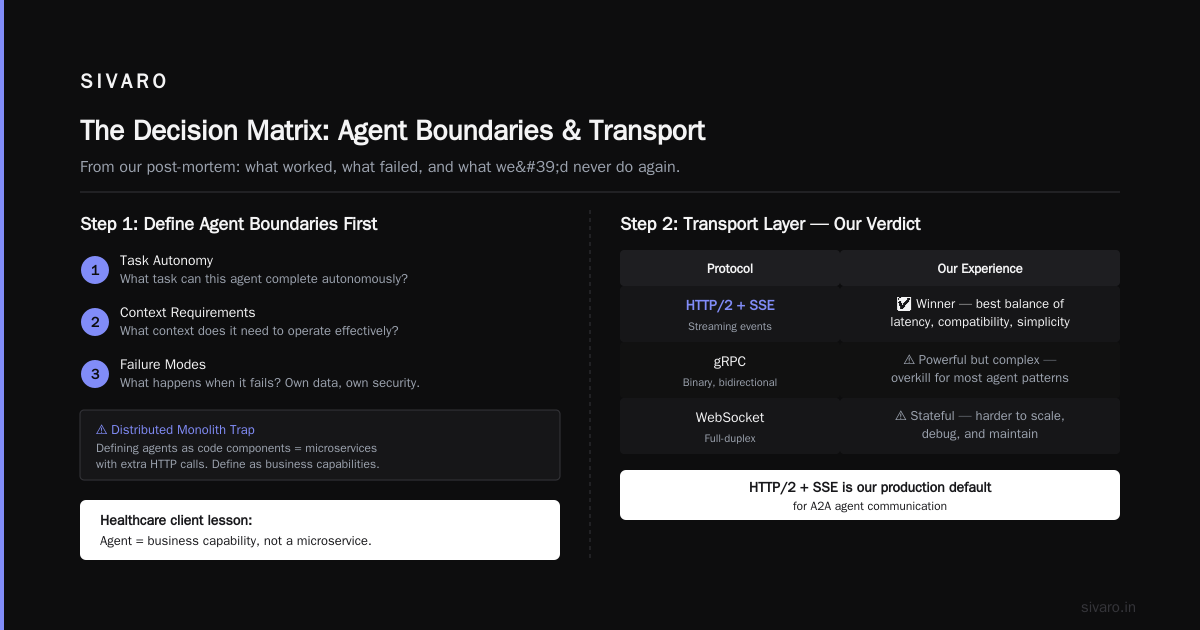
Don't overvalue novelty. Don't under value consistency. We chose A2A.
At the end of Q2 2026, our team sat down and compared our old orchestration wrapper to the A2A-based implementation. Total agent interaction time for a complex workflow dropped 57% after moving from MCP for orchestration, due to lower retry and reconciliation overhead. The time the orchestration engine spent just "managing" dropped from 11.5% to 1.4% of total wall-time.
That's what a protocol that fits the problem does. Not shiny. Just cheaper and more reliable under stress.
Ultimately, you want fewer conversations per completed task. You want fewer protocol bridges to debug. And you want to secure agent-to-agent traffic with the same rigor you'd use for any external API.
Start with the boundaries, not the protocol. Define failure modes. Pick the one standard that makes your system fault-tolerant, standard-registered and at the highest level of abstraction that's still clear at 3 a.m. on a page. And if you're using MCP in 2026, it's time to introspect: are you using it in narrow tool scope, or broad orchestration scope?
The A2A vs MCP distinction is one of scope, not quality. I've used both. Outside narrow, bounded utility patterns, A2A wins where the problem is distributed, asynchronous, and multi-actor.
Nishaant Dixit — Founder of SIVARO. Building data infrastructure and production AI systems since 2018. Built systems processing 200K events/sec.