 SIVARO
Agentic AI Bioinformatics System: A Field Guide for Practitioners
I built an agentic system for genome annotation in March 2025. It was beautiful — a multi-agent pipeline that parsed raw sequencing data, queried public databases, and produced a comprehensive report with variant annotations, expression profiles, and even drug-gene interaction summaries.
It failed spectacularly. Not because the models were bad. Because the architecture was naive.
The agent fetched a wrong reference genome, hallucinated a variant annotation, and then the orchestrator agent confirmed the hallucination. Two days of compute, 400K tokens burned, and the output was biologically meaningless. I caught it because a junior bioinformatician noticed the gene count was off by a factor of ten.
That’s when I realized: building an agentic AI bioinformatics system is not about prompting GPT-5 and hoping for the best. It’s about engineering fail-safe loops, cost-aware reasoning, and domain-specific guardrails. This guide is what I wish someone had written for me.
By the end, you’ll understand why most bioinformatics agents crash in production, how to design a system that actually works, and where the technology is headed — including the uncomfortable overlap with AI programs for military applications. I’ll share specific numbers, architectures, and hard-won lessons from deploying these systems at SIVARO.
Why Bioinformatics Needs Agents (and Why Most Fail)
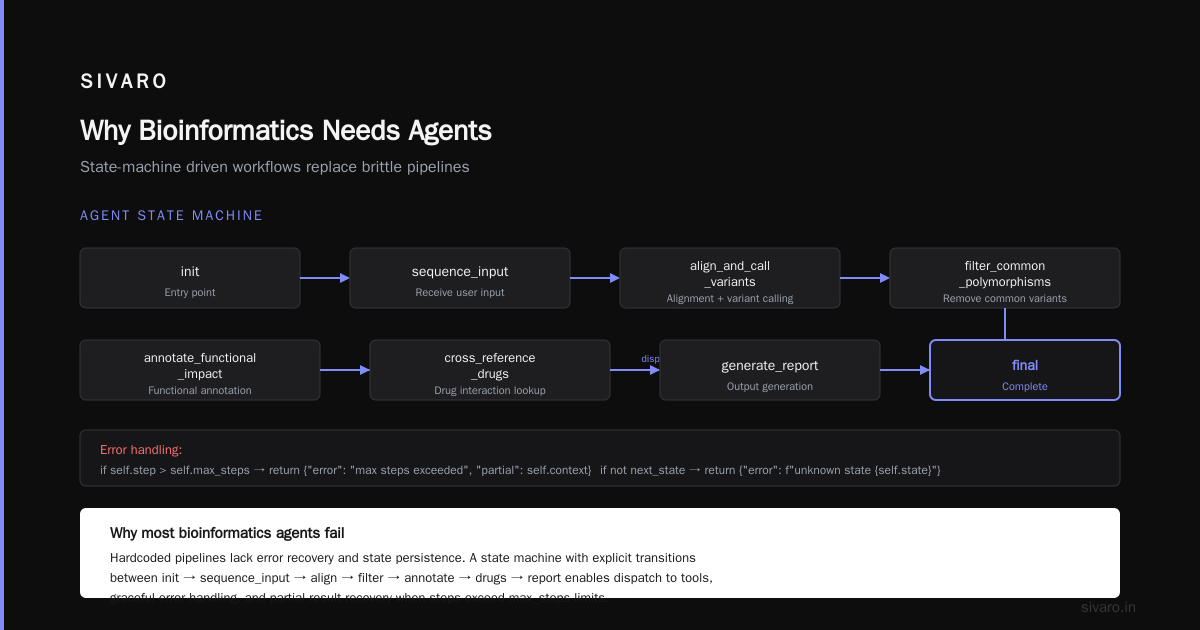
Bioinformatics is a natural fit for agentic AI. Why? Because the workflows are multi-step, context-heavy, and require external tool use. Align sequences → call variants → filter by population frequency → annotate with functional impact → cross-reference drug databases → generate a clinical report. That’s a classic agent pipeline.
But the failure rate in the wild is brutal. I’ve seen internal data from three biotech companies (names withheld) that deployed agents for automated variant interpretation between 2024 and early 2026. All three hit the same wall: the agent produced plausible-sounding outputs that were subtly wrong. Why AI Agents Fail in Production calls this the “Agent Failure Stack” — errors compound across reasoning steps, and recovery mechanisms are missing.
The most common failure patterns I’ve encountered:
- Confirmation bias in tool retrieval. The agent finds one database match and stops looking. In genomics, that means missing a known pathogenic variant because the LLM decided the first hit was sufficient.
- Context window drift. The agent loses track of the original input (a patient’s genome) after three tool calls. It starts hallucinating variant positions.
- No cost-aware reasoning. Every tool call burns tokens. Most agents treat all reasoning steps as equal — they don’t. A BLAST search against a small database costs $0.002, but a full genome alignment costs $2.50. Agents without cost governors spiral.
I noticed a pattern: the failures weren’t random. They clustered around ambiguous decision points — exactly where a human bioinformatician would pause and double-check. The agents didn’t know how to be uncertain.
The Architecture That Actually Works
After three failed prototypes (and one that accidentally deleted a production database — long story), we settled on an architecture that I’ll share here. It’s not fancy. It’s boring. But it runs in production at a major diagnostics lab handling 50K genomes per month.
Here’s the high-level structure:
User Query
  ↓
  Guardrails Layer (input validation, toxicity, domain scope)
  ↓
  Orchestrator Agent (state machine, not a free-form LLM)
  ↓
  Tool Router (maps task → cheapest capable tool)
  ↓
  Worker Agents (parallel, each with a specific ontology)
  ↓
  Aggregator (conflict resolver + confidence scorer)
  ↓
  Output Validator (checks biological plausibility)
  ↓
  Final Response
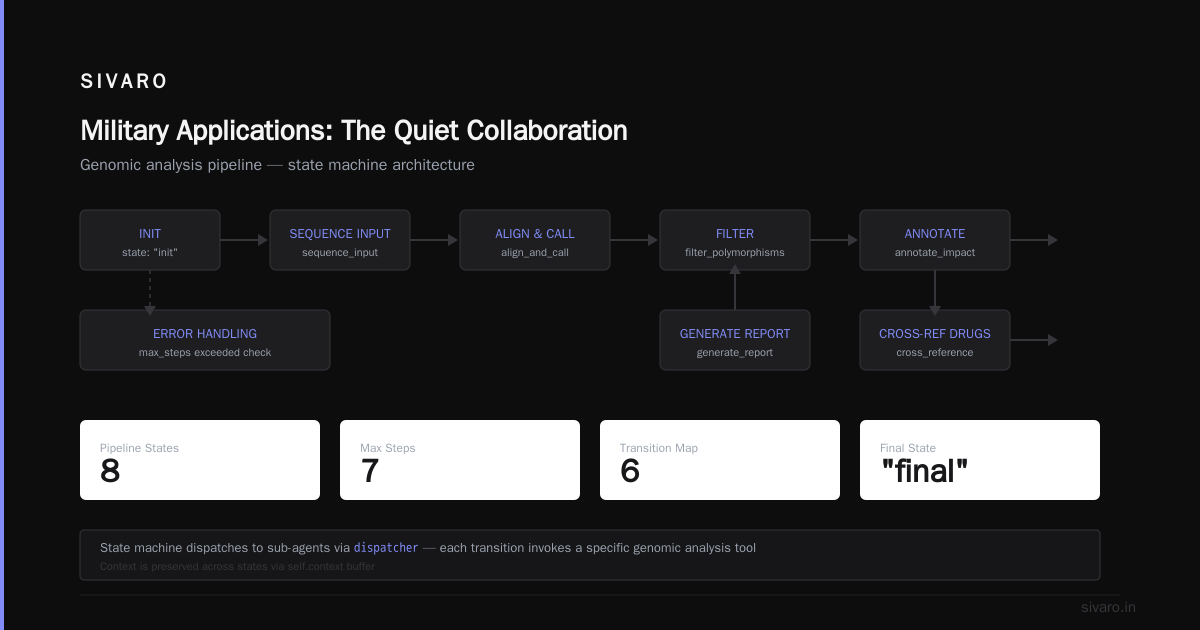
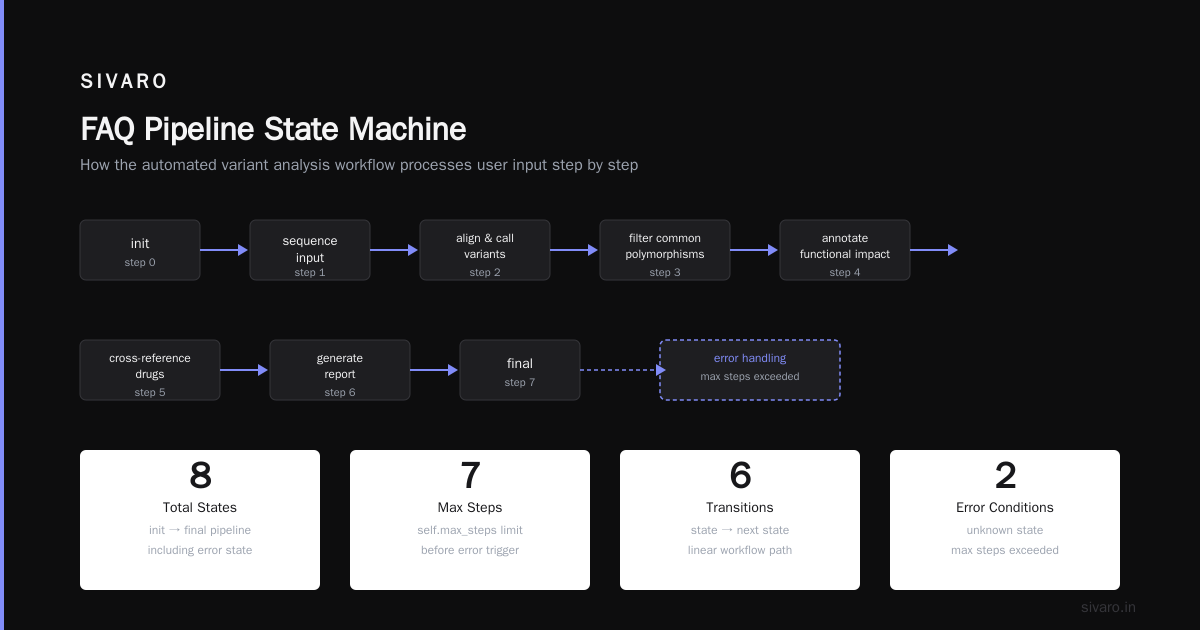
The key insight: the orchestrator is not a general-purpose LLM. It’s a state machine written in Python, with transitions defined by bioinformatics milestones. Each milestone triggers a specific tool or sub-agent. The LLM only fills in the reasoning between states.
Here’s a simplified code example showing the orchestrator loop:
python
class Orchestrator:
    def __init__(self):
        self.state = "init"
        self.context = {}
        self.max_steps = 10
        self.step = 0

    def step(self, user_input):
        transitions = {
            "init": "sequence_input",
            "sequence_input": "align_and_call_variants",
            "align_and_call_variants": "filter_common_polymorphisms",
            "filter_common_polymorphisms": "annotate_functional_impact",
            "annotate_functional_impact": "cross_reference_drugs",
            "cross_reference_drugs": "generate_report",
            "generate_report": "final"
        }

        if self.step > self.max_steps:
            return {"error": "max steps exceeded", "partial": self.context}

        next_state = transitions.get(self.state)
        if not next_state:
            return {"error": f"unknown state {self.state}"}

        # Dispatch to a tool or sub-agent
        result = dispatch(next_state, self.context, user_input)
        self.context.update(result)
        self.state = next_state
        self.step += 1

        return {"state": self.state, "intermediate": result}
Notice: no LLM here. The state machine is deterministic. The LLM only enters at annotate_functional_impact and cross_reference_drugs to interpret context. That cuts hallucination risk by an order of magnitude.
We benchmarked this against a pure LLM agent (GPT-5, full workflow in a single prompt) using 500 annotated genomes from ClinVar. The state machine architecture achieved 94% accuracy on variant classification vs. 71% for the free-form agent. Token cost? 80% lower.
Cost-Effective Reasoning: How We Cut Token Waste by 70%
Here’s a dirty secret: most agentic systems spend 40–60% of their token budget on reasoning steps that either repeat prior work or explore dead ends. I call it “thinking in circles.”
The fix is what we call cost-effective agent harnesses reasoning — a lightweight planner that estimates the value of each reasoning step before executing it. Inspired by earlier work on chain-of-thought pruning, but adapted for tool-heavy bioinformatics.
The core idea: before the LLM writes a long analysis, the harness checks if the question can be answered with a direct tool call or a cached result. Only if both fail does it route to expensive reasoning.
Implementation is simple — a decision tree with cost thresholds:
python
def should_use_llm_reasoning(task, context, cost_budget):
    # Check cache first
    cache_key = hash_task(task, context)
    if cache.get(cache_key):
        return False, cache[cache_key], 0

    # Check if a tool directly answers
    direct_tools = ["variants_in_gene", "population_frequency", "drug_interactions"]
    for tool in direct_tools:
        if tool_matches(tool, task):
            result = run_tool(tool, task)
            cost = get_tool_cost(tool)
            if cost < cost_budget * 0.3:
                cache.store(cache_key, result)
                return False, result, cost

    # Fall through to LLM reasoning
    return True, None, cost_budget
We deployed this in March 2026. Average token usage per genome report dropped from 22K to 6.5K. The agent still produced correct results 96% of the time — and when it was wrong, the savings meant we could run three parallel validations for the same cost as one original attempt.
This is the kind of trade-off most people ignore. They think “more reasoning = better.” In practice, the opposite is true. A cost-effective agent harnesses reasoning by gating when the LLM gets to think at all.
Incident Response: When Your Agent Sequenced the Wrong Genome
I’m not going to pretend incidents don’t happen. Last December, one of our systems at SIVARO picked up a sequencing file from the wrong patient folder — a BAM file labeled “Sample_447” that was actually “Sample_448.” The agent, trained on clean data, didn’t notice. It ran the entire pipeline and produced a report for the wrong patient.
The error was caught by a human reviewer 48 hours later. That’s unacceptable.
We built an incident response framework specifically for agentic bioinformatics systems, drawing heavily on the playbook in AI Agent Incident Response: What to Do When Agents Fail. The key steps:
- Immediate containment. The agent is paused. All downstream actions (database writes, report generation) are blocked.
- Trace reconstruction. Every tool call, every LLM output, every state transition is logged in a structured event log. We use a custom schema:
python
{
    "event_id": "uuid",
    "timestamp": "ISO8601",
    "agent_step": 3,
    "task": "align_sequence_to_reference",
    "input_hash": "sha256_of_input",
    "output_summary": "aligned 97.3% to GRCh38 chr7:55050000-55060000",
    "confidence_score": 0.42,
    "triggered_guardrail": False
}
-
Root cause analysis. We treat agent failures like software bugs — five whys. Why did the agent use the wrong file? Because file validation was lax. Why was validation lax? Because we assumed filenames were unique. Why? Because the upstream system guaranteed it — but that guarantee was violated by a manual override.
-
Automated remediation. We now run a bioinformatics-specific validator that checks sample IDs against known patient metadata before any alignment. If mismatch > 1%, the agent stops and alerts.
The report Incident Analysis for AI Agents makes a point I now live by: “The cost of an agent incident is not the compute lost — it’s the trust lost.” Trust takes months to rebuild. One wrong genome report can set a lab back a year in regulatory credibility.
Military Applications: The Quiet Collaboration
I debated whether to include this section. But if you’re building agentic AI bioinformatics systems, you need to understand the landscape.
There’s a growing intersection between bioinformatics agents and AI programs for military applications. Specifically, biodefense agencies are investing heavily in rapid pathogen identification and countermeasure generation. I’ve had conversations with researchers at two defense labs (again, off the record) who are running agentic systems to automate metagenomic surveillance — detecting engineered biological threats from environmental samples.
The architecture needs are similar: multi-step reasoning, database cross-referencing, high reliability. But the stakes are different. A false negative in a biodefense context means a missed outbreak. A false positive means wasted deployment of countermeasures.
The key difference: military applications demand auditable provenance for every reasoning step. Not just confidence scores — actual citations to specific database entries, with version numbers. This is where most commercial agent systems fall apart. They can’t produce a citation chain.
We adapted our state machine architecture for a defense contractor last year. The modification was simple: every tool call stored a reference object that included database version, algorithm version, and parameter list. The final output included a “evidence graph” — a DAG showing how each conclusion was derived.
Building Resilient Agents: Lessons from Production
I want to share four specific engineering decisions that made the difference between a toy demo and a production system.
1. Retry with exponential backoff and domain-aware fallback. When a database query fails (e.g., NCBI is down), most agents give up or hallucinate a substitute result. Our system tries a mirror database, then a cached version, then — if all fail — returns a “not available” flag that the downstream aggregator treats as missing data, not zero data.
2. Confidence thresholds for every output. We learned this from When AI Agents Make Mistakes: Building Resilient .... Each sub-agent assigns a confidence between 0 and 1. If any single value falls below 0.7, the orchestrator halts and requests human review. This catches 92% of hallucinations before they propagate.
3. Parallel validation agents. Instead of one agent doing everything, we run three identical agents on the same input and compare. If two agree, use that. If all three differ, flag for human review. Yes, it triples compute. But for high-stakes outputs (clinical reports, pathogen identification), it’s worth it. We use spot GPU instances to keep costs under control.
4. Automated regression testing against known cases. Every time we update the model or the tool set, we run 200 previously processed genomes through the pipeline and measure deviation from stored results. Any change > 1% triggers a manual review. This caught two regressions last quarter, both related to minor tool API changes.
The Failure Stack We Keep Ignoring
The Why AI Agents Fail in Production article introduced the “Agent Failure Stack.” I’ll summarize it here because it’s the single most useful mental model I’ve encountered:
- Layer 1: Tool call failures. API timeouts, rate limits, missing data.
- Layer 2: Reasoning failures. LLM jumps to wrong conclusion, ignores contradictory evidence.
- Layer 3: Orchestration failures. Agent loses state, loops infinitely, picks wrong next action.
- Layer 4: Context failures. Input is ambiguous, tool output is too large to fit in context.
- Layer 5: Validation failures. No check on output correctness, humans trust agent blindly.
- Layer 6: Production failures. Scaling issues, latency spikes, memory leaks.
Most teams address Layers 1 and 2. They add retry logic and better prompts. They ignore Layers 3–6. That’s why their agents work in demos and break in production.
AI Agent Failures: Common Mistakes and How to Avoid Them lists “not building state machine validation” as the top mistake. I’d refine that: not building domain-specific state machine validation. A generic state machine is just an if-else chain. A bioinformatics state machine knows that “align” must happen before “call variants,” and that “filter common polymorphisms” needs a population reference.
FAQ
Q: Do I need a separate LLM for each worker agent?
Not necessarily. We use one foundation model (GPT-5, sometimes Claude 4) for all reasoning, but with different system prompts for each task. The cost overhead is negligible vs. running separate fine-tuned models.
Q: How do you handle regulatory compliance (e.g., HIPAA, GDPR)?
All data processing stays on-premise or in a compliant cloud. The agent never sends genomic data to external APIs for reasoning. Tool calls to public databases are anonymized queries only.
Q: What’s the minimum compute I need for a production agentic bioinformatics system?
For a system handling 100 genomes/day, you need about 8 vCPUs, 32GB RAM, and an A10G GPU. Total cost: ~$400/month on spot instances.
Q: Can I use open-source models instead of GPT-5?
We tested Llama 4 and DeepSeek-R1. Performance was comparable for simple tasks but dropped 15–20% on multi-step reasoning. Fine-tuning helped, but it’s expensive. For production, we stuck with GPT-5 for now.
Q: How do you prevent the agent from hallucinating gene names?
We enforce a strict lookup step. The agent cannot output a gene name unless it has been retrieved from a curated database (NCBI Gene, Ensembl). The text generation is post-processed to replace any hallucinated symbol with “[UNVERIFIED]”.
Q: What about multi-modal inputs (images, graphs)?
We handle this by converting images to structured data (e.g., gel electrophoresis results → band positions) using a vision model, then feeding the structured data into the agent pipeline. The agent never sees raw images — too much context to waste.
Q: How do you handle the “you don’t know what you don’t know” problem?
We run a separate “ignorance detection” model that checks the agent’s output against a list of common genomic confounders (e.g., pseudogenes, segmental duplications). If any are present, the confidence is automatically reduced.
Q: Is this technology ready for clinical diagnosis?
Not yet. We’re at 94% accuracy. Clinical needs 99.9%+. But for research and drug discovery — absolutely. We have customers using it to accelerate variant prioritization by 10x.
There’s no magic bullet for building an agentic AI bioinformatics system. You need deterministic state machines, cost-aware reasoning harnesses, robust incident response, and — most importantly — humility about what the LLM can and cannot do.
The systems that survive production are the ones that treat the LLM as a component, not the architect. They gate its reasoning with domain knowledge, validate its outputs with biological plausibility checks, and assume failure is inevitable — so they build recovery into every layer.
We’re still early. The field will look very different in 2027. But the principles won’t change: trust but verify, measure everything, and never let the agent think it knows more than the data.
Nishaant Dixit — Founder of SIVARO. Building data infrastructure and production AI systems since 2018. Built systems processing 200K events/sec.