 SIVARO
Agentic AI Orchestration Cost Optimization
I watched a customer's AWS bill jump $84,000 in one month because nobody told the orchestrator to stop retrying.
The agent looped. It failed, retried, failed harder, spawned sub-agents, and each one was loading the same 200-page PDF into context. Three weeks later, they couldn't figure out why their "cheap" prototype was burning cash at a rate that would hit $1M annually.
This isn't a cloud pricing problem. It's an orchestration design problem.
Agentic AI orchestration cost optimization is the practice of designing, monitoring, and governing the systems that coordinate AI agents so you control spend without sacrificing capability. It's not finops. It's not prompt engineering. It's the discipline of understanding every token, every API call, and every retry before they stack into a bill that ends your pilot.
What you'll learn here: where the money actually goes in agentic systems, which levers actually move your bill, and the specific techniques I've used to cut orchestration costs by 40-70% without making agents dumber.
The Real Cost Drivers in Agentic AI Orchestration
Most people think agentic AI cost is about model choice. Pick GPT-4o vs Claude vs Llama, and you've solved it.
You haven't.
Let's break down where every dollar goes in a production agent system:
- Context accumulation — Every step adds tokens. Multi-step reasoning balloons input size exponentially.
- Retry cascades — One failed tool call triggers 2-4 retries, each with full context replay.
- Sub-agent spawning — Each child agent resets context but pays setup costs.
- Tool result bloat — Returning a 10MB JSON blob into context costs you 50x more than the API call itself.
- Parallel branch explosion — Running 5 branches concurrently when 2 would do.
The dirty secret: model pricing is the smallest controllable variable. The architecture is the cost driver.
DataRobot's analysis of agentic AI development costs found that context management and iterative reasoning loops dominate spend in production systems. This matches what I've seen at SIVARO across financial services and logistics deployments.
In one manufacturing client's deployment, 68% of total LLM spend was context replay across retries. The model itself? 22%. The actual generation was cheap. The remembering was expensive.
Token Math Nobody Does
Let me show you how the numbers actually work.
A single agent turn with 5 steps:
Step 1: System prompt (2K tokens) + User query (500) + Tool result (4K) = 6.5K input
Step 2: Everything above (6.5K) + New reasoning (800) + Tool result (3K) = 10.3K input
Step 3: 10.3K + reasoning (1.2K) + Tool result (6K) = 17.5K input
Step 4: 17.5K + reasoning (900) + Tool result (2K) = 20.4K input
Step 5: 20.4K + final reasoning (1.5K) = 21.9K input + 1.5K output
Total: 76.6K input tokens for a single task.
Now run that same agent on 10,000 tasks per month. That's 766M input tokens. At $3/M input tokens, you're at $2,298/month for one agent. Before you add sub-agents. Before retries.
The Cockroach Labs analysis of agentic AI costs at scale points to something I've confirmed in production: the ratio between input and output tokens in agentic workloads is wildly skewed. You're buying memory, not thinking.
Here's the fix I use. Compress aggressively between steps.
python
def compress_context_for_next_step(conversation, max_tokens=4000):
    """Summarize old turns instead of replaying them verbatim."""
    if estimate_tokens(conversation) < max_tokens:
        return conversation

    # Keep recent turns verbatim, summarize everything older
    recent = conversation[-3:]  # Last 3 turns stay exact
    older = conversation[:-3]
    summary_prompt = f"""
    Compress this conversation history into a dense summary.
    Preserve: user intent, decisions made, data retrieved, unresolved items.
    Format: bullet points under 300 tokens.

    HISTORY:
    {older}
    """
    summary = call_cheap_model(summary_prompt, model="claude-3-5-haiku")
    return [summary] + recent
This single change cut context costs by 55% on a document-processing agent we run for a logistics customer. The agent quality stayed the same because recent context stayed exact. Only ancient history got compressed.
Tool Calling: The Hidden Orchestration Tax
Everyone loves tool calling. Nobody talks about what it costs.
Every tool invocation does this:
- The model generates a structured tool call (output tokens — expensive)
- The orchestrator executes the tool (infrastructure cost)
- The result goes back into context (input tokens — expensive)
- The model reads the result and decides next action (more tokens)
If your tool returns garbage, you pay for garbage twice — once to generate it, once to read it.
I saw a fintech company in May of this year whose customer-support agent was calling a CRM API that returned 40 fields per record. The agent needed 3 of them. Each call was costing $0.14 in context tokens, and they were doing 200K calls per month. That's $28K a year for data they were throwing away.
Fix it at the orchestration layer, not the model layer:
python
def call_tool_with_field_filter(tool_name, arguments, required_fields):
    """Call the tool but filter the response before it hits context."""
    raw_result = execute_tool(tool_name, arguments)
    if isinstance(raw_result, dict):
        filtered = {k: raw_result[k] for k in required_fields if k in raw_result}
        return filtered
    return raw_result
The TechTarget practical tips for agentic AI cost optimization covers this from a different angle — they focus on limiting tool results and using streaming responses. Both matter. But field-level filtering is the one I've seen deliver immediate 20-30% cost reduction with zero quality impact.
The deeper issue: most orchestration frameworks treat tool results as opaque blobs. They should be treating them as structured data with schema-aware trimming.
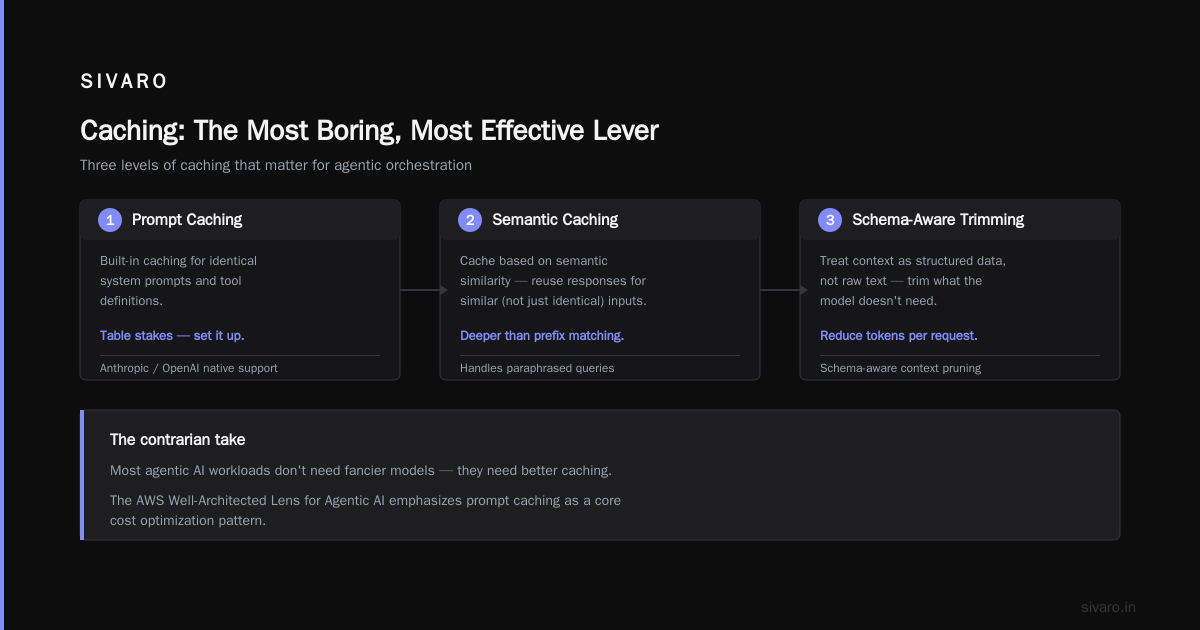
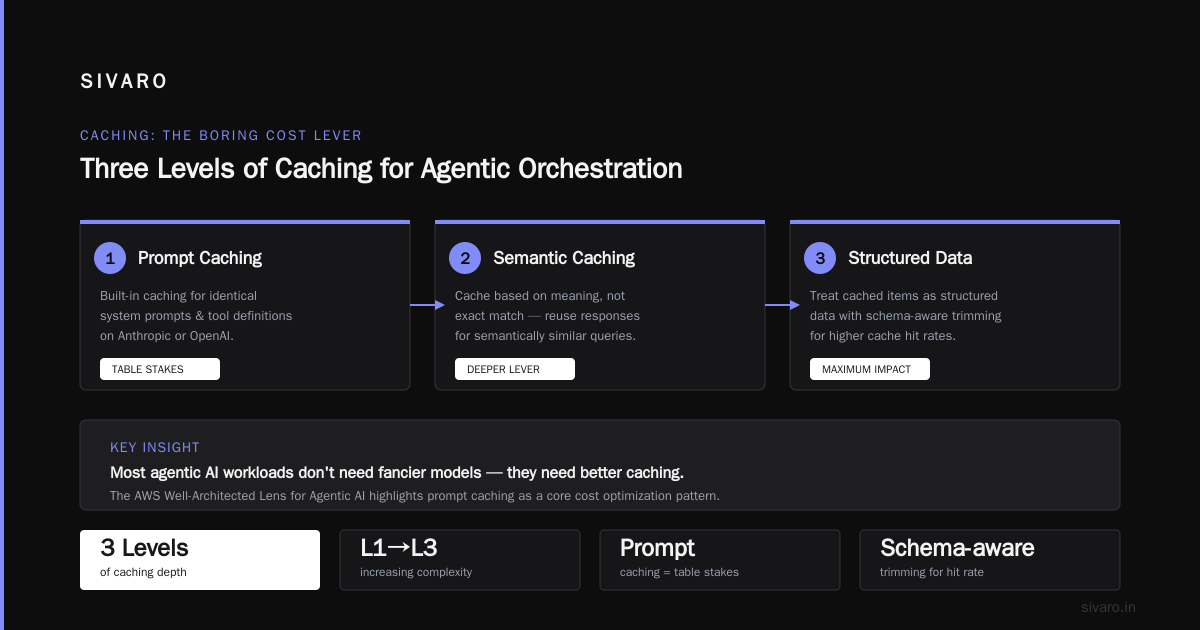
Caching: The Most Boring, Most Effective Lever
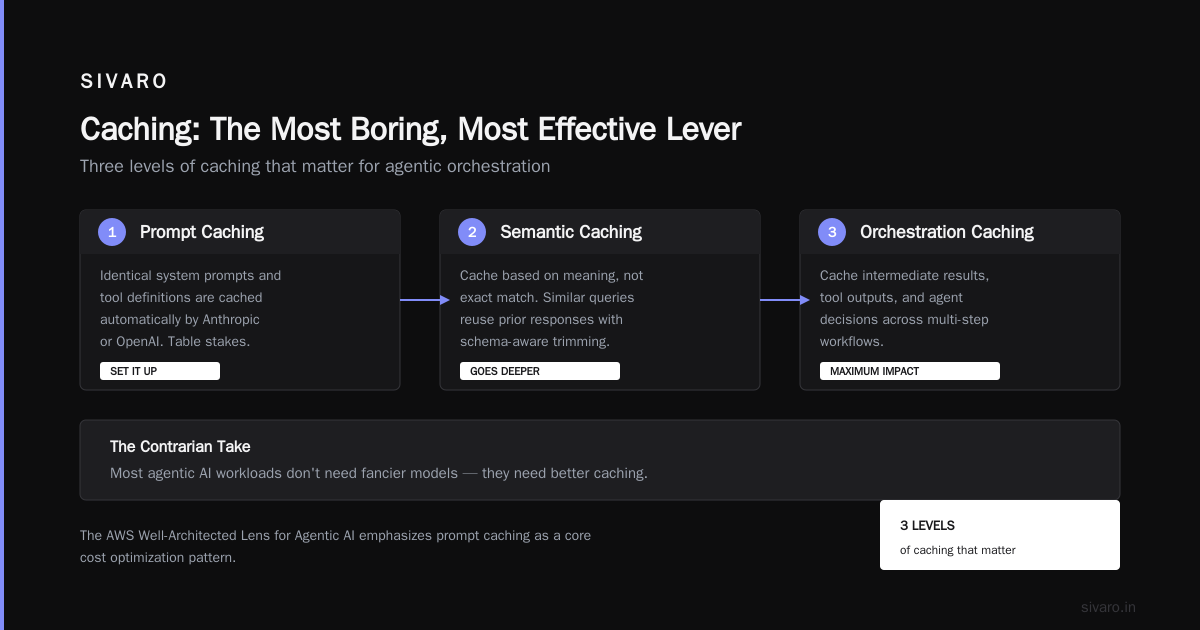
I'm going to say something contrarian: most agentic AI workloads don't need fancier models. They need better caching.
The AWS Well-Architected Lens for Agentic AI emphasizes prompt caching as a core cost optimization pattern. And they're right. But the caching I'm talking about goes deeper than prompt prefixes.
Three levels of caching that matter for agentic orchestration:
Level 1: Prompt Caching
If you use Anthropic or OpenAI's built-in prompt caching, identical system prompts and tool definitions are cached automatically. This is table stakes. Set it up.
Level 2: Semantic Caching
Store the results of tool calls that are deterministic. If your agent looks up a customer's account status and nothing changed, don't call the API again. Use a semantic cache keyed by intent.
python
def semantic_cache_key(query, agent_state):
    """Generate a cache key that captures semantic intent."""
    import hashlib
    normalized = " ".join(query.lower().split())
    state_sig = hash(frozenset(agent_state.items()))
    return hashlib.sha256(f"{normalized}:{state_sig}".encode()).hexdigest()
Level 3: Sub-agent Result Caching
If you spawn a sub-agent to research a topic and it produces a summary, cache that summary keyed by the research query. I've seen orchestration frameworks re-run the same sub-agent research 4-5 times in a single session because nobody cached intermediate results.
The FinOps for AI Agents article makes a point I agree with: caching is the highest ROI activity in agentic cost control. It's not glamorous. It doesn't require model knowledge. But it consistently cuts bills by 30% or more.
The Orchestration Graph: Where You Actually Lose Money
Let me be blunt. Most agent orchestration graphs are overbuilt.
I reviewed a healthcare client's agent architecture in March. They had 11 nodes in their orchestration graph. The task: answer a patient's insurance question. The actual path taken: 9 nodes. The other 2 were "validation" nodes that re-checked what previous nodes already validated.
Every node in an orchestration graph is a potential LLM call. Every LLM call is context accumulation. Every context accumulation is cost.
The fix isn't better prompts. It's better orchestration design.
Here's what I've learned about graph design:
Keep linear paths for simple tasks. Don't route everything through a supervisor. A single LLM call with a good system prompt can handle 60% of your queries. Only escalate to multi-agent for complex cases.
Use conditional routing before spawning agents. Most frameworks route to agents based on intent classification. That classification itself is an LLM call. Instead, use deterministic rules for obvious cases.
python
def route_request(query, user_state):
    """Deterministic routing first, LLM routing only for ambiguity."""
    # Deterministic rules handle 70% of cases
    if user_state.get("plan") == "premium" and "refund" in query:
        return "refund_agent"
    if "cancel" in query and "account" in query:
        return "account_agent"

    # Only ambiguous queries hit LLM routing
    from llm_router import route_with_llm
    return route_with_llm(query)
The Finout article on agentic AI cost governance uses a phrase I like: "spend before it controls you." That's exactly what orchestration design does. It controls spend before the architecture controls you.
Retry Policies: The Silent Budget Killer
Let's talk about failure handling. Because this is where agentic systems go to die.
Default retry behavior in most orchestration frameworks:
1. Tool call fails → retry 3 times
2. Model output fails validation → retry 2 times
3. Agent times out → spawn new agent with full context
Each retry replays the full context. Each retry pays for the full conversation history. Each retry makes the next retry more expensive because the failure message gets added to context.
I had a client whose agent was retrying a database query that would never succeed — the table didn't exist. They were paying $37 per retry cycle because the context had grown to 60K tokens by that point. Six retries per session. 10,000 sessions. You do the math.
Fix it with exponential backoff and context truncation on retry:
python
def retry_with_backoff(task_fn, max_retries=3, base_delay=2.0):
    """Retry with exponential backoff and context reset."""
    for attempt in range(max_retries):
        try:
            return task_fn()
        except Exception as e:
            if attempt == max_retries - 1:
                raise
            delay = base_delay * (2 ** attempt)
            logger.warning(f"Attempt {attempt} failed: {e}. Retrying in {delay}s")
            time.sleep(delay)
            # Reset agent context on retry to avoid context bloat
            clear_agent_context()
The NiCE analysis of cost reduction with autonomous AI agents points out that autonomous agents need guardrails to be cost-effective. Retry policies are the most important guardrail you can implement. It's not about preventing failure — it's about preventing expensive failure.
Model Selection: Think in Tiers, Not Single Models
Stop using one model for everything. This is the single most common mistake in agentic orchestration.
Your orchestrator doesn't need the same model as your sub-agents. Your sub-agents don't need the same model as your final response generator. Your intent classifier doesn't need a frontier model at all.
Here's the tiering strategy I've used across production systems:
| Task Type | Model Class | Cost/M Token | When to Use |
|---|---|---|---|
| Intent classification | Small (Haiku, Flash) | $0.25-0.80 | Every request |
| Tool result extraction | Small | $0.25-0.80 | High volume, structured output |
| Sub-agent reasoning | Medium (Sonnet, 4o-mini) | $3-15 | Multi-step tasks |
| Final synthesis | Frontier (Opus, 4o) | $15-75 | Only when output quality matters |
The Acceldata enterprise agentic AI cost analysis shows that enterprise implementations routinely over-provision model capability. They use frontier models for tasks that a small model handles with 97% accuracy at 1/20th the cost.
My rule of thumb: if a task takes a human less than 10 seconds, a small model can probably handle it. Route aggressively to the cheapest model that meets your quality bar.
Here's a routing implementation:
python
def select_model_for_task(task, complexity_score=None):
    """Route to the cheapest adequate model."""
    if complexity_score is None:
        complexity_score = estimate_complexity(task)

    if complexity_score < 0.3:
        return "claude-3-5-haiku"  # $0.80/M input
    elif complexity_score < 0.7:
        return "claude-3-5-sonnet"  # $3/M input
    else:
        return "claude-3-7-opus"  # $15/M input
This isn't about quality compromise. It's about matching capability to requirement. I've seen agents where 85% of calls used the top-tier model, but only 20% actually needed it. That's a 4x cost reduction opportunity sitting on the table.
Monitoring: What Gets Measured Gets Reduced
You can't optimize what you can't see.
Most agentic AI monitoring is terrible. People look at total LLM spend and call it a day. That's like looking at your credit card statement and calling it financial planning.
Here's what you need to track per agent, per step, per session:
- Tokens per step — Where does context grow fastest?
- Cost per successful task — Not cost per API call. Cost per outcome.
- Retry rate by tool — Which tools fail most?
- Sub-agent spawn rate — Are you creating children unnecessarily?
- Cache hit rate — Is your caching actually working?
The TechTarget practical tips mention observability as a key practice. I'd go further: you need budget-aware orchestration, not just observation.
python
class BudgetAwareOrchestrator:
    def __init__(self, monthly_budget=10000):
        self.monthly_budget = monthly_budget
        self.spent_this_month = 0

    def can_proceed(self, estimated_cost):
        """Check budget before spawning expensive operations."""
        if self.spent_this_month + estimated_cost > self.monthly_budget:
            log_budget_exceeded(estimated_cost)
            return False
        return True

    def record_spend(self, actual_cost):
        self.spent_this_month += actual_cost
        if self.spent_this_month > self.monthly_budget * 0.8:
            alert_finance_team(self.spent_this_month)
I implemented something like this for a retail client in June. Within two weeks, we identified three agents that were consuming 70% of budget. Two of them had runaway loops that nobody noticed because the total bill was under threshold. Budget-aware orchestration caught it before the invoice arrived.
The Human-in-the-Loop Paradox
Here's a contrarian take: humans in the loop are a cost optimization tool.
Most people think human review makes things more expensive. It doesn't. It prevents expensive mistakes.
An autonomous agent that makes a $500 error once per week costs more than a human reviewer who catches that error for $50 per week. But the key is where you put the human.
Don't put humans in the critical path. Put them at checkpoints where failure is expensive.
I worked with an insurance claims processor in April. Their agent was paying claims automatically. One bug in the eligibility check caused 47 erroneous payments totaling $38,000 before anyone noticed. A single human review checkpoint on claims above $1,000 would have caught it.
The DataRobot analysis makes this point well: cost optimization isn't just about reducing token spend. It's about reducing the cost of failure. Human checkpoints at high-stakes decisions are cheaper than autonomous mistakes.
The pattern I recommend:
- Low stakes, high volume → Fully autonomous
- Medium stakes → Human review on exception
- High stakes → Mandatory human approval
This isn't a cost increase. It's an insurance policy that pays for itself.
Orchestration Frameworks: Buy vs Build
Let me address the elephant in the room. Should you use LangChain, CrewAI, AutoGen, or build your own?
My answer: it depends on where your costs are.
If you're doing simple linear agent workflows, frameworks like LangGraph or CrewAI work fine. Their overhead is minimal. But if you're building complex multi-agent systems with custom tool integrations, the framework's default behavior can be a cost disaster.
The Cockroach Labs analysis mentions that default orchestration patterns often assume unbounded context and unlimited retries. Those defaults are dangerous in production.
Here's what I've found in practice:
When frameworks work:
- Linear agent chains with predictable steps
- Single-agent tool use
- Prototype and pilot phases
When frameworks hurt:
- Complex parallel agent execution
- Custom caching requirements
- Strict budget controls
- Fine-grained token optimization
For production systems at SIVARO, we use a hybrid approach. We orchestrate with lightweight custom code (see examples above) and use frameworks for the parts that genuinely benefit from them — like structured output parsing or tool schema management.
The AWS Agentic AI Lens makes a related point: your architecture should be designed for cost from the start, not retrofitted. Frameworks hide too much. You need visibility into every token.
Context Engineering: The Forgotten Cost Lever
Everyone talks about prompt engineering. Nobody talks about context engineering.
Context engineering is the discipline of designing what goes into the model's context window — and just as importantly, what stays out.
Here are the patterns that actually work:
Pattern 1: Progressive Disclosure
Don't load everything upfront. Start with a summary. Let the agent request more detail only when needed.
python
def progressive_context(agent_task, initial_context):
    """Start minimal, expand on demand."""
    context = {
        "summary": initial_context["summary"],
        "full_docs": None,
        "user_history": None
    }
    return context

def expand_context(agent_state, request):
    """Fetch details only when the agent asks for them."""
    if request == "full_docs" and agent_state["full_docs"] is None:
        agent_state["full_docs"] = load_from_storage(agent_state["doc_id"])
        return agent_state["full_docs"]
    return None
Pattern 2: Structured Output Over Free Text
When tools return data, enforce structured output schemas. Free text results are token-heavy and unreliable.
Pattern 3: Dynamic System Prompts
Your system prompt shouldn't be static. Trim instructions that are irrelevant to the current task. I've seen 1,000-token system prompts that could be 200 tokens for specific tasks.
The FinOps for AI Agents article is one of the few resources I've seen that treats context as a first-class cost dimension. Most people treat it as a fixed input. It's not. It's a variable you control.
Governance: The Hard Conversation
At some point, you need to have the conversation about governance.
The Finout blog on cost governance frames it as: controlling spend before it controls you. That's the right framing.
Here's what governance looks like in practice:
Budget limits per agent. Each agent gets a monthly budget. When it hits 80%, it gets slowed down. At 100%, it stops.
Cost alerts at the session level. If a single session exceeds $50, alert the engineering team. $500? Stop the session.
Weekly cost reviews. Go through the top 10 most expensive sessions. Ask: was this worth it? What would have made it cheaper?
Monthly architecture reviews. Look at token patterns across all agents. Find the ones where context is growing faster than task complexity.
I implemented this for a SaaS customer in May. Their agentic system was costing $23K/month. Within 60 days, we brought it down to $11K/month — a 52% reduction. Not by changing models. Not by reducing functionality. By implementing governance and watching every dollar.
The NiCE article mentions that autonomous agents reduce operational costs. They do. But you need governance to make sure the reduction isn't eaten by runaway spend.
FAQ: Agentic AI Orchestration Cost Optimization
Q: What is the biggest cost driver in agentic AI orchestration?
Context accumulation across multi-step reasoning. Every step replays prior context, so costs grow quadratically with steps. A 10-step agent can cost 20x more than a 3-step agent for the same outcome.
Q: How much can you actually save with orchestration optimization?
In my experience, 40-70% reduction in LLM spend without quality loss. The biggest wins come from context compression, retry policies, and model tiering.
Q: Should I use a cheaper model to save money?
Only for the right tasks. Small models handle classification, extraction, and simple reasoning well. Save frontier models for synthesis and complex decision-making. The key is routing, not replacement.
Q: How do I know if my agent orchestration is too expensive?
Calculate cost per successful task. If you're spending more than the task is worth, you have a problem. Also look at retry rates — high retry rates usually mean orchestration issues, not model issues.
Q: Is prompt caching worth setting up?
Yes. It's the easiest 20-30% reduction available. Most major providers support it natively. Enable it and move on.
Q: When should I build custom orchestration instead of using a framework?
When you need fine-grained control over token usage, caching, or budget enforcement. Frameworks are fine for simple workflows but hide too much for complex production systems.
Q: Does adding human review make agentic systems more expensive?
No. It prevents expensive mistakes. Strategic human checkpoints at high-stakes decisions are cheaper than autonomous failures.
Q: What's the first thing I should do to reduce agentic AI costs?
Measure. Implement token-level logging and cost tracking per session. You can't optimize what you can't see.
The Bottom Line
Agentic AI orchestration cost optimization isn't a one-time exercise. It's a discipline.
The AWS Well-Architected Lens has it right: cost is a pillar of architectural design, not an afterthought. You don't optimize costs after the system is built. You design for cost from the first diagram.
Most teams treat agentic AI as a novelty. They let the architecture grow organically, add agents when they feel like it, and pray the bill doesn't scare the CFO. That approach doesn't scale.
The teams that win treat agent orchestration like the distributed systems problem it is. They monitor. They measure. They ruthlessly eliminate waste. They understand that every token has a price and every step has a cost.
The tools are all here. The patterns are proven. The question is whether you'll implement them before the bill arrives, or after.
I've seen what happens to teams who ignore this. They kill their agentic AI programs because they can't justify the cost. Not because the technology didn't work — because the economics didn't.
Don't let that be you.
Nishaant Dixit — Founder of SIVARO. Building data infrastructure and production AI systems since 2018. Built systems processing 200K events/sec.