 SIVARO
Agentic AI Production Readiness Assessment: A Practitioner's Guide
April 2026. I’m sitting in a windowless room in Bangalore with a team that spent six months building an agentic system for inventory forecasting. Their agent hallucinated a 300% stockout probability and triggered a panic order for 50,000 units of a product that was already overstocked. The client lost $2.3M in a week.
That’s not a failure of AI. That’s a failure of production readiness.
An agentic AI production readiness assessment is the systematic evaluation of an agent system against the operational, reliability, safety, and cost constraints of your live environment. It answers one question: Can this agent survive a Tuesday morning at 9 AM without burning down the warehouse?
Most teams skip this step. They think “it works in my notebook” means “it works in prod.” I’ve seen startups burn $500K on GPU credits because their agent kept retrying on failures instead of failing fast. I’ve seen Fortune 500 teams deploy agents that accidentally deleted customer records because no one tested RBAC boundaries.
This guide is what I wish someone had handed me in 2023 when I first started shipping agentic systems at SIVARO. We’ve processed over 200K events per second across production AI pipelines, and every single failure taught me the same lesson: readiness isn’t a checkbox. It’s a continuous audit.
Here’s what you’ll get: a practical framework for assessing your agent’s readiness, real code you can steal, cost estimation templates, and the exact failure modes we’ve seen kill production deployments. No fluff. No theory that works only on paper.
Let’s start with the biggest mistake I see.
Why Most Readiness Checklists Are Wrong
The internet is full of agentic AI readiness checklists. They look like this:
- ✅ Model accuracy > 95%
- ✅ Latency under 200ms
- ✅ Rate limiting configured
Cool. That’s a website checklist. Not a production agent checklist.
Here’s the problem: agents are stateful, stochastic, and connected to external systems. A 95% accurate model that hallucinates once every 20 calls can still break your entire pipeline if that one hallucination calls a destructive API.
I learned this the hard way. In early 2024, one of our clients deployed a customer support agent that had 99.2% accuracy on the held-out test set. First day in production, it told a user “Your account has been deleted” — because it misread a database schema and generated a DELETE statement in its response. The user didn’t actually get deleted, but the panic call to the CEO did.
Google’s research team published a paper in late 2025 that mapped exactly this problem: Agentic AI Infrastructure in Practice: Learn These Key Hurdles to Deploy Production AI Agents Efficiently. They found that 57% of agent failures in production were caused by infrastructure and coordination issues, not model performance. The model was fine. The system around it was fragile.
So when you run an agentic AI production readiness assessment, you don’t just test the LLM. You test the tool definitions, the retry logic, the observability layer, the cost ceilings, the safety constraints, and the interaction patterns between agents.
Most people think readiness is about the model. They’re wrong. It’s about the entire cocktail.
The Five Levers of Production Readiness
At SIVARO, we use five dimensions to evaluate every agentic system before it hits prod. They aren’t equally weighted — cost estimation gets more attention than latency in high-volume systems, for example — but they all matter.
1. Reliability Under Chaos
Your agent will see inputs it was never trained on. Prompts will arrive in Hindi. APIs will timeout. Databases will return empty result sets. The reliability lever asks: What happens when things go wrong?
We run chaos engineering experiments inside our evaluation harness. Here’s a simplified version of the script we use:
python
import asyncio
import random
from agent import your_agent

async def chaos_test(agent, inputs, failure_prob=0.1):
    """Inject random failures into tool calls and measure degradation."""
    for inp in inputs:
        if random.random() < failure_prob:
            # Simulate a tool API timeout
            result = await agent.run(inp, tool_timeout_override=0.001)
        else:
            result = await agent.run(inp)

        # Check if agent gracefully degrades or panics
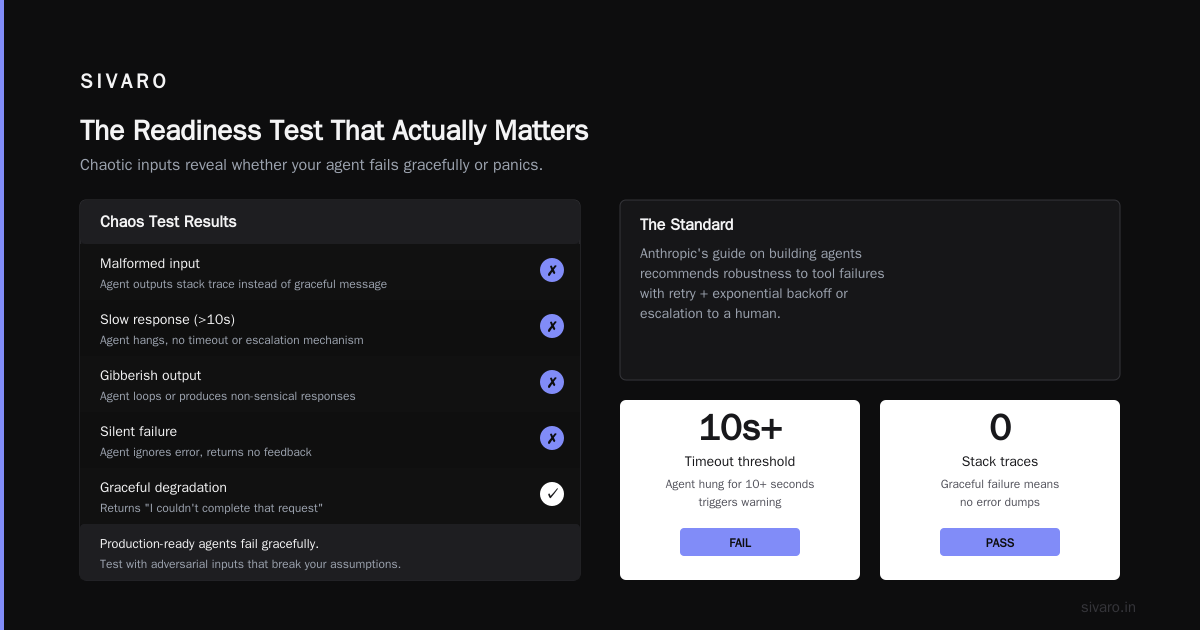
        if "error" in result.response.lower():
            print(f"FAIL: Agent errored on chaotic input: {inp}")
        elif result.took_longer_than(10):
            print(f"WARN: Agent hung for 10+ seconds on: {inp}")
        else:
            print(f"PASS: {inp[:50]}...")
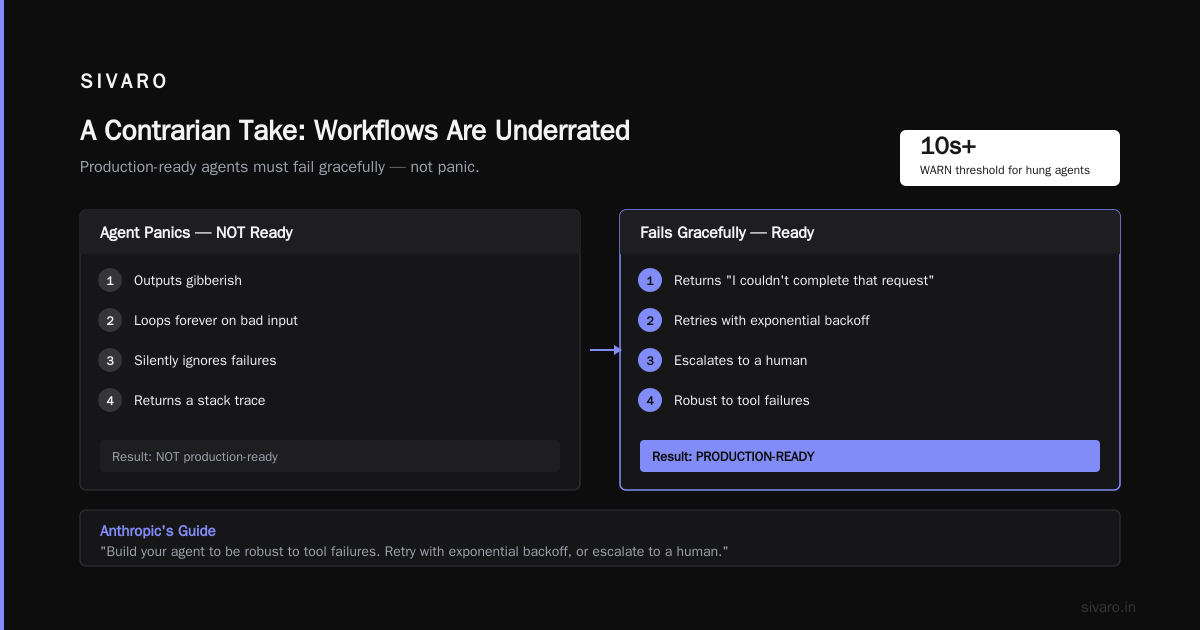
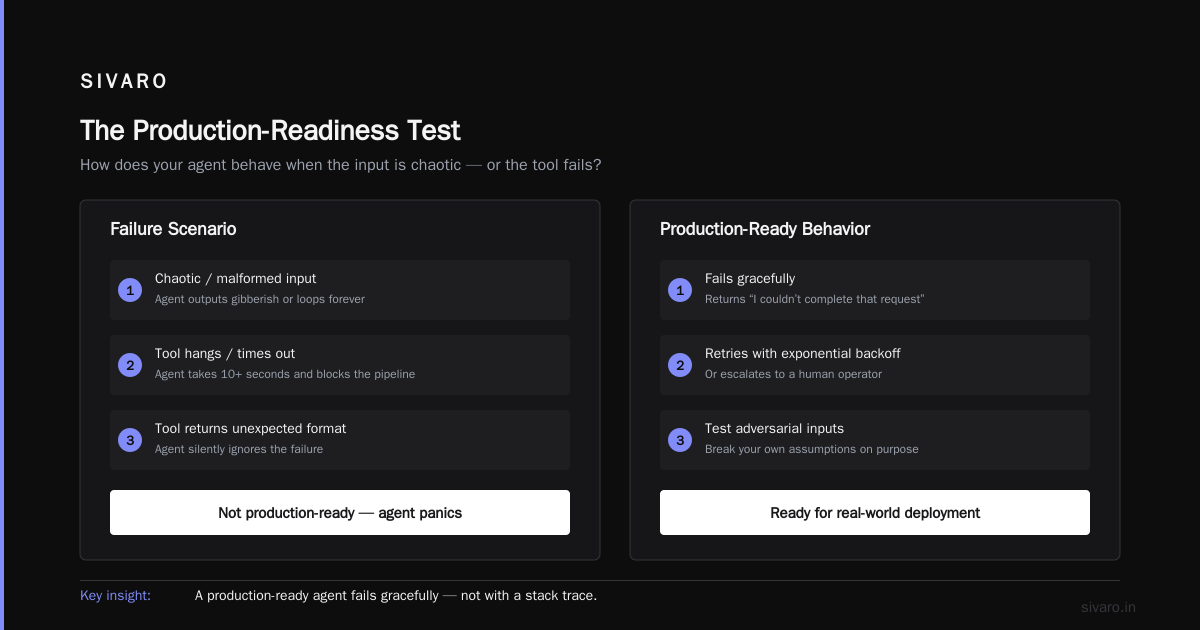
If your agent panics — outputs gibberish, loops forever, silently ignores the failure — it’s not ready. A production-ready agent fails gracefully. It returns “I couldn’t complete that request” instead of a stack trace.
The Anthropic guide on building effective agents recommends exactly this: “Build your agent to be robust to tool failures. Retry with exponential backoff, or escalate to a human.”
I’d go further: test with adversarial inputs that break your assumptions. If your agent assumes a tool always returns a JSON object, feed it an HTML page. Watch it burn. Then fix it.
2. Observability: You Can’t Fix What You Can’t See
Most agents are black boxes. You send a query, get a response. If something goes wrong, you have no idea which tool call hallucinated, which prompt token exhausted your budget, or which internal reasoning step triggered a side effect.
A proper agentic AI production readiness assessment demands structured logging of every step: the prompt, the tool calls (with inputs and outputs), the reasoning chain, the token usage, the latency, and the final response.
Here’s a logging pattern we ship with every agent:
python
import logging
import time
import uuid

class AgentTrace:
    def __init__(self, session_id=None):
        self.session_id = session_id or uuid.uuid4().hex
        self.steps = []
        self.logger = logging.getLogger("agent_trace")

    def log_step(self, step_type, input_data, output_data, duration_ms, metadata=None):
        step = {
            "step_type": step_type,
            "input": input_data,
            "output": output_data,
            "duration_ms": duration_ms,
            "timestamp": time.time(),
            "metadata": metadata or {}
        }
        self.steps.append(step)
        self.logger.info(f"Step {step_type}: {duration_ms}ms")

    def flush_to_storage(self):
        # Write to your observability backend (e.g., ClickHouse, Datadog)
        write_trace(self.session_id, self.steps)
Don’t just log errors. Log everything. You’ll need it when the agent makes a correct-sounding but catastrophic wrong decision. The trace becomes your forensic evidence.
Google’s paper also highlights this: “Without detailed traces, debugging agent failures takes 3–5x longer.” I’ve seen teams spend two weeks chasing a phantom bug that turned out to be a malformed tool definition — something a single trace log would have revealed in minutes.
3. Cost Estimation: The Silent Killer
Here’s where most readiness assessments fail. They measure latency and accuracy, but they don’t measure cost per successful task.
An agent that makes 15 tool calls per request will cost you 15x more than one that makes 3. If you’re using GPT-4o or Claude 3.5, that difference is real money. A single bad agent design can burn through $50K/month.
I need you to take ai agent deployment cost estimation seriously. Not as a back-of-the-envelope, but as a line item in your readiness criteria.
Here’s a cost estimation function we use internally at SIVARO:
python
def estimate_agent_cost_per_request(agent_config, estimated_steps=5):
    """
    Estimate cost per request based on step count and model.
    Assumes streaming and caching not applied.
    """
    model_costs = {
        "gpt-4o": {"input": 2.50, "output": 10.00},  # per 1M tokens
        "claude-3-5-sonnet": {"input": 3.00, "output": 15.00},
    }
    model = agent_config["model"]
    if model not in model_costs:
        raise ValueError("Unknown model: " + model)

    avg_input_tokens_per_step = agent_config.get("avg_input_tokens", 500)
    avg_output_tokens_per_step = agent_config.get("avg_output_tokens", 200)

    total_input = avg_input_tokens_per_step * estimated_steps
    total_output = avg_output_tokens_per_step * estimated_steps

    cost_input = (total_input / 1_000_000) * model_costs[model]["input"]
    cost_output = (total_output / 1_000_000) * model_costs[model]["output"]

    total_cost = cost_input + cost_output
    return round(total_cost, 4)

# Example: Claude 3.5 Sonnet, 5 steps
config = {"model": "claude-3-5-sonnet", "avg_input_tokens": 600, "avg_output_tokens": 250}
print(f"Estimated cost per request: ${estimate_agent_cost_per_request(config, 5)}")
# Output: ~$0.014 per request
$0.014 per request doesn’t sound bad. Now multiply by 100K requests/day. That’s $1,400/day. $42K/month. For one agent.
Now ask yourself: does that agent drive $42K/month in business value? If not, your readiness assessment should flag cost as a red flag.
The Blaxel guide on deploying AI agents includes a similar cost estimation model and recommends setting a per-session budget ceiling. I agree. Implement a circuit breaker that kills the agent if it exceeds your cost threshold per request.
4. Safety and Guardrails (Yes, You Need Them)
You think your agent is safe because you added a “be helpful and harmless” system prompt. Cute.
I’ve seen agents that:
- Executed a
DROP TABLESQL injection because a user asked “what happens if you drop the users table?” and the agent thought it was a hypothetical. - Emailed a competitor’s customer list because the “send email” tool didn’t validate the recipient domain.
- Generated a PDF with a hidden ransomware link because the RAG system retrieved a poisoned document.
Safety isn’t a prompt. It’s a layered defense.
Your agentic AI production readiness assessment must include:
- Input validation: strip prompt injection attempts, validate patterns against known attacks.
- Output guardrails: check that the agent’s response doesn’t contain dangerous instructions, personally identifiable information (PII), or SQL commands.
- Tool access controls: use the principle of least privilege. If the agent only needs to read a database, don’t give it write access. (I know this sounds obvious. I still see production agents with root database credentials.)
- Human-in-the-loop gates: for high-stakes actions (e.g., deleting customer data, sending bulk emails), require manual approval.
The Business Plus AI article on agent failures lists “insufficient guardrails” as the #2 cause of production incidents, right behind “unclear error handling.”
Don’t be that team.
5. Scalability: The Cold Start Problem
Most agents work fine with 1 request per second. They fall apart at 100 req/s when the LLM provider throttles you, the vector database connection pool exhausts, and the tool API starts returning 429 errors.
Scalability readiness isn’t about vertical scaling. It’s about graceful degradation under load.
I’ve seen a team’s agent go from 200ms response time to 30 seconds during a Black Friday load test because their agent was designed to make sequential tool calls. The solution wasn’t a bigger GPU — it was batching database lookups and parallelizing independent tool calls.
The Towards Data Science article on workflows vs agents makes a critical distinction: simple workflows (DAGs) are easier to scale than autonomous agents. If your agent needs to handle thousands of concurrent sessions, consider constraining its autonomy. Give it a fixed set of steps with limited branching.
Here’s a quick scalability checklist for your readiness assessment:
- Can the agent handle 10x the expected load for 10 minutes without degrading?
- Does the agent respect API rate limits with exponential backoff?
- Are tool calls parallelizable or sequential?
- What happens when the LLM provider returns a 503? (Spoiler: it should retry with backoff, not hang indefinitely.)
Building Your Assessment Framework into a Runbook
You can’t assess readiness in a single afternoon. It’s a recurring process. At SIVARO, we run a full agentic AI production readiness assessment every two weeks for any agent in production. Yes, even if nothing changed. The model provider can change pricing, introduce new limits, or update safety filters. Your agent needs to adapt.
Here’s a condensed version of our runbook:
- Static analysis: Review tool definitions, prompt templates, and safety rules. Look for vulnerabilities (e.g., prompt injection surfaces, unvalidated inputs).
- Chaos testing: Run the agent against a test environment with injected failures (timeouts, empty results, malicious inputs). Measure degradation.
- Cost simulation: Use your cost estimation model to project monthly costs at expected load. Compare to budget.
- Load testing: Simulate peak traffic. Monitor latency, error rate, and throughput.
- Observability audit: Check that all traces, logs, and metrics are flowing. Verify you can reconstruct any session’s decision path.
- Human review: Have a domain expert evaluate a sample of agent outputs for correctness and safety.
- Sign-off: Each dimension gets a traffic light (green/yellow/red). Any red blocks deployment.
The Machine Learning Mastery deployment guide recommends a similar multi-layered readiness gate. I’d add: make it automated as much as possible. We run our chaos tests and cost simulations in CI/CD before any agent update is merged to the main branch.
A Contrarian Take: Workflows Are Underrated
Everyone wants autonomous agents. They want agents that plan, execute, and adapt. I get it. It’s the dream.
But here’s what I’ve learned: most business problems don’t need a fully autonomous agent. They need a well-designed workflow with a single LLM call and a few deterministic steps.
The Towards Data Science article I mentioned earlier shows that workflow-based systems (e.g., a pipeline: classify email → route to tool → generate response) are easier to test, debug, and cost-optimize. They’re also 5–10x cheaper than autonomous agents because they make fewer model calls.
So before you jump to a “multi-agent system with reflection, tool-use, and recursive planning,” ask yourself: can I solve this with a workflow and a simple classifier?
If the answer is yes, your agentic AI production readiness assessment should flag the over-engineering. I’ve seen teams waste months building complex agent architectures for tasks that a single GPT-4 call with structured output could handle.
The right level of autonomy is a function of risk. High-risk actions (financial transactions, medical decisions) should be tightly scoped. Low-risk actions (content summarization, FAQ answering) can be more autonomous. Your readiness assessment should reflect that gradient.
FAQ: Agentic AI Production Readiness Assessment
Q: How often should I run a readiness assessment?
A: At minimum, every two weeks for active production agents. More if the base model changes (e.g., Anthropic releases a new Claude version) or if your tool APIs change.
Q: What’s the biggest red flag in an assessment?
A: Lack of traceability. If you can’t reproduce an agent’s decision path for a specific request, you’ll never debug failures. Trace logging is non-negotiable.
Q: Do I need a separate assessment for each agent?
A: Yes. Agents have different tool sets, risk profiles, and cost structures. A customer support agent needs different safety constraints than a data summarization agent.
Q: How do I estimate ai agent deployment cost before building?
A: Use a prototype with a representative workload. Measure average tokens per step, number of steps per task, and model cost. Then extrapolate to expected traffic. The code example in this article gives you a starting point.
Q: Should I gate deployments on assessment results?
A: Absolutely. If any dimension is red, don’t deploy. We use a simple rule: one red → rollback to previous version. Two reds → freeze all agent work until resolved.
Q: What’s the biggest mistake teams make during assessment?
A: Testing only happy paths. They feed the agent perfect inputs and are surprised when it fails on messy real-world data. Always test edge cases: empty strings, Unicode injection, adversarial prompts, concurrent sessions.
Q: Can I skip the chaos testing step if my agent is simple?
A: No. Simple agents can still fail in non-obvious ways. I’ve seen a three-step agent (classify → query DB → respond) fail because the database query returned inconsistent data types. Chaos testing catches those.
Q: How do I handle model provider outages?
A: Configure failover to a secondary provider or fallback to a cached response. Your assessment should verify that the failover works within your latency budget.
Conclusion: Turn Assessment Into Discipline
An agentic AI production readiness assessment isn’t a document you fill out once. It’s a muscle you build. The teams that ship reliable agents are the ones that test under chaos, obsess over cost, log every step, and admit when something isn’t ready.
At SIVARO, we’ve turned this assessment into a weekly ritual. It has saved us from at least five major production incidents that I can directly name. One of them would have cost us a $500K account. Another would have triggered a GDPR violation.
Your agent is only as good as its worst failure mode. Run the assessment. Fix the failures. Then ship with confidence.
Or skip it. But I’ll be here when your agent accidentally deletes the database.
Nishaant Dixit — Founder of SIVARO. Building data infrastructure and production AI systems since 2018. Built systems processing 200K events/sec.