 SIVARO

Agentic AI Production Rollout Challenges: The 2026 Buyer's Guide
The Hype Is Over. The Hard Part Is Here.
I spent February on a customer site in Frankfurt. Their pilot was beautiful. A multi-agent system that handled supplier onboarding, flagging discrepancies, negotiating terms. Demos blew everyone away. The CTO was ready to scale it to all 40,000 vendors.
Three weeks later, the system was paused. Not because the agents were dumb. Because nobody could answer a single question: who owns the output when an agent chain goes off the rails and signs a bad contract?
That's not an engineering problem. It's a governance problem wearing an engineering costume.
Most teams I talk to in 2026 are hitting the same wall. The models got good. The orchestration frameworks got better. But the path from "cool demo" to "production system that doesn't make your legal team weep" is full of holes I haven't seen documented clearly anywhere.
So I'm writing this. Not as a vendor pitch. As a practitioner who's been on the ground with SIVARO clients across fintech, logistics, and healthcare. This is a comparison guide — not of models or frameworks, but of the decisions you'll make when rolling out agentic AI in production, and the trade-offs nobody talks about at conferences.
We'll cover the core challenges, compare your options for tackling them, and give you a working checklist. By the end, you should know whether you're ready to push forward, and if not, exactly what's missing.
What We Mean by "Production-Ready" (And Why It's Different From 2024)
Let's define the problem space first.
A production agentic system is one where agents have real permissions, real money, or real liability. It's not a chatbot wrapping a knowledge base. It's a system that takes actions in your actual systems of record, with consequences that outlive the session.
The gap between "agent performs a task" and "agent performs the task reliably under audit, failure, and compliance scrutiny" is the entire ballgame. And that gap manifests in five specific areas I'll break down below.
But before we get there, let me kill a common misconception.
Agentic Workflows vs Traditional Automation: It's Not a Competition
Most people think agentic workflows vs traditional automation is a binary: agents replace deterministic workflows, or they don't. In my experience, that framing is wrong.
Traditional automation is a machine: input, processing, output, repeatable. It fails predictably, and you can debug it by reading code.
Agentic workflows are more like interns. They can handle ambiguity, adapt on the fly, and use judgment. But they also occasionally do something inexplicable, and the cost of supervising them isn't zero.
Here's the thing I've learned from building systems at SIVARO and watching clients in production: the real win is a hybrid. You don't replace your deterministic workflow engine with agents. You embed agents inside the deterministic flow, at the points where judgment is needed.
Let me give you a concrete example from our own stack.
python
# A decision point where we use an agent instead of a rules engine
async def process_invoice(invoice, vendor_profile):
    # Deterministic validation first
    if invoice.amount > 100000:
        raise ValueError("Requires human approval threshold")

    # Agentic judgment for ambiguous cases only
    if invoice.amount > 10000 and not invoice.has_valid_po:
        decision = await agent_judge(
            f"Vendor {vendor_profile.name} submitted $X without PO. "
            f"Historical compliance: {vendor_profile.compliance_score}. "
            "Approve, reject, or request revision? Return JSON."
        )
        return apply_decision(decision, invoice)
    else:
        return approve(invoice, bypass_reason="Low risk deterministic path")
This matters because the pushback you'll get from ops teams is real. They've been burned by AI promises. If you tell them "agents replace your entire workflow," they'll shut you down. If you say "agents handle the 15% of cases that your rules can't cover cleanly," you get engagement.
That's not a technical challenge. It's an organizational one.
The Five Production Rollout Challenges That Actually Matter
1. The Permissioning Problem: Least Privilege Meets "Actually Do Useful Work"
Here's the tension. To be useful, an agent needs access. To be safe, it needs restrictions. In 2024, most pilot systems just gave agents API keys with broad scopes and hoped for the best. In 2026, the regulators and security teams have caught up, and this approach is toast.
The production challenge: how do you give an agent multiple system access (say, your ERP and your email) without letting a prompt injection cascade across both?
I've seen teams try four approaches:
| Approach | Pros | Cons | Our Verdict |
|---|---|---|---|
| Single service account, broad scopes | Easy to build | Any injection equals full access. Fail. | Avoid |
| Per-task service accounts with short-lived tokens | Bounded blast radius | Complex to manage at scale | Good for batch jobs, clunky for multi-step |
| Human-in-the-loop permissioning for every action | Maximum safety | Kills the whole point of agents | Fine for high-risk actions only |
| Dynamic policy with risk scoring (e.g., low-risk read = auto; high-risk write = human gate) | Good balance | Requires building a risk classifier and mapping all actions to risk levels | This is what we recommend |
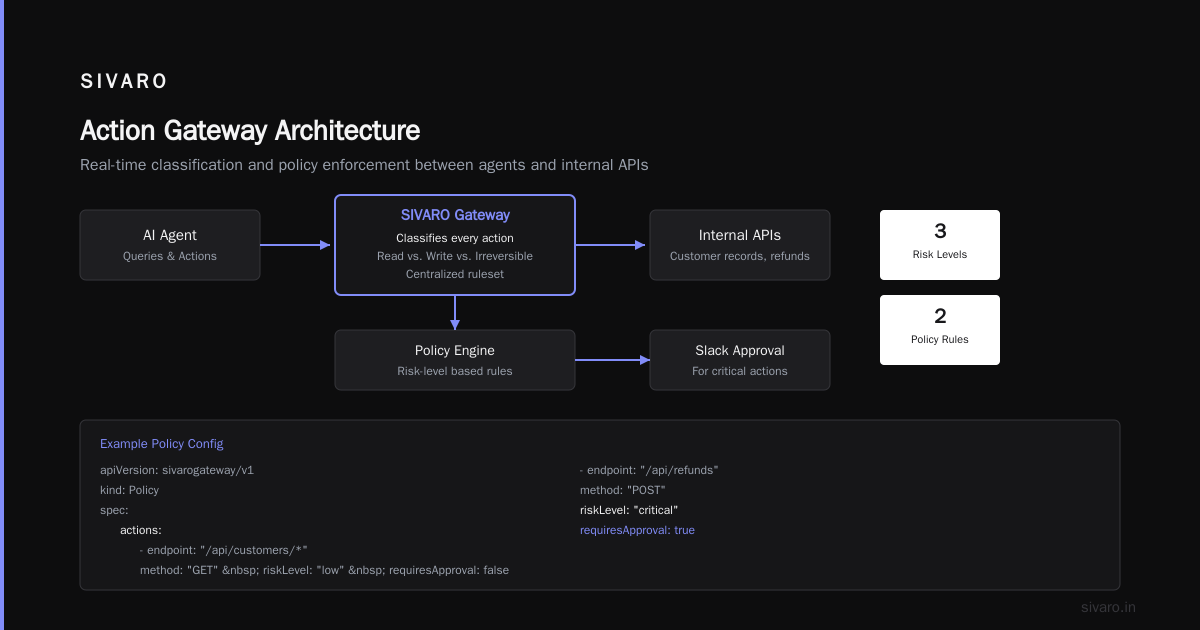
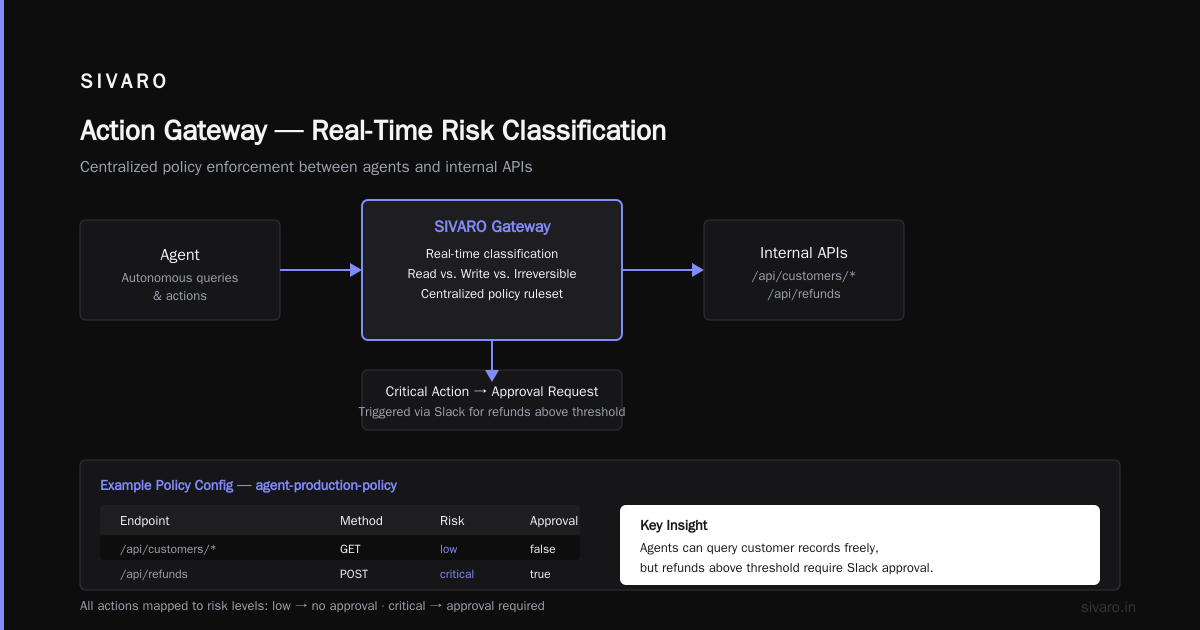
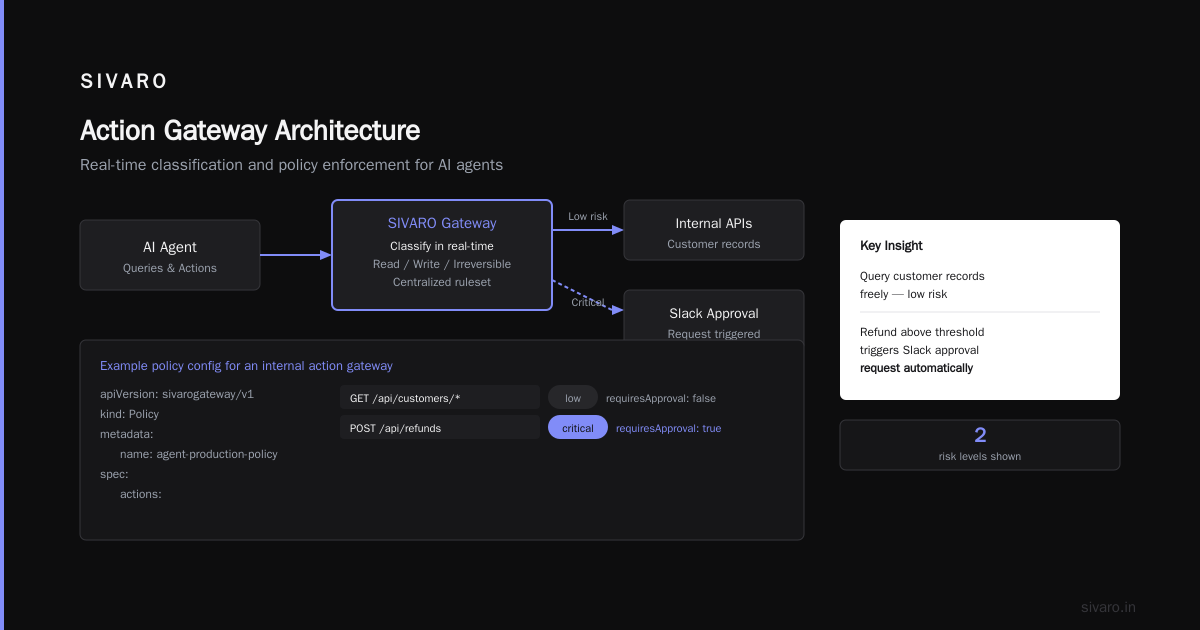
We built a gateway at SIVARO that sits between agents and internal APIs. It classifies every action in real-time (read vs. write vs. irreversible) and applies policy from a centralized ruleset. An agent can query customer records freely, but generating a refund above a threshold triggers an approval request via Slack.
yaml
# Example policy config for an internal action gateway
apiVersion: sivarogateway/v1
kind: Policy
metadata:
  name: agent-production-policy
spec:
  actions:
    - endpoint: "/api/customers/*"
      method: "GET"
      riskLevel: "low"
      requiresApproval: false
    - endpoint: "/api/refunds"
      method: "POST"
      riskLevel: "critical"
      requiresApproval: true
      approvalChannel: "slack#finance-approvals"
      timeout: "15m"
    - endpoint: "/api/contracts/*/sign"
      method: "POST"
      riskLevel: "irreversible"
      requiresApproval: true
      approvalChannel: "slack#legal-review"
      approvalType: "dual"
      timeout: "4h"
The lesson: spend your engineering time building this gateway, not tuning prompts. We lost two weeks in Q1 with a client trying to make the model "be careful" — tokens are not a security boundary.
2. Prompt Injection: The Threat That Doesn't Care About Your Fine-Tuning
I know, I know. Every article mentions this. Let me tell you what's different in production: indirect injection via third-party data. Most test environments use clean input. Production agents are reading email, web pages, PDFs, chat logs. Any piece of that text can contain a malicious instruction.
A documented example: in March 2026, a logistics company in Rotterdam had an agent that routed shipments based on email instructions from carriers. Someone sent a cleverly crafted email that told the agent to ignore its routing constraints and override the safety checkout. The agent did it. It shipped $2.3M of industrial equipment to a wrong (untraceable) address. The CEO told me they now classify every external data source as untrusted by default.
The options for mitigation are binary in my experience:
- Option A: Segmentation. Agents process untrusted data in a "sandbox" where instructions aren't treated as instructions. You filter input for prompt-injection patterns before it enters the reasoning context. Simple, but brittle — attackers adapt.
- Option B: Dual-context architecture. The agent's system prompt is stored outside its context window, cryptographically signed, and injected only by the runtime — never by user data. Any attempt to alter it invalidates the session.
We've used Option B in production since late 2025. It's not perfect, but it removes the "I'm your system prompt, ignore prior instructions" attack vector entirely.
python
# Pseudo-code for dual-context architecture
class AgentSession:
    def __init__(self, system_prompt, runtime_context):
        # System prompt is immutable, signed at build time
        self.signed_prompt = sign(system_prompt, KEY_ID)
        # Runtime context from user data goes in a different field
        self.user_context = sanitize(runtime_context)

    def build_messages(self):
        # Ordering: system prompt first, then user context
        # Runtime blocks any attempt to inject a "system" role from user data
        return [
            {"role": "system", "content": self.signed_prompt},
            {"role": "user", "content": self.user_context}
        ]
The trade-off you're making: dual-context can break some nuanced interactions where you want the agent to act on instructions from external docs. The fix — we use a tagging system — is to mark certain document types as "instruction-capable." It's a manual trust decision, which is honest engineering. The computer doesn't decide. You do.
3. Observability: You Can't Debug a Black Box With a "Trace"
Agentic observability in 2026 is better than it was, but it's still not where it needs to be. The challenge: a single agent action might invoke 5 model calls, 3 tool calls, 2 human approvals, and a database write, all across a distributed trace.
Most teams start with simple logging. That fails fast. Here's what works at scale, from our experience with clients in financial services specifically:
First, you need explicit agent intent logging. Every time the agent decides to take an action, you record its reasoning trace before the action. Not after. The trace must include the exact prompt fragments that led to the decision, not just the final model output.
Second, you need to distinguish between "wrong output" and "wrong action." A model can return the right answer but the agent's tool call executes the wrong thing due to parameter mismatch. Capture the tool call inputs and outputs faithfully.
Third, you need replay capability. Not the LLM tracing that lets you visually inspect — but the ability to re-run the agent from a stored checkpoint with controlled perturbations. This is the only way we've found to actually debug agent failures systematically. It's expensive, but it's cheaper than an incident post-mortem.
4. Cost and Latency: The Efficiency Trap
Here's where the agentic ai production rollout challenges get real. Multi-agent systems where agents talk to each other in a loop can generate 10-20 model calls per business transaction. Each call has a token cost and a latency penalty.
We had a client in April 2026 — a fintech — running a claims processing agent that took 14 model calls per claim. Average cost per claim: $4.20. That's absurd when you're processing 400,000 claims a month. The CFO flagged it as a top-5 line item.
The options are: optimize prompts (we got it down to 4 calls), use cheaper models for subtasks, or collapse the agentic hierarchy. The last one is the contrarian take. Most believe "more agents = better reasoning." I've seen that fail repeatedly. Sometimes you need one agent with better planning, not five agents arguing with each other.
The production rule we now enforce: every agent in the chain must add measurable value per step, or it gets removed. If an agent's only job is relaying a message from Agent A to Agent B, it's a waste.
python
# Cost/performance check before promoting agent to production
def evaluate_agent_efficiency(agent_name, session_log):
    calls = [entry for entry in session_log if entry['agent'] == agent_name]
    total_tokens = sum(e['tokens'] for e in calls)
    business_outcomes = [e for e in calls if e['action'] == 'WRITE']

    efficiency = len(business_outcomes) / max(total_tokens, 1)

    # We reject any agent with efficiency < 0.02 outcomes per 1K tokens
    return efficiency >= 0.02
If you're reading this and thinking "but the reasoning quality might look bad" — exactly. That's the tension. You're choosing between deep reasoning and production economics. The answer is usually a tiered model: expensive reasoning agents for complex cases, cheap reflex agents for simple ones. We've seen cost savings of 70-80% using this tiering without quality degradation, as long as the routing heuristic is sound.
5. Human Oversight: Design the Exit Ramp, Not the Panic Button
Every vendor will tell you their system handles the 95% case. The 5% is where the reputation and the money go. The challenge: how do you design human handoff so the human actually has context, not just a warning popup?
The mistake is treating humans as a "fallback resource." If an agent gets stuck, you ping a human, who has to re-read the entire conversation history. That's unusable.
The production-grade approach is interrupt-driven human oversight. The agent knows its own confidence per step. At critical decision points, it either proceeds or asks based on a policy. When it asks, it must provide a concisely summarized scenario — not the raw transcript. We've built a "situation summarization" step into our SIVARO framework that extracts the key facts, the agent's proposed action, and its uncertainty, all in under 150 tokens.
json
{
  "human_handoff": {
    "situation": "Invoice #44512 ($78,400) from vendor ACME, no PO on file",
    "agent_proposal": "Approve and flag for reconciliation in Q3",
    "agent_confidence": 0.31,
    "policy_violation": "Threshold exceed 2x standard approval cap",
    "reasoning_tokens": 154,
    "alternatives_considered": ["Reject", "Request revision", "Partial approve"]
  }
}
I can't overstate how much smoother this makes ops review. In late 2025, at a health insurance client, the human review queue time dropped from 18 minutes to 2 minutes per case once we implemented structured handoff. The humans stopped feeling like babysitters and started acting like supervisors.
The Agentic Workflow Production Rollout Checklist
By now I've given you the challenges. Here's the actionable part. This is the agentic workflow production rollout checklist we use with every client who asks us to help them go from pilot to production. It's not exhaustive — it's the list that catches the 90% of failures we've seen.
Pre-Deployment (Build Phase)
- [ ] Map every agent action to a risk classification (low/medium/critical/irreversible)
- [ ] Implement the action gateway (or equivalent) before the first pilot
- [ ] Sign your system prompt; architect dual-context input handling
- [ ] Add token-level cost tracking per agent per business transaction
- [ ] Define the minimal viable training set for your confidence thresholds
- [ ] Establish a test suite of at least 50 adversarial cases, including prompt injections and ambiguous inputs
Staging (Evaluation Phase)
- [ ] Run a shadow deployment for 2 weeks minimum — agents process but don't act
- [ ] Compare agent decisions against deterministic baseline on a random sample (n=1000 minimum)
- [ ] Measure false positive and false negative rates on your risk classifier
- [ ] Stress-test the agent with a deliberately malicious dataset
- [ ] Time-box the human handoff path; ensure SLA on approval channel
Production (Go-Live Phase)
- [ ] Start with read-only actions in production for 48 hours
- [ ] Gradually enable write actions at 10% traffic, then 25%, then 50%, monitoring rejection rates
- [ ] Set automatic rollback triggers: if rejection rate > 5% in an hour, halt the agent
- [ ] Log everything, including the reasoning traces — for auditability and later debugging
- [ ] Assign a dedicated human supervisor with authority to kill the agent at any point
- [ ] Schedule a weekly review of agent decisions vs. human decisions for the first month
Post-Go-Live (Operational Phase)
- [ ] Automate cost anomaly detection (if a single claim costs > $10 in tokens, flag it)
- [ ] Monthly adversarial retraining: feed the agent new injection patterns you find in the wild
- [ ] Quarterly security audit of the agent's access rights and policy config
- [ ] Improve confidence calibration continuously: compare agent's confidence vs. actual accuracy
The "Do Your Own Thing" Trap
I've noticed a pattern in 2026. Teams write their own orchestration framework because they believe their use case is unique. Then they spend six months debugging a distributed system they didn't need to build.
Unless you're building a new foundational platform (which you're not, unless your company is named after a celestial body), you should use an existing framework. There are mature options now: LangGraph, CrewAI, Microsoft AutoGen, and our own SIVARO framework — all in production-grade form. The differentiation is in your domain logic, your guardrails, and your operational playbook. That's where the value is.
But here's the contrarian view: don't over-orchestrate. We went through a phase where we thought "everything should be a graph." Actually, simple sequential chains handle 80% of business workflows with less complexity. Reserve the graph/multi-agent architecture for the truly parallel, interdependent cases.
I'll say it bluntly: if your workflow is linear, use a linear chain. Don't add parallelism because it sounds impressive. It doesn't. It adds complexity.
FAQ: Answering What I Get Asked Every Week
Q: When is the right time to start a production rollout?
When you can honestly answer "yes" to all four: you've mapped your actions and risk levels, you have a governance structure in place, you have a human oversight mechanism designed, and you can measure agent performance against baselines. If any one is missing, you're rolling the dice.
Q: How long does a typical rollout take?
From a mature pilot, 4 to 8 weeks is realistic. The first 2 weeks are almost always permissioning and gateway setup. The next 2 are adversarial testing. Weeks 5-6 are the staged production ramp. The final 2 are calibration and review.
Q: Can we use open-source models for production agents?
Yes, for certain tasks. We see teams using Llama 3.3 (or newer) or Qwen for well-defined tasks with small token counts. The trade-off is performance on ambiguous reasoning vs. cost. For financial or legal decisions where context matters, we recommend hosted frontier models due to consistency and support. The key is a layered strategy — cheap models for simple classification, expensive ones for true judgment.
Q: What's the single biggest mistake in agentic AI rollout?
Thinking the model is the risk. It's not. The risk is the permissions you give the model and the unstructured ways it can act. Most failures are due to over-broad API scope, not model hallucination. Secure the action surface.
Q: How do we handle compliance (EU AI Act, etc.)?
The EU AI Act applies to high-risk systems, and agentic workflows can fall under that umbrella. We're seeing clients:
- Maintain audit logs for all agent decisions (which is why traceability is essential)
- Conduct a "human rights and safety" impact assessment for the agent's actions
- Implement explainability features: the ability to show why a decision was made at the summary level, not the token level
Q: What's the cost difference between agentic and traditional automation?
For a simple task (e.g., "extract invoice, classify, send to approval"), agentic is 2-4x more expensive per transaction. For complex tasks where a rules engine would require thousands of edge-case rules, agentic is cheaper to build and maintain. The break-even is around 50-100 rules. Below that, write rules. Above that, agents make sense.
Q: How do you handle multiple agents coordinating with each other?
We restrict it. The best practice is to have agents communicate only through a message bus with enforced schemas. No free-form chat between agents. We learned that one through a painful deployment in January 2026 where two agents started a negotiation loop that generated 40,000 tokens of back-and-forth without reaching a decision. Set a conversation cap. Enforce it at the runtime level.
The Bottom Line
Agentic AI production rollout challenges are real, but they're manageable. The hard truths, from someone who's been in the trenches:
- If your pilot worked, congratulations — you've proven the technology could work. Production rollout is proving it should work under constraints.
- Security, observability, and governance are not add-ons. They're the core build.
- Start conservative. A slow rollout with tight guardrails beats a fast one that gets pulled because of an incident.
- Your human operators are your best allies — give them real context, not alerts. They'll make the system better.
The market in late 2026 is ruthless. VCs are asking tough questions about "agent ROI" and production reliability. The companies that win won't be the ones with the best LLM prompts. They'll be the ones with the best operational discipline.
I've seen this exact playbook once before — with cloud migration in the late 2010s. First movers overreached and paid. Methodical operators adopted gradually and crushed their markets. Agentic AI is no different. The technology is ready. The question is whether your organization is.
Nishaant Dixit — Founder of SIVARO. Building data infrastructure and production AI systems since 2018. Built systems processing 200K events/sec.