 SIVARO
Agentic AI Production System Design
Agentic AI is eating the software world. But most deployments are burning to the ground.
I've spent the last eight years building data infrastructure at SIVARO. The patterns that worked for streaming pipelines are the same ones that make or break agentic systems in production. The difference is that agents are unpredictable in ways your Kafka cluster never was.
The gap between a demo that impresses your CEO and a system that survives a Tuesday afternoon is enormous. Most teams find this out the hard way. This guide is about skipping that particular learning experience.
What Agentic AI Production System Design Actually Means
Agentic AI production system design is the discipline of building AI systems that make decisions and take actions autonomously, then keeping those systems alive, observable, and safe in production. It's not prompt engineering. It's not model fine-tuning. It's infrastructure, architecture, and operations.
Think of it as the difference between building a race car and driving one in the Indy 500. Both require skill. One requires surviving lap 200.
Here's what you'll learn:
- Why workflow orchestration beats letting models run wild
- The six elements that separate production agents from prototypes
- Specific deployment strategies that don't fall apart at 10,000 requests
- How to roll back an agentic system without losing your mind
- The observability stack you actually need
- Why security has to be designed in, not bolted on
The Hype Is Real, The Math Is Worse
Let's talk about why agentic systems fail in production.
A language model has a certain error rate per step. Let's say it's 98% accurate. That sounds great. But chain ten steps together and your success rate drops to 82%. Chain fifty steps and you're at 36%.
Most teams don't do this math before they deploy.
From Proof of Concept to Production: Why Agentic AI Workflows Fail at Scale breaks down the failure modes. The number one killer is compounding errors. The second is latency. The third is cost. None of these show up in a demo with five hand-picked examples.
At first I thought this was a quality problem — better models would solve it. Turns out it's an architecture problem.
Workflows vs Agents: Choose Your Fighter
There are two ways to build agentic systems. Workflows are predefined paths where the LLM fills in the blanks. Agents are autonomous loops where the model decides what to do next.
Both are useful. Neither is universally better.
Agentic AI Explained: Workflows vs Agents makes the distinction clear. Workflows are deterministic. They're predictable, testable, and cheap. Agents are flexible. They handle novel situations but they're harder to control.
Here's my rule: if you can define the steps, use a workflow. If you can't, use an agent. And if you're not sure, start with a workflow.
The Orchestration Layer
Every production agentic system needs an orchestrator. Not a framework. An orchestrator.
A framework is a library. An orchestrator is a service that manages state, retries, and recovery. The difference matters when your system is handling real traffic.
The agentic workflow patterns on AWS are a good reference. They cover the router pattern, the evaluator-optimizer pattern, and the supervisor pattern. Each has its place.
We tested the supervisor pattern at SIVARO for a client in the fintech space. It worked. But the latency overhead was brutal. Every request had to hit the supervisor, the supervisor had to think, then route. When you're processing 200,000 events per second, that's not sustainable.
We switched to a hybrid. Workflows for the common paths. A supervisor agent for edge cases. The 80/20 rule applied — 80% of requests used the deterministic workflow, 20% escalated to the agent.
The Six Elements of Production-Grade Agentic Systems
McKinsey's work on agentic AI deployment identifies six elements. Here's what they don't tell you about each one.
1. State Management
Agents need memory. Not the context window — actual durable state.
You need to know what the agent has done, what it's doing, and what it plans to do next. This is your system of record. Redis, Postgres, whatever. Just make it durable.
2. Observability
You can't debug what you can't see. And agents are black boxes that generate their own reasoning traces.
We built a custom tracing layer at SIVARO that captures every prompt, every response, every tool call, and every token count. It's ugly. It's necessary.
3. Security
Agents have more privileges than traditional software. They can call APIs, read databases, send emails. That's a lot of attack surface.
You need to scope credentials to the minimum required for each task. And you need to validate every tool output before it goes back into the model. Prompt injection is not theoretical anymore.
4. Evaluation
You need automated tests that measure whether your agent is doing the right thing. Unit tests don't work for LLMs. You need evals.
5. Guardrails
Define what the agent can't do before you define what it can. Content filters, action constraints, approval workflows for high-impact actions.
6. Cost Management
Token costs add up fast. An agent that makes 50 tool calls per task is 50x more expensive than a workflow that makes 2.
Why Most PoCs Fail in Production
The gap between proof of concept and production is not a gap. It's a canyon.
Your PoC has three example cases. Production has ten thousand edge cases. Your PoC runs on a single machine. Production needs horizontal scaling. Your PoC has no security review. Production is audited by people who don't care about your prompt engineering.
The report on PoC to production failures hits on the core issue: teams optimize for demo performance instead of production resilience.
I've seen this at three companies in the last year alone. They build a demo that works beautifully. Then they show it to leadership. Leadership says "ship it." And the team has to retrofit everything — observability, security, state management, rollback — while the system is already live.
Don't be that team. Build production features from day one.
The State Machine Pattern That Saved My Sanity
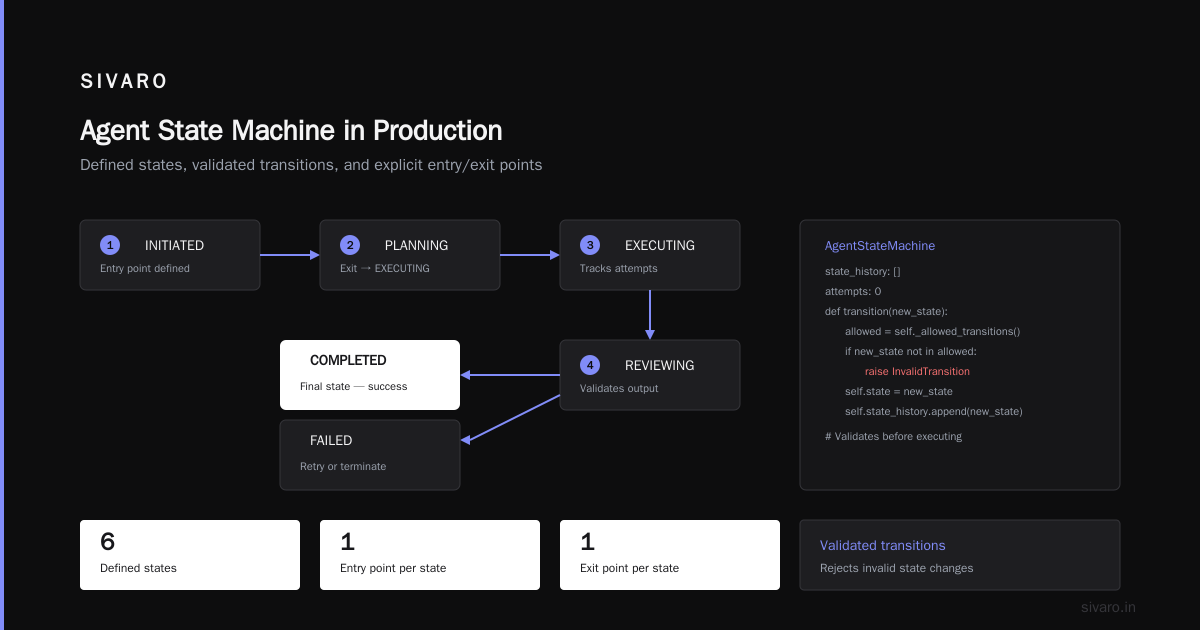
The single most important pattern in agentic AI production system design is the state machine.
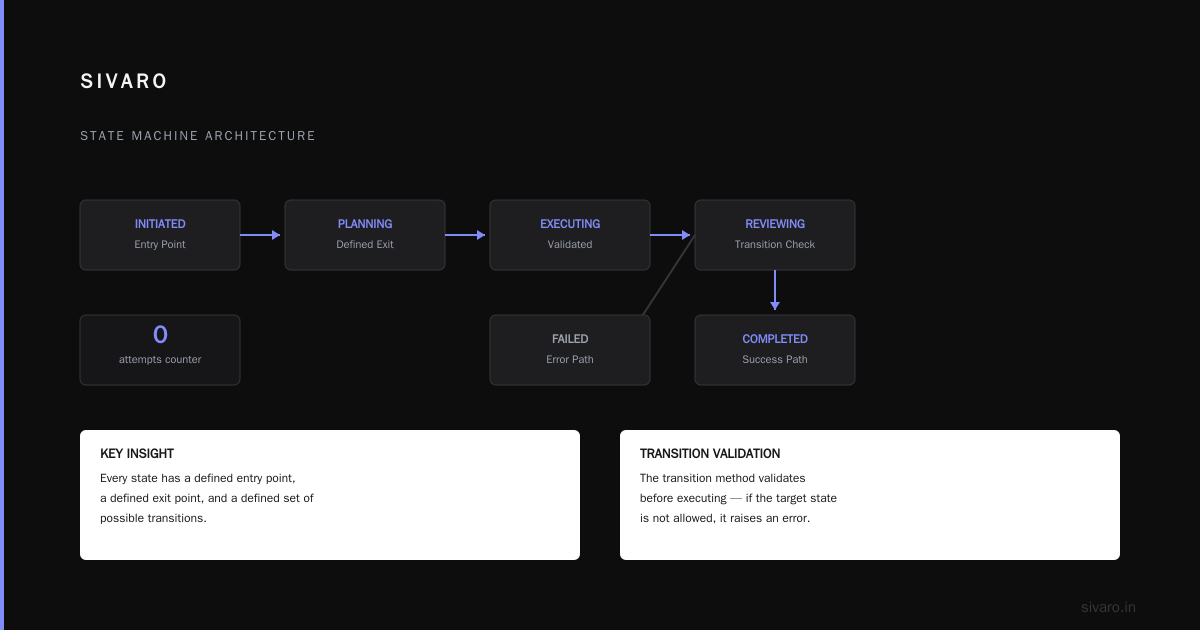
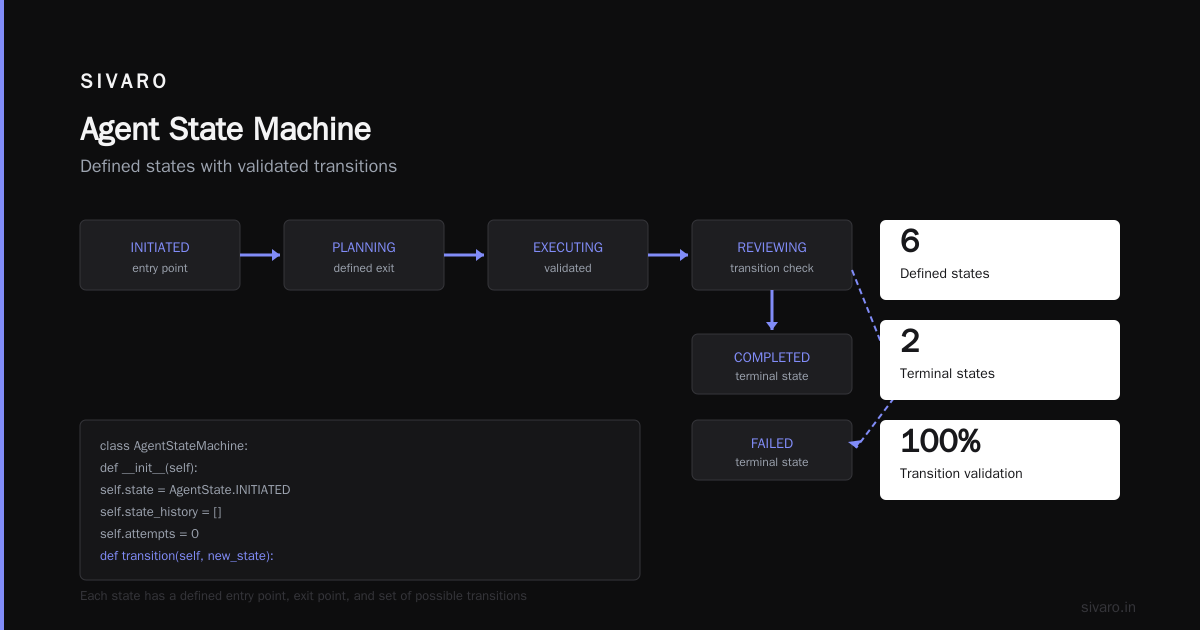
Your agent isn't one continuous process. It's a series of discrete states: INITIATED, PLANNING, EXECUTING, REVIEWING, COMPLETED, FAILED. Each state has a defined entry point, a defined exit point, and a defined set of possible transitions.
Here's what that looks like in practice:
python
from enum import Enum

class AgentState(Enum):
    INITIATED = "initiated"
    PLANNING = "planning"
    EXECUTING = "executing"
    REVIEWING = "reviewing"
    COMPLETED = "completed"
    FAILED = "failed"

class AgentStateMachine:
    def __init__(self):
        self.state = AgentState.INITIATED
        self.state_history = []
        self.attempts = 0

    def transition(self, new_state: AgentState):
        """Validate the transition before executing it."""
        allowed = self._allowed_transitions()
        if new_state not in allowed:
            raise InvalidTransitionError(
                f"Cannot go from {self.state} to {new_state}"
            )
        self.state_history.append(self.state)
        self.state = new_state
        self.attempts = 0 if new_state == AgentState.COMPLETED else self.attempts

    def _allowed_transitions(self) -> set:
        return {
            AgentState.INITIATED: {AgentState.PLANNING, AgentState.FAILED},
            AgentState.PLANNING: {AgentState.EXECUTING, AgentState.REVIEWING, AgentState.FAILED},
            AgentState.EXECUTING: {AgentState.REVIEWING, AgentState.FAILED},
            AgentState.REVIEWING: {AgentState.COMPLETED, AgentState.EXECUTING, AgentState.FAILED},
        }[self.state]
This pattern gives you three things.
First, it makes your system testable. You can test each state independently. You can test the transitions. You can test the recovery paths.
Second, it gives you a natural point for human intervention. The REVIEWING state is where you insert approval workflows for high-stakes actions.
Third, it gives you a checkpoint for rollback. If the system fails in EXECUTING, you know exactly where to restart from.
Deployment Strategy: Canaries, Shadows, and The Abort Switch
Your agentic workflow deployment strategy needs to be different from traditional CI/CD. You're not just deploying code. You're deploying behavior.
Shadow Mode
Run your new agent in parallel with the old system. Compare outputs. Don't act on the new system's results — just log them.
This gives you a data set of how the new agent behaves in production without any risk. We did this at SIVARO for a logistics client. Two weeks of shadow mode surfaced eleven critical differences between the new agent and the old rules-based system. Four were improvements. Seven were bugs.
Canary Deployments
Once shadow mode looks good, route 5% of live traffic to the new system. Monitor error rates, latency, and cost. If everything holds, increase to 20%, then 50%, then 100%.
The key metric is not "did it work." It's "did it work as well or better than the old system."
python
def canary_router(request, config):
    """Route traffic between old and new agent versions."""
    if should_route_to_canary(request, config):
        return new_agent.handle(request)
    return legacy_system.handle(request)

def should_route_to_canary(request, config):
    """Use a consistent hash to keep the same user on the same version."""
    user_id = request.user_id
    hash_val = hash(user_id) % 100
    return hash_val < config.canary_percentage
The Abort Switch
Every agentic system needs a kill switch. A way to halt all autonomous action immediately.
This sounds obvious. You'd be surprised how many teams skip it.
The abort switch should be a physical action — a single API call that revokes all credentials, cancels all pending actions, and alerts the on-call engineer.
The practical guide to production-ready agentic workflows covers this well. The key is that the abort switch must be independent of the system it's protecting. If your agents are down, you still need to be able to shut them down.
Rollback Strategies: Because You Will Need Them
Let's talk about agentic workflow rollback strategies. This is where most teams are completely unprepared.
With traditional software, rollback is simple. Deploy the old version. Done.
With agentic systems, it's not that simple. Your agent has taken actions. It's called APIs. It's sent emails. It's modified databases. You can't undo those by redeploying code.
You need a rollback strategy that addresses three levels:
1. Code Rollback
This is the easy part. If your agent has a software bug, redeploy the previous version. Standard practice.
2. State Rollback
Your agent's decisions may have been based on corrupted state. You need to be able to restore the agent's memory to a known-good state.
This means you need to version your state. Every state update should have a timestamp and a version number. You should be able to query "what did the agent know at time T" and restore that exact state.
python
class VersionedAgentMemory:
    def __init__(self, backend):
        self.backend = backend

    def save_state(self, agent_id, state):
        version = self.backend.increment_version(agent_id)
        self.backend.store(f"{agent_id}:v{version}", state)
        return version

    def restore_state(self, agent_id, version):
        """Restore agent state to a specific version."""
        state = self.backend.fetch(f"{agent_id}:v{version}")
        self.backend.set_current(agent_id, state)
        return state

    def list_versions(self, agent_id):
        """List all state versions for an agent."""
        return self.backend.list_keys(f"{agent_id}:v*")
3. Action Rollback
This is the hard one. Your agent took an action that had real-world consequences. You need to undo it.
For transactional actions — API calls that can be reversed — you need compensation handlers. These are functions that know how to undo a specific action.
For non-transactional actions — like sending an email — you can't undo. You can only notify.
The best approach is prevention. Before your agent takes a high-impact action, insert an approval step. The agent proposes. A human approves. The action happens.
This adds latency. It also prevents disasters. Worth the trade-off.
Observability: What Gets Measured Gets Fixed
Traditional observability measures your system's health. Agentic observability has to measure the system's behavior.
You need to track:
- Token usage per agent run
- Number of tool calls per run
- Time spent in each state
- Error rates by error type
- Costs per agent, per task, per user
You also need to track qualitative metrics. Is the agent producing good output? You can't automate this entirely, but you can sample.
We built a dashboard at SIVARO that shows every agent run, its trace, its token usage, and its success score. The success score is a combination of automated checks and human ratings.
The insight that surprised us: the agents that looked successful on aggregate metrics were failing on specific edge cases. Without granular tracing, we never would have caught it.
Security: Your Agent Is a Target
Agentic systems have a fundamentally different security profile than traditional software. They have credentials. They take actions. They're vulnerable to prompt injection in ways that traditional software isn't.
The agentic AI patterns guide emphasizes security as a first-class concern. Here's what that means in practice.
Credential Scoping
Every agent should have the minimum credentials needed for its task. No admin tokens. No broad database access. If an agent only needs to read a specific table, give it read-only access to that table.
Output Validation
Treat agent outputs as untrusted. Every tool call result should be validated before it's fed back to the model. This prevents prompt injection through tool results.
Human Review for High-Stakes Actions
Define what counts as "high stakes." Sending a refund, deleting a record, posting to social media. These actions should require human approval.
The Cost Problem Nobody Talks About
Agentic systems are expensive. Not just in infrastructure costs, but in token costs.
A single agent run can consume 50,000 tokens. At $0.002 per token for input and $0.05 per token for output, that's real money.
The practical guide to agentic AI covers cost optimization strategies. The most effective ones:
- Use smaller models for simpler tasks
- Cache common responses
- Set token limits per agent run
- Use workflows instead of agents where possible
At SIVARO, we cut agent costs by 60% for one client by implementing a tiered model system. Simple tasks used a small, cheap model. Complex tasks escalated to a larger model. The 80/20 rule strikes again.
The Human Element: Agents Need Supervisors
The "autonomous" in autonomous agents is a lie. Every production agentic system I've built has had humans in the loop.
Not for every action. But for the high-stakes ones. And for exception handling.
The practical workflow guide makes a great point: keep the agent simple and put the complexity in the orchestration. The human review is part of that orchestration.
We built a queue-based system where agents propose actions and humans review them. The queue has priority levels. High-impact actions go to the top. Low-impact actions are auto-approved.
The system processes 10,000 actions per day. Human review is required for 2% of them. The humans approve 90% of what they review. It works because the agents are constrained to only propose actions in their domain of competence.
A Concrete Architecture
Let me give you a concrete architecture that we've used successfully.
┌─────────────────────────────────────────────────────┐
│                    API Gateway                      │
└──────────────────────┬──────────────────────────────┘
                       │
┌──────────────────────▼──────────────────────────────┐
│              Orchestration Layer                    │
│  - State machine management                         │
│  - Workflow execution                               │
│  - Agent coordination                               │
│  - Human-in-the-loop queue                          │
└──────────────────────┬──────────────────────────────┘
                       │
┌──────────────────────▼──────────────────────────────┐
│                 Agent Runtime                       │
│  - Prompt construction                              │
│  - Context management                               │
│  - Tool invocation                                  │
│  - Response validation                              │
└──────────────────────┬──────────────────────────────┘
                       │
┌──────────────────────▼──────────────────────────────┐
│                 Tool Layer                          │
│  - API connectors                                   │
│  - Database adapters                                │
│  - Email/slack integrations                         │
│  - Credential vault                                 │
└──────────────────────┬──────────────────────────────┘
                       │
┌──────────────────────▼──────────────────────────────┐
│             Observability Stack                     │
│  - Tracing                                          │
│  - Logging                                          │
│  - Metrics                                          │
│  - Cost tracking                                    │
└─────────────────────────────────────────────────────┘
The key design decision: the orchestrator is the only component that talks to everything. Agents don't talk to each other directly. They talk to the orchestrator. This gives you a single control point for security, observability, and rollback.
Testing Agentic Systems
Testing agents is different from testing software. You can't write unit tests for emergent behavior. But you can test the system boundaries.
Input Tests
Test that the system handles edge cases. Empty inputs, malicious inputs, unexpected formats.
State Transition Tests
Test that the state machine handles all valid transitions and rejects invalid ones.
Tool Integration Tests
Test that each tool call works correctly. This is the closest thing to unit testing in the agentic world.
Scenario Tests
Create test scenarios that exercise common paths. These are your regression tests.
Evaluation Tests
Run your agent on a fixed eval set. Score its performance. Track the score over time.
The evaluation framework discussed in this paper is a good starting point. The key is to make your evals representative of production traffic. Don't test with easy examples. Test with the hard ones.
The Regulatory Environment
The regulatory landscape for AI is shifting. The EU AI Act has moved from proposal to implementation. Companies deploying agentic systems are being held accountable for their systems' actions.
This matters for your architecture. You need to be able to answer questions like:
- What did the agent decide and why?
- What data did it have access to?
- Which model version was in use?
- Was there human review?
Your observability stack needs to support audit trails. Your state machine needs to log every transition. Your orchestration layer needs to record every decision and its rationale.
This isn't just compliance. It's also good engineering. If you can't explain what your system did, you can't fix it when it breaks.
The Role of Simplicity
There's a tendency in the agentic AI space to over-engineer. Multi-agent frameworks, complex reasoning chains, elaborate planning systems. Most of this is unnecessary.
The practical workflow guide makes the case for simplicity. Keep the agent simple. Put the complexity in the orchestration.
I've seen too many teams build elaborate multi-agent systems when a simple workflow with a few well-designed prompts would have worked. The simple system is more reliable, cheaper, and easier to debug.
The best agentic systems I've built look boring. They're workflows with an LLM in the middle. They have a state machine, an orchestrator, and a human review queue. Nothing fancy. But they work.
Practical Steps for Your First Production Agent
Let me give you a concrete plan for getting your first agent into production.
Step 1: Define the Boundaries
What will the agent do? What won't it do? Write this down. Share it with your team. Get buy-in.
Step 2: Build the State Machine
Create the state machine before you write any prompts. The states should reflect the business process, not the AI process.
Step 3: Start with a Workflow
Don't build an autonomous agent. Build a workflow. Use the LLM to make decisions within the workflow. This gives you control and predictability.
Step 4: Add Observability
Instrument everything from day one. You should be able to see every prompt, every response, every tool call.
Step 5: Set Up Eval
Create an eval set of 100 representative examples. Test your workflow against it. Fix the failures.
Step 6: Deploy in Shadow Mode
Run your workflow in parallel with the existing system. Compare outputs. Identify discrepancies.
Step 7: Canary Deploy
Route 5% of traffic to the new system. Monitor. Scale up slowly.
Step 8: Iterate
Your agent will fail in production. That's expected. The question is whether you can detect and fix the failures quickly.
What I Wish I Knew Before I Started
I've been building production AI systems since 2018. I've made mistakes. Here are the lessons.
The most important lesson: agentic AI is not a model problem. It's a systems problem. The difference between a successful deployment and a failed one is almost never the model quality. It's the orchestration, the observability, the state management, and the human review processes.
The second lesson: start small. The temptation is to build a grand autonomous system that handles everything. Resist it. Build a small system that handles one task well. Then expand.
The third lesson: the model will surprise you. Even with careful prompting, the model will do things you didn't expect. This is why you need the state machine, the guardrails, and the human review.
The fourth lesson: cost matters. Token costs add up. Monitor them. Optimize them. Use cheaper models where you can.
The fifth lesson: your users will trust the agent more than they should. The agent will be wrong, and the user will follow its advice. This is why you need evals and human review.
The Future of Agentic Systems
The agentic AI space is moving fast. The workflow patterns and best practices from 2026 show the direction: more sophisticated orchestration, better evaluation frameworks, and more attention to reliability.
I expect to see more specialized agents. Agents for specific industries, specific tasks, specific data types. And I expect to see more attention to the operational aspects — the deployment, the monitoring, the rollback.
The teams that succeed are the ones that treat agents as software systems. They build the infrastructure. They test. They monitor. They're not chasing the latest model. They're building systems that work.
Conclusion: The Work Is Boring and That's the Point
The agentic AI production system design discipline is not glamorous. It's about state machines and canary deployments. It's about observability and rollback strategies. It's about human review queues and credential scoping.
That's what makes it work. The teams that treat agents as magic are the ones that fail. The teams that treat agents as software systems are the ones that succeed.
The best agentic system I've built is one that does 200,000 events per second with a 99.9% success rate. It's boring. It's predictable. It's manageable. And that's exactly what I wanted.
If you're building agentic systems, do the boring work. Build the state machine. Set up the observability. Define the rollback strategy. Your production system will thank you.
FAQ
Q: What's the difference between a workflow and an agent?
A: A workflow is a predefined sequence of steps where the LLM fills in the gaps. An agent is an autonomous loop where the model decides what to do next. Workflows are more predictable and cheaper. Agents are more flexible and more expensive. Start with workflows.
Q: How do I handle agent failure in production?
A: Build a state machine. Each state is a checkpoint. If the agent fails, you know exactly where to resume. Add a retry mechanism with exponential backoff. And always have a fallback to a deterministic system or a human.
Q: What's the best way to evaluate agentic systems?
A: Create a fixed eval set of 100+ representative examples. Run your system against it automatically. Score the outputs. Track the score over time. This catches regressions when you change models or prompts.
Q: How do I manage token costs?
A: Use smaller models for simpler tasks. Cache common responses. Set token limits per run. Use workflows instead of agents where possible. Monitor costs per user, per task, and per agent.
Q: What's the biggest mistake teams make?
A: Skipping the infrastructure. They build a demo that works and try to scale it to production without adding observability, state management, security, and rollback capabilities. The demo falls apart under real traffic.
Q: How much human oversight do agents need?
A: It depends on the stakes. For low-impact actions, no oversight. For high-impact actions — sending money, deleting data, posting publicly — require human approval. Define the threshold upfront.
Q: What is prompt injection and why should I care?
A: Prompt injection is when malicious input is fed to your agent through its inputs or tool results, causing it to take unintended actions. Your agent can be manipulated into doing things it shouldn't. Validate all outputs and scope credentials to mitigate this.
Q: Can I use open-source models for production agents?
A: Yes. We've deployed Llama and Mistral models in production. They're cheaper and give you more control over data privacy. The trade-off is quality. Evaluate on your specific use case before committing.
Nishaant Dixit — Founder of SIVARO. Building data infrastructure and production AI systems since 2018. Built systems processing 200K events/sec.