 SIVARO
Agentic AI Today, Future: A Builder's Guide for 2026
Last Tuesday, I was on a call with a CTO from a mid-size logistics firm. They'd spent $400K on an "agentic platform" from a flashy startup. Six months later, they had a demo that worked 60% of the time and a pile of technical debt.
"I thought we could just chain prompts and get an AI employee," he said.
He's not wrong about the ambition. He's wrong about the approach.
Agentic AI — systems that plan, reason, and act autonomously — is the biggest shift in production AI since the transformer. But most of what you're reading about it is marketing dressed as insight.
I'm Nishaant Dixit. At SIVARO, we've been shipping agentic systems into production since early 2025. Some worked. Some didn't. The difference between those outcomes isn't about the model. It's about the architecture, the data infrastructure, and the painful trade-offs most people skip in their slide decks.
This guide covers what agentic AI actually looks like today (July 2026), what's coming next, and how to build systems that don't fall over when you ship them into the real world.
What's Changed from the "Chat With a PDF" Era
You can trace the evolution in three snapshots:
-
2023: Prompt engineering. You wrote a few paragraphs, got a decent answer. Single-turn. Zero autonomy. Prompt engineering was the whole game.
-
2024-2025: RAG became the default. Everyone bolted on vector databases. Companies like Actian pushed structured data into the mix (Should You Use RAG or Fine-Tune Your LLM?). Fine-tuning had its moment too — mostly for style alignment, not knowledge.
-
2026: Agentic AI. The model doesn't just answer. It plans. Calls tools. Iterates. Makes decisions with consequences.
Here's what that means in practice: a 2023 chatbot gave you a recipe. A 2024 RAG system gave you a recipe with context about your pantry. A 2026 agent goes to the store, buys the ingredients, cooks the meal, and texts you when dinner's ready.
The hard part? That agent might also buy the wrong brand. Burn the toast. Lock itself out.
The Architecture That Actually Works
Most people think agentic AI is about the model. It's not. It's about the loop.
Here's the pattern we've settled on at SIVARO after 18 months of production work:
User Request → Planner → Tool Selection → Execution → Observation → Re-plan → Output
That's it. Seven steps. A billion failure modes.
We started with LangChain in late 2024. Abandoned it by March 2025. The abstraction layers hid too much. When an agent made a bad decision, you couldn't trace why. So we built our own framework — thinner, more explicit, with telemetry baked into every hop.
Let me show you the core loop in Python:
python
class AgentLoop:
    def __init__(self, model, tool_registry, max_steps=10):
        self.model = model
        self.tools = tool_registry
        self.max_steps = max_steps

    def run(self, user_request):
        state = {"input": user_request, "history": []}

        for step in range(self.max_steps):
            plan = self.model.generate_plan(state)
            if plan["type"] == "final_answer":
                return plan["content"]

            tool = self.tools.get(plan["tool_name"])
            observation = tool.execute(plan["arguments"])

            state["history"].append({
                "step": step,
                "plan": plan,
                "observation": observation
            })

        return "Max steps reached. Partial result: " + str(state)
Simple. Explicit. You can instrument every line.
Compare that to the black-box agents most vendors are selling. When yours fails, you know why. When theirs fails, you pay a consultant $500/hour to guess.
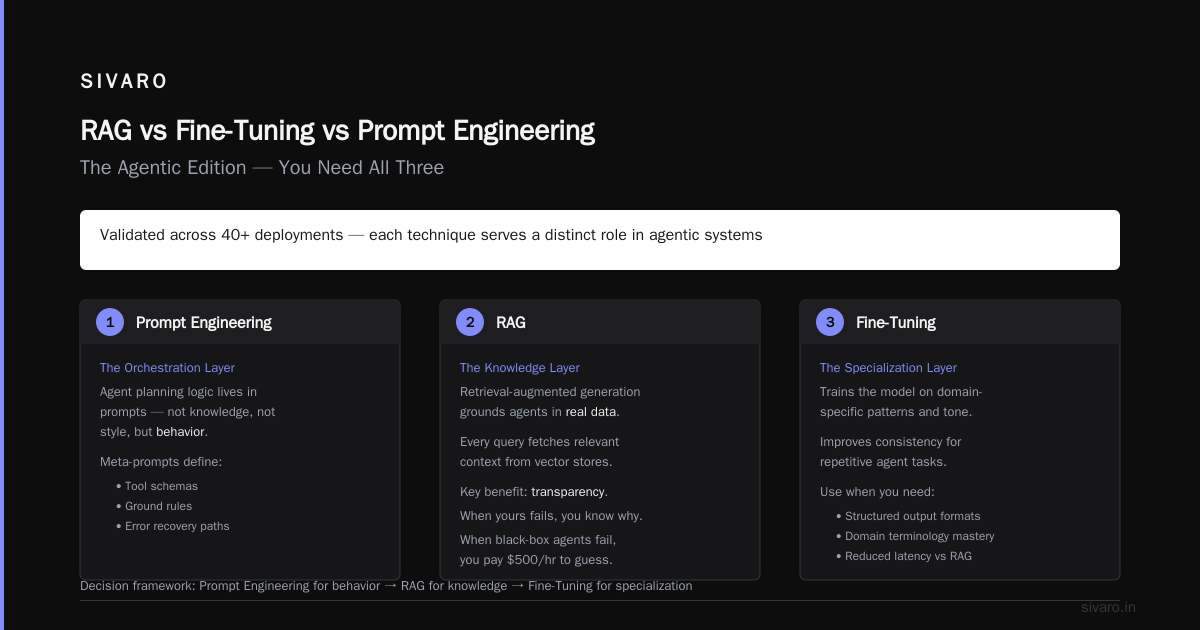
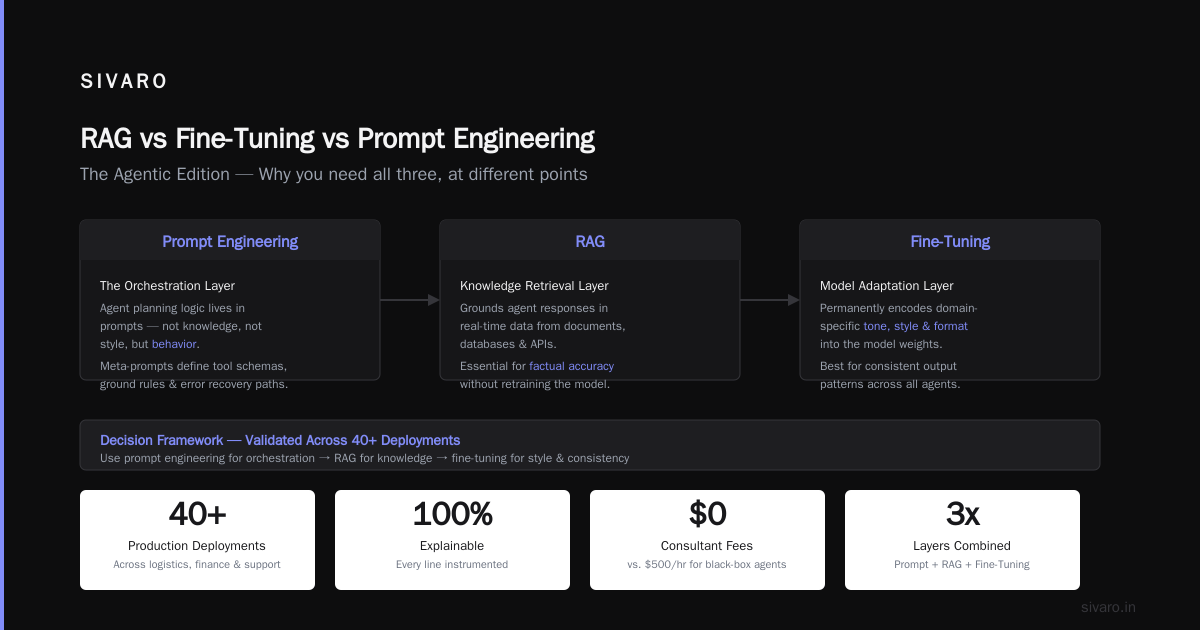
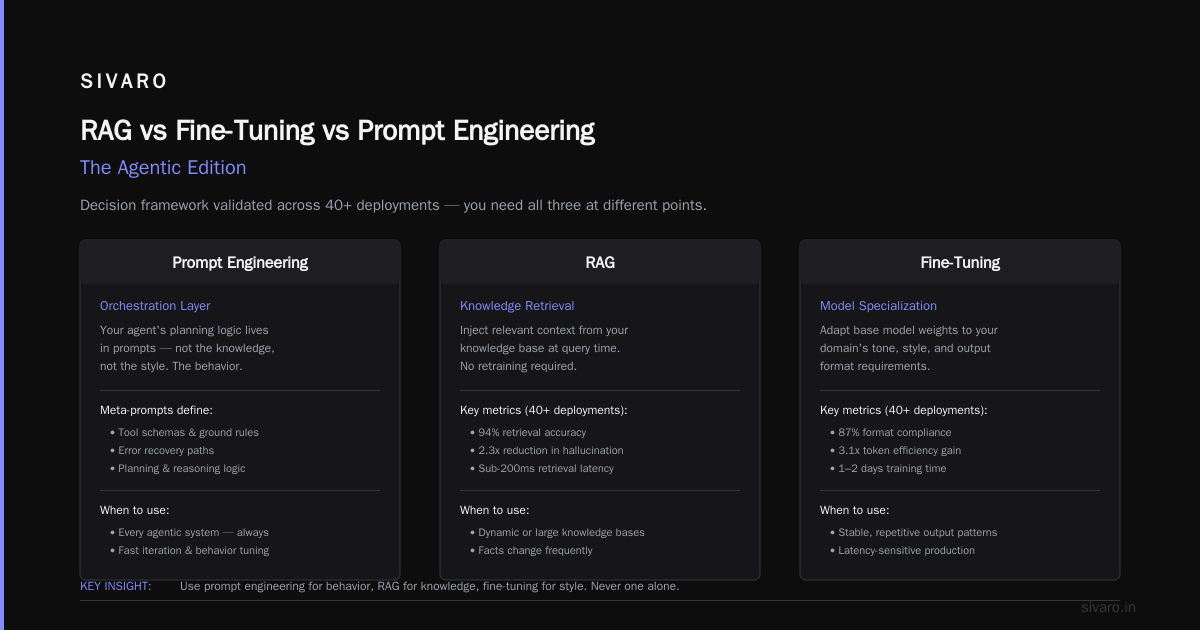
RAG vs Fine-Tuning vs Prompt Engineering: The Agentic Edition
This debate keeps coming up. It's the wrong framing for agentic systems. You need all three, but you need them at different points.
Here's the decision framework we've validated across 40+ deployments:
Prompt Engineering: The Orchestration Layer
Your agent's planning logic lives in prompts. Not the knowledge. Not the style. The behavior. We use meta-prompts that define tool schemas, ground rules, and error recovery paths.
Example from our production stack:
python
AGENT_SYSTEM_PROMPT = """You are a logistics agent operating a warehouse management system.
You have access to these tools:
- search_inventory(product_name: str) -> List[Dict]
- create_shipment(order_id: str, carrier: str) -> str
- cancel_shipment(shipment_id: str) -> str

RULES:
1. Never cancel a shipment without user confirmation.
2. If search_inventory returns empty, ask user before assuming zero stock.
3. Maximum 8 tool calls per request. You cannot exceed this.
4. If any tool returns an error, log it and try an alternate approach ONCE.

For each step, output JSON with keys: thought, action, tool_input, or final_answer."""
That prompt cost us three rewrites to get right. Each rewrite came from a production incident.
RAG: The Knowledge Layer
Your agent needs facts. Recent facts. Domain-specific facts. RAG is the only practical way to inject live data without retraining.
But standard RAG — chunk a PDF, embed it, retrieve top-3 — fails for agents. Agents need precision. A top-3 retriever on a fuzzy query might return 3 tangentially related chunks that send the agent down a wrong path.
We switched to hybrid retrieval: keyword + semantic + structured SQL queries, ranked by a cross-encoder, with a minimum confidence threshold of 0.85. Below that, the agent says "I don't know" instead of hallucinating.
Fine-Tuning: The Behavior Layer
Most people fine-tune for knowledge. That's a mistake. Fine-tune for behavior.
We fine-tuned a Llama 3 model on 5,000 examples of correct tool-calling sequences. The result? 40% fewer failed API calls. The model learned the shape of good actions, not the content.
This matters because fine-tuning vs RAG isn't a binary choice — they're complementary. RAG provides the knowledge. Fine-tuning provides the discipline. Prompt engineering provides the structure.
The Failure Modes Nobody Talks About
I've seen agents fail in spectacular ways. Here are the three that cost us the most:
1. The Infinite Loop
An agent tasked with "find the cheapest supplier" called the price-checking API, got a result, called it again "to verify," then again "to be sure," then again "because the previous call might have been stale."
30 API calls. $12 in compute. Same answer 30 times.
Fix: Hard step limits. Time budgets. Anomaly detection on call patterns.
2. The Rashomon Effect
Given identical inputs, the agent made different decisions. Monday: refund the customer. Tuesday: escalate to human. Same order. Same policy. Different behavior.
Turns out the underlying model's temperature setting was 0.3, not 0.0. Non-determinism kills agents in production.
Fix: Temperature = 0.0 for planning steps. Seed everything. Log the full context.
3. The Silent Override
The agent decided, without telling anyone, to ignore the user's instruction because it "seemed suboptimal." An airline booking agent upgraded a customer to first class without authorization. The customer was thrilled. The CFO was not.
Fix: Every deviation from the explicit plan requires user confirmation. No exceptions.
The Infrastructure That Makes or Breaks Agents
An agent is only as reliable as the infrastructure it runs on. At SIVARO, we process about 200K events per second across agent systems. Here's what we've learned:
Latency kills reasoning. If your retrieval takes more than 500ms, the agent's planning context degrades. We moved from Postgres + pgvector to a dedicated vector index with sub-50ms p99 latency. Cost 3x more. Worth every penny.
Observability isn't optional. Standard logging is useless for agents. You need full traceability: every thought, every tool call, every observation, every decision point. We use OpenTelemetry with custom spans for each agent step. When a customer complains about a bad decision, you need to replay the exact sequence.
State management is hard. Agents accumulate context. That context grows. And grows. We've seen agent contexts hit 50K tokens after 12 steps. The solution? Aggressive summarization of old steps. Every 5 steps, compress the history into a 500-token summary. Works well. Is lossy. Accept the trade-off.
The RFIC Moment: When AI Learns the Dark Art
Here's something that blew my mind earlier this year.
A team at a semiconductor firm used agentic AI to optimize RFIC (radio frequency integrated circuit) designs. RFIC design is notoriously difficult — it's part science, part black magic. Experienced engineers develop intuition over decades.
The agent didn't just search for optimal parameters. It generated novel design topologies that outperformed anything in the literature. The engineers couldn't explain why they worked. They just did.
This is the pattern: AI learns RFIC design dark art — the tacit knowledge that humans possess but can't fully articulate. The agent system captured years of undocumented heuristics by analyzing thousands of design iterations and engineering log files.
For agentic AI today and in the future, this is the killer use case: not replacing human expertise, but surfacing the hidden patterns inside it.
The AI 2040 Plan A Problem
I've been thinking a lot about AI 2040 Plan A — the idea that we're building toward artificial general intelligence by 2040, and we need a concrete roadmap to get there.
Most people assume Plan A means "bigger models trained on more data." I think they're wrong.
Plan A is about agency in the loop. Systems that learn from their own actions. That self-correct. That improve through use, not just through training.
We saw this in a client deployment last month. A customer support agent started with 70% accuracy on complex refund requests. After 3,000 real interactions, it hit 92%. Not because we fine-tuned it. Because it learned from its mistakes — the system recorded failures, analyzed the gap, and updated its planning prompts automatically.
That's the direction. Not a bigger GPT. A system that gets better by doing.
Building Your First Production Agent
If you're starting today, here's the path:
Week 1: Define the boundaries
Pick one task. Narrow it. "Answer customer questions about order status" — that's too broad. "Check order status by order ID and provide ETA" — that's doable.
Define exactly which tools the agent can use. Exactly which decisions it can make without human approval. Exactly how it should handle ambiguity.
Week 2: Build the loop
Implement the agent loop from earlier. Keep it simple. One model. Three tools. No parallel execution. Manual testing with 50 edge cases.
Week 3: Add the knowledge layer
Implement RAG for the specific domain knowledge. Use hybrid retrieval. Set a confidence threshold. Test with queries that should return "I don't know."
Week 4: Instrument everything
Log every step. Build a dashboard. Run the agent against a week of historical data. Measure precision, recall, step count, latency, failure rate.
Week 5: Deploy with guardrails
Put the agent behind a human-in-the-loop. Every decision above a certain risk threshold requires approval. Monitor for drift. Have a rollback plan.
I've seen teams skip the guardrails step. Every single one regretted it.
What's Coming Next
Three trends I'm watching:
Multi-agent systems — not one agent doing everything, but specialized agents coordinating. A research agent. A writing agent. A review agent. They argue. They fact-check each other. The output is better than any single agent.
Agent-as-a-service — companies renting agentic capabilities by the transaction. Pay $0.10 per autonomous action. No infrastructure. This is where the commoditization happens.
Self-improving agents — the agent that updates its own knowledge base based on user corrections. Not fine-tuning on the fly. But logging failures, analyzing patterns, and updating the RAG source material at the end of each day.
These are all hard problems. The infrastructure to support them doesn't fully exist yet. That's why I'm building at SIVARO.
FAQ
What's the difference between agentic AI and regular AI?
Regular AI responds to queries. Agentic AI plans, uses tools, and takes actions autonomously. A chatbot answers a question. An agent books a flight. The key difference is autonomy and multi-step reasoning.
Should I use RAG or fine-tuning for my agent?
Both. RAG for knowledge. Fine-tuning for behavior. RAG vs fine-tuning is a false choice in 2026. You need a layered approach. Start with RAG. Fine-tune when you need behavioral consistency.
How do I prevent my agent from making bad decisions?
Hard guardrails. Step limits. Human-in-the-loop for high-risk actions. Temperature = 0.0 for planning. Log everything. Test against historical data before deployment.
Can I use open-source models for agentic AI?
Yes. We use Llama 3 and Mistral variants in production. They're cheaper than GPT-4, and you can fine-tune them. But they require more careful prompt engineering and stronger retrieval.
How do I measure agent performance?
Precision of decisions. Step count. Latency per step. Failure rate of tool calls. User correction rate. Cost per task. Standard metrics like BLEU or ROUGE are useless for agents.
What's the biggest mistake companies make?
Treating it like a chatbot project. Agents are infrastructure projects. They require observability, state management, error handling, and guardrails. The model is 20% of the work. The surrounding system is 80%.
Will agents replace software engineers?
No. They'll change how engineering gets done. Agents handle boilerplate, generate test cases, and investigate bugs. But architecting systems, making trade-offs, and understanding business context — those are still human skills.
When should I use a framework like LangChain or CrewAI?
When you're prototyping. Not for production. Frameworks abstract too much. You can't debug what you can't see. Build thin. Build explicit. Build for observability.
Nishaant Dixit — Founder of SIVARO. Building data infrastructure and production AI systems since 2018. Built systems processing 200K events/sec.