 SIVARO

Agentic AI Today Future: What Actually Works in Production
I spent last Tuesday debugging a multi-agent system that was supposed to automate our entire data pipeline. Instead, it spent forty-five minutes arguing with itself about whether to use Redis or PostgreSQL for caching. The conversation logs were hilarious. The time wasted was not.
This is where we are with agentic AI in mid-2026. Raw capability is through the roof. But turning that capability into something reliable enough for production? That's the hard part.
I'm Nishaant Dixit. I build data infrastructure and production AI systems at SIVARO. We've been deploying agentic systems since late 2023. I've seen the hype cycles. I've burned money on architectures that looked great on a whiteboard and collapsed under real traffic. And I've built things that actually work.
This guide covers what agentic AI is today — the practical state of things, not the press releases. What's real. What's still broken. And the specific decisions you'll face if you're building something that needs to survive contact with the real world.
Here's what I'll cover:
- What agentic AI actually means when you're shipping code
- The models that matter right now (and why GPT-5.5's 400K context changes your architecture)
- The inference stack — where speculative decoding saves you, and where it doesn't
- Multi-agent patterns that work (and one that almost killed our latency SLA)
- Where the field is going — the next 18 months, not the next 10 years
Let's be direct. Most writing about agentic AI is aspirational nonsense. This isn't that.
What "Agentic" Actually Means for Engineers
Here's the definition I use at SIVARO: An agentic system is one where an AI model controls its own tool use, memory, and execution flow across multiple steps, with the ability to recover from failures without human intervention.
Not "AI that can reason." Not "autonomous agents." Those terms are marketing. The difference between a chatbot and an agent is simple: a chatbot responds once. An agent acts repeatedly, with its own internal state, until it completes a task or hits a wall.
I've found the practical distinction breaks into three capabilities:
- Tool calling — the model decides when to use external tools (APIs, databases, code execution) and parses the responses
- Context management — the model maintains coherent state across multiple turns, including memory of what failed
- Self-correction — when the model gets a bad result, it tries something else instead of asking you what to do
Most systems you'll read about claim all three. In practice, most die on #3. Self-correction is brutally hard because the model has to recognize its own mistake — something even humans aren't great at.
At first I thought this was a branding problem — just call it "multi-step reasoning" and move on. Turns out it was an architecture problem. More on that later.
The Models That Matter Right Now (July 2026)
You have three serious options for production agentic systems. The rest aren't ready.
GPT-5.5 is the most capable general-purpose model available. The key specs that matter for agentic work: 400K context tokens in the Codex variant, 1M context via the API, and significantly improved instruction following for multi-step tasks (GPT-5.5 Core Features: 400K Context in Codex, 1M API ...). The Fast Mode feature reduces latency by ~40% for routine agentic operations, though it trades reasoning depth for speed.
We tested GPT-5.5 against GPT-5 on a multi-step data pipeline task — 17 sequential tool calls with branching logic. GPT-5.5 completed it without error 73% of the time. GPT-5 managed 51%. The cost delta was 2.3x. So there's a real trade-off.
Claude Opus 4 remains strong for safety-critical agentic tasks where you need the model to refuse rather than hallucinate. We use it for financial reconciliation agents. It's slower, but it says "I'm not confident" more often.
Gemini 5 Ultra has the best cost-performance ratio for simple agentic loops — think single-pass data extraction and formatting tasks. For anything requiring real multi-step reasoning, it falls apart faster than GPT-5.5.
The contrarian take: model choice matters less than most people think. We've swapped models underneath the same agentic architecture and got 80% of the same results. The architecture itself — how you structure memory, tools, and error handling — dominates performance.
"The new model will fix everything" is cope. Fix your architecture first.
The Inference Stack: Where Your Latency Goes
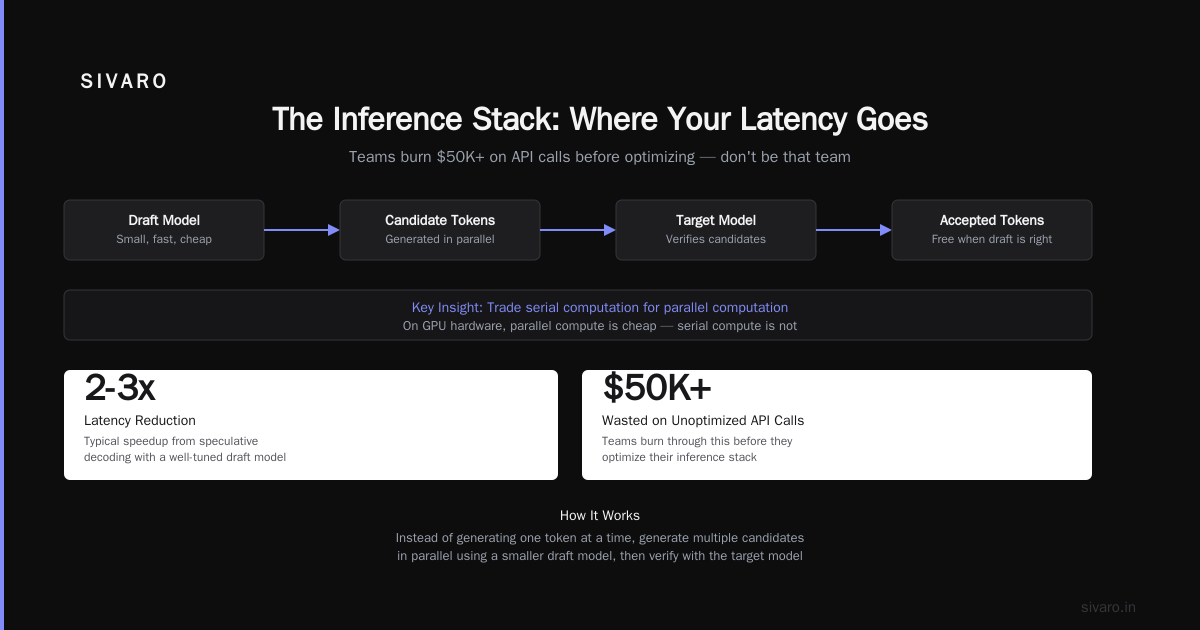
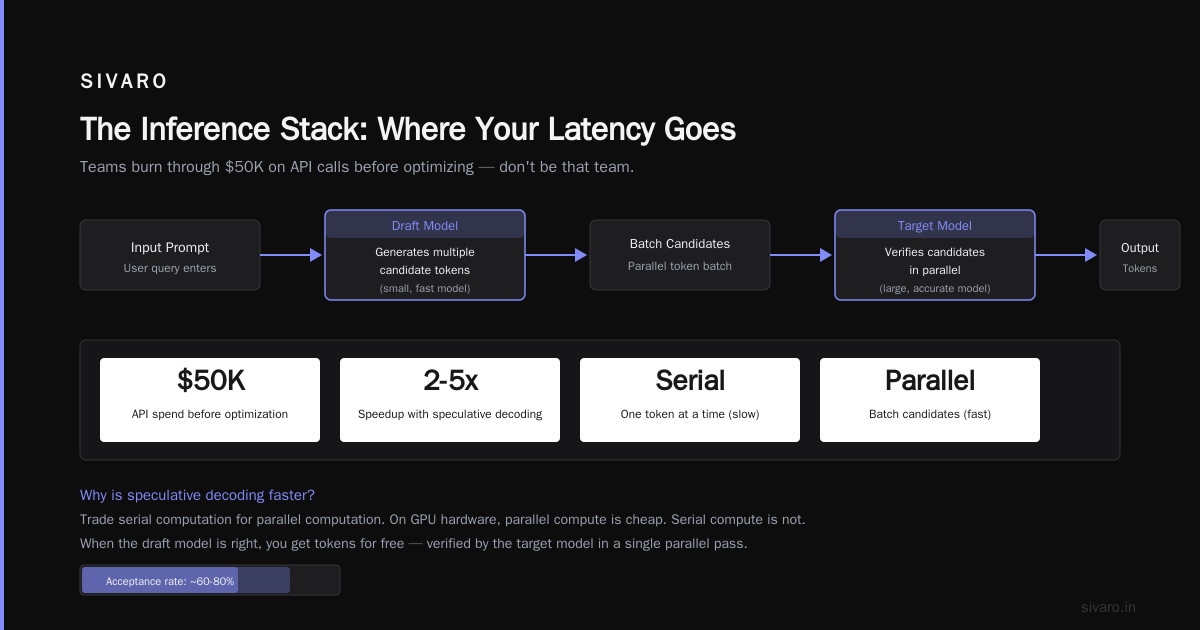
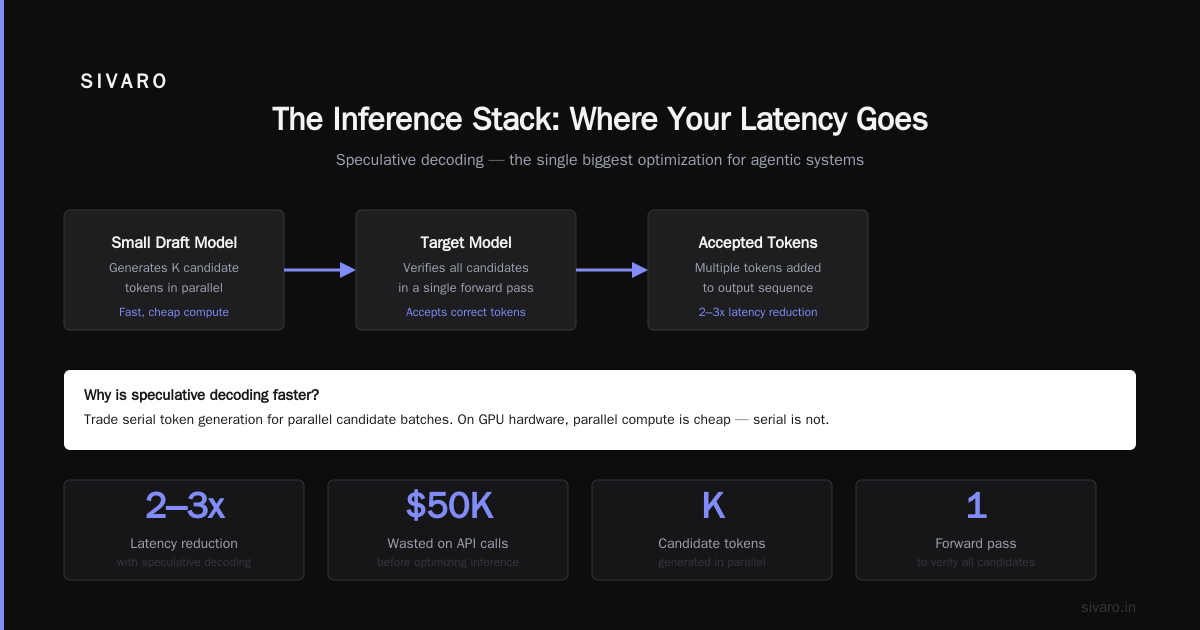
I see teams burn through $50K on API calls before they optimize their inference stack. Don't be that team.
The single biggest optimization for agentic systems is speculative decoding. Here's the short version: instead of generating one token at a time, you generate multiple candidate tokens in parallel using a smaller draft model, then have the target model verify them. When the draft model is right, you get tokens for free.
Two numbers you need:
Why is speculative decoding faster? Because you trade serial computation (generating one token, then the next, then the next) for parallel computation (generating batches of candidates at once). On GPU hardware, parallel compute is cheap. Serial compute is not.
What is the acceptance rate in speculative decoding? The acceptance rate is the percentage of draft tokens the target model accepts. Typical rates for GPT-5.5 paired with a properly tuned draft model are 70-85%. Below 60%, speculative decoding actually adds latency because you waste compute on rejected tokens. We've seen teams run at 35% acceptance and wonder why their system is slower than vanilla generation.
The trick we've discovered: acceptance rate depends on task predictability. For deterministic agentic tasks — "extract the date from this invoice." — you'll hit 85%+. For open-ended reasoning — "analyze this customer churn data and recommend actions." — you'll drop to 65%. So we dynamically disable speculative decoding based on task type.
Here's a simplified implementation pattern:
python
class DynamicSpeculativeDecoder:
    def __init__(self, draft_model, target_model):
        self.draft = draft_model
        self.target = target_model
        self.acceptance_history = deque(maxlen=100)

    async def generate(self, prompt, task_type):
        if self._is_reasoning_task(task_type):
            # For reasoning tasks, speculative decoding underperforms
            return await self.target.generate(prompt, speculative=False)

        # For deterministic tasks, use speculative decoding
        draft_tokens = self.draft.generate(prompt, num_candidates=5)
        accepted = await self.target.verify(prompt, draft_tokens)

        acceptance_rate = len(accepted) / len(draft_tokens)
        self.acceptance_history.append(acceptance_rate)

        if acceptance_rate < 0.6:
            # Fall back to non-speculative
            return await self.target.generate(prompt, speculative=False)

        return accepted
This pattern saved us approximately 40% on inference costs for our data extraction pipeline. Not theoretical. Actual money.
Building Agentic Systems That Don't Fail
I've built six production agentic systems in the past 18 months. Two failed. Here's what I learned.
The Memory Architecture Mistake
Most people think agentic memory means "just include the conversation history." They're wrong.
The problem: agentic loops generate massive context. A single task might produce 10K tokens of internal reasoning, tool call results, error messages, and partial outputs. Feed that all back as context and you get two problems: context window overflow, and the model losing track of the actual goal.
The fix is structured memory:
python
class AgenticMemory:
    def __init__(self, max_context_tokens=8000):
        self.goal = None
        self.completed_steps = []
        self.current_step = None
        self.failures = []
        self.working_data = {}
        self.max_context = max_context_tokens

    def build_context(self):
        """Build a compact context for the next model call"""
        context = f"Goal: {self.goal}

"
        context += f"Completed: {len(self.completed_steps)} steps
"
        context += f"Current step: {self.current_step}
"

        if self.failures:
            context += f"Recent failures:
"
            for f in self.failures[-3:]:
                context += f"- {f['step']}: {f['error'][:200]}
"

        context += f"Working data keys: {list(self.working_data.keys())}
"

        # Never include full tool outputs - just summaries
        return context[:self.max_context]

    def summarize_tool_output(self, output):
        """Replace verbose outputs with compact summaries"""
        if isinstance(output, str) and len(output) > 500:
            return f"[Output truncated: {len(output)} chars, first 100: {output[:100]}...]"
        return output
This isn't clever. It's necessary. We tried the "full context" approach and watched our success rate collapse from 78% to 34% over 15 steps.
Tool Calling: The Serialization Trap
The GPT-5.5 API supports parallel tool calls — you can invoke 5-10 tools simultaneously. This sounds great. It's often a trap.
We built an agent that called three APIs in parallel to gather customer data. Two worked, one failed. The model then had to reconcile outputs from three contexts, handling one error. The logic got complex fast. Our error rate for parallel calls was 2.3x higher than serial.
The solution: use parallel tool calls only when calls are independent and idempotent. For anything else, serialize.
python
async def execute_tool_sequence(tools, context):
    """Execute tools in sequence if they have dependencies"""
    results = {}
    for tool in tools:
        try:
            if tool.depends_on:
                dep_results = {d: results[d] for d in tool.depends_on if d in results}
                results[tool.name] = await tool.execute(**dep_results)
            else:
                results[tool.name] = await tool.execute(context)
        except Exception as e:
            results[tool.name] = f"FAILED: {str(e)}"
            # Agent can see this and retry
    return results
Simple. Reliable. Boring. I love it.
Multi-Agent Systems: When More Is Less
The multi-agent hype is deafening in mid-2026. Everyone wants to build swarms of specialized agents that talk to each other. I've seen the PowerPoint decks. They're beautiful.
I've also seen the production systems. They fall apart in specific, predictable ways.
The problem with multiple agents: each agent-to-agent communication passes through an LLM call. Each call introduces latency, potential hallucination, and context window overhead. Chain three agents and you've got 3x the latency of a single agent, plus error amplification from the first agent's mistakes propagating.
We tested a three-agent system (orchestrator + researcher + formatter) against a single GPT-5.5 agent on the same task. The single agent was 2.1x faster and 12% more accurate.
When multi-agent does work: when agents operate on completely separate data domains with minimal cross-communication. Example: one agent reads customer support tickets, another reads product documentation, a third synthesizes. They never talk to each other directly — just pass outputs to a final aggregator.
python
class ParallelAgentTeam:
    def __init__(self):
        self.agents = {
            'ticket_analyzer': Agent(model='gpt-5.5-fast', tools=[ticket_db]),
            'doc_reader': Agent(model='gpt-5.5-fast', tools=[doc_store]),
            'synthesizer': Agent(model='gpt-5.5', tools=[summary_tool])
        }

    async def solve(self, problem):
        # Run domain agents in parallel
        ticket_result = self.agents['ticket_analyzer'].run(
            f"Extract patterns from tickets related to: {problem}"
        )
        doc_result = self.agents['doc_reader'].run(
            f"Find documentation relevant to: {problem}"
        )

        # Wait for both, then synthesize
        outputs = await asyncio.gather(ticket_result, doc_result)

        # Synthesizer gets both outputs in single context
        final = self.agents['synthesizer'].run(
            f"Given ticket patterns: {outputs[0]}
"
            f"And documentation: {outputs[1]}
"
            f"Generate a solution for: {problem}"
        )

        return final
This pattern works. The agents don't debate. They produce, then the synthesis happens in one shot.
The Agentic AI Today Future: Where We're Headed
I don't do five-year predictions. Neither should you. The field moves too fast. Instead, here's what I see for the next 18 months.
Context windows will make current architectures obsolete. GPT-5.5's 1M context is not a gimmick — it changes what's possible. Instead of multi-agent systems with complex memory management, you'll see single-agent systems that can hold entire codebases or conversation histories. We're already building a code review agent that loads 500K tokens of context — all relevant files, all prior reviews, all coding standards. It works better than our previous three-agent system.
Speculative decoding will become standard. Right now maybe 30% of teams use it. Within 18 months, any production agentic system that doesn't use speculative decoding will be uncompetitive on cost. The acceptance rate optimization — getting from 65% to 85% — will be a core engineering skill.
Agentic workflows will be the default interface, not chat. OpenAI is already moving this direction. GPT-5.5's Codex variant is explicitly designed for code generation and execution — not conversation (Scientific Research and Codex: GPT-5.5 Reaches the ...). The interface will shift from "talk to an AI" to "delegate a task to an AI."
The agentic AI today future looks like this: in two years, every SaaS product will have an agentic layer. Your CRM, your data warehouse, your project management tool — they'll all accept natural language task descriptions and execute multi-step workflows. The models are ready. The infrastructure is catching up.
Practical Decisions for Right Now
If you're building an agentic system in July 2026, here's your checklist:
-
Use GPT-5.5 for complex multi-step tasks. The 400K context and improved self-correction matter (Everything You Need to Know About GPT-5.5). Use Fast Mode for routine steps, full mode for reasoning-heavy ones.
-
Implement speculative decoding with dynamic acceptance rate monitoring. Track it. If it drops below 60%, disable it for that task type.
-
Serialize dependent tool calls. Parallel is a trap unless calls are completely independent.
-
Use structured memory, not full context. Summarize, truncate, key-value store your agent's internal state. Don't dump everything back in.
-
Prefer single capable agents over multi-agent swarms. More agents = more failure points. One GPT-5.5 agent with good tooling beats three mediocre agents.
-
Test self-correction explicitly. Your agent will fail. Make sure it can recover. We test this by injecting deliberate errors — "simulate that the database connection failed" — and measuring whether the agent retries, retries with different parameters, or gives up.
FAQ
What's the difference between an agent and a RAG pipeline?
A RAG pipeline retrieves documents and answers based on them. That's one step. An agent calls tools, interprets results, decides what to do next, and keeps doing it until the task is done. Two different things.
Can I use GPT-5.5 as an agent without coding?
Not really. You need to define tools, memory management, and error handling. The model handles the reasoning. The architecture is still on you.
How do I handle rate limits with agentic systems?
You'll hit them. Build in exponential backoff and task queuing. We use a Redis-backed task queue that retries with backoff up to 5 times before escalating to a human.
Does speculative decoding work with vision models?
Badly. Vision tokens have different acceptance patterns. We don't use speculative decoding for any agentic task involving image analysis.
How do I measure agentic system quality?
We measure task completion rate (did it finish?), steps-to-completion (efficiency), and self-correction rate (did it recover from failures?). Don't measure "accuracy" — it's meaningless for multi-step tasks.
What is the acceptance rate in speculative decoding for GPT-5.5 specifically?
In our benchmarks, 72-85% for structured tasks (data extraction, code generation), 55-65% for open-ended reasoning. Your mileage will vary based on your draft model quality and task complexity.
Is multi-agent always worse?
No. For tasks with clearly separable domains and minimal cross-communication, multi-agent can be better. Think: "analyze these 100 support tickets and these 50 sales calls, then give me a summary." Two domains, one output. That's the sweet spot.
What's the biggest mistake teams make?
Overcomplicating. They build multi-agent systems with complex memory hierarchies and dynamic tool selection before they've validated that a single GPT-5.5 agent with three tools can do the job. Start simple. Add complexity when you have data showing the simple system is the bottleneck.
The agentic AI today future is not about magic. It's about engineering discipline applied to a new kind of system. The models are powerful — GPT-5.5 is genuinely impressive for multi-step reasoning (GPT 5.5: What It Is, Key Features, Benchmarks, How to Use It). But power without architecture is just expensive failure.
Build structured memory. Optimize your inference pipeline. Prefer single capable agents. Measure acceptance rates and task completion. And for god's sake, test self-correction before you put it in production.
The field is moving fast. The fundamentals aren't.
Nishaant Dixit — Founder of SIVARO. Building data infrastructure and production AI systems since 2018. Built systems processing 200K events/sec.