 SIVARO
Agentic Workflow Deployment Architecture: A Field Guide
You don't deploy an agent. You deploy a system.
I learned this the hard way in March 2026, when SIVARO pushed a customer-support agent to production for a logistics client. The demo was flawless. The pilot was promising. Then real traffic hit — and the agent started hallucinating shipment statuses, calling customers "valued stakeholders," and burning through $4,000/day in API credits because a retry loop went infinite.
The model wasn't the problem. The architecture was.
Agentic workflow deployment architecture is the discipline of designing, packaging, and operating AI agents in production environments — not as isolated models, but as distributed systems with memory, tools, guardrails, and control planes. It's the difference between a chatbot that demos well and an agent that survives its first Monday.
Most teams treat agent deployment as an API call. That's why their agents fail.
In this guide, I'll walk you through the architecture patterns that actually work in production — drawn from real deployments, including my own mistakes — and the infrastructure requirements that most people discover too late.
The Infrastructure Trap
Here's the contrarian take: the model is the easiest part of the agent.
From Proof of Concept to Production reports that the vast majority of agentic AI failures at scale stem from infrastructure gaps — not model quality. I've seen the same pattern across dozens of client engagements. Teams spend months fine-tuning prompts, then deploy to a single container with no observability, no rate limiting, and no fallback strategy.
The agent works. Then it breaks. Then nobody knows why.
Google's research on agentic AI infrastructure identifies four core hurdles: evaluation, observability, tool integration, and guardrails. Every single one of these is an infrastructure problem, not a modeling problem.
Let me be blunt. If your agent deployment architecture doesn't include:
- A tracing system that captures every LLM call, tool invocation, and state transition
- An evaluation harness that runs before every deployment
- Rate limiting and cost controls at the agent level
- A human-in-the-loop escalation path
- A graceful degradation strategy when tools fail
...then you're not deploying an agent. You're running an experiment with real users.
Core Architecture Patterns
The RunPod analysis of agentic workflows breaks down the pattern families — sequential, hierarchical, and iterative loops. All valid. But the real architectural decisions are about how agents execute in your environment.
The Execution Stack
Every production agent needs five layers:
- Interface layer — where users or systems trigger the agent
- Orchestration layer — the control flow that decides what the agent does next
- Tool layer — the APIs, databases, and services the agent can call
- Memory layer — short-term context, long-term storage, and state management
- Observation layer — logging, tracing, monitoring, and alerting
Most architectures I see conflate these. The orchestration layer runs inside the model's context window. The memory layer is a single Redis cache. The observation layer doesn't exist.
Here's what I've learned: separate these concerns early, even in prototypes. It costs nothing to define the boundaries, and it saves you from rewriting everything when your pilot goes viral.
The Orchestration Question
The biggest architectural debate right now: do you use a framework (LangGraph, CrewAI, etc.) or write your own orchestration?
My position after building SIVARO's own agent platform: frameworks are great for prototyping and terrible for production — unless you're willing to read their source code and patch their bugs.
We tested LangGraph for a claims-processing agent in late 2025. The graph abstraction was elegant. Then we hit a state-management edge case that required digging into the internals. We forked it, patched it, and moved on. But that's not a sustainable strategy for every team.
For production, I now recommend a hybrid approach:
python
# Instead of letting a framework own your control flow,
# define explicit state transitions you control.

class AgentState:
    def __init__(self, task_id, tools, max_steps=10):
        self.task_id = task_id
        self.step_count = 0
        self.max_steps = max_steps
        self.tools = tools
        self.context = {}
        self.history = []
        self.status = "pending"  # pending → running → succeeded | failed | escalated

    def transition(self, new_status):
        # Log the transition before mutating state
        log_transition(self.task_id, self.status, new_status, self.step_count)
        self.status = new_status
Own your control flow. Use frameworks for what they're good at — tool definitions, prompt templates, model routing. Don't let them own your production runtime.
Agentic AI Infrastructure Requirements
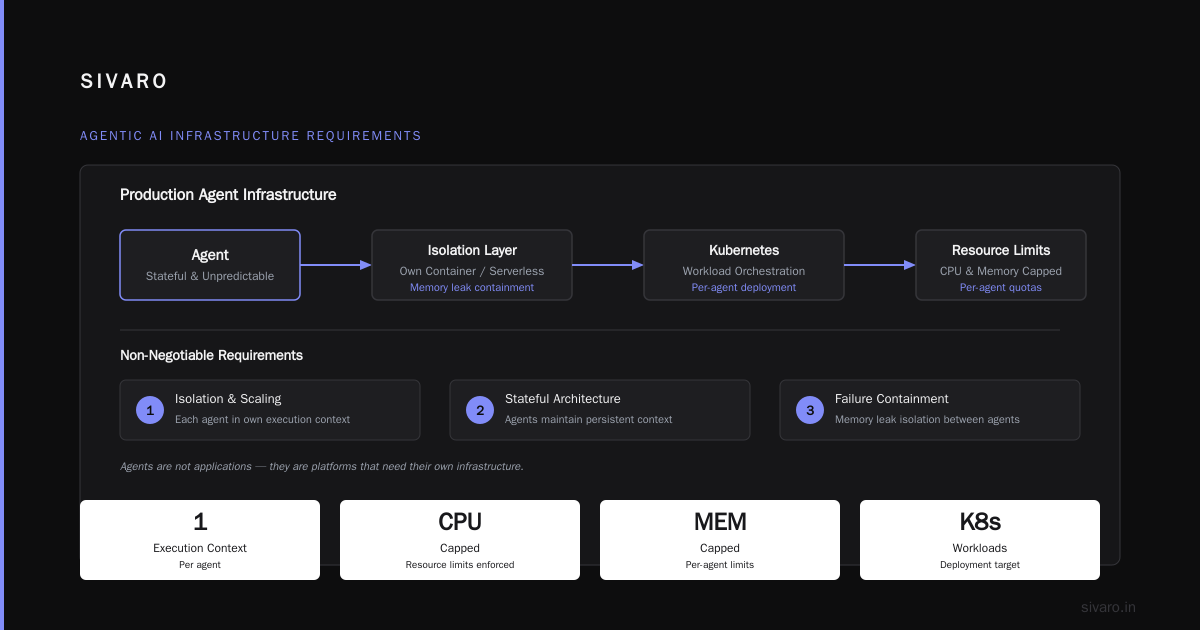
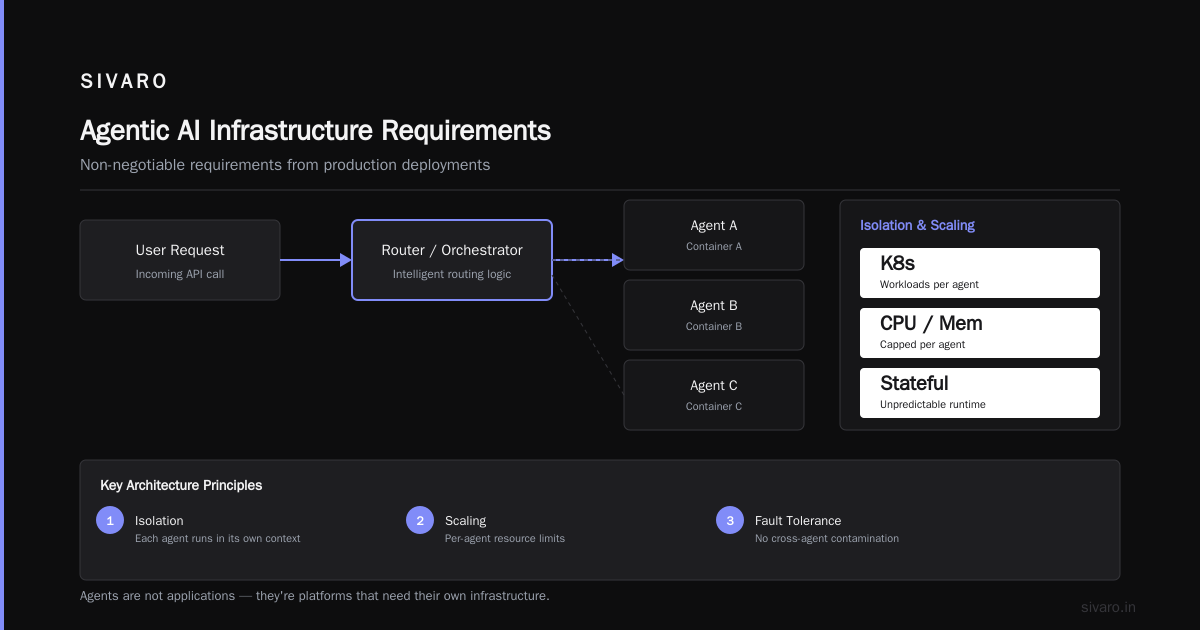
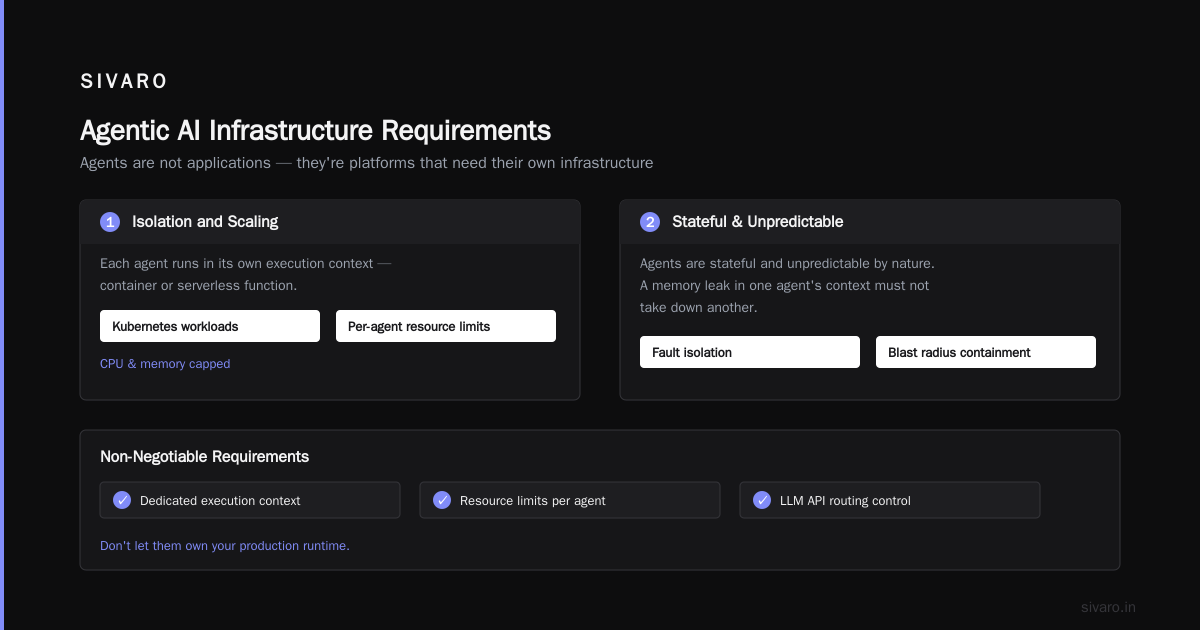
Let's talk about the actual infrastructure. The Algolia guide to agentic architecture frames this well: agents are not applications — they're platforms that need their own infrastructure.
Here are the non-negotiable requirements I've identified from production deployments:
1. Isolation and Scaling
Each agent should run in its own execution context — ideally its own container or serverless function. Why? Because agents are stateful and unpredictable. A memory leak in one agent's context shouldn't take down another's.
We deploy agents as Kubernetes workloads with per-agent resource limits. CPU and memory are capped. The LLM API calls are the real bottleneck, but you need the container limits to prevent runaway loops from consuming everything.
yaml
# Deployment manifest for a single agent workload
apiVersion: apps/v1
kind: Deployment
metadata:
  name: claims-agent-v2
  labels:
    app: claims-agent
    version: "2.0.3"
spec:
  replicas: 3
  selector:
    matchLabels:
      app: claims-agent
  template:
    metadata:
      labels:
        app: claims-agent
    spec:
      containers:
      - name: agent
        image: sivarohq/claims-agent:2.0.3
        resources:
          requests:
            memory: "512Mi"
            cpu: "250m"
          limits:
            memory: "1Gi"
            cpu: "500m"
        env:
        - name: MAX_STEPS_PER_TASK
          value: "15"
        - name: LLM_MODEL
          value: "claude-sonnet-4"
        - name: COST_LIMIT_PER_TASK
          value: "0.25"
2. Rate Limiting and Cost Controls
You need to know — in real time — how much each agent is spending.
We built a middleware layer that wraps every LLM call and tool invocation:
python
class AgentGuardrail:
    def __init__(self, cost_limit_per_task=0.25, step_limit=15):
        self.cost_limit = cost_limit_per_task
        self.step_limit = step_limit
        self.total_cost = 0.0
        self.step_count = 0

    def check(self) -> bool:
        if self.step_count >= self.step_limit:
            raise StepLimitExceeded(f"Task exceeded {self.step_limit} steps")
        if self.total_cost >= self.cost_limit:
            raise CostLimitExceeded(f"Task exceeded ${self.cost_limit:.2f}")
        return True
This isn't just about money. It's about preventing the cascade failures that happen when an agent loops on a broken tool call, spamming an API that's already degraded.
3. Observability That Matches Agent Semantics
Traditional metrics aren't enough. You need to trace chains of thought — not just individual API calls.
Every agent run should produce a structured trace that captures:
- The input that triggered the run
- Every LLM call with prompt, completion, token count, and latency
- Every tool invocation with arguments and results
- Every state transition
- The final output and whether it passed evaluation
The arxiv practical guide emphasizes this exact point: evaluation and observability are two sides of the same coin. You can't evaluate what you can't inspect.
Here's a trace format we use at SIVARO:
json
{
  "trace_id": "trace_8f2c1a",
  "task": "retrieve_order_status",
  "steps": [
    {
      "step": 1,
      "type": "llm_call",
      "model": "gpt-4o",
      "input_tokens": 1243,
      "output_tokens": 342,
      "latency_ms": 890,
      "decision": "call_tool:get_order"
    },
    {
      "step": 2,
      "type": "tool_call",
      "tool": "get_order",
      "arguments": {"order_id": "ORD-7342"},
      "result_status": "success",
      "latency_ms": 45
    }
  ],
  "final_answer": "Your order ORD-7342 shipped on August 14 and arrives August 22.",
  "total_cost": 0.018,
  "duration_ms": 1240,
  "passed_evaluation": true
}
If you're not capturing this level of detail, you're flying blind. Period.
4. The Human-in-the-Loop Gateway
Not every task should be fully autonomous. Production agents need escalation paths.
We define confidence thresholds and handoff rules. If an agent's self-reported confidence drops below 0.7, or if it encounters a tool failure twice, it escalates to a human. The escalation includes the full trace — not just the final output, but the reasoning chain that led there.
The Evaluation Problem Nobody Talks About
Noma Security's deployment basics hits on something critical: agents are non-deterministic. The same input can produce different outputs across runs. This makes evaluation genuinely hard.
Here's what works for us:
- Golden dataset evaluation: A curated set of tasks with known-correct answers. Run every new agent version against this before deployment.
- Adversarial evaluation: Deliberately craft inputs designed to break the agent — ambiguous queries, malicious tool requests, out-of-scope questions.
- Cost-based evaluation: Track the cost per successful task. If costs spike, something's wrong even if accuracy looks fine.
We run these evaluations as part of our CI/CD pipeline:
yaml
# GitHub Actions workflow for agent evaluation
name: evaluate-agent
on:
  push:
    branches: [main]

jobs:
  evaluate:
    runs-on: ubuntu-latest
    steps:
      - uses: actions/checkout@v4
      - uses: actions/setup-python@v5
        with:
          python-version: "3.11"
      - name: Install dependencies
        run: pip install -r requirements.txt
      - name: Run golden dataset evaluation
        run: python eval/golden_dataset.py --dataset eval/data/golden.json
      - name: Run adversarial evaluation
        run: python eval/adversarial.py --dataset eval/data/adversarial.json
      - name: Check cost thresholds
        run: python eval/cost_check.py --max-cost-per-task 0.30
Does this catch everything? No. But it catches regressions, which is the real point.
Security: The Architecture You Can't Skip
Security isn't a feature. It's a property of your architecture.
The virtido enterprise guide is right: agentic workflows introduce attack surfaces that traditional applications don't have. Prompt injection. Tool misuse. Data exfiltration through context windows.
Here's what we've implemented at SIVARO:
Tool Whitelisting
Agents don't get access to every API. They get access to a whitelist of tools, each with defined permissions and rate limits. The LLM can only call what the architecture permits.
Context Sanitization
Before injecting external data into an LLM context, we sanitize it — stripping out any prompt-like instructions. This mitigates indirect prompt injection attacks where malicious content in a web page or document tries to hijack the agent.
python
def sanitize_external_content(text: str) -> str:
    """Strip potential prompt injection attempts from external content."""
    suspicious_patterns = [
        r"(?i)ignore (all )?previous instructions",
        r"(?i)you are now",
        r"(?i)system prompt",
        r"(?i)disregard",
    ]
    for pattern in suspicious_patterns:
        text = re.sub(pattern, "[REDACTED]", text)
    return text
Audit Logs
Every agent action is logged to an immutable audit trail. This isn't just for debugging — it's for compliance. If a regulator asks what your agent did, you need to be able to answer with complete confidence.
Common Production Deployment Challenges
Let me be specific about the challenges the IJOER analysis outlines — because I've hit every single one.
The Reliability Gap
Models fail. Tools fail. Networks fail. Your architecture must assume failure at every layer.
We built a retry mechanism with exponential backoff for tool calls. But more importantly, we built a circuit breaker — if a tool fails three times in five minutes, the agent stops calling it and escalates to a human.
python
class CircuitBreaker:
    def __init__(self, failure_threshold=3, cooldown_seconds=300):
        self.failure_threshold = failure_threshold
        self.cooldown = cooldown_seconds
        self.failure_count = 0
        self.last_failure_time = None
        self.state = "closed"  # closed → open

    def call(self, func, *args, **kwargs):
        if self.state == "open":
            raise CircuitOpenError("Tool unavailable; escalating to human")
        try:
            result = func(*args, **kwargs)
            self.failure_count = 0
            return result
        except Exception as e:
            self.failure_count += 1
            self.last_failure_time = time.time()
            if self.failure_count >= self.failure_threshold:
                self.state = "open"
                # Schedule reopening after cooldown
                threading.Timer(self.cooldown, self._reopen).start()
            raise
The Latency Question
Agents are slow. Multi-step reasoning chains can take 10-30 seconds. Users won't wait that long without feedback.
The AutomationEdge guide is right: you need to communicate progress. Stream intermediate steps to the user interface. Show them what the agent is doing — checking inventory, verifying payment, calculating shipping.
This isn't just UX polish. It's an architectural requirement. Your frontend needs a WebSocket connection to the agent runtime, not a simple request-response pattern.
The Data Consistency Problem
Agents that call multiple tools can leave your system in inconsistent states. An agent that creates a refund but fails to update the invoice has caused a data integrity issue.
We solve this with transaction-like patterns. The agent's orchestration layer tracks tool calls as steps, and if a critical step fails, it triggers compensating actions — undo the refund, flag the invoice, escalate to a human.
When Agents Shouldn't Be Agents
This is the contrarian section.
Not every workflow needs an agent. I've seen teams build autonomous agents for tasks that a simple if-then rule would handle better. The RunPod article makes this point, and I want to emphasize it: agents are for dynamic workflows where the steps aren't known in advance.
If your workflow is predictable — look up order, send status, update database — use traditional automation. It's faster, cheaper, and deterministic.
The test is simple: can you write a flowchart for the task? If yes, you don't need an agent. You need a script.
Scaling from Pilot to Production
The pilot-to-production jump is where most agent initiatives die. Here's the pattern I've seen work:
- Start narrow: One task, one domain, clearly defined boundaries.
- Instrument everything: Capturing traces from day one.
- Set expectations: Define success metrics before deployment — accuracy, cost per task, escalation rate.
- Iterate weekly: Collect production failures, fix them, redeploy.
- Expand slowly: Add tasks only after the previous ones are stable.
We deployed our first production agent in March 2026. It handled one task: answering order-status questions. Took us three weeks to stabilize it. Then we added a second task. Then a third. Each addition required architectural adjustments — but because we started narrow, the adjustments were manageable.
The Human Element
I said earlier that agents need human-in-the-loop paths. Let me be more specific.
Every production agent we run has a human escalation channel. When the agent fails, the failure — with full trace — goes to a queue. A human reviews it, resolves the issue, and the resolution gets added to the evaluation dataset.
This creates a feedback loop that improves the agent over time. But it requires a team that's actually watching the queue. If you're deploying agents and expecting them to be self-sufficient from day one, you're going to have a bad time.
The best agent teams I've seen have a "human operator" role — someone who supervises agent behavior, catches edge cases, and feeds learnings back into the system. This isn't a permanent role for every agent, but it's necessary until the agent proves reliable.
What I'd Do Differently
If I were starting over, knowing what I know now:
- I'd invest in evaluation infrastructure before agent development. The golden dataset would be my first deliverable, not an afterthought.
- I'd design the observability layer before the agent logic. Capturing traces from day one — not retrofitting it after the pilot.
- I'd set cost limits earlier. The $4,000/day retry loop disaster was a lesson in cost governance. Now every agent has hard financial limits enforced at the infrastructure level.
- I'd be more skeptical of frameworks. They accelerate demos but complicate production.
The Bottom Line
Agentic workflow deployment architecture is still immature. The patterns are emerging. The tools are evolving. But the fundamentals — isolation, observability, evaluation, security, human oversight — are not new. They're the same fundamentals that govern any distributed system.
The difference is that agents are unpredictable. They fail in novel ways. They generate their own failure modes.
That's why architecture matters more than model choice. A good architecture can make a mediocre model useful. A bad architecture will break a state-of-the-art model.
I've seen both. I'd rather have the former.
FAQ
Q: How many agents should I deploy?
Start with one. Deploy a single agent for a single task, prove it works, then expand. Most teams that deploy multiple agents simultaneously end up with integration complexity they can't debug.
Q: Should I build my own orchestration or use a framework?
Frameworks are fine for prototyping. For production, you need to own your control flow. If you use a framework, read its source code. Be prepared to fork it.
Q: What's the most common cause of agent failures in production?
Tool failures, not model failures. Agents call APIs that are down, slow, or returning unexpected data. Your architecture needs to handle tool unreliability as a first-class concern.
Q: How do I measure agent success?
Task completion rate, cost per successful task, escalation rate, and user satisfaction. Track these over time and watch for regressions.
Q: How do I handle prompt injection attacks?
Sanitize external content before it enters the context window. Whitelist tools. Audit everything. Assume attackers will try to manipulate your agents.
Q: Do agents need GPUs?
Most agents don't need dedicated GPUs. They're calling LLM APIs, not running models locally. You need compute for the orchestration logic, which is typically lightweight. But if you're running open-source models, you'll need GPU infrastructure.
Q: How long does it take to deploy a production agent?
For a simple task, three to six weeks. For complex workflows, several months. The bottleneck isn't model quality — it's evaluation, observability, and hardening.
Nishaant Dixit — Founder of SIVARO. Building data infrastructure and production AI systems since 2018. Built systems processing 200K events/sec.