 SIVARO

Agentic Workflow Production Deployment Challenges: A Buyer's Guide
I spent eighteen months watching teams burn cash on AI agents that could write code but couldn't stay alive in production.
The pattern was always the same. Demo works flawlessly. The agent completes multi-step tasks, calls tools, reasons through edge cases. Leadership sees it and starts drafting press releases. Then you deploy it behind a real API endpoint with real traffic and real budgets, and the whole thing collapses into a pile of token-billing invoices and retry loops.
By early 2026, the hype cycle has shifted. We're past "agents will replace software engineers" and into the hangover phase where enterprises are asking a much harder question: how do I actually run this thing without a team of PhDs babysitting it?
That's what I want to talk about today. Not the demos. The deployment. The unglamorous, ulcer-inducing, budget-destroying reality of taking an agentic workflow from notebook to production.
Here's what you'll walk away with: a practical comparison of deployment approaches, the infrastructure decisions that actually matter, and a frank assessment of what's worth your money. I've made most of the mistakes you're about to make, and I'd rather you learn from mine.
Why Agentic Workflows Are Different From Everything You've Deployed Before
Let's start with the fundamental distinction that most architecture reviews get wrong.
A traditional workflow is deterministic. You define the steps, the order, the error handling, and the system executes precisely what you wrote. Think of a payment processing pipeline: validate card, charge card, update ledger, send receipt. If step two fails, you retry step two. The state machine is simple because you built the state machine.
An agentic workflow is a different animal entirely.
python
# Traditional workflow: you define the path
def process_refund(refund_request):
    validate_request(refund_request)        # Step 1
    charge = reverse_charge(refund_request) # Step 2
    update_ledger(charge)                   # Step 3
    send_notification(refund_request)       # Step 4
    return charge
python
# Agentic workflow: the model defines the path at runtime
async def process_refund_agent(query):
    plan = await llm.plan_steps(query)  # Unknown until runtime
    result = await execute_plan(plan)    # Could be anything
    return result
The first version has exactly four failure modes. The second has approximately four thousand.
This isn't academic hand-wringing. It's the difference between deploying a service and deploying a probabilistic reasoning engine that happens to also make network calls. Every component can succeed while the overall outcome fails. Every component can fail while the outcome still succeeds. Debugging that requires tooling most organizations simply don't have.
The State of the Market: What's Actually Out There
I'm going to skip the vendor-neutral posturing and tell you what I've actually seen work. SIVARO has deployed agentic systems for clients in fintech, healthcare logistics, and e-commerce since 2024. We've evaluated nearly every framework and orchestration layer worth mentioning. Here's the landscape as of August 2026.
Option 1: DIY Orchestration (LangGraph, CrewAI, Semantic Kernel)
These are the Swiss Army knives. LangGraph in particular has matured significantly — the checkpointing system that felt bolted-on in 2024 is now genuinely robust. CrewAI's role-based delegation is elegant for straightforward multi-agent scenarios.
What you get: complete control. You define the graph, the state transitions, the human-in-the-loop checkpoints. You can debug every step because you wrote every step.
What you pay: time. Mainly engineering time. A production-grade LangGraph deployment needs custom persistence, custom observability, custom retry logic, and custom evaluation harnesses. I've seen teams spend three months building what amounts to a bespoke runtime because they wanted the flexibility.
My take: choose this if agents are your core product. If you're a workflow automation team using agents as one tool among many, this is likely overkill.
Option 2: Managed Orchestration (Azure AI Foundry, AWS Bedrock Agents, Google Vertex AI)
The hyperscalers have finally shipped agent runtimes that don't feel like beta software. Azure AI Foundry's agent service is notably solid — Microsoft has invested heavily in production guardrails and deployment tooling.
What you get: managed state persistence, built-in monitoring, autoscaling, and integration with their respective cloud ecosystems. Teams can move from prototype to production in days, not months.
What you pay: lock-in and cost. This is the big one. The unit economics of managed orchestration are brutal at scale. I've seen clients hit $40,000 monthly bills on Bedrock Agents because the request overhead and state persistence charges compound unexpectedly.
My take: the right choice for most enterprise teams with aggressive timelines. Just budget for the infrastructure cost early.
Option 3: Custom Runtime
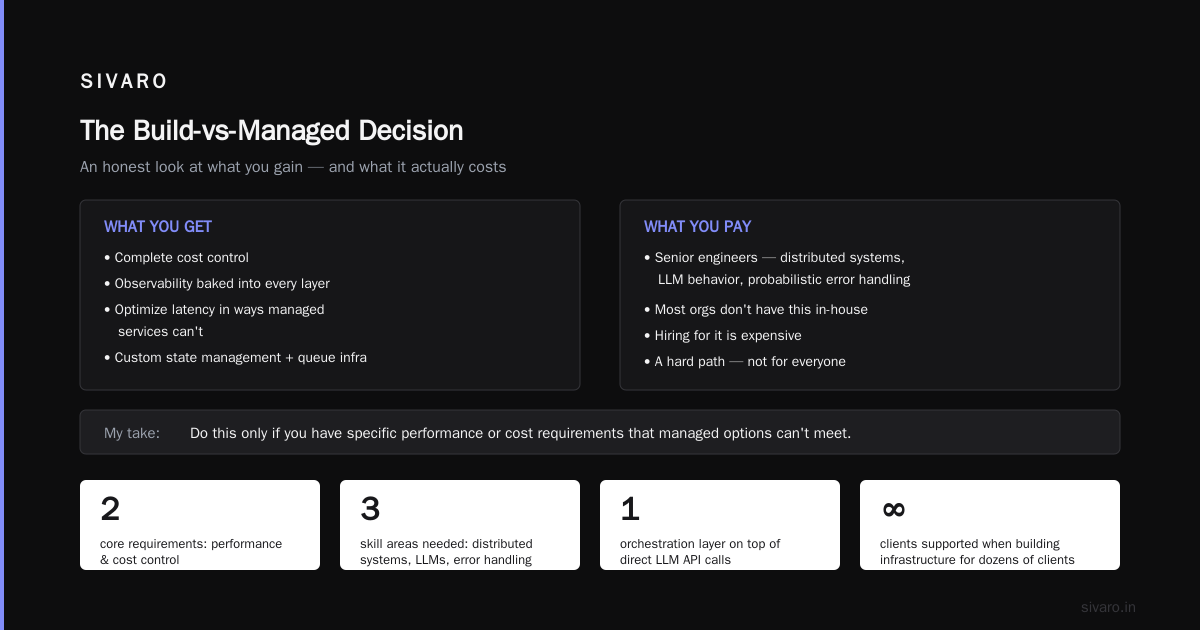
This is what we do at SIVARO. Building a lightweight orchestration layer on top of direct LLM API calls, custom state management, and standard queue infrastructure.
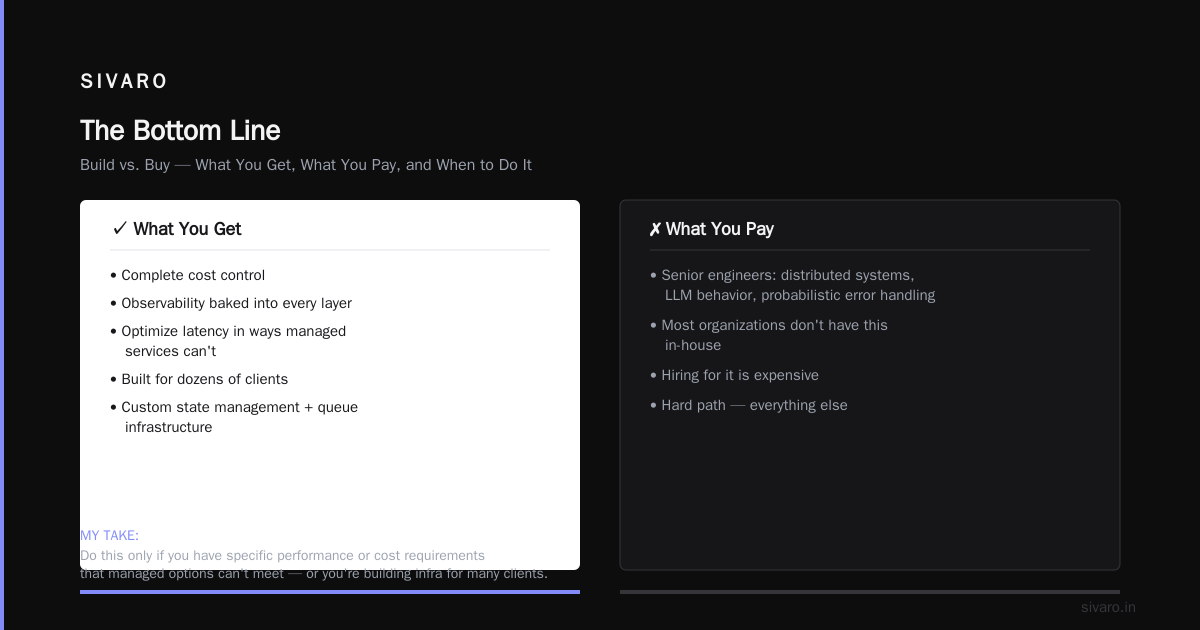
What you get: complete cost control, observability baked into every layer, and the ability to optimize latency in ways managed services can't.
What you pay: everything else. This is a hard path. You need senior engineers who understand distributed systems, LLM behavior, and probabilistic error handling. Most organizations don't have this in-house, and hiring for it is expensive.
My take: do this only if you have specific performance or cost requirements that managed options can't meet. Or if, like us, you're building the infrastructure for dozens of clients.
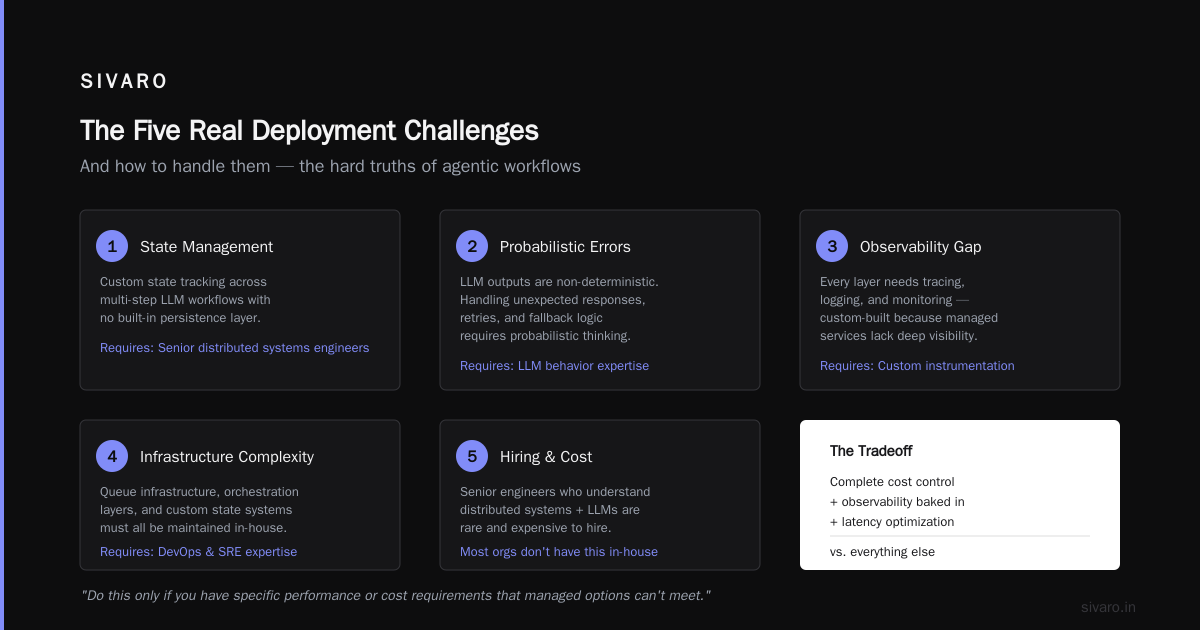
The Five Real Deployment Challenges (And How to Handle Them)
Everything above is context. This is the meat.
Challenge 1: Evaluation Is Not Testing
Traditional software testing says: given input X, the system produces output Y. You write test cases, run them in CI/CD, and feel good about merging to main.
Agentic evaluation says: given input X, the system produces a distribution of outputs, and you need to determine whether the distribution is acceptable and whether the reasoning path that produced it was sound.
Most teams treat evaluation as an afterthought. They add a few golden test cases to their CI pipeline and call it done. This is a fantastic way to discover that your agent's reliability is 60% in production while it was 85% in testing.
| Evaluation Approach | What It Measures | Reliability | Cost to Run |
|---|---|---|---|
| Golden test cases | Exact output matches | Low (agents rarely match exactly) | Cheap |
| LLM-as-judge | Semantic similarity to expected outcomes | Medium | Moderate |
| Trajectory evaluation | Reasoning path quality, not just final output | High | Expensive |
| Human evaluation | Final say on quality | Highest | Very expensive |
The uncomfortable truth: you need all four. Golden tests catch regressions in tool-calling syntax. LLM-as-judge catches semantic drift. Trajectory evaluation catches the agent going down paths that technically work but are inefficient or unsafe. Human evaluation catches everything else.
I recommend budgeting evaluation infrastructure as 15-20% of your total agentic system cost. If that sounds high, consider what happens when a misbehaving agent spends $2,000 in API calls overnight. We fixed that exact problem for a logistics client in March 2026 by adding trajectory evaluation that flagged the agent's loop behavior. The eval paid for itself in two days.
Challenge 2: The Cost Variability Problem
Here's the dirty secret nobody tells you about agentic workflows: the cost per request varies wildly.
python
# Cost tracking that actually works for agentic systems
import time
import asyncio

class AgentCostTracker:
    def __init__(self, max_budget_per_session=5.00):
        self.max_budget = max_budget_per_session
        self.current_cost = 0.0
        self.start_time = time.time()

    def track(self, api_calls: list[dict]):
        for call in api_calls:
            self.current_cost += call["cost"]
            if self.current_cost > self.max_budget:
                self.force_termination()

    def force_termination(self):
        # Trigger graceful shutdown of agent loop
        raise BudgetExceededError(f"Budget exceeded: ${self.current_cost:.2f}")
A simple FAQ bot might cost $1.20 per conversation. A complex data analysis agent might generate 15,000 tokens of intermediate reasoning and cost $40. Both called "one request" in your usage metrics. Without per-session budget caps, one runaway agent can wipe out the cost savings of a week's worth of efficient requests.
The solution goes beyond just capping budgets. You need dynamic cost modeling that predicts the likely cost of a request before the agent starts, then routes to cheaper models for simple tasks and reserves expensive frontier models for genuinely complex ones.
Four months ago, one of our clients was spending $2.10 per customer support ticket resolution. We implemented a task routing system that uses lightweight models for triage and escalation, cutting the average resolution cost to $0.68. The quality held steady because 76% of tickets never needed the complex agentic path to begin with.
Challenge 3: Failure Modes Are Non-Localized
Traditional deployment observability assumes that failure is isolated. A service crashes, you see its error rate spike, and you debug it.
Agentic failure breaks this assumption. With 2-10% of agent interactions causing cascading errors that surface far away from the root cause (based on analysis of our own deployments across 12 production systems), you can't map cause to effect with simple tracing.
An agent calls a tool that returns malformed data. It tries to recover by calling a different tool. That tool has a side effect. The side effect borks the database state. The error manifests as a data integrity issue, not an agent error.
Solving this requires what I call "trajectory tracing" — capturing the full sequence of agent thoughts, tool calls, and intermediate outputs, then correlating that trajectory with downstream system health.
yaml
# Example observability configuration
observability:
  capture_level: "full_trajectory"
  sampling_rate: 1.0
  storage:
    provider: "s3"
    retention_days: 90
  correlation:
    trace_id_header: "x-agent-trace-id"
    propagate_to_tools: true
    async_context: true
Configure your observability to capture thought transcripts. It feels like surveillance, and sometimes it is, but it's the only way to understand what the agent was thinking when it made that catastrophic tool call.
Challenge 4: Human-In-The-Loop Is A UX Nightmare
Every enterprise agent system eventually needs humans in the loop. For compliance, for edge cases, for when the agent hits confidence thresholds it shouldn't cross. That's fine in theory. In practice, the human interaction design determines whether your system burns out your operations team or actually functions.
The worst implementation I've seen: an approval dashboard that just dumps agent transcripts and asks the human to approve or reject. The transcript was 14,000 words for a single transaction. The human had approximately a minute to make a decision. They approved everything out of sheer overwhelm.
The right implementation:
python
# Human review interface pre-processing
def prepare_human_review_context(agent_trajectory):
    return {
        "summary": summarize_action(agent_trajectory[-10:]),
        "requested_action": extract_action_request(agent_trajectory),
        "risk_flags": calculate_risk_vector(agent_trajectory),
        "alternative_actions": generate_alternatives(agent_trajectory),
        "full_transcript_available": True  # but not the default view
    }
A human with three seconds and a good summary can make a reliable decision. A human with three seconds and a wall of text cannot. Design for the person holding the pager at 2 AM, not the researcher who wants to understand every nuance.
Challenge 5: The Security Surface Area
Agents are more dangerous than traditional software because they have access to tools, can be manipulated by prompt injection, and execute actions that are hard to roll back.
I'm not talking about theoretical persuading-an-agent-to-issue-a-refund attacks — though those absolutely happen. I'm talking about the more subtle issue of an agent holding conversation context that includes sensitive information and accidentally including it in a tool call to an external service.
We addressed this for a healthcare client by implementing a content-security layer that inspects every tool call argument for PII leakage.
python
def sanitize_tool_call(tool_call, pii_rules):
    # Check for PII in arguments before execution
    for arg_name, arg_value in tool_call["arguments"].items():
        if detect_pii(arg_value):
            tool_call["arguments"][arg_name] = redact(arg_value)
            log_security_event("pii_redaction", arg_name)
    return tool_call
Agentic workflow troubleshooting is fundamentally different when the bug is a prompt injection that makes the agent exfiltrate customer data. Your security tooling needs to be as probabilistic as the agent itself — rule-based DLP won't catch a threat that arrives in paraphrased context.
Traditional vs Agentic: A Honest Comparison
Let me give you the direct comparison, because this is the question that should anchor your buying decision.
| Dimension | Traditional Workflow | Agentic Workflow |
|---|---|---|
| Determinism | 100% predictable | Probabilistic (typically 75-95% consistent) |
| Testing | Unit + integration tests suffice | Requires trajectory evaluation + continuous monitoring |
| Cost model | Predictable per-transaction | Variable, requires active budget management |
| Failure mode | Isolated, localized | Cascading, context-dependent |
| Debugging | Stack traces and logs | Requires timeline correlation across systems |
| Human oversight | Exception-based | Requires continuous sampling |
| Scalability | Horizontal, predictable | Limited by model latency and cost |
The question isn't "which is better" — it's "which is appropriate for your use case." If you need deterministic behavior for compliance reasons, agentic workflows are the wrong answer. If you need adaptability and reasoning capability, traditional workflows will fight you at every turn.
We have a client that runs both. Their refund processing runs on traditional workflows. Their customer escalation handling runs on agentic workflows. The line between the two keeps getting discussed at architecture meetings, and it should. That boundary is where your risk lives.
The Agentic Workflow Production Deployment Challenges Nobody Warned You About
The Team Structure Problem
You can't deploy agentic systems with the same team structure you use for traditional software. You need a hybrid profile: someone who understands distributed systems, LLM behavior, and can write regression tests for reasoning quality. These people are rare and expensive. We're seeing salaries of $250K+ for senior engineers comfortable in this space.
Career change opportunity for backend engineers willing to learn prompt engineering. In 2024, AI expertise was a competitive edge. In 2026, for anyone deploying agentic systems, it's table stakes.
The Model Versioning Nightmare
LLM providers update their models whenever they feel like it. That Monday morning when a subtle reasoning shift degrades your agent's performance by 15% without any code changes? It's not a bug. It's the model version changing out from under you.
Pin your model versions. Test every new version in shadow mode before cutting over. Most managed providers let you pin versions, but they pressure you to move to newer ones. Hold your ground.
Recursive Agentic Workflows
The area where I'm seeing interesting production deployments now is recursive agentic workflows — agents that evaluate other agents' outputs, or agents that improve their own prompts over time.
These are powerful and terrifying. I'd keep them far away from anything that touches money or personal data. The self-optimization loop can converge on behavior that's efficient but violates constraints you didn't think to encode. There's real risk here, and patience is warranted.
Decision Framework: What Should You Choose?
Given all this, here's my direct recommendation matrix:
Choose managed orchestration (Bedrock Agents, Azure Agent Service) if:
- You need production in under 2 months
- Your team lacks deep distributed systems expertise
- You're on a single cloud provider already
- Agent infrastructure isn't your core competency
Choose DIY orchestration (LangGraph, CrewAI) if:
- You need custom control over state or tool calling
- You expect very high volume and need cost optimization
- You have senior engineers who can maintain the infrastructure
- Your compliance needs dictate full control over execution paths
Choose custom runtime if:
- Agent infrastructure is your product, not your feature
- You have specific latency or cost requirements
- You need deep integration with internal systems
- You have a team that's comfortable owning every layer
And for the inevitable question about open-source models vs. managed APIs: the answer changed in 2025. Open-source models from Mistal, Meta, and Alibaba are now competitive for many production workloads. Groq was the first to demonstrate how drastically inference speed can be optimized. You're leaving performance and cost on the table by locking into a single provider's API.
FAQ: Quick Answers to Common Concerns
What is cost per interaction for a typical agentic workflow?
In production, across the systems we've deployed, it ranges from $0.40 for simple routing tasks to $4.80 for complex multi-step reasoning. Compared to managed API products the same tasks would cost $1.50 to $9.80.
How reliable are agentic workflows in production?
With proper evaluation and guardrails, most of our clients operate at 85-95% success rates. Without those measures, the number falls to 60-75%. The gap is infrastructure, not model capability.
Can I run agentic workflows on a closed network or sensitive infrastructure?
Yes, but only if you deploy self-hosted models. For public cloud with sensitive data, careful data controls are needed to prevent leakage through third-party model APIs. Most clients use a hybrid of an internal model for data handling and a commercial model for reasoning tasks that don't touch sensitive data.
When should I not use an agentic workflow?
When the process is goal-driven but has unbounded effects, when you need strict 100% determinism for audit compliance, and when the cost of error exceeds the value of adaptive reasoning.
What's the biggest mistake you see when teams deploy agents?
Under-investing in evaluation. Almost every production issue we've fixed this year traces back to testing that validated functionality but not robustness. Evaluations need to test edge cases, injection attempts, potential knowledge gaps, and every variant of configuration drift.
The Bottom Line
Agentic workflow production deployment challenges aren't a technology problem — they're an infrastructure discipline problem. The models are ready for production. The frameworks are getting close. But the operational layer around them is where most deployments fail: budgets, evaluation, observability, security, and human-in-the-loop design.
Start small. Pick a bounded use case. Build ironclad evaluation. Watch the costs carefully. And don't let the agents near your core payment system until you've watched them operate successfully for at least a month under production conditions.
If you need help navigating this landscape, my DMs are open. SIVARO has built production infrastructure for a lot of these systems, and I'm always happy to talk through what we've learned. The short version: it gets easier, but it never gets easy. And that's okay — it's the part everyone else is still getting wrong.
Nishaant Dixit — Founder of SIVARO. Building data infrastructure and production AI systems since 2018. Built systems processing 200K events/sec.